
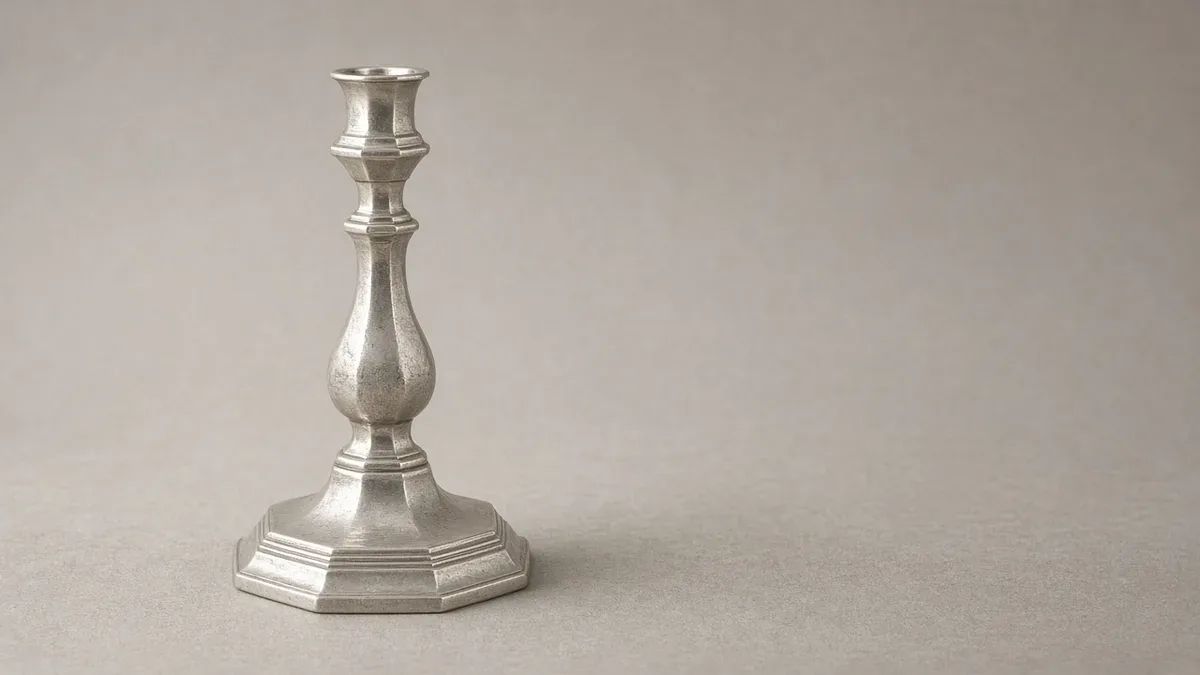
How to Identify Italian Silver Candlesticks by Marks and Construction
How to identify Italian silver candlesticks by city marks, threaded stems and detachable nozzles, from papal Rome to Venice, Naples and Genoa.
A table candlestick is a small machine of parts. Italian workshops of the seventeenth and eighteenth centuries raised the foot from sheet, cast or turned the stem, cut a socket, and locked the stack with a threaded iron or silver screw. Marks sit where the punches would reach: under the foot rim, on the socket wall, sometimes on a detachable nozzle. City, assayer and maker, read together, are more reliable than style alone.
The Italian term is candeliere. Domestic pairs for the table run roughly 14 to 28 centimetres. Altar sets, often five or six lights, can exceed 80 centimetres and carry vine trails, angels or a cross punch reserved for worship silver. Confusing the two classes is a common cataloguing error.
Construction before marks
Christie's description of a Roman pair by Francesco De Martini, dated 1696–1700, states the method in workshop language: the circular foot raised and chased from sheet (lastra sbalzata e cesellata), the baluster cast in lost wax (fusione a cera persa), the join a threaded screw (vite filettata). Punches appear under the foot rim, on the upper edge of the baluster and on the outside of the bobèche. Height 15.5 centimetres; weight of the pair 642 grams.
That sequence is the first test. Unscrew a period stick, if the construction allows, and look for:
- a foot whose underside shows hammer and planishing marks, not a sand-cast skin
- a stem whose interior is hollow or shows a casting core, with a screw or nut at the junction
- matching punches on at least two separate elements
- later nozzles, often lighter and struck with a nineteenth-century or foreign control, seated on an earlier socket
A Venetian example sold by the same house, early eighteenth century, makes the same join visible in a different city style: octagonal moulded foot, faceted piriform baluster and faceted socket, screw between stem and foot. Height 14.5 centimetres; weight 284 grams. Marks sit under the foot and on the socket: the Venetian assay leone in moleca, the assayer Zuanne Cottini as Z.C., and the maker initials D.F.
Later electroplate and 800/1000 factory sticks often hide a single soldered column. There is no screw, no second punch on the socket, and the metal reads thin at the rim.
Rome and the Papal States
Roman goldsmiths' statutes already required a warranty punch in 1358. The Università degli Orefici was founded in 1508; from 1509 the master's mark was to be added to the guarantee. Pre-Napoleonic cameral marks generally show the crossed keys of Saint Peter under the ombrellino, in a shield, oval or other reserve. They date a piece only to a broad band unless the maker is identified from a numbered punch.
De Martini (born Rome 1661) received his patent in 1695 by presenting a silver salt. He kept shop at the sign of the Cavallo d'Oro in Via del Pellegrino and supplied golden roses to the Apostolic Palace. Andrea Valadier, founder of the later Roman dynasty, is recorded among his workmen in 1723. De Martini died in 1740 and was buried in Santa Maria in Vallicella. Anna Bulgari Calissoni lists him in Maestri argentieri gemmari e orafi di Roma (1987). The 1696–1700 pair uses large vertical gadroons on foot and baluster, a late baroque table type rather than an altar shaft.
The Metropolitan Museum holds a silver table candlestick by Ludovico Barchi, working in Rome 1716–1730, height 17.1 centimetres (accession 13.41.23a). It is the same domestic scale as the De Martini pair: a lighting tool for a sideboard, not a sanctuary.
French occupation changed the punches. A decree of 13 April 1810 imposed the French decimal system from 1 October 1810. Two offices opened: Rome for the Department of the Tiber (letter H) and Spoleto for Trasimeno (letter I). After the Restoration, the Bando Generale of 7 January 1815 returned to ounces and set three silver titles: 11.09 ounces (947/1000), 10.16 ounces (889/1000) and 9.14 ounces (800/1000, old work). Maker's marks became lozenges with initials and an assay-office number. A pair by Giovacchino Belli, Rome 1811, shows the Empire table type that followed: fluted circular feet, tapering stems with laurel swags and classical masks, vase sockets with pierced rims. Height 27.5 centimetres; weight of the pair 612 grams. Marks on foot rims and sockets.
For the sequence of Roman silver hallmarks of the Papal States, the candlestick is useful because it carries the same punches on more than one element. A lozenge on the foot and a blank socket is a warning.
Venice
Venetian table sticks of the mid eighteenth century favour a shaped circular foot, a knopped and fluted or faceted stem, and a spool socket, often with a removable nozzle. Christie's has catalogued sets marked by Zuan Piero Grappiglia and by the initials MG and GP, citing V. Donaver and R. Dabbene, Argenti italiani del Settecento, page 72, numbers 402, 404 and 405. Heights in that group run 17.8 to 19.1 centimetres. Marks sit on the socket and under the foot; some nozzles in the same sale were later.
The city mark is the lion of Saint Mark in a shield, the leone in moleca. An assayer's initials accompany it, as with Cottini's Z.C. on the early-century faceted stick. The Venetian punch system, as summarised in the BeWeb record of Piero Pazzi's compilation, ceased on Christmas Day 1810.
A matched pair is not automatic. One Grappiglia group in the same catalogues was assembled from two pairs, one engraved with a coat of arms under a coronet. Weight and height should be recorded for each stick. A difference of a few millimetres is normal; a difference of a centimetre plus unmatched punches is a marriage.
The same lion and assayer language appears on other Venetian plate. For the wider punch series see Venetian silver hallmarks.
Naples
Naples concentrated precious-metal work in the city by the Prammatica De Monetis LVII of 19 August 1690, issued by the viceroy, the Count of Sant'Esteban. The legal fineness was ten ounces of cupelled silver and two of alloy in the pound, 833.33/1000. Three punches were required: the guild mark, the sitting console's initials plus C, and the master's initials.
The guild mark until about 1690 is a crowned NAP, NAPL or (from about 1680) NA. From 1690 to 1699 the last two digits of the year sit under the abbreviation; from 1700, usually the last three. A few years (1729, 1732, 1735) use four digits. The series runs to 1808. Workshop-sign punches, common in other Italian cities, were not the Neapolitan habit.
A pair by Tommaso Anastasia, Naples 1797, shows the late Bourbon table type: circular foot with neoclassical beading and lanceolate leaves, tapering stem, flared socket with a beaded junction and an integral bobèche. Height 23 centimetres; weight of the pair 695 grams. Light distortion is recorded on the lot, the sort of bruise a used stick acquires at the rim.
French reform under Joseph Bonaparte and Joachim Murat abolished the guilds. Law 242 of 17 December 1808 set 917/1000 and 834/1000, marked with the siren Parthenope and the numerals 4 and 5. Those punches lasted until 1823. Ferdinand I's decree of 15 December 1823 replaced them with a Parthenope head and 7 (about 916/1000) or 8 (833/1000). From 26 January 1832 the letter N (Nostrale) or E (Estero) was added. Decree 5207 of 4 March 1839 reserved a cross, in place of the female profile, for objects destined for religious service.
An ICCD scheda for a candlestick by Gennaro Romanelli, held by a religious institution in Bari and dated by punch between 1832 and 1872, records the later domestic format: cast, chased and engraved silver, height 24.6 centimetres, diameter 11.5 centimetres. Punches on the foot rim: Parthenope in profile with N cut by 8, and G. ROMAN. Condition notes a stain and oxidation, not a polished exhibition surface.
Naples kept its own system after annexation in 1860 until the national law of 2 May 1872. For console names and the 1808 to 1839 sequence, see Neapolitan silver workshops and marks. Sicily after 1826 used a Ceres head in a square, a different punch from the mainland Parthenope; Palermo and Messina plate is treated separately in the silver of Palermo and Messina.
Genoa and Turin
Genoese silver is identified by the torretta, a stylised castle standing for the city and its castrum. The Corporazione dei Fraveghi is documented from 1248; the oldest silver cited with the mark is a mid-fifteenth-century pyx at Meglio. Dealers adopted the name torretta in the nineteenth century. The punch changed shape over time and remained in use through the French département marks of 1805 and the Sardinian annexation, until 1824. After that date the Kingdom of Sardinia used an eagle for 950/1000, the Cross of Saints Maurice and Lazarus for 800/1000, and a dolphin for the Genoa assay office, until 1872.
Table sticks from Genoa in the 1760s and 1770s follow French rococo models: spiral-fluted domed feet, twisted balusters, foliage. A pair catalogued as Genoa, probably 1762, stands 25.4 centimetres and weighs 1,035 grams; a later Italian tax mark was added on the foot. Another pair, about 1780, has a circular foot with tripartite twisted lobes, a piriform stem with a triple volute and an asymmetrical socket; height 23.5 centimetres, 775 grams. Bonhams recorded a 1768 pair with the town mark only, on the foot rim and again on the capital, height 25.5 centimetres.
Altar work is another scale. BeWeb catalogues a set of five candlesticks from a Genoese workshop, dated 1745 by a torretta (17)45 punch on the stem: raised and chased silver, vine trails, adoring angels, height 89 centimetres, high circular foot, baluster shaft and vase knop. A 25-centimetre table stick and an 89-centimetre altar stick can share a city mark and still belong to different markets.
Turin, under the Savoy assay, used assayers rather than a castle. Palazzo Madama holds a two-light candlestick by Carlo Bartolomeo Minutto (master 1737, documented to 1753), inventory 0293/A: raised and chased silver, rocaille, flowers and leaves, height 34 centimetres, width 25.5 centimetres, weight with its pair 2,390 grams. Punches on the foot rim: assay of Carlo Micha, counter-assay of Bartolomeo Pagliani, and Minutto's master mark. Christie's has sold late-eighteenth-century Turin pairs under the assayer Bartolomeo Bernardi (circular beaded foot, tapering stem with swags, matching socket; height 26.5 centimetres, 1,138 grams the pair) and mid-century sticks under Francesco Pagliani.
Florentine assay practice is a separate Tuscan series and is not a shortcut for attributing an unmarked stick to Tuscany.
Church and table
Measure first. A domestic pair is meant to stand on a board or gueridon. An ecclesiastical candeliere is meant to stand on a predella or altar gradine. The Genoese 1745 set at 89 centimetres and the Brescian late-seventeenth-century set by Filippo Hennin at 92 centimetres (BeWeb, diocese of Crema: cast and sheet silver, lion-paw tripod foot, religious reliefs) are furniture of the sanctuary. They are often sold as singles from broken sets.
The 1839 Neapolitan cross punch is specific: it marks metal destined for worship, not a style. A small table stick can carry it if it was made for a chapel. A large vine-trail shaft without a worship mark may still be church plate; the punch is evidence, not the only evidence.
Pricket spikes belong mainly to earlier bronze and brass church sticks. Silver table sticks of the eighteenth century take a wax candle in a socket, with or without a detachable nozzle and drip pan. A later nozzle on an earlier socket is ordinary; record both punches.
Later work and frequent mistakes
The law of 2 May 1872, issued under Vittorio Emanuele II, liberalised production of precious metals in the Kingdom of Italy. Inspection became optional. National marks for 950, 900 and 800/1000 appear on some later sticks and are absent on others. Absence of a pre-1872 city punch is not proof of age. Presence of a fascio-era or republican 800 lozenge on a "baroque" stick is proof of a later object or a later repair.
Common faults in the trade:
- A single stick catalogued as a pair, or two sticks of different cities married by height.
- Later nozzles struck with French or Italian tax marks, described as original.
- Electroplate and 800 factory copies of the faceted Venetian baluster, with no screw and a seam under the foot.
- Altar shafts cut down and remounted on modern feet.
- "Italian" used as a style word for an unmarked Central European stick.
The national overview of Italian silver hallmarks is the place to check a punch that does not match the city series above. If the mark is unread, say so. A clear torretta with a date, a crowned NAP with three digits, or a leone in moleca with an assayer is enough to date a candlestick to a city and a decade. Style without punches is not.
FAQ
How can you tell a Roman candlestick from a Venetian one?
Rome prefers a circular gadrooned or fluted foot and, after 1815, a lozenge maker's mark with an office number. Venice prefers the lion in a shield plus an assayer, and in the mid eighteenth century a shaped foot with a fluted knopped stem. Measure: many Venetian table sticks sit near 18 centimetres; Roman Empire examples such as the Belli pair reach 27 centimetres.
Do Italian silver candlesticks always come in pairs?
Workshops made pairs. Survival is uneven. Auction catalogues regularly describe matched or assembled groups. Weigh and punch each stick. A coat of arms on one foot only is not by itself a condemnation; it may mark a later gift engraving.
Where are the marks?
On period work, under the foot rim and on the socket; sometimes on the nozzle and on the upper stem. De Martini's 1696–1700 pair was punched in three places. A single punch on a heavy foot and a blank socket is a reason to look for a replacement shaft.
What fineness should the metal be?
Naples after 1690 was 833.33/1000 until the 1808 decimal titles of 917 and 834. Papal Rome after 1815 allowed 947, 889 and 800/1000. Genoa after 1824 used 950 and 800 under Sardinian marks. A modern 800 stamp on a claimed early-eighteenth-century stick is a later object or a later addition.
Are church candlesticks more valuable than table pairs?
They are a different market. Large altar sets have diocesan and export constraints and are often incomplete. Table pairs with readable city and maker punches are the standard collector object. Value follows marks, weight, condition and whether the pair is original, not the presence of angels.
A candlestick that unscrews, carries the same city punch on foot and socket, and matches a documented height and weight is dated. One that does not should be catalogued by what can be seen, not by a city name borrowed from the style.