
How to Identify Roman Silver Hallmarks of the Papal States
How to identify antique Roman silver by Papal States assay marks, including 1815 titles, the wolf punch, tiara and keys, and workshop lozenges.
Roman silver is dated from punches struck under papal authority, not from a skyline of cupolas chased on the body. The Camera Apostolica, the financial office of the Holy See, guaranteed the metal. Those punches change with French occupation, the Restoration of 1815, and the annexation of Rome on 20 September 1870.
This article is for collectors who already know the later national system of 800 and 925 and now need Rome as a separate file. For Kingdom and Republic of Italy punches after unification, use the Italian silver hallmarks guide. What follows is the city’s own language: guild statutes, the bollo camerale, the 1815 titles, and the lozenge that names the workshop.
Guild control and the Camera Apostolica
The first statutes of the Roman goldsmiths’ corporation that prescribed a warranty punch date to 1358. Under Julius II, in 1508, the Università degli Orefici was founded. The following year the Reverenda Camera Apostolica recognised the statutes and required a master’s mark in addition to the guarantee. In 1738, under Clement XII, the association took the name Nobil Collegio degli Orefici ed Argentieri di Roma.
The guarantee used before the French invasion is a pair of crossed keys of St Peter under the liturgical umbrella (ombrellino or gonfalone), struck in a shield, an oval, or another small geometric field. It is a chamber mark. It is not a papal portrait and it is not a souvenir motif. Eighteenth-century town marks also exist as small civic punches that change every few years. On a Luigi Valadier ladle from the Borghese buffet, Christie's recorded a Rome town mark that Aldo and Ubaldo Vitali, citing Costantino Bulgari, identified as the punch in use no later than 1769 (Bulgari, Argentieri, gemmari e orafi d’Italia, vol. 1, no. 130). Town-mark tables in Bulgari remain the practical dating tool for that century. Do not treat a later copy of the keys as an eighteenth-century guarantee.
French occupation, 1809–1814
Napoleon’s decree of 17 May 1809 annexed papal territory and declared Rome an imperial free city. An imperial decree of 13 April 1810 imposed the French hallmarking model. The Roman ounce system was replaced by millesimal fineness. Two assay offices served the annexed departments: Rome for the Department of the Tiber, letter H; Spoleto for the Department of Trasimeno, letter I.
Expect 950/1000 and 800/1000 punches of French type on work of those years, plus a small-work warranty and a Spoleto medium-work warranty. Pius VII returned on 24 May 1814. Provisional papal punches were used on silver already in the workshops. Mixed French and restoration marks on one object are therefore possible. They record a change of regime, not a later fake by themselves.
The Bando of 7 January 1815
On 7 January 1815 the Camerlengo, Cardinal Bartolomeo Pacca, issued the Bando Generale sulla garanzia delle manifatture d’oro ed argento. Rome and the first recovered provinces returned to ounces. Three legal titles were admitted:
| Title | Ounce standard | Millesimal equivalent | Typical guarantee |
|---|---|---|---|
| First | 11.09 oz | 947/1000 | Wolf punch |
| Second (carlino) | 10.16 oz | 889/1000 | Papal tiara and crossed keys |
| Third | 9.14 oz | 800/1000 | Restricted to old work |
The millesimal figures are those used in the specialist literature (silvercollection.it / ASCAS, after the ounce tables). Anna Bulgari Calissoni’s Maestri argentieri, gemmari e orafi di Roma (Rome, 1987) is the standard concordance for matching a punch drawing to a name. The first title is the high standard. The second, the carlino, is the punch collectors meet most often: a triregno (papal tiara) with keys decussate. Italian cataloguing records at the Istituto Centrale per il Catalogo e la Documentazione describe that chamber stamp as in force in Rome from 1815 to 1870. The third title, 800/1000, was allowed only for old work already in circulation, not as a free new-work standard.
Rome itself did not add an assay-office letter to the chamber punch. A letter next to the keys is therefore a provincial office, not a Roman city code.
A maker’s mark of lozenge (diamond) shape was introduced at the same time, on the French visual model. It contains the silversmith’s initials and a number assigned by the Rome Ufficio del Bollo. Earlier shop marks had often been silhouettes of animals or plants. After 1815 those fantasia punches give way to a readable letter-and-number lozenge. The 1815 guarantee did not change again until 1870, so style, inscriptions, and the numbered lozenge, not a new civic punch, date work within that half-century.
Provincial offices: Prima and Seconda Ricupera
The provinces recovered first from French rule, the Prima Ricupera, used similar warranty marks with the silversmith’s initials at left and right, the workshop town code at the top of the lozenge, and the assay-office letter at the bottom. Office letters cited in the 1815–1817 regulations include Frosinone (uppercase C), Perugia (lowercase p, later uppercase P), Spoleto (S), Urbino (U), and Viterbo (V). The Frosinone office opened in November 1824. A C on a Roman-looking piece may therefore be Frosinone, not a damaged Rome punch.
The edict of 25 July 1817 organised offices in the Seconda Ricupera, the territories that had been annexed to Napoleon’s Kingdom of Italy: Bologna (B), Ferrara (reversed F), Foligno (F), Forlì (lowercase f), Ravenna (R), Macerata for the Marche and Camerino (M), Jesi (I). Those eastern provinces left papal marking in 1860, when they were annexed to the Kingdom of Italy. A decree of 22 August 1863 extended the Italian hallmarking system there, with the initial of the provincial capital. Rome and Latium continued under the 1815 papal punches until September 1870.
Do not confuse a papal provincial punch with a Grand-Ducal Florentine lion or a Neapolitan NAP console. For those systems see Dating Florentine silver and Neapolitan silver hallmarks. Venetian practice, with the lion of St Mark, is another civic language entirely: Venetian silver hallmarks.
Workshops collectors actually meet
Valadier
Andrea Valadier, a goldsmith and bronze founder from Aramont in Provence, was established in Rome by 1720, first in via del Pellegrino and later at Piazza di San Luigi dei Francesi. His eldest son, Luigi Valadier (1726–1785), moved the shop to via del Babuino around 1762. Luigi is the goldsmith whose neo-classical table silver sits at the centre of Roman collecting. In 1768–1769 the workshop supplied Prince Marcantonio Borghese with a large buffet service: more than a hundred serving dishes, eight salt-cellars, twelve ladles. A silver-gilt soup ladle from that group, later gilded in 1784 according to a Vatican-archive account (“Per spese, e fattura della doratura fatta alli 4: sgumarelli delle due pile, e terrine”), carries Luigi’s maker’s mark and the 1767–1769 town mark. The 1784 Borghese dinner service, mostly silver-gilt, is described in the 1991 Artemis catalogue as Luigi’s most important secular commission.
Luigi died in 1785. Giuseppe Valadier (1762–1839) continued the family mark while practising as an architect. A gold writing-pen in the Galleria Borghese, made for Camillo Borghese, bears Giuseppe’s silversmith punch (the same punch used by Luigi) and a chamber stamp that Bulgari Calissoni dates to 1807–1809 (no. 144). The workshop also produced gilt-bronze furniture mounts. That metal is a different trade from hollow-ware silver; see Italian gilt bronze workshops.
Giuseppe’s punch on a piece with an 1815–1870 tiara-and-keys stamp would be later than the Borghese pen. The same initials across a regime change are a shop continuity, not a contradiction.
Belli
Vincenzo Belli (Turin 1710–Rome 1787) took his Roman patent in 1741. His mark is VB. The shop stood first beside San Luigi dei Francesi, then near the Teatro Valle. The work is Roman barocchetto: chased vine, wheat, and shell on liturgical ewers and table tureens. The Museo Nazionale del Palazzo di Venezia holds a gilt-silver pontifical ewer and basin with the arms of Paolo Francesco Antamoro, bishop of Orvieto. A reliquary bust of St Lanno at Santa Maria Assunta, Vasanello, dated 1754 in its inscription, is struck VB, with the chamber mark and the progressive silversmith number 254. Giovacchino Belli, born in Rome in 1756, continued the Teatro Valle shop and served as console of the Università degli orefici. A later Vincenzo Belli II is documented 1828–1859. The family remains active in the literature into the 1860s.
Ossani, Grimaldi, Giannotti
Francesco Ossani’s lozenge is recorded on ICCD catalogue cards as the punch used from 1815 to 1829, and by his heirs to 1837. Chamber stamps on those objects are the tiara and crossed keys, struck under the foot or on a ring. The combination is a textbook 1815–1870 Roman pair.
Filippo Grimaldi (1782–1848), master on 28 August 1803, used F13G. The shop was in via del Pellegrino. After his death the same punch was used by his son Gaetano, documented at least to 1869 (Bulgari Calissoni, marks 596–597). Heirs reusing a numbered lozenge are normal. The number identifies a registered shop, not a single working year.
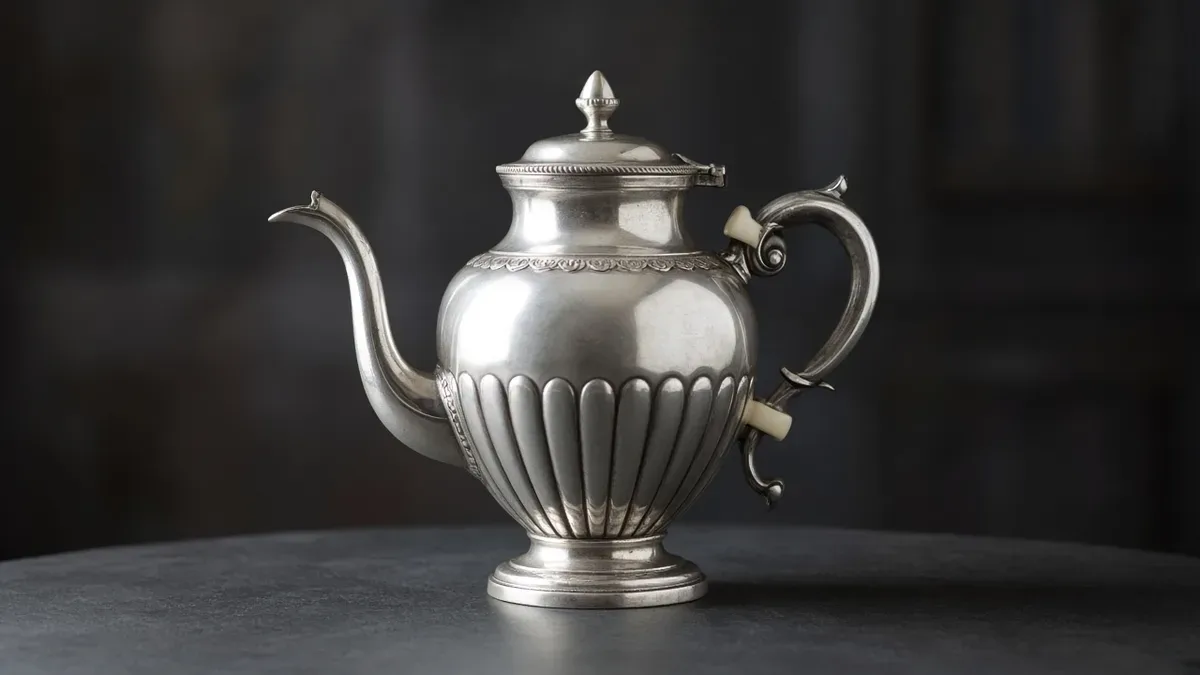
Angelo Giannotti, born in Rome in 1798, was patented in 1824 with the lozenge A99G. He was console of the goldsmiths in 1850–1853 and again in 1864–1865, and died on 2 August 1865. Davide Spagnoletto’s study of the 22–23 August 1865 inventory (Archivio di Stato di Roma, Trenta notai capitolini) describes the last shop in via S. Romualdo: workbenches, iron knife-handle models kept separate from blades as the 1815 rules required, cast ornament models, and liturgical silver already struck with the guarantee. Table coffee-pots with a greyhound handle and a goose-neck spout were a shared type, also made by Pietro Paolo Spagna (documented 1817–1861) and Vincenzo Belli II. Mechanical gadrooning (godronatura) and repeated cast parts explain why mid-century Roman hollow-ware can look serial without being electroplate.
Giannotti also made Jewish ceremonial silver for the Cinque Scole of the Roman ghetto: rimonim (Torah finials) and crowns. Jews in Rome were barred from the metal guilds, a prohibition restated in the 1815 regulation, so Christian shops executed the commissions. Dedicatory Hebrew inscriptions often give a year of gift. Those years are termini ante quem for the object’s arrival, not always the year of manufacture.
The Treaty of Tolentino (1797) and later French levies had already stripped churches, palaces, and ghetto synagogues of earlier plate. Restoration demand, not tourist souvenir production, is the economic background of the 1815 shops.
Construction, wear, and later copies
Look first at the punches, then at how the object is built.
Punches sit on the underside of the foot, on the rim of a lid, at a handle socket, or on the back of a spoon stem. A crisp tiara-and-keys stamp with a matching numbered lozenge is the 1815–1870 pair. A wolf punch is the first title, 947/1000. Soft, sliding strikes and double strikes occur on genuine work. A punch that floats on a solder repair, or that sits on a disc let into a later foot, is not original to the body.
Gauge and joinery still matter. Eighteenth-century Roman hollow-ware is raised and chased (sbalzo and cesello), with cast handles, masks, and finials applied. Mid-nineteenth-century work uses more stamped and gadrooned sheet. Knife handles were made separately from steel blades; the 1815 inventory practice is visible in surviving services. Ivory or bone collars on coffee-pot handles are original when they are pinned and worn with the silver. Replaced collars are common and should be described, not hidden.
After 20 September 1870 the Papal State in Rome ceased. Law no. 806 of 2 May 1872, with the assay regulation published in 1873 and in force from 1 June 1873, made official inspection optional. The Kingdom punches of that period are a turreted head of Italia in profile: 1 for 950/1000, 2 for 900/1000, 3 for 800/1000. Many Roman shops simply struck 800 in digits. The Fascist-period reform of 5 February 1934 restored compulsory marks: an oval 800 or 925 and a truncated lozenge with the maker’s number and the provincial letters RM.
Twentieth-century Italian factories sometimes added pseudo-papal keys or an ombrellino beside a legal 800 and a numbered lozenge. The modern marks make the metal legally saleable. They do not make the object pre-1870. If the 1934 (or later) lozenge is present, the papal-looking punch is ornament. Weight, seaming, and the absence of an 1815 numbered shop lozenge will usually confirm it.
FAQ
How can I tell Roman silver from Florentine or Neapolitan silver?
Read the guarantee, not the iconography. Rome after 1815 uses a papal tiara with crossed keys, or a wolf for the first title, plus a letter-and-number lozenge. Florence uses Grand-Ducal and Arte della Seta punches, then FI in the national lozenge. Naples uses NAP, Parthenope, and console marks. A view of St Peter’s chased on a tray is decoration. It is not an assay.
What does a lozenge with letters and a number mean?
From 1815 it is the registered maker’s mark issued by the Rome assay office: initials and a shop number, for example A99G (Angelo Giannotti, from 1824) or F13G (Filippo Grimaldi and, after 1848, Gaetano). Heirs often kept the same lozenge. It identifies a shop, not a single calendar year.
Is every tiara-and-keys punch from 1815–1870?
The chamber stamp of that design was the Roman guarantee from the Bando of 1815 until 1870. Earlier papal silver uses crossed keys under the umbrella, in a different shield or oval. Later factories copied keys next to Kingdom or Republic marks. Match the keys to a period lozenge, and to construction.
What standard is “Roman silver”?
The 1815 legal titles are 947/1000, 889/1000 (the usual carlino standard), and 800/1000 for old work only. French occupation work is 950 or 800. Post-1872 optional marks and the 1934 system return to 800 and, later, 925. Do not call papal-period plate “sterling” unless a test supports 925, which the 1815 titles do not.
Where are documented pieces?
Public holdings include the Galleria Borghese (Giuseppe Valadier gold pen, inv. DCIV), the Museo Nazionale del Palazzo di Venezia (Vincenzo Belli pontifical ewer and basin), church treasuries such as Santa Maria Maggiore and San Lorenzo in Damaso, and ICCD-catalogued liturgical silver in Lazio. Auction cataloguing of Valadier still depends on the Borghese accounts in the Vatican archives and on Bulgari’s punch corpus.