
How to Identify Italian Antique Fans by Leaf, Sticks and Views
How to identify Italian antique fans by painted leaf, ivory sticks and Grand Tour views from Rome and Naples, including later remounted copies.
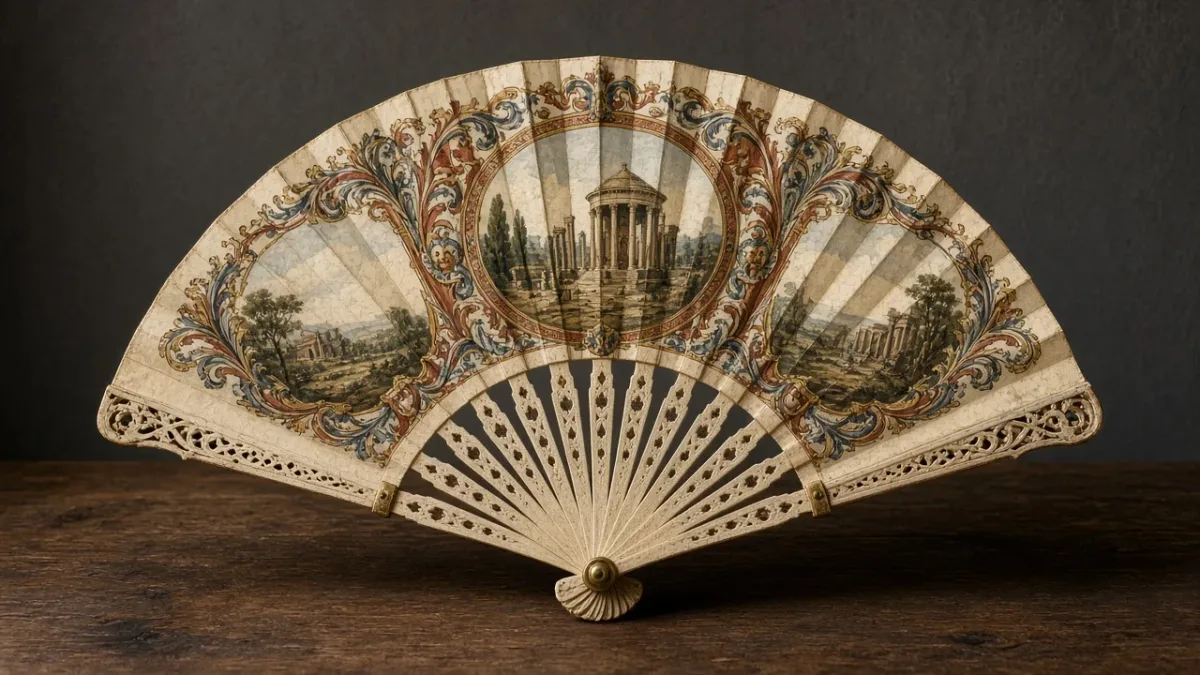
The folding fan that survives in museum stores and dealer inventories is a composite object. Italian catalogues call the painted or printed sheet the pagina. The radiating ribs are stecche; the two outer ribs, thicker and often more heavily carved, are the guardie. A metal rivetto holds the bundle at the head, sometimes with a mother-of-pearl washer or a hanging loop. Fondazione dell'Albero d'Oro, which displays the Ileana Chiappini di Sorio gift of more than 400 fans at Palazzo Vendramin Grimani in Venice, still uses the French workshop term tabletier for the craftsman who cut and assembled this armatura. Identification starts with those parts, not with a city name on a label.
Two constructions dominate the Italian market. The ventaglio plié (folding fan) has a pleated leaf glued to the sticks. The ventaglio brisé has no leaf: the sticks themselves carry the design and are tied near the top with a ribbon. A later dealer caption that reads simply "Italian ivory fan" does not distinguish the two, and the distinction matters for dating.
Leaf, sticks, and the problem of mixed origin
Leaves travelled more readily than complete fans. The Metropolitan Museum of Art records that Grand Tour visitors to Naples often bought unmounted painted leaves, intending to have sticks fitted at home. Some never did. The museum's Fan Design with Views of Mount Vesuvius and the Tomb of Virgil (acc. 38.91.104) is opaque watercolor on parchment, 28 by 55 cm, dated 1779. It is a finished leaf, not a fragment. A complete fan with an Italian leaf and English, French, or Chinese-export sticks is therefore not a fake. It is a documented class of object. The reverse is also true: an Italian veduta printed or painted in the late nineteenth century can sit on older sticks.
The Fan Circle International, drawing on Nancy Armstrong, Susan Mayor, and Anna Gray Bennett, notes that fan parts were traded between countries throughout the eighteenth century. Style of painting on the leaf, compared with dated watercolours and miniatures, remains the primary dating tool. Stick fashion (length, piercing, piqué, foil backing) is corroborative, not decisive, when the monture may have been added later.
Seventeenth-century Italian painted fans
The earliest securely catalogued Italian folding fans in public collections are painted, not printed. The Gallerie degli Uffizi list a Ventaglio di manifattura italiana in the Museo della Moda e del Costume at Palazzo Pitti (inv. Avori Bargello 42), from the grand-ducal collections. The leaf is paper, painted on both sides with mythological and literary scenes. Twenty-six ivory sticks are painted and gilded. The rivet is metal. The museum dates the object to the seventeenth century. The high stick count and double-sided paper leaf are useful comparanda: later Grand Tour souvenir fans more often have a parchment or kid leaf painted on the obverse, with a simpler reverse.
The Victoria and Albert Museum's Triumph of Alexander (acc. 2276-1876) is catalogued as Italy, 1690–1700. Gouache on vellum; carved and pierced ivory sticks; guards with silver piqué and mother-of-pearl. Open, it measures 25.5 by 43 cm. The composition adapts Charles Le Brun's Entry of Alexander into Babylon, painted for Louis XIV between 1661 and 1668. The leaf painter shifted figure groups to fit the arc and changed Alexander's cloak to cobalt. An Italian workshop copying a French court cycle on vellum is consistent with the period's print and tapestry traffic; it is not evidence of a French monture. Silver piqué on the guards, tiny nails set into ivory, is a construction note to record, not a nationality mark.
Jacques Callot's etching L'Eventail of 1619, commissioned by Cosimo II de' Medici in an edition of 500, is a printed fan design, not a mounted fan. It documents Medici commemorative use, not a continuous Florentine factory.
Grand Tour leaves: Naples and Rome
From the 1770s the Italian leaf that collectors meet most often is a souvenir. The Fan Circle summarises the shift: classical ruins, Pompeian ornament in the reserves, eruptions of Vesuvius, and the Bay of Naples. Venice, the same account notes, kept a large format, a grand vol, when French and Dutch fans had already shortened.
Naples was a production centre for painted souvenir leaves. The Met's folding fan with Pompeii and the 1786 eruption (acc. 63.90.26), about 1795, is gouache on parchment with tortoiseshell, gilt metal, and glass, 27 by 50.8 cm. Inscriptions identify Pompeian sites. Related Met fans show Vesuvius, the Colosseum, and the Bay of Naples. Acc. 63.90.73, about 1779, is parchment, ivory, and mother-of-pearl, 29.8 by 55.9 cm. Acc. 14.73, about 1815, records the 1806 eruption on both sides, mounted on mother-of-pearl sticks with spangles, 19.4 by 38.7 cm. The smaller format and spangled nacre sticks belong to the Empire and Restoration decades.
Rome supplied architectural vedute. The V&A fan CIRC.377-1959, Rome, 1770–1780, is gouache on vellum with a view of St Peter's fitted to the colonnade's curve. Reverse: a building with the word "Vatican" inked at one edge. Guards 28 cm; fully open 46 cm. The ivory sticks and inlaid guards, with pink foil behind, are carved with chinoiserie, a European reading of Chinese ornament. Leaf subject and stick ornament need not match. The museum's Aurora fan (acc. 65-1870) copies Guido Reni's 1614 fresco in the Casino Rospigliosi. The goat-vellum leaf is dated about 1780; the carved ivory sticks about 1740, with tortoiseshell or horn around the rivet. The catalogue describes a dotted, pointillist handling of the figures. A reported provenance (gift of Pope Clement XIV, 1769–1774, to Sir Robert Hughes) was attached at acquisition in 1870; it is a claim, not a documented papal warrant.
Museo Poldi Pezzoli, Milan, holds a coherent Grand Tour group: twenty-four fans and four unmounted leaves, bequeathed in 2005 by Carlo Martino Enzo Borgomaneri, dated from the late eighteenth century to the early nineteenth. Inv. 5371 shows the Pantheon from the north-east, including the fountain and obelisk, on painted parchment with silk and ivory sticks, 237 by 463 mm, 1790–1800. Side panels carry floral ornament, a gilt bird, blue meander, and faux marble. The presence of unmounted leaves in the same gift confirms the Met's observation that the leaf could be sold as a complete article.
These fans sit in the same souvenir economy as dated Grand Tour objects in other materials and as Roman micromosaics. Leaf compositions often follow the same monuments that copperplate engravers in Rome and Venice issued as prints.
How to read the leaf
Record the support first. Eighteenth-century Italian painted leaves are commonly parchment, kid, or the thin kid known in English as chickenskin. Paper appears in the seventeenth-century Pitti example and again, as a printed or engraved support, in the nineteenth century. Silk, taffeta, tulle, and lace leaves belong mainly to later fashion fans, though silk can appear as an eighteenth-century lining or overlay.
Then record what is painted. A nocturnal Vesuvius with a dated eruption (1779, 1786, 1806 on Met objects) is stronger evidence than a generic volcano. Inscribed Pompeian buildings, "Vatican" on the reverse, or a named Roman monument (Pantheon, Castel Sant'Angelo, Temple of Vesta, tomb of Caecilia Metella) place the leaf in the souvenir trade. Mythological cycles after named Roman frescoes (Reni's Aurora) or after reproductive prints (Le Brun) belong to an earlier, courtly market. Venetian subjects (Piazza San Marco, bauta, Commedia dell'arte on the sticks) are reported in specialist literature; they should be dated by costume and format, not by an assumed Canaletto connection. The Fan Circle's remark that Venetian fans remained large is a format test, not an attribution.
Look at the reverse. A fully painted verso is more typical of high seventeenth-century leaves. Grand Tour examples often have a slighter reverse: a building outline, a floral spray, or Pompeian grotesques. Gold paper binding at the upper edge (bordino di finizione) is a finishing detail to note; Palazzo Morando's Italian fan of about 1835 has it, together with brush-applied gold varnish a giorno, a treatment the Lombard catalogue associates with production between 1830 and 1860.
Unmounted leaves should be measured as sheets. The Met 1779 Vesuvius leaf is 28 by 55 cm; Poldi Pezzoli 5371, mounted and open, is 237 by 463 mm. A leaf that has never been pleated will lack the regular fold wear of a used fan. A leaf with old fold stains but a new monture has been remounted.
How to read the monture
Count the sticks, including the two guards. Pitti Bargello 42 has 26 ivory sticks. Musei Civici di Padova inventory 724, Italian, eighteenth century, has 21 pierced bone sticks, a brass rivet, a mother-of-pearl loop, and a blond tortoiseshell grip; height 29.7 cm. Palazzo Morando's Italian fan of about 1835 has 17 blond horn sticks. A Milanese example there, about 1880–1890, associated with Countess Guglielmina Litta Biumi Durini, has 15 bone sticks. Stick count alone does not date a fan, but the drop from the high twenties toward the mid-teens tracks the later reduction in size.
Material of the sticks is often misread. Ivory, bone, horn, and tortoiseshell were all used in Italian and imported montures. Ivory shows a Schreger pattern on a cut end; bone shows pores. Horn is warmer and more translucent; blond horn is recorded on the 1835 Morando fan. Tortoiseshell appears on Met 63.90.26. Chinese-export ivory guards with chinoiserie, as on the V&A St Peter's fan, are not proof that the leaf is Chinese. English bleached ivory, which the Fan Circle distinguishes as softer and whiter, can carry an Italian leaf.
Rivet and washer deserve a photograph. Brass rivets are standard. Mother-of-pearl occhiello (loop) appears on both the Padua and Morando examples. Spangles on mother-of-pearl sticks, as on Met 14.73 (about 1815), belong to a specific early-nineteenth-century fashion, not to 1770s Grand Tour leaves.
Nineteenth-century Italian work
Italian production did not stop when the Grand Tour leaf went out of fashion. The Catalogo generale dei Beni Culturali records at Palazzo Morando – Costume Moda Immagine, Milan, a folding fan of Italian manufacture, about 1835: seventeen blond horn sticks, guards dotted with metal discs and red and turquoise glass beads (conterie), minor sticks pierced with leafy sprays, brass rivet, mother-of-pearl loop. The double paper leaf is a coloured engraving with tempera retouching. Gold varnish a giorno on the leaf edges is the dating detail the cataloguers isolate for 1830–1860.
The same museum's Milanese fan of about 1880–1890 shows the later society fan: fifteen plain bone sticks, brass ring for a chain, cream taffeta painted both sides with violets, fuchsias, forget-me-nots, daisies, and roses, and on the reverse two shields under a comital crown. That object is a costume accessory with heraldry, not a souvenir veduta. It should not be catalogued as an "eighteenth-century Grand Tour fan" on the strength of being Italian.
Later copies, lithographs, and remounts
Printed leaves complicate the market. From the 1720s European fanmakers printed leaves in bulk; England became a large exporter. Late-nineteenth-century chromolithography supplied souvenir fans in France, Spain, and elsewhere, some with Italian views and no Italian workshop. A Mediterranean monument on lithographed paper with wooden sticks is iconography, not origin. French exhibition lithographs of 1855 and 1889 at the Met used ivory, mother-of-pearl, or wood under printed leaves in the same way.
Common discrepancies to record:
- A parchment or kid leaf with eighteenth-century wear on a bright, unworn, machine-pierced bone monture.
- A Vesuvius or Colosseum composition in chromolithograph, not gouache, on wooden sticks.
- Stick length and leaf arc that do not match: a shortened or trimmed leaf, or a leaf forced onto too few sticks, leaving gaps at the folds.
- A replaced rivet that crushes the heads of the sticks.
- Ivory claims without a CITES document where the law of the sale venue requires one. Auction houses in Italy now routinely note Community certificates for ivory; bone should be named as bone.
Condition notes that affect both identification and value are mechanical. Paint loss along the folds, parchment cockling, split kid, replaced ribbon on a brisé, and later "strengthening" silk on the reverse are ordinary. Overcleaning of varnished brisé sticks, which the Fan Circle warns against because the painting sits on the varnish, destroys the object.
Eighteenth-century Venetian painted and lacquered woodwork, discussed separately in the lacquer furniture of that century, is a parallel luxury trade. It does not make every large fan with a lagoon view a Venetian workshop product.
What to photograph and measure
Record closed guard length, open width, stick count, materials, leaf support and medium, inscriptions, and any mismatch between leaf wear and monture wear. Met 63.90.26 (27 by 50.8 cm), V&A CIRC.377-1959 (28 by 46 cm open), and Poldi Pezzoli 5371 (237 by 463 mm) cluster as late-eighteenth-century souvenir fans. Met 14.73 at 19.4 by 38.7 cm is a smaller, later type.
Comparanda: Met, V&A, Uffizi/Pitti, Poldi Pezzoli, Palazzo Morando, Palazzo Vendramin Grimani, Musei Civici di Padova. Bibliography: Avril Hart and Emma Taylor, Fans (V&A, 1998); Hélène Alexander; Mary Kitson on Grand Tour fan-leaf imagery in European Fans in the 17th and 18th Centuries (2020).
FAQ
How can you tell an Italian Grand Tour fan from a later souvenir with Italian views?
Start with the leaf. Eighteenth-century Neapolitan and Roman souvenirs are hand-painted in gouache or opaque watercolor on parchment or kid, often with inscribed sites or a dated eruption. Later souvenirs are commonly lithographed on paper and mounted on plain wood. Size helps: many 1770s–1790s Italian painted fans open near 45–55 cm; early-nineteenth-century spangled examples can be smaller. Mixed origin (Italian leaf, foreign sticks) is period practice, not automatic evidence of a late fake.
Does ivory prove an eighteenth-century date?
No. Ivory appears on the seventeenth-century Pitti fan (26 sticks) and on many late-eighteenth-century montures, but bone, horn, and tortoiseshell were used in the same decades. Palazzo Morando records blond horn about 1835 and bone about 1880–1890. Unworn, regularly pierced "ivory" is often bone. Elephant ivory requires the documentation of the sale venue.
Are unmounted painted leaves incomplete?
Not necessarily. The Met and the Poldi Pezzoli both hold unmounted Grand Tour leaves that were sold as sheets. Absence of fold wear can mean the leaf was never mounted. Presence of old folds with a new rivet and sticks means remounting.
What Italian terms should a condition report use?
Pagina (leaf), stecche (sticks), guardie (guards), rivetto (rivet), occhiello (loop), armatura or montatura (the stick assembly), ventaglio plié (folding fan with leaf), ventaglio brisé (sticks only). French éventail and monture appear in international catalogues; they are not proof of French manufacture.
The Italian antique fan is identified by the physical agreement, or the documented disagreement, of leaf and monture. City views, eruption dates, stick counts, and published comparanda in New York, London, Florence, Milan, and Venice will carry more weight than a label that says only "Grand Tour."