
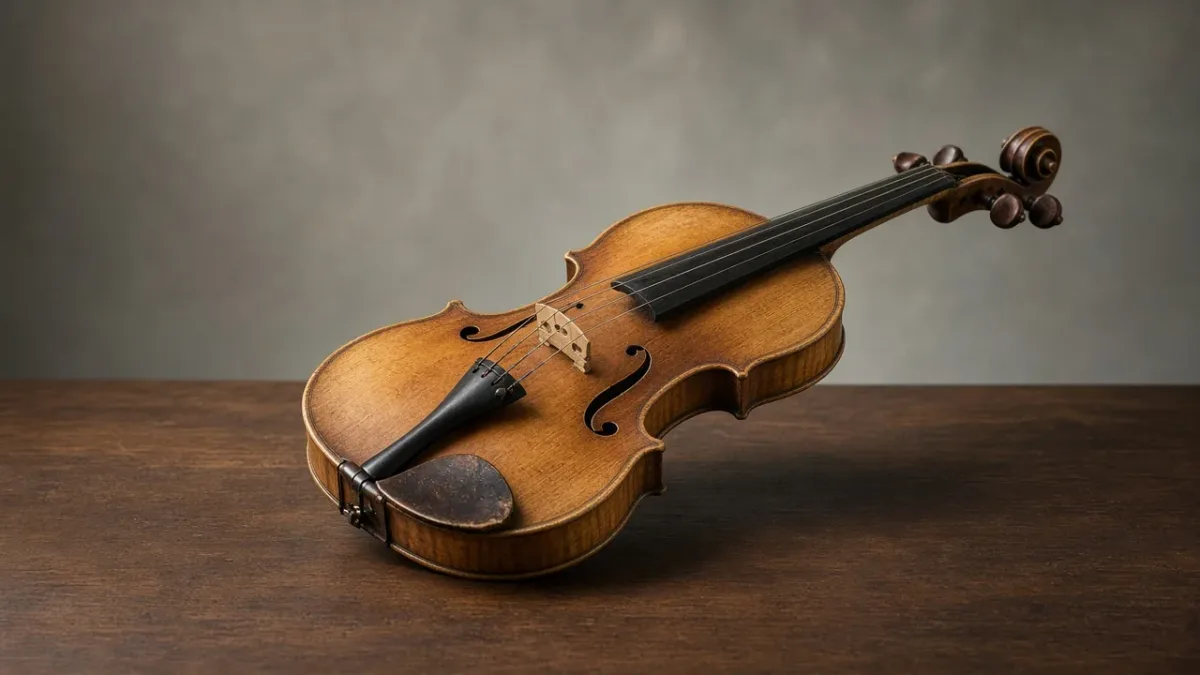
How to Identify Antique Italian Violins by Label and Construction
How to identify antique Italian violins by label and construction. Cremona, Naples, Venice and Turin schools, and the facsimile labels collectors still misread.
A paper slip seen through the bass f-hole is not a certificate of origin. The Smithsonian Institution states the point without qualification: a label naming Amati, Stradivari, Guarneri, Maggini or Stainer has no bearing on whether the instrument is by that maker. John Dilworth, writing in The Strad, puts the same rule in workshop language. Look at the wood first. The label, if it is original, comes last.
Antique Italian violins are identified by construction, outline, arching, f-holes, varnish and wood, then by the school those features imply. Cremona, Brescia, Venice, Naples, Milan and Turin used related but distinguishable methods. Trade copies from Saxony, Mittenwald and Bohemia reused the same Latin formulae for more than a century. The collector’s task is to separate a workshop object from a model name.
Why the label is not proof
Mislabeling is not a modern accident. The Hill family recorded, in Antonio Stradivari: His Life and Work (1902), a petition of 1685 in which the violinist Tommaso Antonio Vitali asked the Duke of Modena for redress after buying a violin labelled Nicolò Amati. Behind that slip was the label of Francesco Rugeri, then selling at about a third of Amati’s price. Jason Price, writing for Tarisio’s Cozio archive, treats most surviving labels as false until they cannot be dismissed. Original labels, when they survive, remain the building blocks of expertise. They are not a substitute for it.
Nineteenth-century catalogues sold inexpensive instruments as copies of Italian masters, often for less than ten dollars. The purchaser understood the name as a model. That knowledge disappeared as instruments passed through attics. The same Latin line, Antonius Stradivarius Cremonensis Faciebat Anno followed by a date, appears in genuine Cremonese work and in German factory output. After 1891, United States import rules required a country of origin in English. A slip that adds “Made in Germany,” “Made in Czechoslovakia,” or simply “Germany” dates the object to the trade, not to eighteenth-century Cremona. Christie's has catalogued the type routinely: a German violin labelled “Copy of Antonius Stradiuarius, Made in Germany,” branded Conservatory Violin, back length 361 mm.
A genuine Italian label, conversely, can be older than the instrument, younger than the instrument, or moved from another belly. Dendrochronology at the Conservatorio di San Pietro a Majella in Naples dated violin CN 5.61, labelled Ferdinando Gagliano 1768, to a terminus post quem of 1883. Claude Lebet had already questioned the attribution in 2001 and given the work to a late-nineteenth-century Bohemian shop. The wood agreed.
Cremona: inner mould, linings and pins
Cremonese construction is the most useful first filter. UNESCO inscribed “Traditional violin craftsmanship in Cremona” on the Representative List of the Intangible Cultural Heritage of Humanity in 2012. The nomination file describes the method still taught in the city: the maker shapes more than seventy pieces of wood around an inner mould (forma interna), by hand, without industrial materials, producing three to six instruments a year. Dilworth isolates the historical consequences of that mould. Outlines are consistent and change in steps when a new form is cut. Corner blocks take a characteristic shape. Linings are mortised into those blocks. Back and belly are often pinned to the end blocks. A small peg in the centre of the back is a Cremonese habit. Stradivari frequently omitted that central pin.
None of these details, taken alone, proves a name. Together they exclude most nineteenth-century trade work, which used exterior moulds, built ribs without mortised linings, or fitted a through-neck later patched at the upper block.
The Museo del Violino in Piazza Marconi, Cremona, keeps a dated sequence that collectors can study in one room. The civic and Stauffer holdings include Andrea Amati’s “Carlo IX” violin of about 1566; Girolamo Amati’s “Stauffer” viola of 1615; Nicolò Amati’s “Hammerle” violin of about 1658; Andrea Guarneri, 1659; Francesco Rugeri, called “il Per,” about 1680; Antonio Stradivari’s “Clisbee” of 1669, “Il Cremonese” of 1715 and “Vesuvius” of 1727; Giuseppe Guarneri filius Andreae, the “Quarestani” of 1689; Giuseppe Guarneri “del Gesù,” the “Stauffer” of 1734; and Carlo Bergonzi’s “Misha Piastro” of about 1739. The museum dates Andrea Amati about 1505–1577. Other catalogues, including the Metropolitan Museum of Art, give about 1511–1580. The difference is cataloguing, not two different men.
Andrea Amati established the classic sizes of violin, viola and cello. Instruments associated with Charles IX of France, including the Cremona example, belong to that first generation. Nicolò Amati (1596–1684) carried the shop through the plague years around 1630, when Girolamo died and Brescia’s leading makers were also lost. His so-called grand pattern, wider than the earlier Amati outline, became the default for later Cremonese work. Stradivari’s own violins of the 1660s still follow the older, narrower Amati form. That is a dating clue.
Antonio Stradivari (1644–1737) is not listed as a garzone in the Amati household in surviving census documents. The Metropolitan Museum records the gap and notes the stylistic debt all the same. He worked with his sons Francesco (1671–1743) and Omobono (1679–1742). Current estimates put the workshop’s output above 1,100 instruments, of which about 650 survive. In the 1690s he used a longer, narrower body, the “long pattern.” By about 1700 he returned to a broader outline and a flatter, full-edged arch. The years about 1700–1720 are conventionally called the golden period. Red pigments enter varnish more often after 1700; a strongly red coat is a reason to look after that date, not proof of it.
Guarneri “del Gesù” (1698–1744) cut f-holes that depart from the Amati–Stradivari sequence: small circles, extended wings, a broader opening. Dilworth points to Gasparo da Salò in sixteenth-century Brescia as a precedent unconnected with the Amati template. A “del Gesù” label on a regular Amati outline is a contradiction, not a rarity to be explained away.
How Italian labels were printed and dated
When a label is original, its typography is evidence. Price’s survey of dated slips is the practical reference.
Few sixteenth-century labels survive. Those that may reflect Andrea Amati’s wording often give the year in Roman numerals, for example ANDREA AMADI IN CREMONA MDLXIV. Brescian makers, Zanetto Micheli, Gasparo da Salò and Giovanni Paolo Maggini among them, used short undated printed slips. That is why early Brescian instruments are not catalogued to a precise year.
Antonio and Girolamo Amati printed their names in Latin, stated that they were brothers, Cremonese, and sons of Andrea, and wrote the four-digit year by hand after a printed F. for fecit. They dissolved the partnership in 1588. Girolamo continued to use the brothers’ label for decades. Nicolò Amati’s earliest surviving original label may be that in the 1649 “Alard.” His slips print the century digits 16 and leave the decade and year to the pen.
Stradivari’s labels of the mid-1660s to the late 1690s print three digits, 166_. After 1670 he altered the third digit: scraping for the 1670s, looping a 6 into an 8 for the 1680s, adding a tail for the 1690s. The Hills illustrated the sequence in 1902. Toward the end of the 1690s he ordered a new batch printing only the millennial 1, and wrote the remaining three digits. A slip with a printed 166 and an unaltered third digit cannot be a 1715 “Cremonese.”
Family relationship and claimed training appear as Latin formulae: filius, nepos, alumnus. Those words are claims. Giovanni Battista Guadagnini’s Turin labels read Joannes Baptista Guadagnini / Cremonensis fecit Taurini, sometimes adding alumnus Antoni Stradivari. No archival record places his training in Cremona. The Österreichische Nationalbank’s 1774 “Mantegazza” violin carries the Turin formula with handwritten date and initials GBG. A dendrochronological report on that instrument gives a youngest ring of 1767, consistent with the paper date even though the varnish may have been applied later by the Mantegazza brothers after Guadagnini’s deliveries to Count Cozio di Salabue.
Alessandro Gagliano’s Neapolitan labels often state Alumnus Antonio Stradivarius. The Smithsonian repeats the traditional account that he worked in Cremona before returning to Naples. Treat the sentence as workshop advertising until an independent document confirms it. Nicolò Gagliano’s slips are more local: Nicolaii Gagliano fecit in Napoli or Nicolaus Gagliano filius Alexandri fecit Neap., with a date.
Schools outside Cremona
Brescia precedes and rivals early Cremona. Maggini and da Salò used undated labels and a fuller, more rounded arch. A long body length can indicate Brescian work, or later German trade. The distinction is in the arching and the f-holes, not in the centimetres alone.
Venice produced a separate school in the decades around 1700. Matteo Goffriller’s instruments are frequently unlabeled. Price records at least one version with three printed date digits, in Italian rather than Latin. Unlabeled Venetian work is therefore not, by itself, suspicious. It is a local habit. The same city remains a collecting ground for other Venetian crafts; the trade streets around San Maurizio still mix furniture, glass and the occasional instrument case, as set out in the Venice antiques walking guide.
Naples is the other large Italian centre a collector will meet. The Gagliano family, as many as eighteen makers of that surname in the Smithsonian’s count, supplied violins, violas and cellos through the eighteenth century. Nicolò I’s work has been mistaken for Stradivari. Fernando (Ferdinando) produced both fine and ordinary trade instruments in quantity. The same city later industrialised plucked instruments. Workshop paper in Naples is a shared problem across those trades; the method used for Neapolitan mandolin labels applies here: count courses and construction first, then read the slip.
Turin in the 1770s is inseparable from Count Ignazio Alessandro Cozio di Salabue. Cozio contracted Guadagnini on 28 December 1773, through agents, to supply new instruments, and in the same years bought remaining Stradivari instruments and, by 1775–76, workshop forms and tools from Paolo and Antonio II Stradivari. Guadagnini died in Turin on 18 September 1786. His Cremonensis wording is a market claim from that late career, not a birth record.
Milanese shops, Grancino and Testore among them, appear in Cozio’s own inventories. A verbose Testore label of 1764, with four printed date digits, is one of the exceptions Price notes to the usual two-digit printed year. Northern Italian instruments still surface through the same dealer streets that handle furniture and small sculpture; the Milan antiques walking guide maps the Brera and Navigli circuits where such objects are shown, not where they were made.
Grand Tour travellers bought instruments as they bought micromosaics, plaster casts and marble copies. Dating those souvenirs by material and workshop, as in the guide to Italian Grand Tour antiques, is a parallel problem: the object’s construction outranks the tourist inscription.
Facsimile labels and factory copies
A facsimile Stradivari label on a well-made Italian violin of 1880 is a different object from the same label on a Markneukirchen trade violin. The first may be a dealer substitution or a model citation inside a competent local shop. The second is industrial production. Clues that pull an instrument out of Italy include:
- English country-of-origin wording required for United States imports after 1891.
- “Copy of” printed above the Latin name, as in the Christie's German examples.
- Exterior-mould symmetry, unmortised linings, stained “antique” wear in identical patches, and a through-neck later boxed in.
- Printed labels with all four date digits in a typeface unknown to the claimed century.
- A brand on the scroll, “Conservatory Violin” and similar trade names.
None of these features appears on the civic Cremonese instruments in Sala 5. They are abundant in the auction rooms that handle student outfits.
The reverse error is also common. An unlabeled or relabeled Italian violin of the late eighteenth century can be a Guadagnini, a Gagliano, a Storioni or a competent anonymous. Lorenzo Storioni (documented in Cremona in the last third of the eighteenth century) is represented in the Museo del Violino’s friends of Stradivari displays. His work is not a substitute Stradivari. It is late Cremonese, and it is collected as such.
What a restorer changes
Most antique Italian violins were modernised in the nineteenth century. The Metropolitan Museum’s Nicolò Amati of 1669, later a Paris Conservatoire prize violin, received a modern neck, bass-bar and fittings in that period; in 1977 Fred J. Lindeman returned it toward an earlier setup with a shorter fingerboard and gut strings. A reset neck, an enlarged bass-bar, a longer fingerboard, a grafted scroll and replaced pegs are expected. They do not, by themselves, condemn the body.
Condition notes that do matter for identification are original varnish islands under later polish, the colour of the ground on an unrubbed rib, tool marks in the pegbox, the species of the linings (willow, spruce, poplar), and whether the purfling mitres are bee-stings or blunt. Dilworth’s warning stands: so much old varnish is worn, retouched or French-polished that the first task is to decide what is original.
Dendrochronology dates the youngest ring on the belly, not the day the instrument was assembled. A gap of a few years between felling and making is normal. A gap of a century, as on CN 5.61, is not.
FAQ
Does a Stradivarius label mean the violin is by Antonio Stradivari?
No. The Smithsonian’s wording is the one to keep: the presence of the label has no bearing on authenticity. The usual text, genuine or false, is Antonius Stradivarius Cremonensis Faciebat Anno plus a date.
What construction details point to classical Cremona?
An inner mould, linings mortised into the corner blocks, pins at the end blocks, and, on many makers though not always on Stradivari, a central pin in the back. Consistent outlines that match a known form are stronger evidence than any slip of paper.
How can a date on the label be checked?
Compare printed versus handwritten digits with the maker’s documented batches. Stradivari’s 166_ labels cannot serve unaltered after 1669. Nicolò Amati printed 16. Guadagnini in Turin wrote the year on a Cremonensis fecit Taurini slip. Then compare the paper date with dendrochronology and with the outline and varnish of the claimed decade.
Are Neapolitan Gagliano violins a safe substitute for Cremonese work?
They are a different school. Nicolò I produced instruments that have been mistaken for Stradivari; Fernando’s output includes ordinary trade work. Labels claiming Cremonese training are claims. Identification follows the same order as for Cremona: construction, then paper.
What should be photographed before an expert sees the instrument?
Both f-holes (to record the label without removing it), the back, the scroll from several angles, the rib mitres, any brand or inscription, and a measurement of the back length excluding the button. Do not soak, scrape or lift the label.
A knowledgeable dealer or a specialist in Italian violin attribution remains the final reader of the object. Comparative study of design, wood and varnish, as the Smithsonian notes, has no shortcut. The label is a document about what someone wanted the instrument to be called. The instrument is the evidence of what it is.