
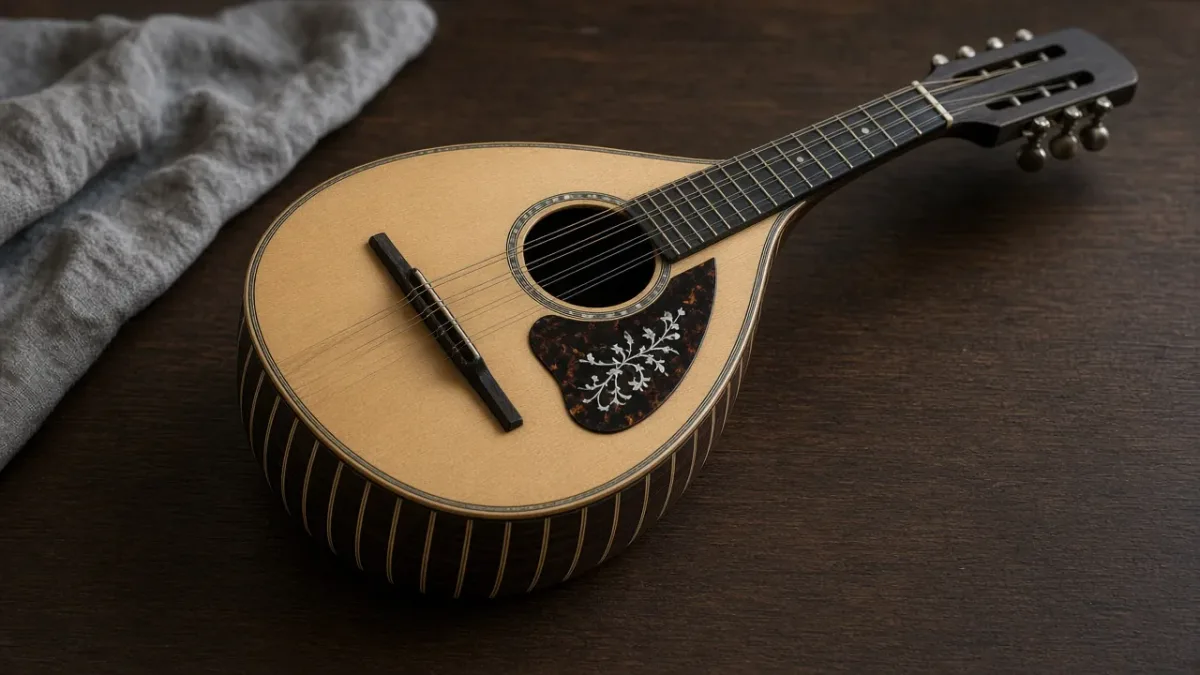
Antique Italian Mandolins by Construction and Workshop Labels
Antique Italian mandolins are dated by bowl construction, soundboard cant, and workshop labels from Naples and Rome, especially Vinaccia, Calace and Embergher.
The market for antique Italian mandolins is still dominated by the Neapolitan bowl-back: four double courses, violin tuning, a canted spruce soundboard, and a paper label that may or may not belong to the wood. Naples supplied most of the export trade in the last third of the nineteenth century. Rome produced a parallel concert type. Milan and other northern centres continued an older, gut-strung lineage that is still confused with the Neapolitan model.
Workshop labels are useful. They are not sufficient. Christie's and the Italian state catalog both record instruments whose paper dates contradict construction. Identification starts with the object: number of courses, bridge type, soundboard geometry, bowl ribs, neck, and the form of the pegbox or machine head.
The Neapolitan type in the eighteenth century
The Neapolitan mandolin, called mandoline in French sources of the period, took shape between Rome and Naples in the 1740s. Anna Rita Addessi, writing for Il Saggiatore musicale, distinguishes it from the earlier Italian mandolino by a broken or canted soundboard (tavola armonica spezzata), a movable bridge, fixed metal frets, four courses, fifths tuning matching the violin, metal-alloy strings, and plectrum technique.
The Metropolitan Museum of Art attributes that design, with due caution, to a member of the Vinaccia family of Naples. Its 1781 mandolin by Antonius Vinaccia (object 89.4.2140) is among the most fully documented luxury examples. Height 58.4 cm. Spruce soundboard with a cant below the bridge. Bowl of twenty-three narrow moulded strips of tortoiseshell with ivory spacers. Circular soundhole with a broad inlaid band. Fingerboard with thirteen gilt frets. Scalloped peghead with eight pegs inserted from behind. Four double courses tuned in fifths, G-D-A-E. The museum's 1773 Vinaccia mandola (89.2.152) shows the same workshop language on a larger body.
An earlier, lighter Vinaccia of 1769, published by Chris Egerton for the Fellowship of Makers and Researchers of Historical Instruments, still used wooden pegs and a mixed stringing of gut, twisted brass, and silver-wound silk. The restoration brief gives pitch around A=390 Hz. High-tension steel was a later, and often damaging, retrofit. Giovanni Fouchetti's tutor of about 1771 belongs to this transitional repertory.
The type was not confined to professionals. Addessi notes its use in public dance, private conversazioni, and aristocratic education, a range visible in contemporary painting. Presentation instruments carry ivory and tortoiseshell that mark court and export taste rather than street playing. A mandolin from the Rothschild collections, sold at Christie's and labelled Gaetanus Vinaccia / fecit Neapoli 1798 / Nella Rua Catalana, has a back of twenty-three concave staves, ivory-edged table and soundhole, tortoiseshell inlaid with mother-of-pearl, and an overall length of 57.1 cm.
Neapolitan decorative workshops of the same decades, including the presepe figure makers of the eighteenth century, used comparable luxury materials and similar export routes out of the port.
What construction tells you
Read the object before the label.
Courses and tuning. The classic Neapolitan instrument has four double courses, eight strings, tuned in fifths like a violin. A six-course, gut-strung bowl-back is not a Neapolitan mandolin. It belongs to the Milanese or Lombard line: flat soundboard, glued lute-style bridge, often a carved rosette, tuning in fourths and thirds. Genoese instruments, as described in the catalogo.beniculturali.it record for a Nicola Calace mandolin in Rome's Museo Nazionale degli Strumenti Musicali, may carry five or six pairs on a wider neck.
Soundboard. Neapolitan tables are spruce. The diagnostic feature is the cant, a fold just below the bridge that stiffens the belly against metal-string tension. Eighteenth-century examples are light. Pasquale Vinaccia's nineteenth-century workshop deepened the bowl, added structural reinforcement, fitted mechanical tuners, extended the fret count, and normalised high-tension steel. If a claimed 1760s instrument has heavy bracing, a thick table, and machines, the date is wrong or the belly has been rebuilt.
Bridge and tail. The Neapolitan bridge is a movable bar. Strings pass over it to a tailpiece at the base of the bowl. A glued lute bridge on a flat table indicates the older or northern type.
Bowl. Ribs are typically maple or rosewood, sometimes tortoiseshell on presentation pieces. Counts in documented instruments range from the mid-teens on plain maple workshop models to more than twenty on fluted luxury bowls. The Neapolitan bowl is bulbous and meets the neck at a blunt angle. The Roman bowl often shows a recurve at the neck joint and a smaller internal volume for a similar outline.
Neck and fingerboard. Neapolitan concert instruments of the Vinaccia-Calace tradition usually have a thin, nearly flat fingerboard and a neck of softwood veneered in rosewood. Roman concert instruments, especially Luigi Embergher's, tend toward a solid maple neck, a radiused and more steeply canted fingerboard, and a pronounced V-section to the neck. Embergher and, independently, Raffaele Calace extended the fingerboard over the soundhole on soloist models.
Pegbox. Eighteenth-century Neapolitan heads take rear-inserted pegs, violin fashion. Nineteenth-century steel-strung instruments use rear machines, often with an engraved metal cover plate on the back of the head. A mismatch between pegbox and belly date is common after later conversion.
Scale length on a documented 1900 Gennaro and Achille Vinaccia concert mandolin is 330 mm. Overall lengths published by Christie's and the Met cluster around 57-58.5 cm. Treat those figures as a range, not a rule. Furniture collectors already used to dating Italian case pieces by construction rather than by a single stamp will recognise the method.
Vinaccia labels
The Vinaccia shop on Rua Catalana, Naples, is the longest-running name in Neapolitan plucked-instrument making. Surviving labels often give the house number as 46; later printed tickets also cite other numbers on the same street. Antonio (Antonius) Vinaccia is documented in Naples from at least 1754 to 1781. Vincenzo (Vincentius) appears on instruments of the 1760s-1790s. The traditional claim that Gaetano Vinaccia invented the Neapolitan mandolin in 1744 is workshop lore, repeated in older dictionaries. It is not a documented patent. The Met's wording remains the safer one: the type was probably designed in that family circle.
Pasquale Vinaccia (1806-1885, dates as usually given in the instrument literature) is the figure who matters for the steel-strung mandolin collectors actually meet. Philip J. Bone's The Guitar and Mandolin (1914) records him as maker to Queen Margherita of Italy; later labels advertise that appointment. After his death the printed wording shifts. Instruments of the 1890s often read F.lli Gennaro ed Achille Vinaccia fu Pasquale (the brothers Gennaro and Achille, sons of the late Pasquale). From about 1900 a shorter brand appears: F.lli Vinaccia fu P.le & C. Fu means "son of the deceased." It is a legal style, not decoration.
Other Vinaccia names circulate. Bonhams sold a mandolin labelled Giuseppe Vinaccia fu Caetano, Salita Arenella no. 66, Naples, 1895. Christie's has catalogued pieces ascribed to Gaetano or Pasquale whose manuscript labels do not match the probable making date. Photograph the entire label, including address, year, and any royal appointment line. Then set it aside until the wood agrees.
Calace
The Calace workshop is the other Naples name that still carries weight on the market. State cataloguing of a branded instrument in Rome gives Nicola Calace's dates as Pignola 1794 to Procida 1869, and notes a characteristic branded mark (initials C.N. flanking a heart) rather than a paper label on his own work. Family accounts place guitar-making on Procida in the 1820s and the move to Naples with Antonio, Nicola's son. Raffaele Calace (Naples, 1863-1934), Antonio's son, trained at the Conservatorio of Naples, composed for plectrum instruments, and ran the shop with his brother Nicola (1859-1923) until that Nicola emigrated to the United States in 1906. After 1911 Raffaele worked in his own name.
A Bonhams mandolin of 1892 carries the label Fabrica di Instrumenti Armonici / Fratelli Nicola e Raffaele Calace fu Antonio / Via Università ... Napoli 1892. Via Università no longer exists in that form; the present firm is in Vico San Domenico Maggiore. Concert Calace mandolins of Raffaele's maturity often have an enlarged bowl and a fingerboard carried over the soundhole. Workshop literature describes extension to a very high fret on the concert model. He also developed the liuto cantabile, a five-course bass instrument related to the mandoloncello. Distinguishing a Calace of the 1890s from a Vinaccia of the same decade by inlay alone is unreliable. Bowl profile, occasional sound ports on Calace models, headstock outline, and the branded or printed label have to be read together.
The Museo Storico Musicale of the Conservatorio San Pietro a Majella in Naples holds the principal public survey of Neapolitan bowed and plucked lutherie of the eighteenth and nineteenth centuries. It is the right first stop before buying a "Vinaccia 1780" from a general antiques shop.
Rome: Embergher and the concert models
Luigi Embergher (Arpino, 4 February 1856-Rome, 12 May 1943) took the Roman mandolin of Giovanni De Santis and Giovanni Battista Maldura and standardised it for the plectrum orchestra. A collaboration with Maldura in the 1890s produced a set of concert sizes, including mandoliola and mandoloncello, shown at Turin in 1898. His own catalogue, issued around 1926, ranks mandolins as student types A and B; orchestra numbers 1-4; soloist numbers 5, 5-bis, and 6; and artistic numbers 7 and 8. Paul Sparks's The Classical Mandolin (Oxford University Press) remains the standard English account of that ranking and of Embergher's place beside the Neapolitan shops.
Roman instruments are not improved Neapolitans. They are a different construction. Recurved bowl at the neck, solid maple neck, radiused and slanted fingerboard, often a sharper cant. Headstock outlines are house signatures. A Vinaccia or Calace label on a Roman-construction bowl is a warning, not a bonus. Regional silver is identified in the same way, by workshop marks read against local construction rather than by the most optimistic line of engraving.
Factory export and later labels
From the 1880s a mandolin fashion in the United States and northern Europe pulled thousands of bowl-backs out of southern Italian shops and factories. The Met's notes on the 1781 Vinaccia place early presentation instruments and later export goods in different commercial worlds. Many labelled "Napoli" mandolins of 1890-1920 are competent trade pieces: rosewood or stained maple ribs, thin pearl, stencilled or generic labels, soft interior lining. They are period objects. They are not concert Calace or Embergher number 5.
Plectrum orchestras of the 1890s-1920s, and composers such as Carlo Munier in Florence, created demand for matched consorts. That demand also created a secondary market in assembled sets and in labels added after the fact. A paper dated 1760 inside a nineteenth-century Calace, as the Rome museum record states outright, is false.
Condition, materials, and restrictions
Tortoiseshell pickguards, ivory bindings, and pearl inlay are normal on better Neapolitan work. They are also restricted. Christie's standard notice on Vinaccia lots warns that several countries prohibit import of tortoiseshell, ivory, and related materials. A collector in the United States or Britain should assume a pre-sale CITES check on any eighteenth-century presentation instrument and on many nineteenth-century pickguards.
The same Campanian luxury trades that supplied Torre del Greco coral also supplied shell and ivory to the Rua Catalana shops. The legal problem is shared.
Common faults: belly sinking below the bridge from later steel on an eighteenth-century table; loose ribs; replaced scratchplates; shortened necks; machine heads grafted onto peg heads; heavy later polish that fills wear. Original varnish on a Vinaccia of the 1780s is thin. Leave it.
Dating in practice
Read the city first. Naples: bulbous bowl, blunt neck joint, veneered neck, four double steel or brass courses, canted table, machines on later pieces. Rome: recurve, maple neck, numbered Embergher model if the label is original. North: six courses, gut, flat table, glued bridge.
Then read the century. Pegs, light construction, mixed gut and wire, fewer frets: eighteenth century, if the belly has not been rebuilt. Machines, deep bowl, high fret count, steel: after Pasquale Vinaccia's reforms, so mid-nineteenth century at the earliest for that specification.
Then read the label against both. Fu Pasquale cannot predate 1885. Fratelli Nicola e Raffaele Calace fu Antonio belongs to the years the brothers worked together in Naples, not to Nicola the elder on Procida. A royal appointment line on a Vinaccia is a late-nineteenth-century advertising formula.
FAQ
Is every bowl-back mandolin Neapolitan?
No. Bowl-backs were made in Rome, in northern Italy, and later in German and American factories imitating the Italian outline. Course count, bridge, and soundboard geometry separate the families.
Are Vinaccia labels reliable?
Sometimes. Addresses and the fu Pasquale formula can date a printed label. They cannot authenticate a belly. Auction houses routinely catalog Vinaccia instruments as "ascribed to" or "labelled."
What is the difference between Calace and Embergher?
Naples versus Rome. Calace continues the bulbous Neapolitan bowl; Embergher the Roman concert pattern with recurved bowl and radiused fingerboard. Both extended fingerboards on soloist models. Both ranked their output.
Should an eighteenth-century mandolin carry steel strings?
Not as original specification. Egerton's conservation note on the 1769 Vincenzo Vinaccia is explicit: later steel distorted a table built for gut and mixed wire. Restorers now return such instruments to period stringing.
Where are reference collections?
The Metropolitan Museum of Art, New York (Vinaccia 1781 and related). Museo Nazionale degli Strumenti Musicali, Rome. Museo Storico Musicale, Conservatorio San Pietro a Majella, Naples.