
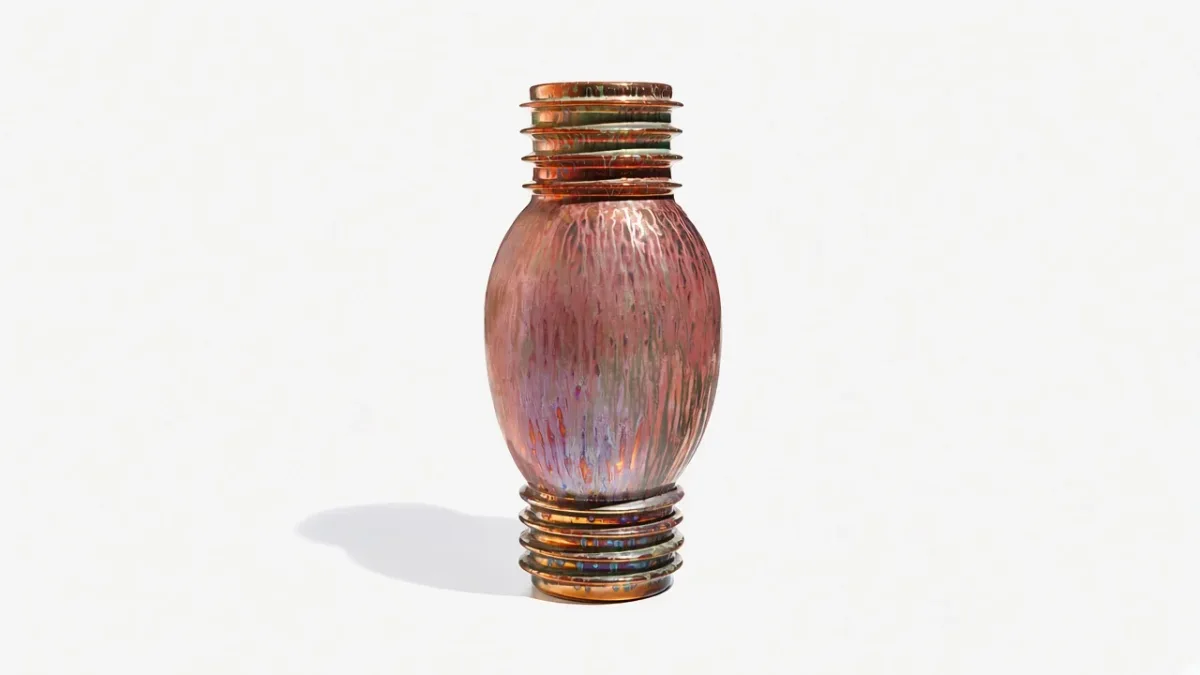
Italian Futurist Ceramics from the Mazzotti Kiln at Albissola
Identify Italian Futurist ceramics from the Mazzotti kiln at Albissola: M.G.A. marks, 1930s wares versus later re-editions, and auction prices.
The lantern-marked plate of seventeenth-century Liguria and the mechanical vase with stacked discs were both fired at Albissola. They are not the same ware. Collectors who search Italian Futurist ceramics are looking at a later kiln, a paler clay, and a market that still reprints the 1930s drawings.
Giuseppe Mazzotti, called Bausin, opened his factory in 1903 in the Pozzo Garitta quarter of Albissola Marina. Between the late 1920s and the Second World War that shop, under his sons Tullio (Tullio d’Albisola, 1899–1971) and Torido (1895–1988), became the principal workshop for Futurist pottery in Italy. The useful questions are which Mazzotti, which decade, and whether the object is a period firing or a later re-edition from the same models.
This is a different collecting field from seventeenth-century Albisola maiolica, whose lantern, crown and fish marks belong to tin-glaze kilns on the same beach.
The Mazzotti kiln, 1903 to 1934
Bausin Mazzotti (1865–1944) had thrown for stoviglie shops in Liguria, Livorno and Naples before taking his own furnace at Pozzo Garitta. Artistic maiolica is recorded from 1906. Torido trained as a draughtsman; Tullio remained on the wheel. In 1925 the firm sent vases and plates to the Ligurian room of the Exposition internationale des arts décoratifs in Paris. The same year it rented extra rooms at Albisola Superiore for serial work, keeping the artistic firing at Pozzo Garitta.
In 1929 the brothers took a specialisation course at Faenza, where they met Gaetano Ballardini at the Museo Internazionale delle Ceramiche and learned to fire both the decorated bello and the biscuit in an electric kiln. They brought that kiln back to Albissola. The local stile Albisola of the 1920s was still a refined Deco reading of traditional Ligurian shapes. Tullio’s own work was already pulling away from it.
The paternal mark adopted in this period is a drawn kiln followed by the letters M.G.A. (Mazzotti Giuseppe Albisola). In 1932 Tullio bought ground at the mouth of the Torrente Sansobbia, on the boundary between Albissola Marina and Albisola Superiore, and had the architect Nicolaj Diulgheroff build a house-workshop-shop to Futurist rules. A second block, drawn by Torido and approved by Diulgheroff, followed in 1934. The two earlier sites were folded into that building. It still stands.
Futurist production at Albissola, 1925–1939
Tullio dated the first “anti-decorative” and “anti-imitative” ceramics to 1925: strong colour cut by heavy black line, on forms that no longer copied the albarello or the parade plate. Marinetti gave him the name Tullio d’Albisola. The Turin Futurists followed the ware: Diulgheroff, Farfa (Vittorio Osvaldo Tommasini), Fillia (Luigi Colombo), Pippo Oriani, Mino Rosso. From Milan came Nino Strada and, from 1927, Bruno Munari, who worked with Tullio on decomposed, polycentric models.
A factory catalogue of about 1928 already lists Futurist types beside historicist and “Persian” lines. Public recognition came in October 1929, when Tullio and the Faentine potter Riccardo Gatti were the only ceramists in Fillia’s exhibition Trentatré futuristi at Galleria Pesaro, Milan. Tullio showed again at the Monza Triennale of 1930 and at Futurist exhibitions in Alessandria, Florence, Savona, Genoa and Paris through the mid-1930s.
On 5 February 1930 he wrote to the Milan artists’ register that he wanted ceramics of “polycentric, anti-imitative, mechanical forms,” executed in local Italian materials. The phrase is workshop language, not a slogan. It describes what the kiln actually made: turbine-like vasi motorati, bolt-shaped bullonvasi, iron-shaped bottles, tea services painted with dots and chevrons, and small sculptures (boxers, motorists, damine) that sit closer to machine parts than to Lenci’s Turin figurines of the same decade.
Fillia and Marinetti named Tullio among the Futurist artists in the Manifesto dell’arte sacra futurista (Gazzetta del Popolo, 23 June 1931). The ceramic manifesto itself is later. Ceramica e aeroceramica. Manifesto futurista, signed with Marinetti, appeared in the same Turin paper on 7 September 1938 and called Albissola the ceramic capital of Italy. Tullio reprinted it in 1939, with a short history of Futurist pottery, as La ceramica futurista, issued by the Manifattura Giuseppe Mazzotti at Albissola Marina. The booklet illustrates work by Tullio, Torido, Diulgheroff, Farfa, Fillia, Munari, Alf Gaudenzi, Mario Anselmo, Ricas, Nino Strada, and Lucio Fontana, who had modelled at the kiln from 1936.
Sanctions after 1935 and then the war contracted the export trade that had carried Mazzotti wares to France and the United States. Bausin died in 1944. The brothers resumed with traditional lines for confectioners and pharmacies before the 1950s collaborations with Fontana, Asger Jorn and others, a later chapter. In 1959 the firm split: Torido kept Giuseppe Mazzotti (by then often marked G.M.A.) with his children; Tullio joined his sister Vittoria in Ceramiche Mazzotti, in the Diulgheroff house. The Museo Internazionale delle Ceramiche at Faenza holds the largest public group of Tullio’s ceramics.
Body, glaze and form
Period Futurist pieces are earthenware, often a light-coloured body, not the red tin-glaze of Ligurian maiolica. Decoration is painted glaze and enamel, sometimes with metallic lustre, on forms thrown, moulded or assembled from stacked elements. Diulgheroff’s tea services of about 1935, produced for Torido, are typical of the tableware line: teapot, milk jug, covered sugar, cups and saucers, each painted M.G.A. underneath, the glaze in geometric fields and dots. The vaso motorato type, associated with Torido in the 1930s, stacks disc rings at neck and foot around an ovoid body, with an iridescent copper-violet glaze running vertically. Farfa’s bullonvaso takes the hexagonal bolt as a vessel. Heights in the trade are modest: museum and auction examples commonly fall between about 18 cm and 38 cm.
Serial production from plaster moulds was factory practice, as it was for popular Madonna types in Renaissance Florence. A moulded Futurist form can still be a period object. What it cannot do, by itself, is prove a 1930s firing.
What determines value
Value on this material tracks workshop, date, name, completeness and condition, not the word Futurist on a label.
Maker or workshop. A piece designed by Tullio, Diulgheroff, Farfa or Munari, and fired at M.G.A., sits above unsigned factory Futurist décor. Torido’s signed motorato vases are collected as design, not as souvenir pottery. Fontana’s Albisola sculptures of 1936 and after are a separate, much higher market and should not be used to price a dotted teacup.
Period. A 1928–1939 firing is the object this article describes. A postwar or contemporary re-edition from the same drawing is workshop product of another date. The drawings survive; the factory still throws them.
Region. Albissola Marina, Savona province. Wares from other Ligurian or Faentine Futurist experiments (Gatti at Faenza is the documented parallel) are scarce by comparison and need their own marks.
Material. Light earthenware with in-glaze colour and, on some vases, metallic lustre. Heavy red bodies with cobalt-on-white landscapes are the wrong century.
Rarity. Unique or small-run sculptures and named mechanical vases are fewer than tea-service duplicates. Complete services are harder to find than a single cup.
Condition. Glaze scuffing, restored feet and missing lids move a service from the Christie's band toward the provincial one. Lustre that has been over-polished reads as later.
Restoration. Filled chips on stacked discs are common and should be priced as repairs, not as original modelling.
Provenance. A Fondazione Giuseppe Mazzotti certificate, a Garth Clark exhibition label, or a continuous Italian private history helps. A modern silver factory sticker does not.
Size. The Phillips Motorato at 37.5 cm is a different lot from a 17 cm bottle. Height is in the catalogue for a reason.
Market demand. Design sales in London, New York and Vienna pay for complete Diulgheroff services and for named mechanical vases. Small unsigned pieces trade in Italian decorative-art rooms at a fraction of those figures. Demand is for documented Futurist production, not for anything painted in bright enamel at Albissola after 1950. That later field includes Bitossi’s Montelupo stoneware, which is a different kiln and a different decade.
Prices at auction
The following results are published hammer or realised prices. They are not a valuation. Condition, completeness and attribution move the figure, and the market for 1930s design is not the market for 1950s artist ceramics.
Christie's, London, King Street, 20th Century Decorative Art & Design, 26 October 2006, sold a Futurist teaset designed by Nicolaj Diulgheroff and Tullio d’Albisola for Torido Mazzotti, 1936–37: partially glazed earthenware, teapot, hot-water jug, cream jug, ten cups, ten saucers, ten shallow cups and a large plate, teapot 18 cm, plate 24.1 cm, each piece painted M.G.A. Price realised GBP 3,360 (estimate GBP 3,000–4,000).
Christie's, South Kensington, 28 October 2014, sold another Diulgheroff and Tullio d’Albisola Futurist tea service, circa 1935, produced for Torido Mazzotti: teapot, milk jug, covered sugar and six cups and saucers, teapot 15.8 cm, undersides painted M.G.A. Price realised GBP 3,750 (estimate GBP 3,000–5,000).
Dorotheum, Vienna, Jugendstil and 20th Century Arts and Crafts, 12 December 2022, lot 76, sold a Diulgheroff and Tullio d’Albisola tea service designed about 1935 for Torido Mazzotti: teapot, milk jug, covered sugar, six cups and six saucers, light body, geometric glaze, slight scuffing, undersides marked in black. Realised EUR 1,792 including buyer’s premium and VAT (estimate EUR 800–1,500).
Phillips, New York, Design, 9 June 2021, lot 41, sold Torido Mazzotti’s Motorato vase, 1930s, glazed earthenware, 37.5 cm, manufacturer’s mark and “toRido” painted in glaze, Fabbrica Ceramiche Giuseppe Mazzotti, Albisola. Sold for USD 2,520 (estimate USD 3,000–5,000).
Il Ponte, Milan, auction 388, 11 April 2017, lot 82, sold a Torido Mazzotti Futurist maiolica vase, M.G.A. Albissola, marked and signed under the base, height 27 cm. Awarded EUR 400 (estimate EUR 200–250).
Taken together, named tea services in London have realised a little over £3,000–3,750 including premium; a documented Motorato in New York made USD 2,520; a smaller signed vase in Milan made EUR 400 hammer. Provincial or incomplete lots sit below those figures. None of these sales is a guide to a re-edition still in the factory shop.
Authentic or later
The first confusion is chronological. Seventeenth-century Albissola tin-glaze and 1930s Futurist earthenware share a place-name. They do not share clay, glaze, form or mark. A lantern on the reverse dates the wrong object.
The second confusion is the re-edition. Giuseppe Mazzotti 1903 still produces Futurist models from the original drawings, by the same hand processes the firm describes on its own catalogue. The Museum of Fine Arts, Houston, accessioned a Farfa Bullonvaso whose underside is painted “1903 / G. [kiln] M / A / riedizioni / futuriste,” with a modern printed label “Fabbrica Casa Museo GIUSEPPE MAZZOTTI 1903.” That inscription is a dating tool. Period pieces of the 1930s are commonly painted M.G.A., sometimes with the kiln drawing, sometimes with “Tullio d’Albisola” and a year (including Fascist-era numerals, as on a 1931 sculpture marked “1931 IX”). Later G.M.A. and “1903” kiln marks, silver stickers, and the words riedizioni futuriste belong to postwar and contemporary firings. The form can be identical. The firing is not.
The third confusion is attribution. Bright geometric enamel on a conventional jug is not, by itself, Diulgheroff. Compare the painted mark, the weight of the black line, and published shapes (McCready 1995; Chilosi and Ughetto 1997). Unsigned factory Futurist décor exists and should be catalogued as such.
Typical later copies and mistakes:
- Current Mazzotti re-editions sold as “1930s” because the model number is period.
- Lenci or other Deco figurines offered as Futurist Albissola.
- 1950s–60s artist ceramics from Albissola (Fontana, Jorn, Mazzotti postwar) mixed into a 1930s Futurist group.
- Over-cleaned lustre, replaced lids, and stacked discs recast in a smoother modern mould.
A period object should show a biscuit fracture at any chip, glaze that belongs to the firing rather than sitting as cold paint, and a mark consistent with M.G.A. practice before the 1959 split. Thermoluminescence is rarely used on this material; the Fondazione Mazzotti certificate is the workshop’s own later opinion and should be read as such, not as a laboratory date.
Appraisal
A named mechanical vase, a complete tea service, or any object offered as Fontana at Albissola warrants a specialist condition report before purchase or sale. So does any piece whose only proof of date is a model still in production. Ask for photographs of the underside, a transcription of every painted mark, and a note on restoration of lids, spouts and stacked rings. An opinion from a decorative-art specialist or from the Museo Internazionale delle Ceramiche at Faenza is proportionate when the asking price sits in the Christie's band. This is not a valuation.
FAQ
How do you identify Italian Futurist ceramics from Mazzotti?
By form, body and mark together. Mechanical or polycentric shapes, light earthenware, painted M.G.A. or a kiln drawing, and a glaze scheme that matches published Diulgheroff, Tullio or Torido types of 1928–1939. A modern factory label is not a 1930s mark.
What does the M.G.A. mark mean?
Mazzotti Giuseppe Albisola. Treccani records the kiln drawing plus those letters as the paternal mark adopted as Futurist production got under way. After the 1959 split, Torido’s line is often G.M.A.; contemporary re-editions add 1903 and, on some bases, the words riedizioni futuriste.
Are Mazzotti Futurist re-editions fakes?
No. They are later firings of documented models, often marked as re-editions. They become a problem only when they are catalogued as period 1930s objects.
What is a vaso motorato?
A mechanical vase type of the 1930s, with stacked disc rings at neck and foot. Phillips sold a Torido example, 37.5 cm, in 2021. Related machine forms include Farfa’s bullonvaso.
Is Futurist Albissola the same as Albisola maiolica?
No. Albisola/Albissola tin-glaze of the seventeenth and eighteenth centuries is a different body, palette and mark system. The Futurist kiln reused the place, not the recipe.