
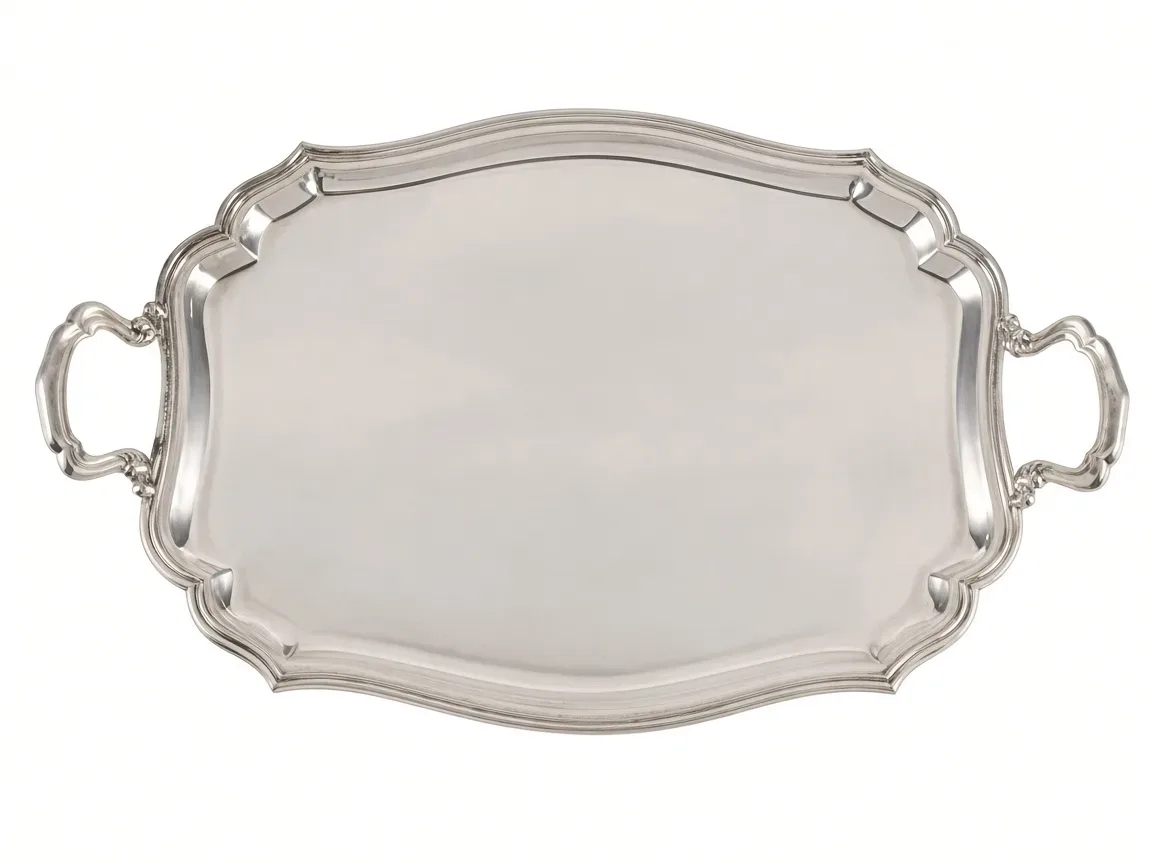
What an Antique Italian Silver Tray Is Worth at Auction
What an antique Italian silver tray is worth at auction. City marks, weight and later copies, with verified prices from Vienna, London and Milan.
Italian inventories call a serving tray a vassoio. A two-handled example is a vassoio biansato. A salver raised on a foot is an alzata. Auction catalogues mix the three under the English word tray, which is why two objects of similar size can sit in different price bands. The market pays for city, date, maker and construction. Weight is a floor, not the valuation.
A large 800 tray from a twentieth-century Milanese factory is table silver. An eighteenth-century Roman or Venetian tray with a documented punch is plate. Confusing the two is the usual expensive error.
What determines value
Maker or workshop comes first when the punch can be read. Antonio or Tomasso Politi in mid-eighteenth-century Rome, the Miracoli shop in early-twentieth-century Milan, and an unsigned 800 factory mark are not interchangeable. Unsigned work can still sell if the civic assay is sound and the form is of the period. A famous name on a later, thin-gauge tray does not rescue weak metal.
Period and region separate collector plate from household silver. Pre-unification trays carry civic systems that ended with the Italian law of 2 May 1872, which liberalised manufacture and made assay optional. Genoa used the torretta castle punch into 1824, then Sardinian eagle or St Maurice cross marks with the Genoa dolphin. Venice used the lion of St Mark in moleca and an assayer, often only two punches rather than the five the statutes imagined. Rome used Papal States assays discussed in the guide to Roman silver hallmarks. Naples used crowned NAP dates, then the Parthenope head. Florence used Grand-Ducal punches. After 1872 the national 800, 900 and 950 standards, and from 1934 the numbered lozenge, dominate factory trays.
Material is almost always silver, usually 800/1000 on later Italian tableware. Sterling 925 appears on some export and luxury lines. Silvered metal (metallo argentato) is catalogued as plate and should not be priced as silver. A magnet will not settle the question; a wear-through on the rim or a grey copper blush under a worn well will.
Rarity follows documented city work of the eighteenth century more than sheer size. Small Genoese or Venetian trays with a coherent torretta or lion punch and original chasing outsell larger unsigned 800 plate. Armorial engraving, if original and not later recut, adds a provenance layer. Erased crests leave a pale oval in the well and usually cut the price.
Condition is visible at arm's length. Dents in a raised well, split rims, resoldered handles and a dished floor that rocks on a table are all priced. Houses still sell bruised eighteenth-century trays; they do so at a discount to an unbruised example of the same punch. Overpolishing flattens chasing and rounds punch edges. Relined wells and replaced handles are restorations, not original construction.
Size and demand pull in opposite directions on later trays. A 60 cm two-handled vassoio of 2 kg is useful in a dining room and finds bidders among household buyers. Collectors chasing eighteenth-century marks often prefer a smaller, heavier-gauge tray with a readable assay. Matching a tray to a tea and coffee service can lift the group; a lone factory tray sells closer to metal plus form.
These figures are sale results, not a valuation. Condition, attribution and the room on the day all move the hammer.
Prices at auction
Dorotheum, Silver, Vienna, 17 June 2025, lot 269: an Italian rectangular tray with two handles, 63 × 38.5 cm, 2,039 g, company mark, Italian hallmark and 800, twentieth century. The realised price was EUR 2,080 including buyer's premium and VAT, against an estimate of EUR 1,200–1,800.
Dorotheum, Silver, Vienna, 13 December 2023, lot 70: a Venetian rococo tray, oval, with repoussé rocaille and foliage, 33 × 25 cm, 832 g, Venetian hallmark, about 1770. The realised price was EUR 5,200 including buyer's premium and VAT, against an estimate of EUR 1,000–1,500. The smaller eighteenth-century piece outsold the large 800 tray. Period and a city punch outweighed weight.
Christie's, London, 12 September 2018: an Italian silver tray, mark of Antonio or Tomasso Politi, Rome, mid-eighteenth century. Shaped oblong form, reeded rim, reeded and shell-cast handles, 56 cm wide, 1,061 g. Price realised GBP 1,500 against an estimate of GBP 700–1,000. Provenance: the Giampaolo Lukacs collection, previously Sotheby's Milan, 18 April 2007, lot 66.
Il Ponte, Milan, sale 401, 27 October 2017, lot 1423: three trays, two silver (an oval with a gallery, Italy, early twentieth century, and a circular example with a moulded border, Milan, early twentieth century, maker Miracoli; together about 1,780 g) and one silvered metal. Hammer EUR 500 against an estimate of EUR 350–400. The catalogue noted defects. Mixed lots of this kind set the floor for unsigned early-twentieth-century Italian trays sold with plate.
Taken together, the published results support a working distinction, not a price list. Documented eighteenth-century city trays have recently realised from about GBP 1,500 in London to EUR 5,200 in Vienna for a small Venetian example. Large twentieth-century 800 trays with Italian hallmarks have realised around EUR 2,000 when sold as a single lot in Vienna, and far less when bundled with plate in Milan. Ranges between those points are not implied. A Buccellati or other designer tray, a heavy armorial vassoio, or a tray whose punches have been doubted will sit outside this sample.
Authentic or later
Start with the punches on the underside, at the handle junctions, and on the rim. Photograph them in raking light. Civic marks must match the claimed city and date. A Venetian lion next to a modern 800 lozenge is a warning, not a bonus. Giorgio Busetto has documented twentieth-century Italian workshops that added pseudo Lombardo-Veneto or Papal States punches beside the legal 800 and maker lozenge. Some later owners rubbed out the modern marks. The object then looks like pre-1872 plate. Bruno Zaramella of Padua is among the factories whose historicising punches have been recorded in that context.
Wannenes, auction 179, 16 November 2015, lot 32, catalogued a two-handled silver tray and a footed piece with fake eighteenth-century Venice marks. The house stated the imitation in the title. Other rooms are less explicit. A tray offered as Venetian rococo whose lion is weakly struck, off-centre, or accompanied by an 800 in a modern outline should be treated as later until a specialist says otherwise.
Construction is the second test. Eighteenth-century trays were raised and planished by hammer. Italian goldsmiths who specialised in flattening a sheet without a dish in the well were called tiratori a martello. The well shows concentric hammer bloom under raking light. Spun or rolled twentieth-century trays show circular tool rings or a dead-flat mill sheet. Handles on period examples are cast or wrought separately and applied; some Venetian-type trays fix handles with peened rivets rather than a continuous solder fillet. Soft, even solder around both handles, with a colour mismatch to the well, often marks a later repair or a marriage of parts.
Wear and patina follow use. Genuine handle junctions are brighter on the inner grip. The well of a serving tray shows fine scratches in the direction of wiping, not a uniform swirl from a buffing wheel. Later copies in eighteenth-century taste often have sharp, unrubbed chasing and punches with knife-edge rims. Cast-in "marks" that sit in a depression rather than a struck punch are not assays.
Typical reproductions include: 800 trays with historicising borders and extra pseudo-punches; silvered-metal trays with a worn copper blush sold as silver; and composite lots where one plated tray sits with two silver ones. The Il Ponte 2017 lot is the last case in print. Buyers who weigh only the heaviest piece in a group, or who trust an English label that says "Italian sterling" on an 800 object, pay for a category the object does not occupy.
Common mistakes: reading 800 as a date; treating a factory name on a twentieth-century tray as an eighteenth-century maker; assuming a footed alzata and a flat vassoio share a price; and polishing until the assay is a shiny smear. The national hallmark guide and the candlestick construction notes cover punches and applied parts in more detail. They do not replace a tray-by-tray reading of solder and gauge.
FAQ
Does an 800 mark mean the tray is antique?
No. 800 is a fineness, the ordinary Italian standard after 1872 and still used. Many 800 trays are twentieth-century factory work. Age is argued from civic punches, construction and wear, not from the number 800.
How does a vassoio differ from an alzata?
A vassoio is a flat serving tray, usually with handles. An alzata is a salver on a foot. The Victoria and Albert Museum holds a Turin salver of about 1760–1770 from the workshop of Andrea or Giovan Battista Boucheron, assayed by Carlo Micha, raised on a trumpet foot with a pie-crust border. That object is chapel plate from the Sardinian embassy service, not a dining-room tray. Catalogues that call both a tray collapse two markets.
Can weight alone set the price?
Weight sets a metal floor. It does not price a Politi or a Venetian rococo punch. The 832 g Venetian tray at Dorotheum in 2023 realised more than the 2,039 g Italian 800 tray in 2025. Gauge, marks and condition overrule grams.
A professional appraisal or a written condition report is warranted when punches conflict with the claimed city, when an armorial has been erased, when handles have been resoldered, or when the object is offered as eighteenth-century at a twentieth-century price. Export of older plate can also raise heritage questions that a sale catalogue does not settle. None of the prices above is an offer to buy or a substitute for an inspection in hand.