
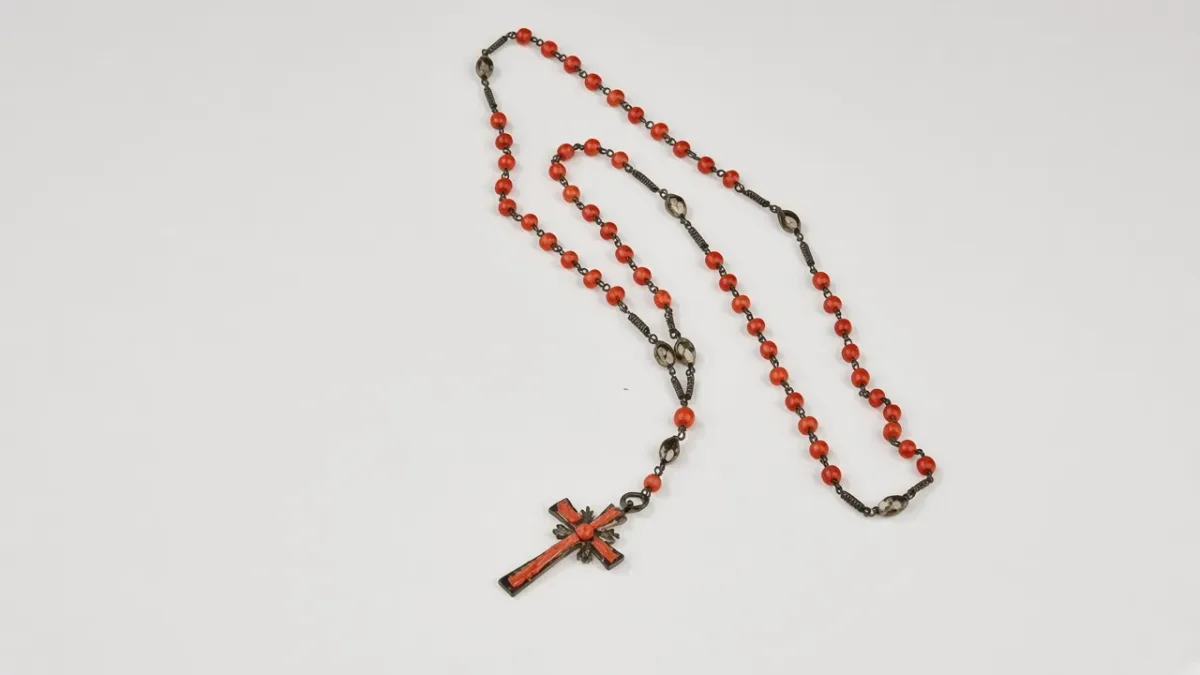
How to Identify an Authentic Italian Rosary by Beads and Medal
How to identify an authentic Italian rosary by beads, filigree and medals, and how later copies differ from Trapani, Liguria and Naples work.
An Italian rosary is a counting chain for the Marian cycle of prayers, not a necklace that happens to end in a cross. In inventories the object is a corona del Rosario. Five decades of ten Ave beads, a larger Paternoster between decades, a centre joining, and a drop of three beads plus crucifix is the ordinary modern layout. Earlier Italian examples can run to six or seven decades. The market prices the materials and the workshop, not the piety.
Dealers collapse several manufactures under one English phrase. Trapani coral mounted in gilt copper or silver is a seventeenth- and eighteenth-century liturgical trade. Ligurian silver filigree with wooden beads is a goldsmith's chain. Nineteenth-century beads cut at Torre del Greco are a coral industry that also supplied jewellery. Gold filigree with facetted coral, catalogued by the Victoria and Albert Museum as Spanish, is routinely offered as Neapolitan. Identification starts with construction, not with the word "Italian" on a ticket.
Construction before attribution
Count the decades with the object in the hand. Ten Ave beads of one size, a larger Paternoster, repeat. The drop below the centre should carry three beads and a crucifix or a medal. A loop opened and fitted with a modern clasp is a necklace conversion. A shortened chain shows mismatched links at the join.
Hand-drilled coral and wood show an off-centre hole and a diameter that varies from bead to bead. Machine-drilled later beads are concentric and identical. Wire-strung examples use thread or a fine silver wire through the holes. Chain-strung examples use a short link between each bead. A coral decade on machine chain with bright jump rings is a restring.
The centre is a medal, a filigree boss, a bow, or a ring. Italian silver medals of the eighteenth and nineteenth centuries are struck or chased, with a saint in relief and a worn rim. Later tourist medals are thin stampings with a sharp font and a ring soldered on as a separate eye. The crucifix may be wood with a metal corpus, silver filigree with a cast Christ, or metal arms inlaid with coral tablets. A corpus identical on both faces is a two-part mould of no great age.
Regional workshops
Trapani is the first name to test. The Museo Regionale Agostino Pepoli, in the former Carmelite convent beside the sanctuary of the Madonna of Trapani, holds the reference group of corallari work: chalices, ostensori, crucifixes and rosary crowns. Maria Concetta Di Natale has documented the shops from the fifteenth to the nineteenth century, including Matteo Bavera's gilt-copper lamp of 1633 in the Pepoli, signed and dated, with coral set by retroincastro, the older Trapani method of seating coral in metal from the reverse. White and blue enamel, coral rosettes, and gilt copper or silver grounds are Trapani traits. They are not a string of polished spheres. An exceptional Trapani rosary sold in Vienna in 2014 used gilt Ave beads with coral inlays, rock-crystal Paternosters, an ivory skull, and a Credo cross set with coral. That construction is a goldsmith's object with coral as inlay.
Ligurian filigree is a different grammar. The British Museum's Hull Grundy rosary of wooden beads on a gold chain with openwork filigree links (reg. 1978,1002.107) is catalogued with a Spanish query. The same record points to the Genoa exhibition catalogue Filigrana Ieri e Oggi (1973), no. 247: a silver rosary with similar filigree links spaced by wooden beads, given as Liguria, late seventeenth century. No. 246 in that catalogue, silver-gilt with beads and links both of filigree, is given as Spanish, eighteenth century. Drawn filigree is a western Mediterranean technique, not a proof of Italy. Liguria is the Italian reading when the beads are wood, the metal is silver rather than gold, and the links take the openwork forms of that Genoa plate.
Nineteenth-century coral beads from Torre del Greco are spherical or barrel-cut Corallium rubrum, drilled and polished in the town that became the Bourbon coral factory centre after Paolo Bartolomeo Martin's permit of 1805. They can be excellent coral and still be later than a Trapani liturgical corona. A medal struck in Naples, an 800 punch, and a machine chain put the object in the jewellery trade, not in the Pepoli group. Sicilian civic silver, including the punches of Palermo and Messina, may appear on a larger centre medal.
Sardinia produced a documented nineteenth-century type recorded in the Catalogo generale dei beni culturali: a silver chain alternating with blue glass-paste beads and an oval filigree medal holding printed images of St Philomena and St Vincent de Paul, in a neo-Gothic surround. Glass paste is not coral. A printed paper under glass is not a struck silver saint.
Spain remains the main misattribution. The V&A rosary acc. 741&PART-1890 is gold filigree with barrel-shaped facetted coral beads, five decades, gold filigree caps, and a gold filigree crucifix with a cast corpus. The museum places it in Spain, 1800–1880, and states that coral was the most popular material for Spanish rosary beads and that gold filigree is characteristic of that country. Facetted salmon-pink coral on gold filigree is a Spanish catalogue description until punches or a documented Italian workshop say otherwise.
What determines value
Maker and workshop come first. A Trapani corona that can be set beside Pepoli work, with retroincastro or gilt beads inlaid with coral, is a different object from an unsigned string of spheres. Ligurian filigree with wooden beads is priced as silverwork. Torre del Greco beads are priced as coral. A Sardinian glass-paste chain is priced as folk silver.
Period and region are linked. Seventeenth-century Trapani is scarce on the open market. Nineteenth-century coral and 800 filigree are not. A civic punch from Naples, Rome or a Sicilian office dates the metal, not the beads: beads are often later replacements on an older medal, or older beads on a later chain.
Material splits the field. Hand-drilled Corallium rubrum of even, deep colour is one market. Drawn silver filigree, not a soapy cast imitation, is another. Wood, jet, bone, amber, rock crystal and glass paste each have their own scale. Gold, as on the V&A Spanish example, sits above silver. Ivory on early Trapani terminals is both a dating clue and a legal problem.
Rarity follows completeness. Five intact decades, original Paternosters, a centre that belongs to the chain, and a crucifix that has not been swapped, matter more than a few extra grams of coral. Condition is read at the drill holes, the joins, and the corpus. Blown holes, mixed solder, a later tin corpus, nylon restringing, and silver polished bright against dry coral all cap the price.
Provenance moves the upper end. The 2014 Vienna Trapani rosary came from a Viennese private collection and was published against the Pepoli 1986 exhibition catalogue. Size is a narrow band. Pocket lengths of about 40 to 50 cm dominate later lots. The 75 cm Trapani example is an outlier because of the inlaid Ave beads and the reliquary reverse, not because it is longer.
Market demand is strongest for documented Trapani liturgical coral and for clean Ligurian or Sicilian silver filigree with original beads. Later 800 filigree and tourist coral sell as jewellery. Incomplete chains, dyed coral, and objects that cannot travel without a CITES paper sit lower.
Prices at auction
These figures are published sale results. They vary with condition, attribution and the day of sale. They are not a valuation of any private rosary.
Auktionshaus im Kinsky, Vienna, 101. Kunstauktion, 25 June 2014, lot 732: an exceptional rosary, Trapani, mid-seventeenth century. Gilt-copper and gilt metal, ivory and coral. Eighteen gilt Ave beads with coral inlays in the Trapani technique; eight Paternoster beads of cut rock crystal with small coral grains; an ivory skull hanger; a Credo cross set with coral; a large gilt engraved metal amulet with the Virgin in relief, the reverse a convent Klosterarbeit of relics with gold and silver bouillon. Length about 75 cm. Very good condition. Literature: Coralli talismani sacri e profani, Museo regionale Pepoli, Trapani, Palermo 1986, no. 86, p. 251. Estimate EUR 12,000–24,000. Hammer (Meistbot) EUR 15,000. Price including fees EUR 19,200.
Eastbourne Auctions, 3 September 2024: Italian 800 silver-gilt filigree rosary box and rosary, the necklace 46 cm, total weight 25.5 g. Hammer £180.
Wannenes, Genoa, Auction 228, 18–19 September 2017, from the collections of Ezio Governale: a silver and coral rosary, nineteenth century, with filigree elements, in the original case (the case damaged), length 44 cm. Estimate EUR 150–300. The lot page does not publish a hammer. The catalogue is useful as a type: later coral and silver, small money, organic-material notice.
Dorotheum, Vienna, Silver, 15 April 2025: two Sicilian rosaries, silver with mounted coral, one with a hanging cross, one with an enamelled saint, lengths 29 cm and 50 cm, probably Trapani, first half of the nineteenth century, small losses, plus a round silver-filigree lid box, diameter 5.5 cm. Starting bid EUR 400. The lot page does not show a realized price. The catalogue description is evidence of the later Trapani coral-and-silver type, not a published hammer.
Taken together, the published hammers support a split, not a single range. A documented seventeenth-century Trapani corona with inlaid Ave beads has sold at EUR 15,000 hammer. A later Italian 800 filigree rosary with its box has sold at £180 hammer. Unsigned nineteenth-century coral-and-silver examples are catalogued in the low hundreds of euros when a house publishes an estimate. Condition, workshop, and whether the beads and the metal belong together decide which band applies.
Authentic or later
Start with the beads and the joins, not with the ticket. Real Corallium rubrum is cold, slightly uneven in colour, with growth lines and a dull polish in old examples. Plastic "coral" is warm, identical, and often magnetic if the cores are steel. Dyed bone and bamboo show a pale interior when a chip is present. Glass paste, as on the Sardinian ICCD example, is a documented historical material. It is not a fake of coral unless it is sold as coral.
Tool traces on metal separate drawn filigree from cast imitation. Drawn wire has a seam or a die line along the grain; the scrolls are built and soldered. Cast "filigree" has a granular surface in the voids, identical repeats, and no solder joints between scrolls. A later Italian 800 punch on the crucifix or the medal is a genuine later object. It is not an eighteenth-century civic mark. Civic sequences for Italian silver are set out in the national hallmarks guide. A star lozenge is 1968 or later.
Wear should agree across the object. Beads that are matt and a chain that is bright have been apart. A crucifix whose corpus is sharp while the Ave beads are ground down at the holes is a swap. Patina in the recesses of a filigree medal, with high points rubbed, is expected. Plate powder in the punch puddle is not.
Typical reproductions are specific. Sanctuary stalls sold, and still sell, pressed-metal medals on glass or plastic grains; some are stamped "Italy" and are twentieth-century pilgrims' stock. Spanish gold-filigree coral rosaries are relabelled as Torre del Greco or Trapani. Nineteenth-century coral beads are restrung on new 800 chain and dated "circa 1780." Cast "Baroque" crucifixes with identical cherub terminals, magnetic clasps, nylon thread, and identical machine-cut beads are later.
Common mistakes follow those types. Taking gold filigree plus coral as proof of Naples (the V&A comparison is Spain). Taking any red bead as Trapani (Trapani liturgical coral is mounted in metal; a polished sphere is usually later cutting). Dating by the saint on a printed paper medal. Paying seventeenth-century money for a 44 cm coral-and-silver chain whose published comparables sit in the low hundreds of euros. Ignoring CITES: Corallium rubrum is a listed species, and a house will flag organic material, as Wannenes did in 2017.
A rosary that incorporates a small relic in the centre or the crucifix should be read with the same caution as a portable theca: a broken seal, a later glass, and a printed cedula are later assembly. Domestic shrines sometimes hang a rosary beside an ex-voto tablet. The two objects are catalogued separately.
Condition, law and export
Coral cracks across the drill hole. Silver chain kinks at the solder. Do not soak coral or dip the silver with the beads attached. Photograph both faces of the medal, the crucifix, a sample of drill holes, and any punch.
Italian cultural-heritage law can treat historic church furnishings as beni culturali. Export may need a licence. Canonical rules and CITES paperwork are separate questions. None of them replaces looking at the chain.
FAQ
How do I identify an authentic Italian rosary?
Count the decades, then look at drill holes and chain. Attribute by workshop: Trapani coral in metal, Ligurian silver filigree with wood, Torre del Greco cut beads, Sardinian glass paste. Gold filigree with facetted coral is a Spanish catalogue type until other evidence exists.
What is an antique Italian rosary worth?
A documented mid-seventeenth-century Trapani example sold at im Kinsky in 2014 for EUR 15,000 hammer (EUR 19,200 with fees). A later Italian 800 filigree rosary with its box sold at Eastbourne in 2024 for £180 hammer. Those are sale results for those lots, not a price for the object in hand.
Are Italian rosaries hallmarked?
Sometimes, on a silver medal or crucifix. Later pieces often carry 800. Unmarked filigree is common and is not by itself a fake. Absence of a punch is not a seventeenth-century date.
How do I tell Trapani coral from Torre del Greco beads?
Trapani liturgical work sets coral into gilt copper or silver, often from the reverse, sometimes with enamel. Torre del Greco supplied cut and polished beads. A string of spheres is the later trade unless the metalwork is independently Trapani.
Can a Spanish coral rosary be sold as Italian?
It is sold that way. The V&A's gold filigree and facetted coral example is catalogued as Spain, 1800–1880. Ask for punches, a workshop, and a reason the object is Ligurian or Neapolitan rather than Iberian.
A private sale, an insurance figure or an export file needs a written opinion from a specialist in Italian goldsmiths' work or coral, and a condition report that photographs the beads, the joins, the medal, the crucifix and any punch. Auction prices above are records of other objects. They do not value the rosary in hand.