
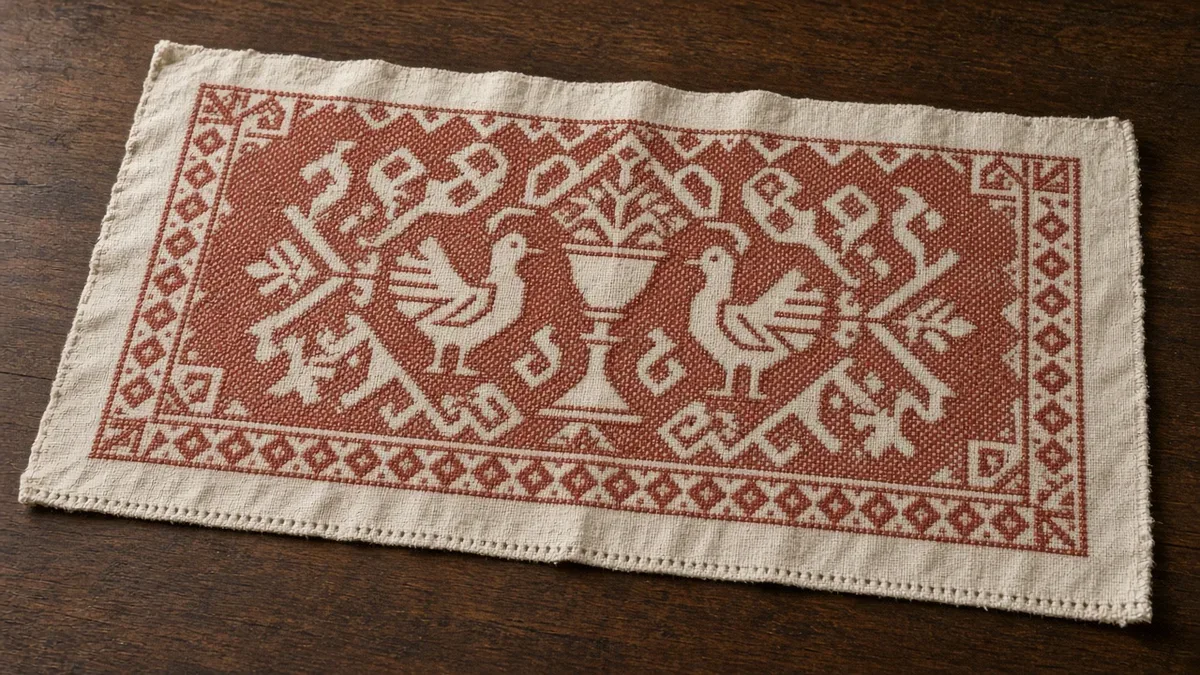
Dating Italian Antique Embroidery by Stitch, Ground and Workshop
Collectors date Italian antique embroidery by stitch, linen ground and workshop: Assisi voided work, Florentine Bargello chairs and Aemilia Ars.
Italian antique embroidery is dated first by how the needle meets the cloth, then by the cloth itself. Ricamo is thread worked on a woven ground. It is not merletto, which builds an open fabric from the thread alone. Collectors who confuse the two misread both Cantù bobbin lace and Burano needle lace. The working evidence is the filling stitch, the outline stitch, whether the ground is evenweave linen or canvas, and whether a workshop or pattern book can be tied to the piece.
Marks are scarce. Silver has punches; embroidery usually has a stitch vocabulary, a dye range, a hem, and, after about 1900, a paper label or inked workshop name. Revival work of 1898–1915 can be as carefully made as sixteenth-century linen. It is not a fake of that century. It is a later Italian product with its own archives.
Stitch and ground before colour
A counted-thread piece is worked over a counted number of warp and weft threads. The motif sits on the grid of the cloth. Free embroidery (gold orphreys, raised white work, liturgical needle-painting) ignores that grid. The distinction is the first dating cut.
Evenweave linen, often left in its natural colour, is the usual ground for Assisi-type voided work and for punto antico (drawn thread and cutwork on linen). Canvas, with a more open, regular mesh, is the ground for Florentine work: upright stitches packed in rows. A silk ground, or a linen so fine that individual threads cannot be counted by eye, points away from the village counted styles and toward professional or convent goldwork.
Hems date as clearly as fields. Traditional Assisi household linens finish in punto quadro (four-sided stitch) and often carry small tassels at the corners. A machine-rolled hem, a zigzag overlock, or a synthetic blend in the ground places the object after industrial sewing, whatever the motif.
Colour is secondary and easily misread. Vegetable dyes, including woad (Isatis tinctoria) for blue, remained in ordinary use into the nineteenth century. After that, synthetic reds and blues appear as even, slightly hard tones that do not sit in the fibre the same way. Revival Assisi work of the early twentieth century commonly uses a single cotton in rust-brown or blue on natural linen. Polychrome Assisi on a printed evenweave is almost always later still.
Pattern books and samplers of the sixteenth century
Italian embroiderers did not work only from memory. Printed libri di modelli appear in Venice within a few years of the first German pattern books (from 1523). Giovanni Antonio Tagliente (c. 1465–1528) issued Essempio di recammi at Venice in 1527; the Metropolitan Museum of Art holds a 1530 edition (object 35.75.3), published by Giovanni Antonio di Nicolini da Sabio and his brothers. The Met record notes a long passage on transferring designs onto cloth. The book is a dating tool in two directions. A motif that matches a Tagliente plate may be sixteenth-century, or it may be a philological copy made in Bologna around 1900. The stitch, the thread, and the ground decide, not the outline alone.
Physical samplers survive in smaller numbers than the books. The Victoria and Albert Museum keeps an Italian linen sampler of the sixteenth century, accession T.14-1931, 80 × 47 cm, embroidered in silk in back stitch and long-armed cross stitch. The museum describes such pieces as working records for experienced embroiderers, not school exercises. Dragons and flowers appear among the motifs. A collector offered a “Renaissance Italian sampler” should expect a comparable scale, a worn linen that has been rolled or folded for use, and stitches that match the period vocabulary. A bright cotton sampler with an alphabet and a date in Arabic numerals is a later European type.
Reticello (geometric cut-and-woven squares of rosettes and stars) is named in Cesare Vecellio’s 1591 pattern book, a point recorded on the cataloguing of an Aemilia Ars sample in the Italian state catalogue. Vecellio is a source for the word. Surviving reticello on a linen can still be sixteenth-century, seventeenth-century, or a revival copy. The catalogue entry for that Bolognese sample is careful to treat the stitches as a continuous Italian practice from the 1500s, not as a single dated object class.
Assisi: voided work and the laboratory of 1902
The stitch now sold as punto Assisi is a counted, usually monochrome method: the motif is left as a void of plain linen; the background is filled, most often in cross stitch; the contour is run in a darker thread, historically in Holbein (double running) or a related outline. The Accademia Punto Assisi, in the rooms of the first Assisi workshop, still specifies rust or blue cotton on natural evenweave linen, with punto quadro hems.
That vocabulary has medieval cousins. Voided animal pairs, scrollwork, and geometric grounds appear on Italian church linen from the thirteenth and fourteenth centuries. The modern product, and the name punto Assisi, belong to a documented revival. The Laboratorio femminile e Ricreatorio festivo San Francesco per le figlie povere del popolo in Assisi was inaugurated on 2 October 1902. The Sistema Archivistico Nazionale records the English promoter Harold E. Goad, Luigi Carloforti (parish priest of the Cathedral of San Rufino), a committee chaired by Count Antonio Fiumi Roncalli, rooms in the former Benedictine convent of Santi Giacomo e Donato, and management by the Istituto Figlie di Sant’Anna. A further Assisi committee of Le Industrie Femminili Italiane is recorded in 1905. Designs were taken from altar cloths, Giotto-cycle ornament, and other local stone and glass, then counted onto linen.
For the market this means a three-part chronology, not a single “Assisi look.”
A pre-revival voided linen, if it is that, should show aged vegetable-dyed silk or linen thread, irregular handspun ground, and wear consistent with liturgical or household use over centuries. Such pieces are uncommon in the trade and need a textile historian, not a pattern book photograph.
A laboratory or cooperative piece of c. 1902–1930 is the object most often met. Evenweave linen, one cotton colour (rust or blue), counted birds, chalices, and geometric borders, punto quadro hems, sometimes a paper label or an inked workshop name. Quality is high. It is Italian needlework of the early twentieth century, made for sale.
A later tourist or kit piece uses printed or heat-transferred outlines, stranded cotton in several colours, a coarse evenweave with an obvious grid, and a machine hem. The voided idea is the same. The construction is not.
Florentine canvas work and the Bargello chairs
English-language catalogues call a family of upright canvas stitches Bargello, Florentine work, or flame stitch. Italian inventories use punto unghero (Hungarian point) and punto fiamma. Encyclopaedia Britannica defines the work from a set of seventeenth-century Italian chairs in the Museo Nazionale del Bargello, Florence: flat vertical stitches laid parallel with the canvas weave, in gradating or contrasting colours, arranged in a wavy zigzag. The characteristic stitch was already called Hungarian stitch in the seventeenth century. The chairs are furniture with an embroidered skin. They sit in the same Florentine collecting field as walnut case furniture from Renaissance and grand-ducal workshops, and they are dated as both.
Origins are not settled. The Bargello inventory description (punto unghero) records what Florentine cataloguers believed, not a proof of Hungarian invention. Flame-stitch upholstery also appears on northern chairs of c. 1700. A dealer’s “Florentine Bargello, sixteenth century” should be treated with the museum’s own century in mind: the famous chairs are seventeenth-century. Earlier Italian canvas work exists, but it is not automatically those chairs, and it is not automatically Italian.
Identification is by stitch geometry. Each stitch is a straight, parallel unit covering a counted number of canvas threads, stepped left or right to form peaks, curves, or medallions. Tent stitch and cross stitch on canvas are different structures, even when the colourway imitates a flame. Wool on canvas is typical of seat furniture; silk on a finer canvas appears on smaller panels and later samplers. A printed flame on fabric, or a machine-made bargello knit, is not the technique.
Condition follows the furniture. Upholstered backs fade on the exposed face and remain stronger under the seat rail. Reupholstery on a period frame is common. The embroidery may be later than the wood. The wood may be later than the embroidery. Date each separately.
Aemilia Ars, punto antico, and the Bologna cooperative
Bologna’s Società Aemilia Ars was founded in 1898 under Alfonso Rubbiani, with Count Francesco Cavazza as administrative head and a paid-up capital of 15,000 lire. Storia e Memoria di Bologna, drawing on the Museo Civico del Risorgimento, records the 1902 Turin exhibition, the break-up of the original mixed-craft company in 1903, and the continuation of the lace and embroidery work as a women’s cooperative under Countess Lina Bianconcini Cavazza. Artistic direction passed from Rubbiani to Achille Casanova. Workers stitched at home. Design, preparation, distribution, and collection were centralised. Production value rose from 8,306.30 lire in 1900 to 209,411.50 lire in 1909. The cooperative took a Grand Prize at St Louis in 1904, a Grand Prize and Belgian government gold medal at Liège in 1905, and a Grand Prize at Brussels in 1910.
The stitch the house made famous is punto antico in the Bolognese sense: drawn thread, punto tagliato (cutwork), and reticello on linen, often combined with opaque stitches (punto reale, punto riccio, punto quadro). A four-strip linen campionario of 1900–1910, catalogued by the Italian state (HistoricOrArtisticProperty 0900134008) and linked to Palazzo Davanzati, Florence, shows those stitches in geometric fields, plus eucharistic emblems and a Sacred Heart. The name Lavinia Massi is embroidered on it, perhaps the maker. The catalogue notes derivation from older model-books (Pagani, Vinciolo) and cites Vecellio 1591 for the term reticello. That sample is a teaching and sales object. It is also a benchmark. A purported “sixteenth-century Bolognese cutwork” that matches the sample’s Liberty-adjacent floral taste, or that carries a cooperative label, is Aemilia Ars, not 1591.
Elisa Ricci, introducing Merletti e ricami della Aemilia Ars (Bestetti e Tuminelli, 1929), stressed design purity over French or Flemish softness. The remark is useful in the hand. Aemilia Ars linens are meant to lie flat so the counted architecture remains readable. Heavy gathering, or a ground of machine-made net, works against that intention.
Aemilia Ars needle lace is a neighbouring product, not the same as the linen embroideries. If the object has no woven ground, it is lace. Treat it with the lace literature, not as ricamo.
A later Tuscan school: Casalguidi
Casalguidi, in the province of Pistoia, developed a high-relief white embroidery on a light linen ground around 1900. Local accounts name Giuseppina Morelli and Camilla Amari as founders of the school. Adele Della Porta’s technical book appeared in 1915 and described a “marmoreal” relief on a very light ground. Pieces were shown at Milan in 1906 and at Turin’s Esposizione-Vendita di Lavori Femminili in 1914. The parish church of Santi Pietro e Paolo at Casalguidi holds examples associated with 1915. The local workshop history states that Amari’s role as inventor is oral, not documented. Catalogue notes should say the same. Motifs (figures, birds, Romanesque and Gothic capitals, fruit) sit in raised white stitch on an almost sheer linen. They do not look like Assisi voids or Bargello flames.
Labels, copies, and what is not evidence
Expect paper labels, inked names, or exhibition tags on cooperative work of 1898–1930. Aemilia Ars, the Assisi Laboratorio San Francesco, Industrie Femminili Italiane, and later local consorzi all used some form of identification. Absence of a label is normal; many were washed off. A printed “Assisi, Italy” on a coarse evenweave with a care symbol is modern retail.
Do not treat a motif match to Tagliente, Vinciolo, or Vecellio as a date. The revival houses used those books as sources. Do not treat a flame-stitch cushion as Florentine because the word Bargello is attached to a museum in Florence. Do not treat voided birds as thirteenth-century because a shop caption says “medieval Assisi.”
Machine copies are usually obvious in raking light: lockstitch on the reverse, chemically even colour, a ground with no selvedge and no hand-hem. More deceptive are recent hand-worked pieces on old linen. The ground can be antique; the stitch is not. Look at the hole pattern. New cotton on old linen leaves a fresh, slightly fuzzy puncture beside older, darkened needle holes if the cloth was previously worked. Unworked old linen is smoother, but the thread still looks new: round, unfaded, without the flattening of long abrasion.
Related woven furnishings are a separate market. A tapestry is a weft-faced cloth built on a loom, dated by warp, border and workshop marks, not by a needle.
Condition that affects price and use
Silk filament of the sixteenth and seventeenth centuries splits along the twist and powders. Cotton revival thread is tougher and often outlives its linen. Linen itself thin at folds, especially down the centre of altar cloths and table runners. Old rust dye can migrate. New rust dye can crock. Both should be noted; only the first is a dating clue.
Do not wash a piece to “see the colour.” Soluble gums, paper labels, and weakened silk do not survive a sink test. A raking photograph and a comparison with a museum sampler are the working method.
Upholstered Bargello is a furniture conservation problem. Replacing a shredded seat with a modern flame fabric changes the object. Dealers should state which they have done.
FAQ
How can Italian antique embroidery be distinguished from Italian lace?
Embroidery sits on a woven ground that remains visible in unworked areas. Lace has no such ground: the thread constructs the fabric. Assisi voids, Aemilia Ars cutwork on linen, and Bargello on canvas are embroidery. Burano punto in aria and Cantù bobbin work are lace.
What dates Assisi embroidery more reliably than the motif?
The 2 October 1902 opening of the Laboratorio San Francesco, the 1905 Industrie Femminili Italiane committee in Assisi, evenweave linen, monochrome rust or blue cotton, and punto quadro hems date the revival product. Motifs taken from Assisi churches were designed to look older than they are.
Are the Bargello Museum chairs the origin of the stitch?
They are the type-objects in English usage and the source of the name Bargello. Britannica dates that set to the seventeenth century and records the period name Hungarian stitch. The chairs do not prove a Florentine invention, and they do not date every flame-stitch panel to Florence.
Is early twentieth-century revival work collectable?
Yes, as dated Italian needlework with archives. Aemilia Ars has exhibition medals and named directors. Assisi has a SAN-recorded laboratory. Casalguidi has a 1915 manual. Catalogue the span (1898–1915, or the relevant workshop years), not “Renaissance style,” unless the revival is stated in the same sentence.
What is the most common mistake in descriptions?
Using a pattern-book match as a century. Tagliente (1527/1530) and Vecellio (1591) were used again by Aemilia Ars and by the Assisi schools. Stitch, thread, ground, hem, and label outweigh the outline.