
Burano Lace: History, Punto in Aria & Collector's Guide
Identify antique Burano lace by punto in aria, the 1872 school revival, and handmade versus machine stitches. A collector identification guide.
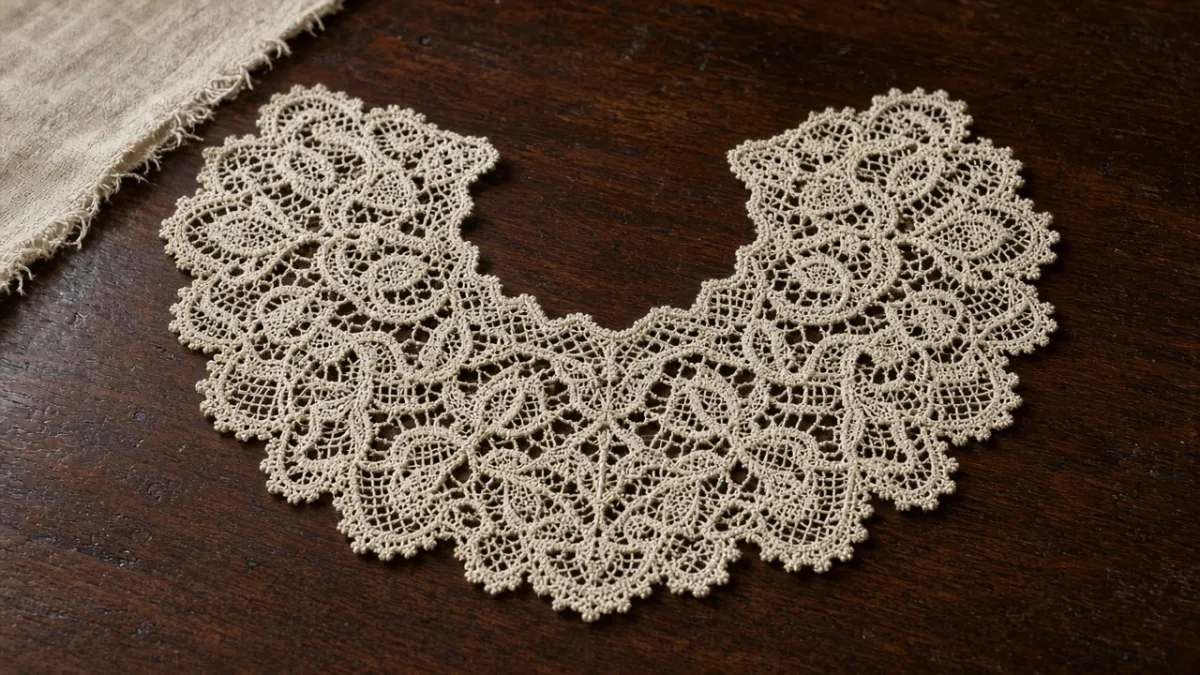
The surest way to identify antique Burano lace is not a postcard of coloured houses, but a stitch. True Burano work is needle lace: a fabric built in the air with needle and thread, not woven on a pillow with bobbins. The island’s own ground — punto Burano — is a net of tiny rectangular meshes that look, under a loupe, like a run of miniature ladders. Punto Venezia, the older companion stitch, joins motifs with buttonholed bars (sbari), often spiked with picots. Both are punto in aria: stitches in the air, made without a woven cloth left in the finished piece.
This guide is for collectors who need to separate that tradition from the machine-made and imported lace sold on Burano today. Bobbin lace from Pellestrina and the commercial reproductions sold by firms such as Jesurum belong in neighbouring files. What follows is the sequence the civic museum on Piazza Galuppi still teaches: Renaissance reticello, Baroque raised gros point, the eighteenth-century Burano mesh, and the 1872 school that copied all of them for European courts.
Needle lace, not souvenir net
In Italian, merletto, pizzo, and trina are near-synonyms for textiles made from nothing: stitch stacked on stitch with a needle, or threads plaited from wooden bobbins (fuselli). The Museo del Merletto, in the former Palazzo del Podestà on Burano, is explicit about the distinction. Needle lace has matericità — a built-up, almost sculptural surface. Bobbin lace is valued for lightness. Burano’s fame rests on the first.
The working kit is small. A design is basted onto stacked layers of cloth and paper (the orditura). That sandwich sits on a wooden cylinder, the murello, which rests on a stuffed cylindrical cushion, the cuscinello. The lacemaker builds the decorative filling (ghipùr in the museum’s Venetian spelling), then the ground, then any raised outline. When the work is finished she turns it over, cuts the basting, and tweezes away the paper. Nothing of the support remains. The Metropolitan Museum of Art describes the same shift in early Venetian punto in aria: once workers laid a pattern on parchment instead of cutting into a woven cloth, curves and free foliage became possible. Geometric reticello — embroidery on a grid of withdrawn warp and weft — is the ancestor, not the finished Burano product.
Materials changed with fashion and cost. Historic pieces used very fine linen, sometimes silk, gold, or silver; from the twentieth century the school listed mercerised cottons. A “linen” label on a tourist collar is not proof of age.
Burano is one island in a city of luxury trades. Glass belongs to Murano and a different guild; start with our Murano glass history and authenticity guide rather than treating a millefiori paperweight as evidence for a lace stitch. Table silver from the same lagoon is a mint problem, not a textile one: see Venetian silver hallmarks.
From modellari to gros point
Sixteenth-century Venice printed hundreds of modellari — pattern books of lace and embroidery designs — for noblewomen working at home. Early borders were geometric: necklines, handkerchief corners, arabesques. By the late century, monasteries, orphanages, and charitable workshops were producing for a market that cloth and convent labour could no longer supply. Isolated female communities, Burano among them, became industrial in all but name.
The seventeenth century is the lace century. Flanders, Milan, and Genoa specialised in bobbins. Venice made needle lace that European courts treated as a hard currency. The civic museum’s typology is still the one auction catalogues use: punto Venezia tagliato a fogliame a grosso rilievo — gros point de Venise in French inventories — from about 1650, with foliage padded into high relief; a flatter punto Venezia without the stuffing; punto rosa from about 1680, motifs miniaturised and stacked until they read like snow crystals; and punto corallino, twisting branches inspired by coral.
The cost of this work helped push France into import substitution. In 1665 Jean-Baptiste Colbert established a royal manufacture of points de France, bringing Venetian and Flemish workers into centres such as Alençon and Sedan with a ten-year monopoly. Venice’s reply, in the museum’s account, was still more virtuosic needle lace — especially punto rosa.
By the eighteenth century taste had shifted toward the light Flemish nets. Venetian needle workshops answered by enlarging the ground into an extremely fine mesh, with measured floral elements seeming to float in it. That ground is the invention called punto Burano: a lattice of minute rectangular meshes, like vertical sequences of ladder rungs, distinct from the bar-and-picot network of punto Venezia. It is the stitch collectors should look for when a dealer says “Burano” and means the island’s own eighteenth-century type, not Venetian needle lace in general.
The Republic’s fall in 1797 removed the court and guild economy that had paid for months of work. Revolutions in America and France had already made lace a political costume. Production dwindled into family work and church linen. Mechanical lace, cheaper and “apparently just as beautiful” in the museum’s dry phrase, finished the commercial argument — until a winter on the lagoon forced a revival.
The 1872 school
The winter of 1871–72 froze the lagoon and stopped the fishing that fed Burano. Countess Andriana Marcello, born Andriana Zon in 1839, widow of the Venetian mayor and parliamentarian Alessandro Marcello, had already begun promoting a lace revival. With the deputy Paolo Fambri she found the last islander who still commanded punto in aria. Venetian sources name her Vincenza Memo, known on Burano as Cencia Scarpariola; Treccani records her as the last keeper of the punto buranese. She did not “invent” Burano lace. She transmitted a stitch that had almost left the island.
Period accounts say she taught the elementary-school mistress Anna Bellorio d’Este, who taught her daughters and a first group of girls. The Scuola dei Merletti opened in the old Palazzo del Podestà on Piazza Galuppi — the building that is now the museum. The Fondazione Andriana Marcello, which later owned the collections, gives enrolment figures: eight pupils in 1873, 250 by 1878, 310 by 1890. Girls entered at twelve; later Venetian reportage describes six-hour winter days and seven in summer.
The school’s commercial engine was patronage, not tourism. Andriana Marcello was for twenty-five years a lady-in-waiting to Queen Margherita of Savoy. The queen lent patterns; royal and aristocratic orders followed — names repeatedly attached to the school include the Princess of Saxony, the Duchess of Hamilton, Countess Bismarck, Princess Metternich, Queen Emma of the Netherlands, and Margherita herself. The foundation records two shops on Piazza San Marco and further outlets in other European capitals. After Andriana’s death in 1893 her son Girolamo, then later generations, kept the enterprise alive through what became the Fondazione Andriana Marcello.
Technically the revival was conservative by design. The civic museum states that decoration was taken from past repertories: every historic type was reproduced, often with greater mechanical precision than the originals. Art Nouveau and Art Deco renewals remained modest. The Victoria and Albert Museum’s linen stole from the school, with irises and lilies of the valley on a light mesh, shows that by the 1890s contemporary floral designs were also in production — still needle lace, still school work, not a return to seventeenth-century gros point. Christie's has catalogued the more typical commercial form: a late-nineteenth-century Burano needlelace bertha of scrolling flowers on a mesh ground, with mixed fillings and couronnes, plus a matching deep flounce.
Michelangelo Jesurum’s factory and school on Pellestrina, founded in the 1870s, is a parallel, not a synonym. The V&A notes that Jesurum et Cie sold Burano needle lace alongside its own bobbin lace and reproduced antiques. A Jesurum silk bobbin dress-front is lagoon lace; it is not Burano punto in aria. Keep the islands straight.
Fashion, the First World War, the cost of handwork against machine lace, and competition from other Italian centres hollowed the school out. After 1945 it made smaller accessories and souvenirs. The museum dates the Scuola 1872–1970; the Marcello Foundation records closure in 1972. A consortium of Venetian public bodies and the foundation reorganised the archive from 1978 and opened the Museo del Merletto in 1981. It entered the Musei Civici di Venezia in 1995. Lacemakers still demonstrate in the galleries. Documentary drawings and the Cini, Grassi, and Jesurum textile holdings used by scholars sit largely at Palazzo Mocenigo, the civic costume museum at San Stae.
How to identify a genuine piece
Work in this order, with a 10× loupe, before you wash or press anything.
1. Name the technique. Needle lace is built with buttonhole (festoon) stitches. Bobbin lace shows plaited pairs and pin-prick holes along a pillow pattern. Irish crochet is a different loop altogether. If the ground is a mechanically regular hexagonal tulle, you are usually looking at machine net, not punto Burano.
2. Read the ground. Punto Burano: tiny rectangular meshes in ladder-like rows. Punto Venezia: connecting bars, plain or with picots. A raised, padded outline (cordonnet, gros point) is compatible with Venetian needle lace of several periods; it is not, by itself, a Burano island mark.
3. Treat irregularity as a clue, not a verdict. Hand needle lace never repeats a mesh with machine perfection. High-grade school pieces of 1872–1970 can look almost too even, because the revival prized precision.
4. Turn the piece over. Fine needle lace is worked as a construction, not as embroidery sitting on a net. A separately woven machine ground with motifs appliquéd or satin-stitched on is a hybrid or a souvenir. Dealer literature on the contemporary island trade is blunt: much of what is sold as “Burano” is machine-made, imported, or machine-drawn with a little hand finishing.
5. Match style to date. A seventeenth-century gros point collar should have sculptural foliage and a heavy cordonnet, not a light eighteenth-century mesh. An 1890s school stole may use historic stitches on a contemporary floral. A “Renaissance” tablecloth with a 1970s cotton look and a fused edge is costume.
6. Price the hours, not the island. A small handmade motif takes days; a bertha or flounce takes months. If the price is that of a printed scarf, the method is industrial. Auction costume sales still see late-nineteenth-century Burano needlelace as identifiable lots; they do not treat every lace collar in a Venetian shop as school work.
7. Ask for a workshop name. Surviving merlettaie and the museum shop are the practical sources for new handmade work. For antiques, provenance (school labels, family inventories, V&A- or MUVE-comparable technique) beats a “Burano” hang-tag.
Fakes, machines, and “Burano style”
There is no punch like a silversmith’s lion. Fraud in lace is commercial, not numismatic. The usual failures are:
- Machine lace with a perfectly repeating pattern, uniform tension, and heat-cut or chemically stiff edges.
- Imported lace retailed on the island under a Burano label.
- Tape lace and chemical lace (motifs sewn to a fabric that is then dissolved) sold as needle lace.
- Revival copies that honestly reproduce gros point or punto Burano but date to the school or later — valuable as 1872–1970 craft, misdescribed if called seventeenth century.
- Over-washing and sunlight, which weaken linen and cotton and flatten raised work. Store flat, away from windows; avoid tight folds that cut the mesh.
Church linen — albs, altar frontals, rochets — is a specialist category. Export and conservation rules are stricter than for a collar. Treat liturgical lace as you would documented church plate in our Italian silver hallmarks guide: a heritage object, not decorative filler.
What to collect, and where to look
Train your eye at the Museo del Merletto before you buy on Via Baldassarre Galuppi. The museum hangs more than two hundred Venetian and lagoon pieces from the sixteenth to the twentieth century, with a room for the 1872–1970 school. Morning visits often include a lacemaker at the cuscinello. Palazzo Mocenigo holds related study collections; the V&A and the Met give international types against which a private piece can be compared.
In the trade you will be offered late-nineteenth- and early-twentieth-century collars, berthas, cuffs, and flounces in the school’s historicising taste, plus smaller modern motifs. Seventeenth-century gros point of museum quality is scarce. For how such textiles sat in a palazzo, among walnut, lacquer, and inlay, see our antique Italian furniture guide. Hardstone inlay is a different luxury language: Florentine pietra dura.
Do not treat “Italian lace” as one category. Cantù in Lombardy is bobbin; Pellestrina is bobbin; Burano is needle. Mixing them in one drawer is how attributions dissolve.
FAQ
What is the difference between Burano lace and Venetian lace?
Venetian lace is the wider family of lagoon needle and bobbin work. Burano lace, in museum language, is needle lace from the island, especially the punto Burano mesh ground invented in the eighteenth century and revived after 1872. Dealers often say “Venetian” for any Italian needle lace with bars and picots. Ask which stitch and which island.
Is punto in aria the same as punto Burano?
No. Punto in aria is the method: needle lace built off a temporary pattern, without leaving woven cloth in the work. Punto Burano is one ground used inside that method — the fine rectangular net. Punto Venezia is another: bars rather than mesh. Both are punto in aria.
Did the 1872 school make antique-looking lace?
Yes. The civic museum states that it copied historic types, often more regularly than the originals. A school collar can look “seventeenth century” and still date to 1880. Date by thread, fashion shape (bertha, rabat, stole), and any documented school provenance, not by motif alone.
How can I tell handmade Burano lace from machine lace?
Look at the ground stitch by stitch. Handmade needle mesh is constructed; machine net is knitted or twist-woven in a rigid repeat. Check the reverse for a separate net with applied motifs. Then look at the price and the seller. Cheap lace on the island is not a bargain punto in aria.
Who was Cencia Scarpariola?
Vincenza Memo, called Cencia Scarpariola, was the elderly Burano lacemaker Andriana Marcello and Paolo Fambri sought out in 1872 as the last local keeper of the needle stitch. Her name on a modern label is marketing unless the work is documented.
Is Jesurum the same as Burano lace?
No. Jesurum ran a bobbin-lace school on Pellestrina and also sold Burano needle lace. A marked Jesurum bobbin piece is not Burano punto in aria.
Conclusion
Antique Burano lace is a stitch problem before it is an island problem. Learn punto in aria as a method, punto Burano as a rectangular mesh, and punto Venezia as a bar ground, and remember that the 1872 school spent a century copying both. Then a cream collar becomes readable: needle or bobbin, mesh or bars, seventeenth-century relief or Margherita-era revival, handmade hours or machine net. Without the stitch, you are buying a souvenir. With it, you are in the tradition the Museo del Merletto was opened in 1981 to keep from vanishing a second time.