
How to Identify Cantù Lace by Tombolo Grounds and Workshop
Identify antique Cantù lace by bobbin construction, cartina pinholes and classic grounds. Separates handmade Lombard work from machine imports.
Antique Cantù lace is bobbin lace. The collector’s first test is mechanical, not geographic. If the textile was built with a needle on a paper sandwich, it is not Cantù work, even when a dealer files it under “Italian lace” or “Venetian type.” Cantù, Carimate, Novedrate and the neighbouring Brianza villages produced merletto a tombolo: pairs of threads wound on wooden bobbins, crossed on a cylindrical pillow, and pinned to a pricked paper pattern.
The place-name is a market term as much as a workshop address. Regione Lombardia’s intangible-heritage record is explicit. Lace made in many houses was gathered at one selling point, and that point gave the product its name. A piece can be “pizzo di Cantù” without having been worked inside the town walls. Attribution therefore rests on construction, stitch family and, when luck holds, a manufacture label, not on a souvenir stamp.
This guide is for dating and sorting tablecloths, insertions, altar laces and dress trims from the late nineteenth century through the first half of the twentieth, the period that put Cantù on the luxury market. For the needle-lace tradition of the lagoon, use the separate Burano lace identification notes. Cantù’s own art school trained furniture makers and lacemakers in the same building; the town’s other trade is outlined in our Italian furniture identification guide.
Bobbin structure, not a postcard of Como
English catalogues often fold Cantù into “Milanese lace.” That label is only half useful. Punto Milano antico is one family inside the Canturino repertoire. Lombardy’s ENAPI lace catalogue, published by the Italian Ministry of Culture, lists several others: continuous-thread lace; punto Venezia, also called Cantù classico; punto mimosa; punto Rosalin; punto ornato. A braid lace with Milan stitches is consistent with the region. It is not, by itself, a Cantù attribution.
The working kit is local and consistent. Threads of cotton, linen or silk are wound on bobbins, i oss. The support is a cylindrical cushion stuffed with straw or horsehair, ul cussin, set on a trestle (ul pundin) and held at an angle by a wooden board (la tapparèla). The design is drawn on a card, the cartina, then pricked, spuntata, along the motif lines. Pins (gügitt) hold the work to those holes. A fine hook of 0.40–0.60 mm (ul crüscè) is used at joins. Three trades share the object: the disegnatrice who designs the card, the spuntatrice who punches it, and the merlettaia who works the pillow.
Those pinholes remain after the lace is lifted. Under a loupe they sit at turns, junctions and the tips of leaves. Machine nets and chemical laces do not carry that pin sequence. Paired threads that enter a cloth-stitch stem and leave it again are likewise a bobbin signature. Needle lace builds a buttonholed cord, not a pair of bobbins.
What “classic Cantù” looks like
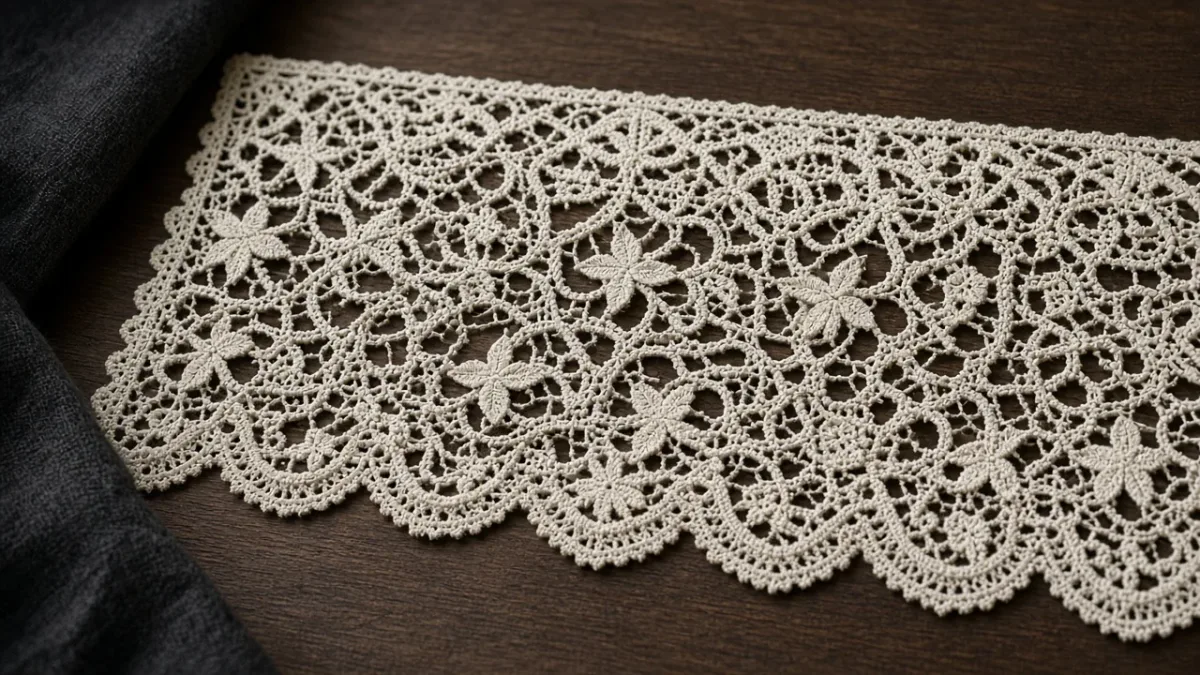
Practitioners still treat punto Venezia / Cantù classico as the school’s representative manner. The typical vocabulary is a cloth-stitch stem, a curl that branches from it (ricciolo), a small flag-shaped leaf (bandierina), and a three-petal flower sometimes called a stella. The stem and flower are commonly worked with eight pairs; the curl and leaf with five. Side petals stay in cloth stitch (punto tela); the central petal and the bandierina shift to a twisted diagonal stitch. A raised cord (cordetta) often rides the outer edge of the stem.
Do not treat that recipe as a dating stamp. It is a grammar. Large tablecloths mix classic motifs with punto Milano braids, torchon or honeycomb grounds, and separately worked pictorial inserts. The Smithsonian National Museum of American History holds a cotton tablecloth insertion, about 1900, made in Cantù for export. Animal and flower motifs are worked in a finer thread than the surrounding lace. The catalogue notes that animals were started at the outer points and worked inward, a sequence that keeps tips clean and supplies extra pairs for the wider body. Long panels measure 100 by 11 inches (254 × 27.9 cm); the cross panels 23½ by 17 inches (59.7 × 43.2 cm). There is no sewing edge where the pieces meet. That construction, two thread weights on one object, and an inward working order, is more diagnostic than any floral “look.”
Earlier Milanese-type braid lace of the late seventeenth and early eighteenth centuries is a different file. It was made across northern Italy, often for the Church, and is hard to localise. Collectors meeting a baroque scrolling braid with a heavy outlining cord should not relabel it “Cantù” because the town later used related stitches. The Cantù product that reaches the market in volume is revival and manufacture work from roughly 1880 to 1950.
Dates that can be documented
The eleventh-century foundation story, Agnese of Burgundy teaching Cluniac nuns at Santa Maria di Cantù, comes from Carlo Annoni’s 1835 notes on the town. It is a local tradition, not an archaeological date. Punto Cluny enters the Cantù repertoire only in the mid-nineteenth century, from a seventeenth-century Genoese model preserved at the Musée de Cluny in Paris, not from a medieval convent. The earliest secure references to bobbin work in the Milanese hinterland belong to the late fifteenth century. Organised teaching to lay girls is placed in the seventeenth century by the ENAPI catalogue: Benedictine nuns of Santa Maria instructing townswomen who then bartered lace for food. Early-nineteenth-century counts, recorded by AESS, put about seven hundred women in Cantù making edgings of every width.
Machine lace in the late eighteenth and nineteenth centuries collapsed the luxury trade across Europe. The Lombard revival concentrated on Cantù and Carimate. Two institutional facts matter for labels. On 22 December 1882 the Ministry of Agriculture, Industry and Commerce decreed the Scuola d’Arte applicata all’industria. A women’s course in lace design opened in 1888. In 1920 the school became the Regia Scuola Professionale del mobile e del merletto, with workshops. In 1900 the Manifatture Riunite Merletti, called il Butegun by the workers, reorganised putting-out: the manufacture issued cartine and thread; the merlettaia worked at home.
Local firms named in secondary accounts of that putting-out system include Tagliabue, Frigerio, Meroni and Colombo. Surviving paper labels, ink stamps on a cartina, or a manufacture envelope with a tablecloth are stronger evidence than a verbal “Cantù” from a later dealer. AESS still records pattern holdings at the Cooperativa Produzione Merletti, Manifattura Giorgio Galbiati, Manifattura Genoveffa Molteni and Manifattura Marelli. A matching cyanotype or pricked card in one of those funds can confirm a design even when the textile itself is unsigned.
The first half of the twentieth century produced the objects that made the name internationally: tablecloths, curtains, bedspreads and liturgical vestments for a luxury market that treated a recognisable Cantù manner as a quality mark. In 1931–34 Giorgio Wenter Marini taught drawing and directed the royal professional school. Fausto Melotti, later the school’s namesake, taught there at the beginning of the 1930s. AESS distinguishes those years’ figurative and geometric merletti d’arte, designed with architects and artists, from the older stitch families. An Art Deco or abstract table lace from Cantù is not a fake classic. It is a later school product and should be dated to the 1930s–40s, not forced into a seventeenth-century Milanese box.
After the last war the economic weight of the craft fell. Commercial houses still trading the name now deal largely in imported lace, as the regional record states plainly. Handmade production continues in schools and associations, often from old cartine re-pricked. Post-1980 amateur work can be technically excellent. It is not “antique Cantù” in the manufacture sense.
Handmade, imported and machine copies
The trade name is now promiscuous. Goods sold as “Pizzo Cantù” may be imported machine lace cut to a Brianza pattern. Identification is a short physical exam.
Handmade bobbin lace shows pinholes at turns; pairs of threads that can be followed through a stem; variation in tension from row to row; and a ground that changes stitch when the design requires it. Joins made with the hook leave a small, slightly irregular stitch, not a factory overlock. Cloth stitch looks like woven linen; half stitch and twisted grounds look like an open mesh whose threads still travel in pairs.
Machine lace of the late nineteenth and twentieth centuries repeats a motif with mechanical identity. Mesh size does not wander. There are no pinholes, or the holes sit on a regular grid unrelated to a pricked cartina. Chemical or “burnt-out” laces leave a faint fabric residue or a plasticky stiffness. A perfectly even torchon ground under a slavish copy of a stella is a warning, not a masterpiece.
Imported handmade lace is harder. AESS notes that contemporary firms still commission work abroad from Cantù drawings. A late cartina worked in a non-Lombard thread, with a different pillow habit (flatter cushion, different pin angle), can look “classic” in photograph and still be a recent commission. Thread fibre helps. Historic export pieces are usually fine cotton or linen; some dress laces use silk. Bright optical-white cotton with a modern mercerised shine, combined with a paper label printed after 1980, should be dated as contemporary even if the design is old.
Condition is not a dating tool by itself. Il Ponte offered a nineteenth-century handmade Cantù tablecloth, 260 × 240 cm, floral ramage with a central field and a rose border, at €10,000–12,000 in October 2015. A stained example of similar size can fall to a few hundred euros at a later house sale. Brown oxidation along folds, broken cordette, and later machine repairs in the ground are common. Record them. Do not “restore” a broken braid by stitching it to a new net unless the object is being used; the repair will read as a later campaign.
Collections and what they prove
Public holdings useful for comparison sit at the Musei Civici Paolo Giovio in Como, the Museo Poldi Pezzoli in Milan, and the historic collection of the Liceo Artistico Fausto Melotti in Cantù. The Museo Didattico della Seta in Como published, with Enaip Lombardia, Carlotta Bianchi and Mariangela Montorfano’s 1999 monograph Pizzo di Cantù: il merletto a fuselli nell’Alta Lombardia, still the regional reference. The Comitato per la Promozione del Merletto has organised an International Biennial of Cantù Lace since 1993 (the committee itself dates from 1992). A planned Museo del Mobile e del Merletto at Villa Calvi is not yet a study room; do not cite it as if the collections were installed.
In 2021 Rita Bargna received a European Heritage Award for teaching at Capiago Intimiano and later at the Associazione Merletti d’Arte, and for a private collection of more than 3,000 European laces, including some 300 of her own. Her Punto Mosaico and three-dimensional experiments are late-twentieth-century inventions. They document the living school. They do not authenticate a 1900 tablecloth.
Cantù’s other craft, furniture, shares the 1882 school and the same patronage network. A lace tablecloth in a Brianza interior often sits with walnut case pieces whose construction is discussed with Maggiolini and Lombard marquetry. The two objects do not date each other, but a matched household group can support a regional provenance that a single textile cannot.
A working sequence for one object
Lay the piece flat. Identify fibre and thread weight. Follow one pair through a stem. Count pairs at a flower or leaf if the work is classic. Look for a second, finer thread in pictorial inserts. Map the ground: empty bars, torchon, honeycomb, or mixed. Search the outer edge and any linen insertion for a manufacture stamp, a stitched inventory number, or a remnant of the cartina. Compare motif and scale with a museum or Biennial catalogue photograph, not with a tourist postcard. Then, and only then, write “Cantù” on the file card. If the structure is needle lace, send the object to the Burano file. If it is a seventeenth-century Milanese-type braid without manufacture context, leave the town name off.
FAQ
Is Cantù lace the same as Milanese lace?
No. Punto Milano is one stitch family used in the Canturino area and elsewhere in northern Italy. Cantù manufacture work also uses punto Venezia (Cantù classico), mimosa, Rosalin, ornate grounds and continuous-thread constructions. English “Milanese lace” usually means the earlier braid style, not a Cantù firm.
How can I tell handmade Cantù from machine lace?
Pinholes at turns, paired threads in cloth stitch, and small irregularities in the ground indicate bobbin work. Mechanical identity of every repeat, a grid mesh, chemical stiffness, or the absence of pairs indicate a machine. A printed “Pizzo Cantù” label does not settle the question.
What dates should I expect on the market?
Most tablecloths and insertions offered as antique Cantù date from about 1880 to 1950, with a concentration in the first half of the twentieth century. Seventeenth-century Lombard braid lace exists, but secure town attributions are rare. Work after about 1980 is usually school or association production, sometimes from old patterns.
Do pieces carry marks?
Often they do not. When they do, look for a manufacture label, an inked cartina number, or a firm name associated with the putting-out system. Workshop paper in Galbiati, Molteni, Marelli or Cooperativa funds can confirm a design. The lace itself is rarely signed by the merlettaia.
How does Cantù differ from Burano?
Cantù is bobbin lace on a tombolo. Burano lace is needle lace (punto in aria), built without bobbins. The two towns are not interchangeable sources. A raised buttonholed cord and a rectangular punto Burano mesh belong to the lagoon, not to Brianza.