
Dating Antique Italian Tapestries by Weave, Border and Marks
Dating antique Italian tapestries by weave, city marks and borders, from Ferrara and Florence workshops to Barberini Rome and Bourbon Naples.
An Italian tapestry is a weft-faced hanging woven on a loom, not a printed textile and not needlework. In Italian inventories the object is an arazzo or panno. The workshop that produced it is an arazzeria. Most tapestries that hung in Italian palaces were not woven in Italy. From the fifteenth century the Este, Medici, Gonzaga, and papal courts bought Brussels and other Netherlandish weaves in quantity. Local manufactories were court projects, staffed at the start by Flemish licciai, and they remain the minority of what appears on the market.
Dating therefore begins with a negative test. A biblical or mythological hanging found in an Italian collection may be Flemish, French, or later. City marks, weaver marks, cartoon style, and border construction decide the question. The marks sit in the selvage. Later slips and rewoven edges often remove them.
Construction before marks
True tapestry is built from a linen or wool warp and a discontinuous weft of wool, with silk reserved for lights and faces. Metal-wrapped gold and silver thread appears on the most expensive court pieces. It is a quality mark, not a city mark. Each colour area is woven separately. Vertical junctions leave slits that were sewn on the loom or later. Those joints, and the rib of the warps seen on the face, distinguish an arazzo from embroidery, from punto work such as Burano needle lace, and from a painted canvas mounted as a hanging.
Italian workshops used two looms. Alto liccio (high-warp) sets the warps vertically. Basso liccio (low-warp) sets them horizontally, with the cartoon often reversed beneath the warps. The distinction is documented in contracts. It is not a reliable field test from the face alone. What can be read on the object is sett (warps per centimetre), the relative wear of silk and wool, and whether the border is continuous with the field or a later attachment.
Silk fails first. Highlights on faces, hands, and architecture abrade to the warp. Nineteenth-century restorers often rewove those losses in aniline colours that now stand apart from the faded original. The Opificio delle Pietre Dure, which treated the Joseph series from Palazzo Vecchio, distinguishes integrative reweaving of missing warps and wefts from a conservative lining that leaves losses visible. Reconstructed narrative passages change the object.
City marks and weaver marks
Brussels regulated marking. A 1528 city ordinance, confirmed by Charles V’s 1544 edict for the Netherlands, required a town mark and the principal weaver’s mark on tapestries larger than six ells. The Brussels device is a red shield flanked by two B’s, usually in the lower selvage, with the weaver’s monogram at the side.
Florentine weavers adapted that practice. On Medici-period hangings the town mark is often the letters FF, read as Factum Florentiae or Fatto a Firenze, placed where a Brussels shield would sit. Jan Rost used a rebus of his name, a roast on a spit. Nicolas Karcher used a monogram, and he used it sparingly. Later directors signed more explicitly. Guasparri di Bartolomeo Papini, who ran the Piazza San Marco workshop from 1588 to 1621, left a condensed mark that Lucia Meoni has read as Factum Florentiae Papini. A Christie's Gathering of Manna of about 1595–96, after Alessandro Allori, still carried a fragmentary Florence town mark and weaver’s initials in a turned-over lower slip.
Ferrarese court weaves of the mid-sixteenth century are more explicit. The eight Storie di San Giorgio e di San Maurelio in the Museo della Cattedrale, Ferrara, are inscribed FACTUM FERRARIÆ and carry Giovanni Karcher’s monograms. Nello Forti Grazzini published the contract of 15 October 1550 in the Archivio di Stato di Ferrara: Karcher bound himself to weave the set in two years, in good wool and silk, from cartoons “facti per magistrum Benvenutum de Garofalo, et magistrum Camillum de Filippis,” with large borders painted by Luca d’Olanda. Two panels are dated 1553. Those inscriptions are primary evidence, not later labels.
Roman private and papal workshops used emblems rather than a civic FF. The Barberini manufactory, founded in 1627 by Cardinal Francesco Barberini, wove the family bee into borders, cartouches, and sometimes the field. Giacomo della Riviera (Jacob van den Vliete) marked early pieces. After that workshop closed in 1683, Clement XI Albani established the only tapestry works of the Papal States at the Ospizio di San Michele. The factory mark is the insignia of Saint Michael the Archangel. Jean Simonet directed the looms at the start; Pietro Ferloni succeeded him in 1717. Small religious panels, often papal gifts, are frequent. A later orange or terracotta outer slip is not a factory mark. It is a mounting.
Absence of a mark is not proof of Italian work. Many Flemish weaves have lost their selvages. Many Italian weaves never received a full civic device. Marks must be read with cartoon style and border construction.
Borders as a dating tool
Borders are easier to see than selvage letters and they change with the workshop.
Ferrarese mid-century borders are wide, secular even on sacred subjects, and packed with fruit festoons, ribbons, and putti. Luca d’Olanda, who had worked with Giulio Romano at Palazzo Te, supplied the Ferrara cathedral borders with chapter emblems, monochrome ovals of complementary scenes, and grotesque animals on the uprights. Forti Grazzini notes that those “lay” frames hold together cartoons by two different painters.
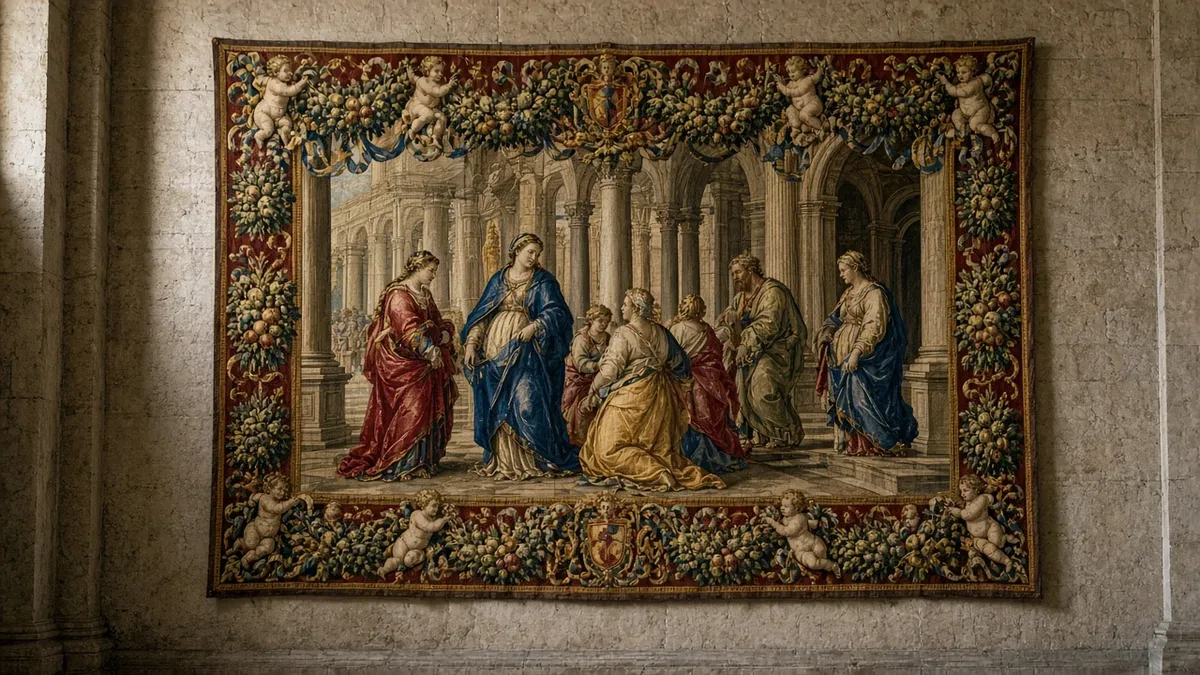
Early Florentine borders oscillate between architectural frameworks and Flemish fruit swags. Bronzino’s first Medici door-covers use both. By the 1590s Papini’s Allori weaves carry dense fruiting swags, cherub clasps at the corners, and side panels of Virtues. That formula is late Medici, not Rost–Karcher.
Barberini borders of the mid-seventeenth century use strapwork, laurel, and the bee on a coloured ground. Sotheby’s recorded a portière of about 1650–60 in which the bee-and-scroll border is continuous with the field, while an inner “frame” border is joined, not woven through. A four-sided border that does not share warps with the field is a later addition until proven otherwise.
Eighteenth-century Roman and Neapolitan borders follow painted cartoons more closely. San Michele panels sometimes set the scene on a simulated silk-damask ground. After 1757 Duranti’s high-warp shop produced painterly hangings with architectural side wings. Gobelins pieces in the same rooms at Palazzo Reale, Naples, are cooler in tone and should not date the Bourbon weaves beside them.
Ferrara, 1536 to about 1580
Este patronage is older than the sixteenth-century factory. Shortly after 1470 the French weaver Rubinetto (Ruben, also called Rubichello di Francia) wove from cartoons by Cosmè Tura. Two Pietà antependia from that partnership survive in the Thyssen collection and at the Cleveland Museum of Art. Local production then lapsed. Alfonso I bought Flemish hangings.
Ercole II reopened a court manufactory in 1536 by calling Brussels weavers already known as restorers of the ducal guardaroba: the brothers Nicola and Giovanni Karcher, and Giovanni Rost. Vasari mentions the Flemings. Nicola Karcher and Rost left within a few years. Giovanni Karcher directed the Ferrara looms until his death in 1562. His son Luigi continued a reduced production to about 1580 under Alfonso II. The Metropolitan Museum of Art dates the Ferrara enterprise as defunct by 1582.
Early series used cartoons after Giulio Romano (Gigantomachia, 1536–39; Deità di Ercole, 1540–43), painted by Dosso and Battista Dossi. From the Metamorfosi of 1543–45 the cartoons stayed in-house: Battista Dossi, Camillo Filippi, Luca d’Olanda, Leonardo da Brescia. Most ducal sets passed to Modena after the devolution of Ferrara and were dispersed in the late eighteenth century. The cathedral Storie of 1550–53 are the only Ferrarese cycle that remains complete in the building for which it was woven. A FACTUM FERRARIÆ inscription, a Karcher monogram, and a Luca-type fruit border form a tighter dating group than a loosely “Este” subject.
Florence, 1545 to 1737
Cosimo I de’ Medici opened two ducal workshops in 1545. Rost, coming from Ferrara, was in Florence before 28 August and was installed at San Marco. Karcher, coming from the Gonzaga shop at Mantua (founded for Federico II in 1539), arrived on 26 October and worked on Via de’ Cimatori. The contracts required the Flemings to train Tuscan apprentices. After Karcher’s contract ended he returned to Mantua in January 1554. In 1555–56 Cosimo opened the shops of the creati fiorentini, weavers trained under the two masters. Rost continued at San Marco until 1560 on non-Medici work.
The largest early commission is the twenty-piece Storie di Giuseppe ebreo, woven between 1545 and 1553 for the Sala dei Duecento in Palazzo Vecchio. Cartoons are by Agnolo Bronzino, Jacopo Pontormo, and Francesco Salviati. Since 1882 the set has been split between Palazzo Vecchio and the Palazzo del Quirinale, ten panels in each city. MUS.E and the Opificio restoration campaigns treat it as one Florentine campaign. A Joseph subject without an FF or workshop mark, and without the Mannerist figure scale of those cartoons, is not from this series.
The Medici looms continued after the founders. Allori became the principal cartoonist by 1576. Papini’s San Marco shop in 1596 employed thirteen weavers, nine of them Italian, and accepted outside work, including the Parato di Clemente VIII for the Vatican (1592–1602). Como Cathedral still holds the re-woven Eucharistic set of 1596–98, ordered after Ferdinand I diverted the first weaving to Alessandro de’ Medici. A second weaving from the same cartoons, in the same year, is documented. It is not automatically a later pastiche.
The grand-ducal manufactory closed on 5 October 1737, after the death of Gian Gastone de’ Medici. That date is a hard stop for Medici production. It is also the start of the Neapolitan sequel.
Florentine pietra dura of the same court is a parallel Medici luxury, not a substitute identification. A commesso table and a Papini hanging can share a patron and still be dated by different marks.
Rome: Barberini, then San Michele
Cardinal Francesco Barberini’s private manufactory began production in 1627. It was not a Vatican workshop. Of the recorded sets, only two were papal commissions. The first series, views of European castles designed in part by Pietro da Cortona and Francesco Mingucci, was on the looms from 1627 to 1631. One survivor, a view of Palestrina, bears della Riviera’s mark. Giovanni Francesco Romanelli supplied later cartoons, including Giochi di putti for the Vatican (1637–42). Michiel Wauters (Michele fiammingo) wove the 1635–36 baldachin hangings with the arms of Urban VIII. The bee in the border is the dating handle. A bee applied as a later embroidered patch is not.
The San Michele works filled the gap after 1683. Several popes had wanted a state arazzeria; Clement XI is the founder who achieved it. The shop sold as well as gifted. Late in the eighteenth century it began reproducing older tapestries so that the originals need not be hung at every ceremony. Those reproductions are Roman and period, but they are not the date of the cartoon. The French occupation closed the manufactory in 1798 as a rival to the Gobelins. A “Barocci” subject on a small wool-and-silk panel with a damask-pattern ground is more likely San Michele, first half of the eighteenth century, than a lost sixteenth-century Roman weave.
Cartoon sources in Rome were often prints. Romanelli’s portière after Agostino Veneziano is one documented case. Italian copperplate engravings of the same subjects help to date a cartoon without proving the weaving town.
Naples, 1737 to 1799
Carlo di Borbone founded the Real Arazzeria in 1737 and hired idle Medici staff. Domenico Del Rosso and Giovan Francesco Pieri arrived in November. The shop was installed beside San Carlo alle Mortelle. Further Florentine weavers, Neapolitan apprentices, and the Frenchman Gaetano Laurie followed. By June 1739 the looms were at work on a Portrait of Carlo di Borbone, now at Capodimonte, and on the Four Elements, still in Palazzo Reale.
Pietro Duranti, a Roman already directing Florentine weavers in Rome by 1743, was called in 1757 to complete a Don Quixote series and to run a new high-warp shop. Del Rosso kept low-warp. The Don Quixote cartoons continue a Gobelins set of 1730–35 given to Charles; the Neapolitan panels are supplements, not the French originals. Later series include the Allegories of the Virtues (1763–67), Cupid and Psyche after Fedele Fischetti (woven 1783–87; hangings now in the Salone d’Ercole), and The Story of Henry IV, signed by Duranti as late as 1791. The manufactory moved into Palazzo Reale in 1778. The Republic of 1799 wrecked the works and most of the archive from 1760 on. The last series, the Royal Apotheosis of 1794–99, was woven without Duranti. The Bourbons did not reopen the arazzeria after 1815.
A Neapolitan royal tapestry is later than any Medici weave and may hang beside Gobelins pieces in the same palace. The French hangings are a different manufactory.
What is later, and what is not Italian
Flemish sixteenth-century weaves with Italian subjects, especially after Raphael’s Vatican cartoons, are Brussels work. They may have hung in Italy for centuries. The city mark, if the selvage survives, will not be FF or FACTUM FERRARIÆ.
Gobelins hangings entered Italian palaces as gifts. Palazzo Reale, Naples, displays a Gobelins Four Elements given in 1719. Colour and border vocabulary differ from Duranti’s shop.
San Michele reproductions of older liturgical hangings are eighteenth-century Roman weaves of earlier designs. Date the weaving, not the iconography.
Nineteenth-century restorations add borders, reweave faces, and replace selvages. A civic mark on a strip that does not share warps with the narrative is not a sixteenth-century signature. Later orange, brown, or terracotta slips are mounts. Needlepoint, painted canvas, and machine-woven picture cloths are not arazzi. If the weft does not turn at each colour boundary, the object is outside this category.
Tapestries were made to move. They covered walls that also carried pictures in giltwood frames, and they were rolled for travel. Fold lines, later linings, and cut-down portières are use, not proof of a different workshop. Measure the field and the border separately. Record every letter in the selvage before conservation restitches the edge.
FAQ
How do I tell an Italian tapestry from a Brussels one?
Look first at the selvage. A red shield between two B’s is Brussels. FF, Factum Florentiae, Fatto a Firenze, or FACTUM FERRARIÆ is Italian civic practice. A Barberini bee or a San Michele archangel is Roman. Then check the cartoon: Bronzino, Allori, Garofalo, Romanelli, and Fischetti do not look like Brussels figure style of the same decades. A Raphael-subject hanging is often Brussels even when its provenance is Italian.
Are Medici tapestries all from the 1540s?
No. Rost and Karcher wove the first ducal campaigns from 1545. The San Marco shop under Papini was still delivering Allori designs in the 1590s. The manufactory closed only in 1737. Late Medici weaves are more Italian in staffing and more explicit in the Florence mark.
Should a tapestry be cleaned or rewoven?
That is a conservator’s decision. Integrative reweaving that invents lost faces changes the object more than a stitched lining. Do not wet-clean silk-worn areas. Photograph the selvage and any inscriptions before any stitch is added.