
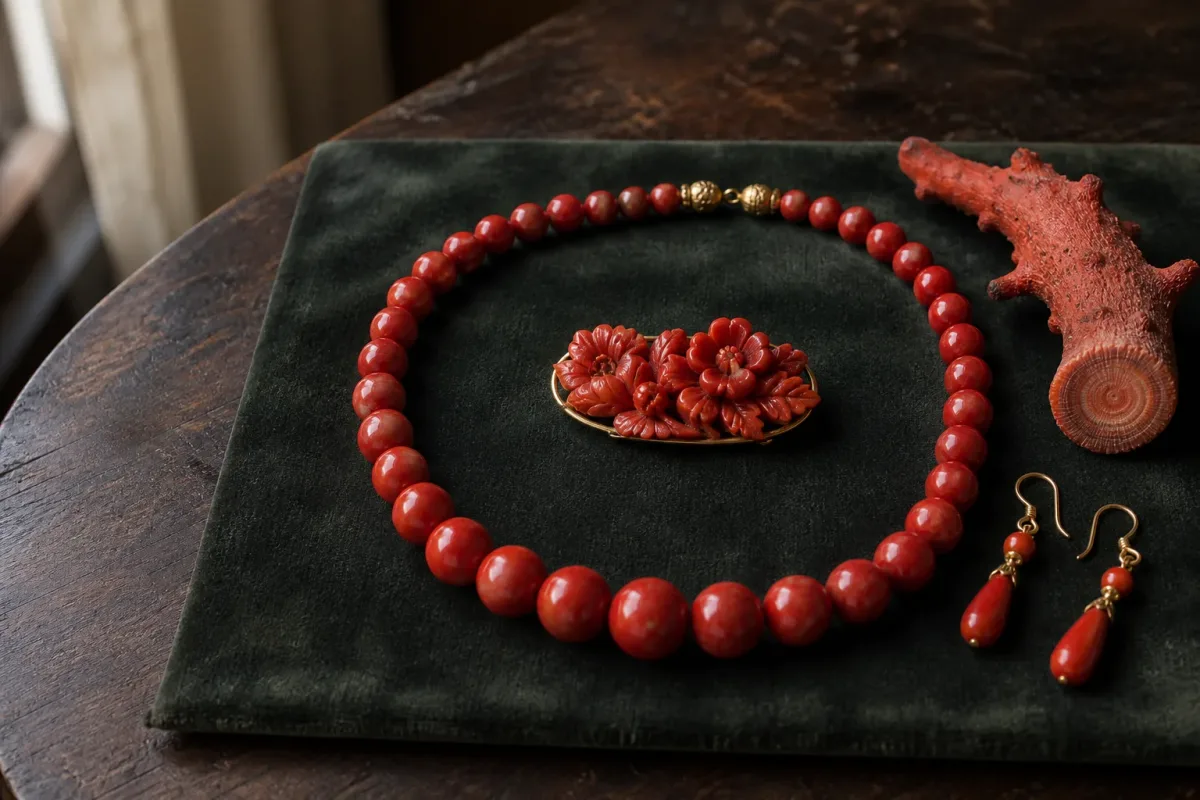
Torre del Greco Coral: History, Identification & Collector's Guide
Identify Torre del Greco coral: Naples workshop history, Corallium rubrum colors, Sciacca material, and how collectors date antique Italian coral jewelry.
The surest way to recognise Torre del Greco coral is not a Vesuvius stamped on the clasp, but the material itself: Mediterranean red coral, Corallium rubrum, cut and polished in a town that turned thin branches into beads, fruit, saints, and parures. Collectors meet that work as “Italian coral,” “Neapolitan coral,” or “oxblood coral.” Those labels are too wide. The fishing boats were Torresi. The factories that learned to sort, drill, and carve the so-called oro rosso sat at the foot of the volcano, a few kilometres south of Naples.
This guide is for collectors who already handle Italian luxury crafts and now need coral as its own file. For dating a gold or silver setting, use our antique Italian silver hallmarks guide. What follows is the workshop language of Torre del Greco: the 1805 privilege, the Sciacca banks, the colours that exist, and the tests that separate Corallium rubrum from dyed bamboo and glass.
A fishing town before it was a jewellery town
Torre del Greco lies on the Bay of Naples, on the western slope of Vesuvius. Coral fishing from its harbour is documented from at least the fifteenth century. Crews left in small coralline — boats fitted for the work — and stayed at sea for months, ranging across the western Mediterranean as far as the North African coasts. The catch was not a souvenir. It was a raw commodity, sold inland to older processing centres. The Parco Nazionale del Vesuvio’s account of the craft is blunt: for a long time the town took the risk of the voyage and then sold the branches to workshops in Genoa and Livorno.
That split — Torresi at sea, Ligurian and Tuscan hands at the bench — lasted until the Bourbon court tried to close the circuit. In 1790 Ferdinand IV issued a Codice corallino regulating fishing and trade, and a Real Compagnia del Corallo meant to concentrate working in the town. The company failed. The idea did not.
On 27 March 1805 the king granted Paolo Bartolomeo Martin (Paul Barthélémy Martin), a Marseille craftsman of Genoese origin who had learned coral cutting in Provençal workshops, the right to open the first factory in Torre del Greco. The privilege included a term of exclusivity, exemption from export and internal duties, and a duty to train local apprentices. Joseph Bonaparte confirmed the arrangement during the French decade; in 1810 Joachim Murat added a licence covering engraved coral. Martin’s second shop, at the Real Albergo dei Poveri in Naples, shows how quickly the court treated coral as a state industry rather than a harbour sideline.
From that date the town’s reputation is not “Italy in general.” It is a specific manufacture: sorting by size, colour, and usable length; cutting; drilling; polishing; and, later, relief carving and shell cameo engraving as a sister trade.
Workshops, a school, and a civic museum
The nineteenth-century factories were family firms, often started by men who already owned coralline. Giovanni Ascione, son of the shipowner Domenico, opened a manufacture in 1855, still under Ferdinand II. Within twenty years the house had medals at the international exhibitions of Porto (1865), Vienna (1873), and Philadelphia (1876), and in 1875 the privilege of using the Savoy arms as a royal supplier. De Simone traces its workshop to about 1830 and an ancestor said to have trained under Martin. Basilio Liverino’s firm dates its coral business to 1894; the family’s private museum on Via Montedoro grew from a collection he began in 1934, at sixteen, and now holds more than a thousand jewellery and sculptural pieces in coral and hardstones.
Training needed a school as well as a bench. In 1878 a public school of coral engraving and industrial design was founded in Torre del Greco — the date used by the town’s bicentennial literature and by the trade press. It is the ancestor of today’s Liceo Artistico at the Istituto Francesco Degni, in the former Carmelite convent that survived the eruptions of 1737 and 1794. Director Enrico Taverna opened a Museo del Corallo there in 1932 for student and master work in coral, cameo shells, mother-of-pearl, silver, and lava stone. Visits are by appointment.
The producers’ association Assocoral was founded in Torre del Greco in 1977. It is a trade body, not a hallmarking office: a piece is not “Assocoral coral” the way silver is 800.
What the material actually is
Precious red coral is the calcareous axis of a colonial animal, not a mineral and not a shell. Mediterranean jewellery coral is Corallium rubrum. Its colour comes from organic pigments (carotenes), not from a surface stain. Under a loupe the structure is organic: fine longitudinal striations and concentric growth layers, visible especially on a cut branch end or inside a drill hole. The surface polish is waxy to sub-vitreous, not glassy.
Trade names you will see — and should treat as grades, not species — include:
- Sardegna / Sardinian red. Live-harvested Mediterranean C. rubrum, typically a saturated mid to deep red. The name is a market geography, not a guarantee that a given bead was taken off Sardinia.
- Sciacca. Sub-fossil C. rubrum from banks discovered off Sciacca, on the southern Sicilian coast, between 1875 and 1880 and fished until 1914. A 2020 study in Facies summarises the episode: about 18,000 tonnes of raw material were taken from deposits at roughly 150–200 metres, and the banks were exhausted. Colour runs orange to salmon-red, sometimes with a “burned” look attributed to the volcanic seabed. Compact, slightly fossilised texture is part of the identification, not a defect. Historic Torre factories (Ascione, De Simone, Rajola among them) still held unworked Sciacca stock more than a century later.
- Moro / oxblood. The darkest, most saturated reds. In older Italian use moro is a colour word, not a separate coral. Do not confuse it with later Pacific “aka” and “moro” grades from Corallium japonicum, which can look similar in a photograph and are a different species.
- Pelle d’angelo (angel skin). Pale pink. In Torre del Greco this colour is associated with larger Pacific precious corals, not with typical Mediterranean branches. Treat a large, even pink carving as a later, often twentieth-century, material story unless the mount and provenance say otherwise.
Until the late nineteenth century the workshops worked Mediterranean C. rubrum. Pacific species entered later, first as Japanese pinks and reds, then as larger material used for sculptures that thin Mediterranean branches cannot support. A big figural group is not automatically better antique coral; it may be a different ocean.
CITES is not a single rule for “coral.” C. rubrum is not listed. Several Pacific jewellery species (C. japonicum, Pleurocorallium elatius, and related taxa) have been on Appendix III. SSEF and the CIBJO coral guide both warn that customs may treat look-alikes as listed species if you cannot prove identity.
Forms collectors actually handle
Early factory output, and still the backbone of the trade, was fili e collane: smoothed beads, barrels, and olives, sorted and strung. A nineteenth-century Torresi necklace is often graduated, slightly irregular in diameter, and drilled by hand. Perfectly identical 8 mm spheres in a screaming uniform red are a warning, not a luxury grade.
Carved work came next: fruit and flowers, putti, small saints, crucifixes, rosary terminals, and the figurative sculptures that Victorian and Belle Époque buyers wanted as souvenirs of the Grand Tour’s southern leg. Religious coral sits in the same southern Italian market as other portable sacred objects; it is not church silver, but export and conservation questions can be similar. Shell cameos — Cassis species engraved in two-colour relief — grew as a parallel industry in the same school and the same streets. They are not coral. Do not catalogue a sardonyx-style shell cameo as “Torre del Greco coral” because the town made both.
Mounts are part of the object. Yellow gold, gilt metal, and later 800 silver frames, clasps, and cannetille surrounds date the jewellery more reliably than the coral colour alone. Read those punches with the national silver system: unofficial “800,” the 1934 lozenge, the 1968 star and province code. A coral parure with a star-and-NA mark is twentieth-century Neapolitan goldsmithing on coral, which can still be excellent; it is not Martin’s factory in 1810.
Coral also appears as small inlay and applied ornament on boxes and furniture, a cousin — not a twin — of Florentine pietra dura. Hardstone mosaic is cut minerals; coral is an organic calcareous axis. If a dealer calls a malachite-and-coral table “pietra dura,” ask which workshop language they actually mean.
How to identify a genuine piece
Work in this order, with a 10× loupe, before you clean anything. GIA research (Christopher P. Smith and colleagues, Gems & Gemology, 2007) is the laboratory standard for colour origin; the field tests below are what you can do at a fair.
1. Look at structure, not redness. Real C. rubrum shows growth layers or faint longitudinal grain. Glass is homogeneous and often carries spherical bubbles. Plastic and resin look “dead” and may show mould seams. Dyed bamboo coral (an isidid, not Corallium) has a coarse, radiating or sunburst pattern around the drill hole.
2. Inspect the drill hole. On dyed or reconstituted material the colour often changes inside the hole or concentrates in pits. Mediterranean beads of one period should be the same colour at the surface and in the perforation, allowing for a little polish wear.
3. Distrust a perfectly even tomato red. Mediterranean coral varies within a strand. Sciacca is more orange than “Ferrari red.” A flat, fluorescent red at a low price is usually dyed bamboo, glass, or pressed powder in resin (“coral paste”).
4. Feel temperature and weight. Coral is cool and relatively dense. Plastic is light and warms at once. Glass can be heavy but has a sharp vitreous lustre unlike coral’s waxier polish.
5. Do not make acetone or acid your first move. Acetone on a cotton bud can lift some dyes; it can also mark a polish. Dilute acid will fizz on calcium carbonate — and damage the surface. Reserve invasive tests for a disputed cheap bead, or leave them to a gemmologist. Raman spectroscopy can confirm natural carotene versus dye without destroying the piece.
6. Read the mount. A hand-cut coral in a well-made nineteenth-century gold frame is a different object from a modern bead glued into a stamped gilt setting. Photograph hallmarks before any restorer “improves” the metal.
Imitations you will actually meet: red glass, celluloid and later plastics, dyed bone or howlite, reconstituted powder, and dyed bamboo sold as “Sardinian” or “Torre del Greco.”
Dating, condition, and the market
Coral does not carry a civic punch. Dating is a triangulation: mount marks, fashion (graduated bead parures, carved fruit, mid-century polished ovals), and material. Sciacca colour and texture point to 1875–1914 stock, whether worked then or later from warehouse branches. A 1980 carving from nineteenth-century raw material is honest if described that way; it is not an 1880 jewel.
Condition is chemical. Household acids, perfume, and ultrasonic baths etch the polish. Old silk threads cut beads; recstringing is normal, but nylon is not “original.” Wear on bead high points is expected; a dead-flat re-polish that erases the grain is a loss of evidence.
Do not treat every southern Italian figurative object as the same file. Sicilian Moor’s Heads are maiolica, not coral, even when a dealer groups them with “Naples souvenirs.” Regional ceramics belong with the Italian maiolica guide. Coral is a harbour industry with a different raw material and different fakes.
Prices vary too widely — bead diameter, colour, carving, gold weight — for a useful number here. Ask for the species name Corallium rubrum in writing if the price assumes Mediterranean precious coral.
Where to look
In Torre del Greco, the Degni school museum and the Liverino collection on Via Montedoro (by reservation) show the craft as a local system. Ascione maintains a house museum in Naples, in Galleria Umberto I. The 2006 bicentennial exhibition Two Hundred and One at Villa Campolieto, Ercolano, remains the English-language reference point for the 1805 privilege.
On the shelf: Basilio Liverino’s Il corallo (1983; later editions), still cited for Sciacca stock in Torresi warehouses; the CIBJO coral guide for nomenclature; GIA’s 2007 paper if colour origin is the whole question.
FAQ
Is all antique Italian coral from Torre del Greco?
No. Trapani and other Sicilian centres worked coral, especially in Baroque religious ensembles with gilt silver. Genoa and Livorno processed Mediterranean coral before 1805. What Torre del Greco owns is the continuous factory tradition from Martin’s privilege onward, and the school that taught engraving.
How can I tell Sciacca coral from ordinary red coral?
Colour and history, not a stamp. Sciacca is C. rubrum that sat in sub-fossil banks off southern Sicily; it tends toward orange and salmon, sometimes with darker “burned” patches. Ordinary live-harvested Mediterranean red is typically a clearer mid to deep red. Laboratory dating exists for research samples; at a fair you are matching colour, texture, and a credible story.
Does antique coral jewellery need a CITES permit?
Mediterranean C. rubrum is not listed. Pacific look-alikes may be. If you travel with a valuable piece, carry species documentation and do not call every pink carving “Sardinian.” Fishing rules for new coral are separate from owning an old necklace.
Are coral cameos the same as shell cameos?
Usually not. Torre del Greco is famous for both, but a cameo with a white figure on a brown or orange ground is typically a Cassis shell. Coral cameos exist; they are carved from a single colour mass. Catalogue the material you see, not the town’s entire output.
Why do some “coral” necklaces fade or bleed dye?
Because they are not precious coral, or they were dyed. Natural C. rubrum colour is in the skeleton. Dye in bamboo, bone, or pale coral concentrates in cracks and drill holes and can lift onto a cloth. A faded, chalky surface can also be acid or ultrasonic damage on real coral — another reason not to “test” with household chemicals.
Can I clean coral jewellery at home?
Wipe with a soft dry or barely damp cloth. Keep it away from perfume, vinegar, lemon, and the ultrasonic tank. Do not re-polish carved surfaces if you care about the tool marks.
Conclusion
Torre del Greco coral is a manufacture with a date — 27 March 1805 — and a material with a Latin name. Learn the difference between Mediterranean Corallium rubrum, Sciacca sub-fossil stock, and later Pacific species. Learn the look of a hand-drilled bead and the grain of a cut branch. Then the gold clasp and the silver lozenge become useful, because you are dating a mount on a known substance, not guessing at a souvenir labelled “Naples.” The town still cuts coral. The collector’s job is to know which century, which sea, and which workshop language a given strand actually speaks.