
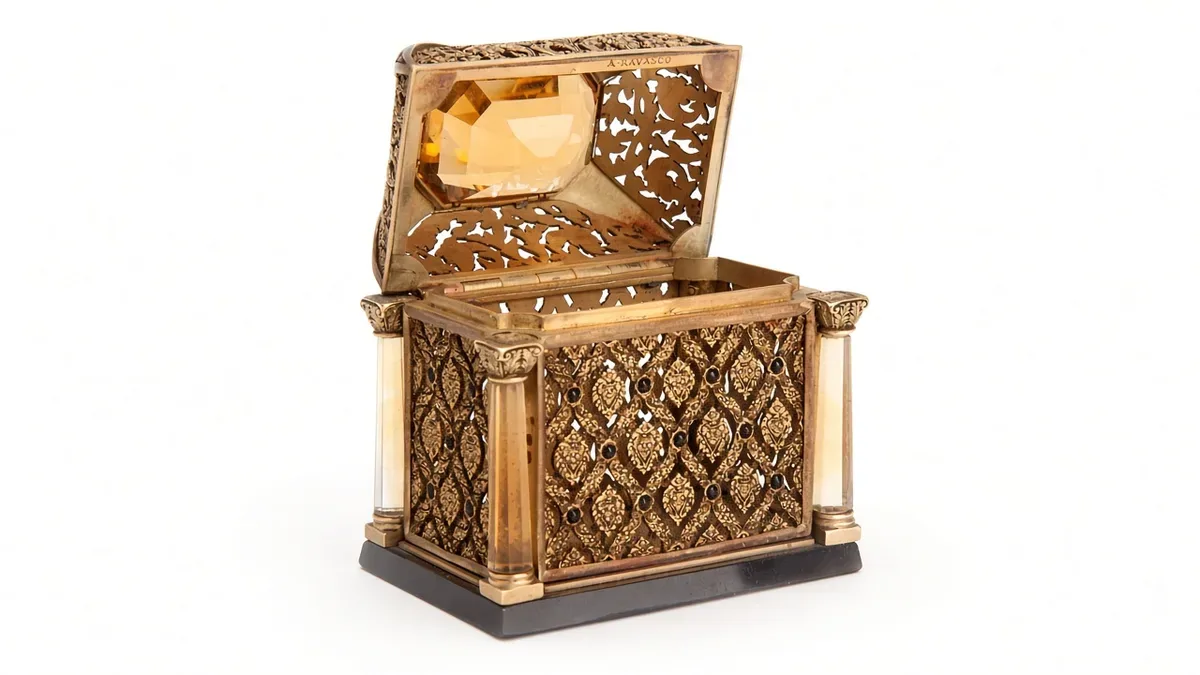
Italian Art Deco Jewelry of Ravasco, Janesich and Cusi
Period Italian Art Deco jewelry is identified by Ravasco hardstone objects, Janesich and Cusi platinum mounts, and the 1934 lozenge maker marks.
Italian Art Deco jewelry is two related productions, not one Parisian silhouette. The first is the hardstone object: malachite, agate, lapis, onyx, and coral cut as boxes, cups, and table sculptures, then mounted in gold or silver. The second is the white jewel of the later 1920s and 1930s, platinum or white gold set with diamonds in geometric plaques. Both were made in Italy. The dealer who dates a piece by a French step-cut bracelet, or who files Mario Buccellati under Déco because the shop opened in 1919, is using the wrong index.
Melissa Gabardi’s Italian Jewelry in the 20th Century, written for the Museo Poldi Pezzoli exhibition of 24 November 2016–20 March 2017, keeps Art Deco and the 1930s as chapters distinct from Liberty and the diamond garland manner. That division is the working tool. Italian Art Nouveau jewelry of the Turin 1902 generation used enamel, yellow gold, and floral mounts. Déco work after about 1922 replaces that vocabulary with hard colour blocks, pierced platinum, and, after 1934, a national maker’s lozenge.
Ravasco: dates, training, and the Milan workshop
Alfredo Ravasco was born in Genoa in 1873 and died at Ghiffa, on Lake Maggiore, on 3 November 1958. Treccani records the first art studies at Brera and a long period as a working craftsman in Italy and abroad. Auction and workshop biographies name Eugenio Bellosio, the Milanese chiseller, as the teacher who formed his metalwork. His father, Giacomo Ravasco (1846–1928), a Genoese goldsmith, moved the family firm to Milan in late 1874 or early 1875. Bonhams dates Alfredo’s assumption of a leading role in that Milan business to 1922. He was already exhibiting in the city by 1906.
The documented commissions sit beside the jewels. The 1938 appendix to the Enciclopedia Italiana, signed Raffaele Calzini, lists the tiara of Pius XI after a design by Luca Beltrami; caskets and reliquaries for the Sancta Sanctorum in Rome; the restoration of the golden altar of Vuolvinio in Sant’Ambrogio, Milan, together with work on the Gravedona cross and the treasury of the Great St Bernard; and the reliquary holding a lock of Lucrezia Borgia’s hair in the Pinacoteca Ambrosiana. Six Ravasco goldsmith’s objects in the Ambrosiana collections were catalogued in 2010, including that Borgia casket and companion teche for hair of Federico Borromeo and of Cavour.
In 1925 the Ministry of Public Education appointed him Inspector of the Scuola del Corallo at Torre del Greco. Paola Venturelli, who published the 2015 Villa Necchi Campiglio catalogue, notes that the collaboration with Torrese coral cutters lasted to the end of his career. That appointment is the documentary link between Ravasco’s marine hardstone objects and the older Torre del Greco coral trade.
The Milan workshop was destroyed in the bombing of the city in 1942–43. He retired to the villa at Ghiffa around 1943 and left the estate to the Stelline girls’ orphanage in Milan. Workshop drawings later survived in the Archivio Merzaghi. Gabardi, interviewing for the Poldi Pezzoli show, named the goldsmiths Eliseo Mangili and Rino Merzaghi as Ravasco’s bench collaborators and warned that not every attributed jewel is signed. Some carry only initials. Others are identified from period photographs, invoices, and the workshop’s construction habits.
Paris 1925, Monza, and the 1933 Triennale
Christie’s, cataloguing an early-1920s pierced diamond bracelet 23.0 cm long, records that Ravasco was one of the few Italian jewellers to exhibit at the Exposition Internationale des Arts Décoratifs et Industriels Modernes in Paris in 1925, and that he made presentation brooches for the Princess of Piedmont, later Queen Maria José. The same year he held a Milan solo exhibition.
Two small perfume containers from that Paris group reappeared in the stores of the Museo Nazionale della Scienza e della Tecnologia Leonardo da Vinci, Milan, during the Villa Necchi show (14 October 2015–6 January 2016). Venturelli identifies a rock-crystal vase with openwork enamelled gold lid, emerald drops, and onyx beads (inv. 1185; 8.8 × 4.8 cm diameter) and an urn-shaped gold and enamel casket with four topaz colonnettes (inv. 1191; 6.7 × 5.8 × 4 cm). Both came from the Mauro donation. The crystal vase is inscribed inside the lid A EDI FRANCESCO XVI-III-MCMXXIV. Margherita Sarfatti and Roberto Papini published praise of this class of object in 1925–27. The type belongs mainly to 1923–27.
The change of language is dated to the gap between the second Monza Biennale of decorative arts (1925) and the third (1927). A grey agate seal shown at Monza in 1927 is a sober parallelepiped, 7 × 6 × 2.3 cm, with two coral seahorses and a single pearl. Ornament is reduced. Geometry takes the load. At the 5th Milan Triennale of 1933 Ravasco showed nineteen works in the Saletta degli Orafi, a room designed by Agnoldomenico Pica and lined with alabaster-onyx slabs. Domus 69 (September 1933) described the group as purified in form and still massive. He also exhibited at the Venice Biennale in 1930 and 1936. Maria Accascina’s review of 23 August 1936, written from the darkened Ravasco room, names a malachite casket crowned by fish cut from a large emerald and a rock-crystal centrepiece on a lapis base.
What period work looks like
Hardstone objects are the surest Ravasco group. Typical materials are malachite, grey or moss agate, lapis lazuli, onyx, chalcedony, rock crystal, and carved coral. Mounts are gold, gilt silver, or silver, sometimes with enamel. Recurring motifs are fish, seahorses, frogs, and other marine or animal figures, often with cabochon ruby eyes and short sprays of seed pearls. The colour blocks are closer to sixteenth-century Milanese hardstone work (the Saracchi and Miseroni shops) than to the diamond architecture of Place Vendôme. Collectors who already handle Florentine pietra dura will recognise the same appetite for cut stone as structure, not as a small inlay on gold.
A dated private-collection example published by Venturelli is an agate box 9.8 × 17 × 11 cm. The lid is carved to suggest a rippled sea. Two coral fish have ruby cabochon eyes and rows of pearls issuing from the mouths. White-gold hinges are set with amethyst cabochons and engraved 6 febbraio 1939. Accascina had already described a related grey-agate box with one coral fish at the 1936 Biennale.
The second register is the white jewel. Gabardi’s Poldi Pezzoli research recovered Ravasco as a maker of platinum and diamond colliers, bracelets, brooches, and rings in the French total white manner of the 1930s, not only as a colourist in hardstone. Artribune’s account of that exhibition pairs Ravasco with the Milan house of Cusi for this white production. A 1930 platinum and diamond brooch was among the objects shown. Christie’s early-1920s bracelet, by contrast, is still floral and pierced: a transitional piece, useful as a warning that a Ravasco signature does not automatically mean a stepped geometric mount.
Not every hardstone box with a coral fish is his. Later decorative objects repeat the marine formula without the dated hinges, the workshop case, or a documented exhibition photograph. Unsigned gold lattice caskets need the same caution. Attribution, Gabardi said, often rests on the Merzaghi drawings rather than on a punch.
Janesich, Cusi, and what is not Déco
The house of Janesich, founded at Trieste in 1835 by Leopoldo Janesich, is the other Italian firm that produced a fully international Art Deco jewel. Trieste was then the Austrian free port; it became Italian after 1918. Bonhams records a Paris shop on rue Lafayette in 1896. The house showed jewellery and silver at the first Monza Biennale of decorative arts in 1923 and, in the same year, made a gold, silver, and enamel casket commissioned by the city of Rijeka as a wedding gift for Princess Yolanda of Savoy. A royal warrant from Victor Emmanuel III followed in 1925. Christie’s has sold a signed Janesich bracelet of about 1925: cushion sapphires and round diamonds in platinum, French marks, 18.0 cm, 58.2 g. Period pieces are often numbered as well as signed. The vocabulary is the French one (calibré colour, platinum openwork) executed for a Triestine and Paris clientele.
Cusi of Milan (Annibale and Rinaldo) belongs with Ravasco in Gabardi’s 1930s white chapter. The house is older than Déco. What matters for dating is the platinum geometric plaque of the 1930s, not the firm’s nineteenth-century name. After the 1934 hallmark law, a Milan lozenge is the expected companion to a Cusi or Ravasco punch on gold or platinum.
Mario Buccellati opened under his own name in Milan in 1919. Shops in Rome and Florence followed in the 1920s. The metalwork is traforato: pierced, engraved gold that imitates lace, linen, or honeycomb, often in two colours, with cabochons in bezels. A 1929 yellow-gold and plated-silver diamond tiara from the Gianmaria Buccellati Foundation was shown at Poldi Pezzoli as a neo-historicist object, not as Déco. Treat Buccellati as a parallel Milanese production of the same decades. The date 1919 is not a Déco hallmark.
Petochi in Rome, Musy in Turin, and Chiappe in Genoa, already discussed as Liberty and garland houses, followed the white fashion when clients asked for it. Their punches date the workshop. They do not, by themselves, date the style.
Marks, platinum, and the 1934 lozenge
Before 1934, Italian precious-metal marking was incomplete. The law of 2 May 1872, no. 806, unified legal finenesses across the kingdom but left state assay optional. Gold jewels of the 1920s may show 750 struck in various shapes, a maker’s initials, or nothing usable. Platinum, widely adopted for diamond mounts in those years, is even less regular on Italian work made for export or finished in Paris.
The law of 5 February 1934, no. 305, made the maker’s mark obligatory. The punch is a lozenge containing the maker’s registration number, the Fascist fascio, and the two-letter province code (MI for Milan, TS for Trieste, TO for Turin, RM for Rome). Gold fineness sits in a hexagon; silver in an oval. Platinum’s legal title was 950 thousandths. The same numbering system is the one already used to read Italian silver hallmarks. Legislative decree 26 October 1944, no. 313, removed the fascio and left a gap in the lozenge. The five-pointed star in a polygonal shield belongs to the law of 30 January 1968, no. 46, and the 1970 regulation, in general use from about 1971. A star mark on a “1925” bracelet is a later object or a later repair shank.
Practical reading:
- No lozenge, 750 or PT struck freely, French eagle-head or dog’s-head marks: possible pre-1935 Italian jewel finished or hallmarked in France, or a Janesich Paris piece. The signature then carries more weight than the Italian state punch.
- Lozenge with fascio and MI, PT 950 or 750 in a hexagon: 1935–44, the core dating window for white Ravasco and Cusi plaques.
- Lozenge without fascio: 1944 or later. Fine for a late white jewel; fatal for a Paris-1925 claim.
- Signed A.RAVASCO or RAVASCO on the inner rim of a gold object, or a workshop case stamped Giacomo Ravasco / Alfredo Ravasco, with a period photograph or invoice: stronger than an unsigned hardstone box of similar colour.
Cases, fitted screwdrivers for convertible brooches, and original invoices are part of the object. Il Ponte and other Italian rooms have sold hexagonal platinum and sapphire centres convertible to brooches, still in Ravasco cases. Absence of a case is not proof against the piece. A new case with an old jewel is not proof for it.
Common mistakes
French diamond jewelry of 1920–35 is not Italian because a later owner bought it in Milan. Look for the lozenge, a Ravasco or Janesich signature, or a documented Italian invoice.
Floral pierced diamond work of about 1920 can be Ravasco and still not be Déco geometry. The Christie’s bracelet is the type specimen of that confusion.
Buccellati lace-gold of the 1920s is contemporary with Déco and is not Déco.
Valenza and Vicenza industrial jewellery after about 1960 repeats stepped baguettes and calibré colour in 18-carat gold. The 1968–71 star mark, modern brilliant cuts, and rhodium-bright white gold give those pieces away.
Faraone is not a 1920s house. Raffaele Faraone’s first shop opened in 1947. Bouquet diamond brooches associated with that name belong to the 1950s.
Coral fish on agate are a Ravasco theme, not a Ravasco monopoly. Demand a date, a hinge inscription, a workshop photograph, or a punch.
FAQ
How is Italian Art Deco jewelry dated?
By construction first, then by marks. Hardstone geometry with coral or enamel mounts points to Ravasco’s 1925–39 group. Platinum plaques with baguette and transitional diamonds point to the 1930s white production of Ravasco, Cusi, and Janesich. The 1934 lozenge with fascio dates Italian-made precious metal to 1935–44. Exhibition labels (Paris 1925, Monza 1927, Triennale 1933, Venice 1936) date specific objects when a photograph or catalogue entry survives.
Is Mario Buccellati an Art Deco maker?
No. The 1919 Milan shop is contemporary with Déco. The house style is pierced and engraved gold in a Renaissance-revival grammar. Use it as a control group, not as a synonym.
Did Ravasco only make coloured hardstone objects?
No. Gabardi’s Poldi Pezzoli work established a parallel production of platinum and diamond jewels in the 1930s. The Archivio Merzaghi is the main tool for unsigned white pieces.
What if there is no Italian hallmark?
Pre-1935 work, export pieces, and Janesich jewels finished in Paris may lack the lozenge. Then the signature, the case, and a period photograph are the evidence. An unsigned, unmarked geometric diamond bracelet is, as a rule, not attributable to an Italian house.
When did the workshop close?
The Milan bench did not reopen after the 1942–43 bombing. Ravasco lived at Ghiffa until 3 November 1958. Objects that depend on a living Milan workshop after 1944 need another name.
The Italian Déco jewel is a small field. Ravasco’s hardstone objects and white plaques, Janesich’s signed platinum bracelets, and Cusi’s 1930s mounts are the documented core. Marks after 1934, workshop cases, and the 1925–36 exhibition photographs do the dating. Motif does not.