
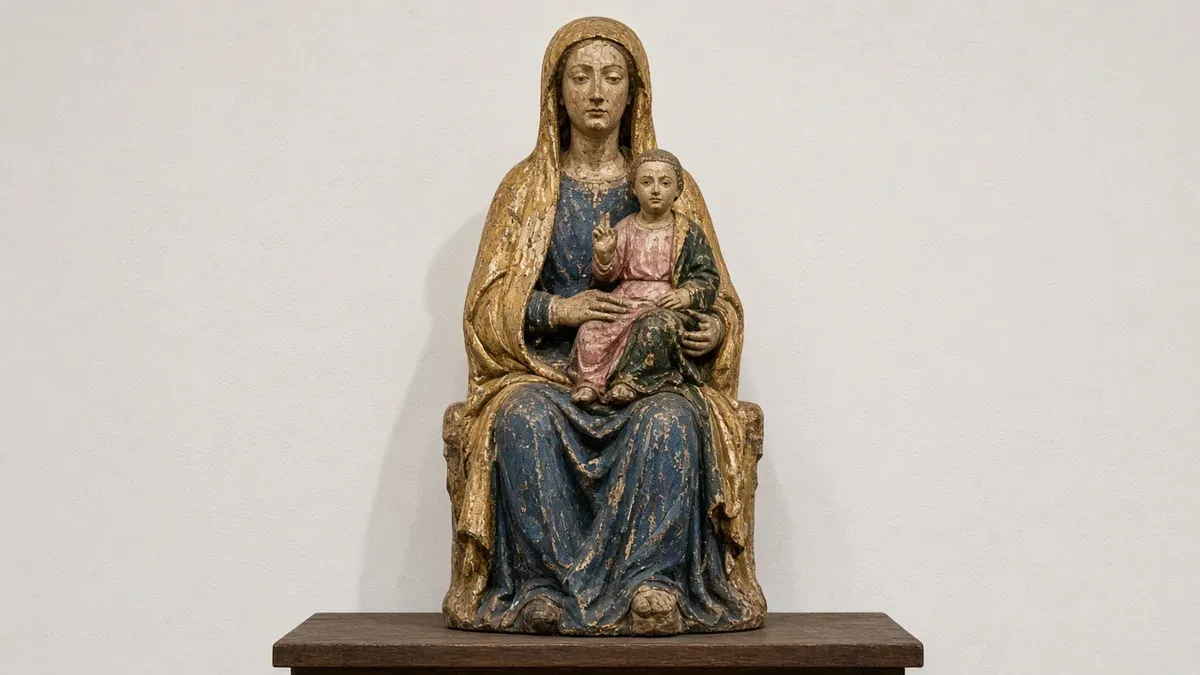
Dating Italian Wooden Madonnas of Tuscany, Naples and Val Gardena
Collectors date Italian wooden Madonnas by timber, gesso and construction, from Tuscan poplar groups to Neapolitan Baroque figures and Val Gardena limewood.
A collector facing an Italian wooden Madonna is looking at a cult statue, not a studio marble. Dating follows the timber, the hollowing of the log, and the paint, not the silhouette. A thirteenth-century Umbrian Sedes Sapientiae in poplar and a nineteenth-century Gardenese limewood Virgin cut for export share an iconography. They do not share a workshop.
The Italian term is Madonna lignea or scultura lignea policroma. Wood was the ordinary material of processional and altar images from the thirteenth century until marble and bronze took the higher rank in Renaissance theory. The paint was not an afterthought. Contracts of the Trecento often split the job: the carver delivered the figure; a painter applied gesso, bole, and pigment. Jacopo della Quercia is named in Lucchese documents as both sculptor and pictor. Most shops kept the two trades apart.
This article treats full-scale wooden Virgins made in Italy, from Romanesque seated groups through Neapolitan Baroque Immacolate and the Val Gardena export trade. It is not a guide to Neapolitan presepe figures, whose heads are usually terracotta. It is not a guide to wooden crucifixes, though the joinery and the paint layers obey the same physics.
Wood, hollowing and gesso
Italian conservation literature is consistent on timber. In Tuscany by the late thirteenth century, carvers preferred lime (tiglio) and poplar (pioppo): both cut cleanly and both are low in tannin, which stains a gesso ground. Conifers were avoided for polychrome work because resin pockets lift the preparation. Walnut appears where a harder, warmer wood was wanted. The so-called Madonna di Acuto in the Museo Nazionale di Palazzo Venezia, Rome, is walnut, 107 cm high, 45 cm wide and 24 cm deep, dated on present consensus to the late twelfth or early thirteenth century. Radiography published in a 2018 technical study shows a single log, deeply hollowed at the back, with both heads carved in the round.
Hollowing is a dating clue, not a defect. Cult statues had to be carried. Removing the heartwood also reduced radial splits. Thirteenth-century figures are often excavated through a wide dorsal slot, the front fully modelled, the back left open. In the Quattrocento, fully round figures become more common; some shops carved front and back as two hollowed shells and joined them. Hands, forearms, and projecting drapery were usually separate pieces, glued and pegged, the joints then covered with linen (camotta or incamottatura) before gesso.
The ground is gesso and animal glue, first coarse (gesso grosso), then fine (gesso sottile). Gold leaf sits on red or yellow bole. Flesh is typically lead white with cinnabar. On the Madonna di Acuto the blues of the tunic analysed in situ are azurite; the reds are cinnabar; the flesh is lead white with variable mercury red. Later overpaint, often oil, sits on top of this system. A figure stripped to “honest wood” in the twentieth century has lost its original surface. A figure with a thick, even oil film and no craquelure in the gesso is usually a later garden or church refurbishment.
The Detroit Institute of Arts holds a seated Italian Madonna and Child Enthroned, acc. 30.383, polychromed and gilded poplar, about 1225, 158.8 × 54 × 50.8 cm. The type is the Sedes Sapientiae: the Virgin as Throne of Wisdom, the Child as a small adult raising a hand in blessing. The museum bought it in 1930 from Enrico Testa in Florence. Losses in the gold and the blue tunic are part of the record. They are not grounds for a later date.
Central Italy: seated groups and Gothic standing Virgins
Umbria, Tuscany, Lazio and Abruzzo produced the wooden Madonnas that still set the medieval market. The DIA group belongs with that central Italian Romanesque current: frontal pose, columnar drapery, throne treated as architecture.
Standing Gothic Virgins are a later, more mobile type. The Madonna of Pacentro, also in Palazzo Venezia (inv. 4903), is a late-fourteenth-century Abruzzo work, 137 cm high and 38 cm wide. IVALSA-CNR in Florence identified poplar for the Virgin and linden for the Child. The catalogue entry by Stefania Paone (VIVE, published 12 February 2025) records a golden cloak edged in lapis, a cinnabar tunic with fleurs-de-lys, a damaged crown, and a slight hip-shot stance that scholars have linked to Gothic taste arriving through Angevin Naples. Vespasiano Pitassi bought the statue at Pacentro in 1924. Federico Hermanin published it as fourteenth-century Abruzzese in 1925; Antonino Santangelo later gave it to Niccolò da Venezia and an early-fifteenth-century date; Enzo Carli moved it toward a Franco-Orvietan current. The wood species and the surviving paint film are firmer than the name on the label.
Tuscan Quattrocento groups tighten the anatomy and the turn of the head. The Madonna col Bambino in Palazzo Taglieschi, Anghiari, attributed to Jacopo della Quercia and dated about 1420, was commissioned by the Compagnia di Santa Maria della Misericordia. The Italian state acquired it in 1977. A restoration in the 1980s recovered original polychromy. The Child stands on the Virgin’s knees; the torso twists. That movement is the dating argument. A rigid Sedes Sapientiae with the same subject is a century or more earlier, not a provincial delay.
Umbrian early-sixteenth-century seated Virgins in the Catalogo generale dei Beni Culturali still use a blue starred mantle over a red underdress. One example, first quarter of the sixteenth century, has had the feet sawn by a few centimetres to fit a niche. Truncation of the base is common in church furniture. It is not, by itself, proof of a fake.
Naples: Colombo, Fumo and the dressed Madonna
Neapolitan Baroque wood is a different carpentry. Figures are carved in the round, often life-size, with deep undercutting of silk-like drapery, glass eyes in many workshops, and a taste for the Immaculate Conception standing on a cloud with cherub heads. The Catalogo generale records an Immacolata attributed to Giacomo Colombo, first half of the eighteenth century: full-length, blue starred mantle, light brown arabesque tunic, two cherub heads in a cloud at the base.
Colombo was born at Este, near Padua, in 1663 and trained in Naples. Treccani’s biography by Gennaro Borrelli (1982) gives his death in Naples as 1730; several ICCD sheets print 1731. He worked in polychrome wood, marble and stucco, and in 1701 was elected prefect of the Neapolitan painters’ corporation. Signed wooden crucifixes exist from 1689 (Cava de’ Tirreni) and 1691 (Capri). His documented Immacolata Concezione of 1718 for San Francesco d’Assisi at Lucera, commissioned through St Francesco Antonio Fasani, is the type collectors meet in provincial churches from Foggia to Ostuni. Nicola Fumo, Giuseppe Picano, Gaetano Patalano and the Verzella shop occupy the same circuit. University of Bari research on Nicola Antonio Brudaglio of Andria (born 1703) places Colombo’s studio as the principal southern training shop of the early Settecento.
A second Neapolitan construction is the manichino ligneo, a dressed Madonna. The body is a carved and often articulated wooden mannequin; the visible flesh (head, neck, hands) is polychromed; the costume is fabric, changed for feast days. Colombo’s Maria Santissima del Rosario of 1716 for the Celestini at San Severo is catalogued as a wooden mannequin. Processional Madonne vestite are still in use. Collectors who strip the textiles to “reveal the sculpture” destroy the object’s liturgical logic. Jointed shoulders and unfinished torsos are correct for the type, not evidence of a broken statue.
Do not confuse these altar and processional Virgins with presepe Madonnas. Eighteenth-century crib figures use terracotta heads with glass eyes, wooden limbs, and hemp-wrapped wire bodies. The scale is usually under 50 cm. A 38 cm Madonna sold as “atelier of Nicola Somma” on the French trade is a crib figure, not an altar Immacolata. Neapolitan giltwood angels share the same Baroque wood language as the full-scale Madonnas; they are a different commission.
A Catalogo sheet for a Neapolitan eighteenth-century Madonna con Bambino describes carved and polychromed wood, the Virgin stepping forward, an octagonal base with gilt mouldings and faux-marble painting. Faux marble on the plinth is ordinary Neapolitan church finish. It is not a later improvement.
Val Gardena: Trebinger, Vinazer, then the export trade
Ortisei (Urtijëi, St. Ulrich) and Santa Cristina in Val Gardena, South Tyrol, became the densest Italian centre of wooden Madonnas after 1600. The earliest documented carver is Christian Trebinger, born about 1580 at the Trëbe farm, San Giacomo. Italia.it and the local literature give his high altar for the church of Santa Cristina, 1646. Nicolò Rasmo placed his training at Brixen with Hans Reichle and Adam Baldauf. The Trebinger sons shifted toward frames and consoles. Figurative sculpture passed to the Vinazer (also Vinatzer) family.
Martin Vinazer (Ortisei, 1674–1744) is the name on signed reliefs. Ladinia Creativa and the Museum Gherdëina record works there, in the Museo Civico at Chiusa, the Diözesanmuseum at Brixen, and the Volkskundemuseum in Vienna. He spent about eight years in Venice and Rome, then built altars in Bolzano and the Eisack valley with his brother Dominikus (c.1666–1736). A polychrome Madonna and Child relief, 26 × 21 cm, reverse incised Martino Vinazer, F, 1711, appeared at Doyle, New York, 28 October 2026: seated Virgin, integral dentil frame, remnants of red, green and gold, pierced for hanging. Small signed reliefs of this class are portable devotional objects, not church furniture. Large unsigned Gardenese Madonnas of the same decades are harder. Compare the undercutting of the drapery and the facial type with museum pieces before accepting a Vinazer label.
By around 1700 the valley already had about fifty carvers. By the mid-nineteenth century Italia.it cites some 2,500 people, roughly every second inhabitant, working wood. Painting and gilding lagged behind the knives. Larger figures often left the valley in the white and were coloured at Castelrotto, Gudon, Val di Funes, Bolzano or Brixen. The vocational school now called Cademia opened in 1872. Twentieth-century fully hand-carved work from the valley carries a small metal plate and a certificate of the Bolzano Chamber of Commerce. That mark dates the piece to the modern certification regime. It does not make an eighteenth-century object.
Limewood remains the usual timber for fine Gardenese sacred figures; Swiss pine, chestnut and walnut appear in later commercial carving. Faces of the export period are smoother, the polychromy more even, the backs often fully closed and sanded. A “Baroque” Madonna with a Chamber of Commerce plaque, or with a uniformly sprayed flesh tone, is a twentieth-century church statue. The Museum Gherdëina in the Cësa di Ladins, Ortisei, keeps the comparison set: Trebinger and Vinazer sculpture, later home carving, and the toy industry that ran beside the sacred trade from the eighteenth century to 1940.
What is later, and what is not
Repaint is the rule, not the exception. A church Madonna was a functioning image. Oil campaigns of the nineteenth century sit over original gesso; faces were often “sweetened.” Ultra-violet light and a conservator’s microscope separate the layers. A collector who insists on a single original film will reject most genuine objects.
Composition and plaster casts of wooden types exist. Knock the back: plaster rings dull; wood has a directional grain and tool marks in the hollow. Later Italian terracotta is a different body. Terracotta shows firing cores, mould seams, and a clay colour in chips. Wood shows growth rings and a hollow log.
German and Austrian limewood Madonnas of the late Gothic and Baroque travel on the same market. Gardenese work of the seventeenth century is already transalpine in training (Brixen, Venice, Rome). Attribution to “Italy” needs a workshop language, not a passport. South Tyrol is Italian territory; the carving culture is Ladin and Tyrolean as much as Italian.
Nineteenth- and twentieth-century Val Gardena production is not fake. It is later. Dealers who date a Cademia-period Virgin to 1720 on the strength of a blue mantle are selling a church-furnishing chronology, not a carving chronology. Conversely, an unsigned seventeenth-century central Italian poplar Madonna with a hollowed back and azurite in the original gesso is not improved by a Gardenese label.
FAQ
How do you tell a medieval Italian wooden Madonna from a later copy?
Look at construction before style. Early figures are often a hollowed log with a dorsal cavity, separate hands, linen over the joints, and a gesso-and-bole system under the colour. Later copies may be fully closed at the back, cut from several boards, or modelled in plaster. Pigment analysis (azurite, cinnabar, lead white) supports a pre-modern film; it does not, by itself, date the carving.
Are Val Gardena Madonnas antique?
Some are. Trebinger and Vinazer works of the seventeenth and early eighteenth centuries are museum objects. The bulk of Madonnas on the trade are nineteenth- or twentieth-century workshop carvings from Ortisei and Santa Cristina, sometimes excellent, often repetitive. The Bolzano Chamber of Commerce plate marks fully hand-carved modern work.
What is a Madonna vestita?
A dressed Madonna: a wooden mannequin with polychrome head and hands, articulated arms, and real textiles. Neapolitan shops, including Colombo’s, made them for processions. The unfinished torso is original.
Should old overpaint be removed?
Only under a conservator, and only after the layers have been mapped. The last oil campaign may be ugly and still be a century of the object’s history. Stripping to bare wood is a loss.
How do wooden Madonnas relate to Italian terracotta and marble?
They occupy the cult market that marble rarely served after the High Renaissance and that terracotta served in a parallel, often smaller, scale. A collector comparing a wooden Virgin with a Grand Tour marble copy of a Roman type is comparing two different economies.
The market still prices names (Colombo, Fumo, Vinazer, della Quercia) above construction. Construction is what survives on an unsigned church figure. Timber, cavity, camotta, gesso and the first paint film will date more Italian wooden Madonnas than a verbal attribution.