
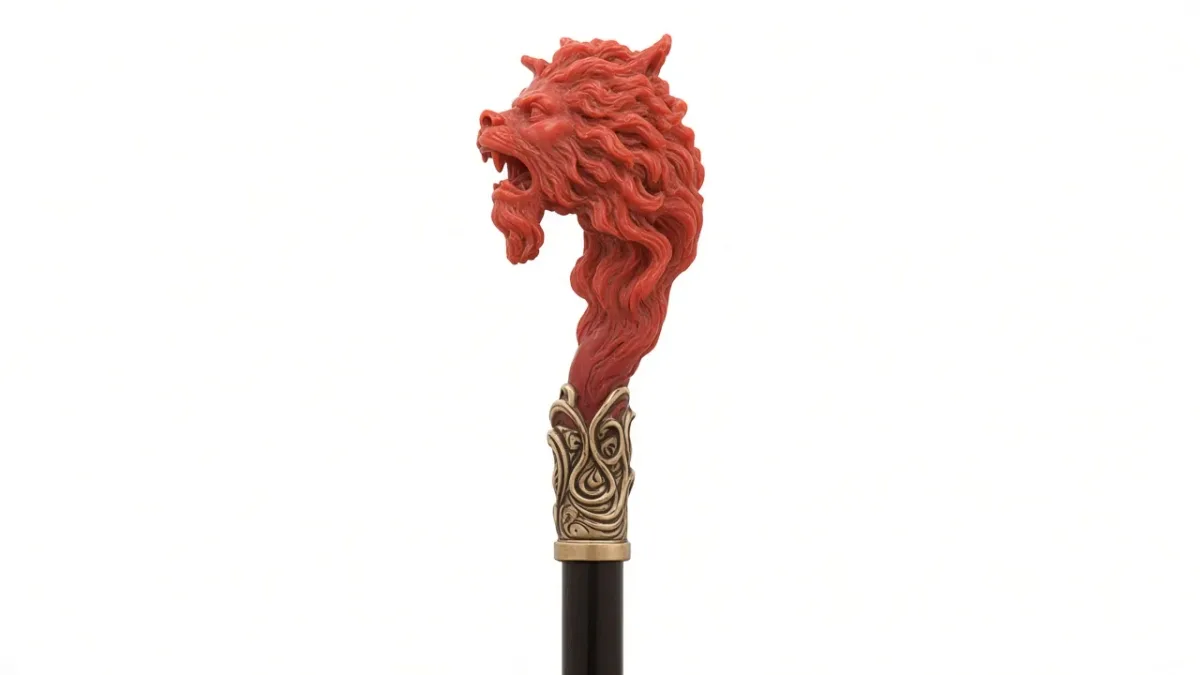
Antique Italian Walking Sticks of Naples and Florence
Identify antique Italian walking sticks of Naples and Florence by coral handles, gold collars, pietra dura shafts, micromosaic grips and later remounts.
An Italian walking stick is four joined parts: the handle (impugnatura or pomolo), the collar (ghiera), the shaft (fusto or canna), and the ferrule (puntale). There was no single national factory. Identification follows those joins, and the trades that supplied them.
Naples and Torre del Greco cut Mediterranean coral, veneered tortoiseshell, and mounted both in gold or silver-gilt. Florence supplied commesso handles and, late in the nineteenth century, entire hardstone shafts. Rome set mosaico minuto plaques into cylindrical grips for visitors on the Grand Tour. A stick bought as "Italian" may combine a Campanian handle, a malacca shaft shipped as canna d'India, and a later English ferrule. The joins, not the sales label, date the object.
Museum pieces kept in Naples record ordinary length and ordinary loss. A bastone da passeggio in the Certosa e Museo Nazionale di San Martino (ICCD NCTN 00311573, inv. 23341, inventoried 1953) measures 91.5 cm and has no ferrule. Cataloguers dated it, with reservation, to 1785 on stylistic grounds and listed gilt brass, Indian cane, and modelled painted porcelain. They assigned the porcelain to Chantilly, not to a Neapolitan kiln. The stick documents a Naples collection, an imported mount on canna d'India, and a missing puntale as expected wear.
Shaft, handle, collar and ferrule
Handles take a few repeating forms. A knob or faceted pommel sits on axis with the shaft. An L- or T-grip (the tau) is held across the palm. Figural heads, opera canes carried high at the chest, and parasol handles share the same goldsmiths' and coral workshops even when the shaft is later or missing.
Shafts in Italian retail were often tropical. Malacca and other rattans appear in Italian inventories as canna d'India. Ebony, coconut wood, and fruitwood occur on signed Neapolitan sticks. Tortoiseshell veneer over a wooden core is a Naples speciality of the later nineteenth century, parallel to Paris rather than to Florence. A black marble shaft with lapis rings is a Florentine exception, not a type.
The collar is the dating hinge. It hides the dowel or screw that fixes handle to shaft, and it is where a goldsmith's punch, a city assay, or an 800 standard mark is most likely to survive. After the Italian assay law of 2 May 1872, n. 806, silver mounts should carry a guarantee punch; after 5 February 1934, n. 305, a numbered lozenge identifies the maker. Many earlier collars are unmarked gold or gilt brass. A later collar on an older handle is the commonest sophistication in the trade.
Documented lengths cluster just under a metre. The San Martino cane is 91.5 cm. The Duca di Martina siren cane discussed below is 87.8 cm. A coconut-wood stick stamped G.BUONGIOVANNI, sold at Christie's South Kensington on 14 January 2004, is 94 cm. Giovanni Montelatici's signed 1890 hardstone cane is 87.6 cm. Vincenzo Miranda's coral Neptune traveling cane, catalogued by Bonhams as Naples, circa 1905, is 88.9 cm and comes apart in three painted fruitwood sections joined by two silver-gilt collars. A stick much shorter than about 85 cm, or one whose ferrule sits proud of a freshly cut tip, needs a construction argument before any city attribution.
Naples: coral, gold and the stick trade
Giovanni Buongiovanni opened the shop called Al Giapponese in 1860. The house history places retail at Via Chiaia 76/77 and Via Roma 198, with the workshop in Via Sergente Maggiore, and lists umbrellas, parasols, walking sticks, and fans as the output. The cane trade and the fan trade shared handles, collars, and tropical shafts. Christie's recorded an applied maker's seal stamped G.BUONGIOVANNI on an early-twentieth-century coconut-wood stick with a reclining female handle. The stamp dates a Naples retailer. It does not, by itself, prove that the figural handle was carved in the same rooms that assembled the shaft.
Coral and tortoiseshell were the expensive Neapolitan materials. A royal school for coral working was established at Torre del Greco by decree of 23 June 1878. From 1887, as the Regia Scuola d'Incisione sul Corallo e di Arti Decorative e Industriali, teaching extended to cameo shells, tortoiseshell, ivory, mother-of-pearl, lava stone, and hardstones: the handle materials of the late stick trade. The school's Museo del Corallo, in the former Carmelite convent, opened on 3 April 1933. ICCD cards there record detached handles, which is how many "Italian canes" now survive.
One handle (NCTN 00815103) is given to Domenico Porzio, born at Torre del Greco on 12 July 1853 and dead in 1927, and dated 1900–1920: wood with agemina and gilding, 24 × 10 cm. Another (NCTN 00815552), dated 1900–1930 and assigned to the school of Renato Ferracciù (Brescia 1888–Capri 1951), is a 25.5 × 4 cm grip in turned calcareous alabaster with ivory and red-coral inlay. Both are handles without shafts. A collector who buys a "Porzio cane" or a "Ferracciù cane" is usually buying a later fusto unless the collar and shaft can be shown to be original.
Goldsmiths in Naples mounted those grips. Bonhams sold, in the Eddi Van Auken collection, a traveling cane catalogued as Torre del Greco coral and 800-standard silver-gilt, marked for V. Miranda, Naples, circa 1905. The carved coral handle is a roaring horned Neptune, 11.4 cm high; the shaft is painted fruitwood in three sections; the ferrule is silver-gilt; overall length 88.9 cm; hammer with premium US$5,376. The punch on the lower collar reads as a maker's or retailer's name, not as a later numbered lozenge. Vincenzo Miranda of Via Roma 306 appears among Neapolitan silversmiths registered after the 1934 law. The cane may therefore carry a pre-register punch by the same shop, or the auction date may be a little early. Either way, the construction is Neapolitan: a coral head, an 800 gilt collar, and a shaft designed to unscrew for travel.
A related object, sold at Bonhams Knightsbridge on 6 October 2010 (lot 236, £600 including premium), is a late-nineteenth- or early-twentieth-century gold, coral, and tortoiseshell parasol handle retailed by Michele Piscione, Naples. The coral tau is carved with a frog among oak and acorns; the gold mount sits on tortoiseshell; cased length 26.5 cm. It is not a walking stick. It shows the same materials and the same retail practice: a named Naples goldsmith selling a coral-and-shell grip that could be fitted to a stick, a parasol, or a later shaft.
Neapolitan silver hallmarks on a collar should be read as they are on a coffee pot. NAP and related city punches belong to the older regime. An 800 mark without a lozenge is consistent with the 1872 law. A numbered NA lozenge is post-1934. Base-metal collars stamped with a shop name, as on the Buongiovanni stick, are retail marks, not assay.
Tortoiseshell piqué (gold inlaid and fused by heat, without glue) is documented on Torre objects in the same museum. Coral and tortoiseshell are restricted materials in current trade. That legal fact does not authenticate a handle. Celluloid, bakelite, and dyed bone remain the usual substitutes.
Placido de Sangro, duca di Martina (born Naples 1829), formed a decorative-arts collection in the second half of the nineteenth century. His heirs gave it to the city in 1911. The Museo Duca di Martina has occupied Villa Floridiana since 1931. ICCD NCTN 00295990 records, in sala 6, "vetrina bastoni," a siren cane, inv. 1622 (1930): gold, iron, wood, and carved jasper, 87.8 × 10.5 cm, dated 1740–1760 and attributed, from the literature, to a German workshop. The vitrine proves that sticks were collected in Naples as European luxury goods. It does not make every cane in that case Neapolitan.
Florence: commesso handles and signed hardstone shafts
Florentine commesso in pietre dure is a cut-and-fitted hardstone picture, not a tessera mosaic. The grand-ducal Galleria dei Lavori, founded in 1588 and later the Opificio delle Pietre Dure, is the institutional background. Cane handles are a late, portable use of the same cutting bench.
Giovanni Montelatici (1864–1930) is the signed name that can be checked on a stick. Bonhams sold, on 8 December 2025, a black-marble, agate, and lapis cane inscribed above the ferrule G. MONTELATICI FECIT / FLORENTIA AD 1890. The faceted handle carries a fleur-de-lis, a falconer's gauntlet and hood, and an hourglass, with a falcon's head on the terminal. Overall height 87.6 cm; handle 7 cm; diameter 3.8 cm; two lapis rings on the marble shaft; metal ferrule; sold for US$3,200 including premium. Provenance ran through Il Segno del Tempo, Milan, to the Van Auken collection in 2013. The inscription is a maker's signature on the object, dated and placed. That is rarer than a shop stamp on a collar.
The 1890 cane predates Montelatici's later shop. In 1898 he went into business with Galileo Chini (1873–1956). They showed jointly at the 1900 Paris Exposition Universelle. After that success Montelatici established La Musiva on Via Arnolfo, with Chini as artistic director, and was later joined by his sons Mario and Alfonso. A stick dated 1890 cannot be a Musiva product. It can be an early signed work by the same cutter. Unsigned floral commesso knobs on crystal or silver, often catalogued only as "Florentine, nineteenth century," need the stone-cutting, not a famous surname, to carry the attribution. The published Florentine pietra dura criteria (sawed siliceous pieces fitted without a grout line, slate or marble backing, natural stone colour used as modelling) apply to a handle as to a plaque.
Hardstone shafts are heavy and brittle. A marble fusto with two decorative rings and a metal ferrule, as on the 1890 cane, is a luxury object, not a street stick. Most Florentine contributions to the trade are handles: a commesso disk or a carved hardstone knob set into a gold or silver collar on a wooden or malacca shaft. A mismatch of collar alloy, shaft wood, and handle stone is more common than a fully signed ensemble.
Rome: micromosaic grips for the Grand Tour
Giacomo Raffaelli was born in Rome on 2 February 1753 and died there on 11 October 1836. In the last three decades of the eighteenth century his studio at San Sebastianello, on the corner of Piazza di Spagna, sold plaques, tables, and jewels in mosaico minuto to foreign visitors. Around 1775 he and Cesare Aguatti (sometimes written Agnatti) developed spun-enamel micromosaic from drawn glass rods, a technique the Vatican Mosaic Studio, organised as a permanent workshop under Benedict XIII in 1727, later practised for small objects. In 1804 Raffaelli founded a mosaic school in Milan for the Napoleonic government and remained there until 1820. After his return he worked with his son Vincenzo in Via del Babuino.
A cylindrical walking-stick handle attributed to his workshop was offered by Colasanti in Rome (ANCA, 20 November 2024): late eighteenth century, 8 × 3.8 cm, naturalistic ground and a circular plaque outlined in yellow gold with a goldfinch on a branch, in a case. The catalogue cites Anna Maria Massinelli, Giacomo Raffaelli, maestro di stile e di mosaico (Aska, 2018), p. 227. Estimate EUR 4,000–6,000. The object is a handle, not a complete cane. The goldfinch plaque is the diagnostic field; the gold outline and the minute tesserae are what separate a period Roman grip from a later tourist disk glued to a new shaft.
Roman micromosaics on canes follow the same rules as on snuffboxes. Spun tesserae, a dark mastic, and a gold or gilt-metal bezel are consistent with the late eighteenth and early nineteenth centuries. Large, even tiles, a bright modern grout, and a view of St Peter's printed more than built, point to later work. A handle sold without its shaft should be catalogued as a handle.
Later shafts and common mistakes
The market is full of assembled sticks. A period coral or micromosaic grip on a twentieth-century malacca shaft with a new brass ferrule is the ordinary case, not the exception. The Miranda traveling cane is the useful counter-example: three shaft sections, two matching silver-gilt collars, and a ferrule in the same alloy. Continuity of metal and of screw threads matters more than a verbal Naples attribution.
Plastic coral is even in colour, warm to the touch only after handling, and often moulded with a seam. Corallium rubrum shows growth rings, drill holes from the branch, and a slightly chalky fracture. Dyed bone takes colour in the pores. A "coral" handle with no pits and a perfectly circular section is suspect.
Unsigned micromosaic disks set into cheap gilt collars are souvenir work from the later nineteenth century and after. They can still be Roman. They are not Raffaelli workshop objects. A dealer label "Giacomo Raffaelli" on a stick whose plaque is a generic Colosseum, without a cited comparable, is a sales claim.
Florentine commesso is not the same as Roman micromosaic. One is cut hardstone fitted edge to edge. The other is glass tesserae in mastic. Catalogues that use "mosaic handle, Florence" for a micromosaic grip are mixing the two trades.
Shop stamps (G.BUONGIOVANNI, V.MIRANDA, a cased Piscione handle) identify a retailer or goldsmith. They do not date the shaft. Assay punches date the collar metal. A signature incised in the stone, as on the 1890 Montelatici cane, dates the hardstone work. Those three classes of mark should not be collapsed.
Condition arguments are short. A missing ferrule is recorded on the San Martino cane and is common. A replaced ferrule is acceptable if disclosed. A recut tip that shortens the shaft by several centimetres changes the balance and should be measured. Hairline cracks in coral, lifting tortoiseshell veneer, and losses to micromosaic tesserae are structural, not "patina."
FAQ
How long should an antique Italian walking stick be?
Documented museum and auction examples cited above run from 87.6 cm to 94 cm. A complete stick much under 85 cm, or one whose ferrule does not belong to the shaft, needs a separate explanation.
Do Naples coral canes carry workshop marks?
Sometimes. Collars may be punched 800, with a city or maker's mark, or stamped with a shop name. Many coral handles are unsigned. Detached grips in the Torre del Greco Museo del Corallo are catalogued by attribution and material, not by a serial mark.
How can Florentine pietra dura be told from Roman micromosaic on a handle?
Pietra dura (commesso) is sawn hardstone fitted without grout. Micromosaic is glass smalti, often spun, set in mastic. Florence signs in stone (Montelatici, 1890). Rome signs, when it signs at all, on the micromosaic tradition of Raffaelli and the Vatican studio, not on a marble shaft.
Are later shafts on period handles common?
Yes. Handles outlived shafts. A collector should price the grip and then ask whether the collar metal, screw, and canna are of one campaign. Traveling canes with matching sectional collars are the exception that proves the join.
What materials now restrict export?
Mediterranean coral and tortoiseshell appear on the best Neapolitan sticks and are restricted in many jurisdictions. That status is a shipping fact. It is not a certificate of age.