
Italian Porcelain: History, Capodimonte, Ginori & Vezzi
Discover the history of Italian porcelain, from Vezzi and Capodimonte to Vinovo, Doccia and Ginori, and learn how Italy's great porcelain traditions evolved.
Porcelain first arrived in eighteenth‑century Europe as a wonder from China, prized as “white gold” for its brilliant translucence, hardness and exotic decorations. European courts and collectors became obsessed with Asian porcelain, fueling intense efforts to solve its secret. Porcelain was technically difficult: true hard‑paste porcelain requires kaolin and petuntse in precise proportions and very high kilns. For centuries only Chinese and Japanese craftsmen knew how. When Saxon alchemist Johann Friedrich Böttger finally made European porcelain at Meissen in 1708, it sparked a craze. Not long after (1710s–1720s) other courts founded manufactories in Vienna and elsewhere. Italy’s own experiments began at this time: in 1720 the Venetian goldsmith Giovanni Vezzi opened the first Italian hard‑paste porcelain factory. Venice’s Vezzi factory (1720–27) was Europe’s third such enterprise, importing expertise from Meissen and Vienna. Less than 200 pieces survive. The Vezzi workshop produced delicate white wares (cups, teapots, some figurines) often decorated in chinoiserie style. All were marked “Venezia” or “Vena” (for Venezia) in blue. Despite technical success, Vezzi lacked royal backing and ceased by 1727 under financial pressure. In 1727 no more Venetian porcelain was made until later ventures in the late eighteenth century.
Capodimonte: the Neapolitan Royal Porcelain (1743–1759). The most famous Italian porcelain story began in Naples under King Charles of Bourbon and his wife, Maria Amalia of Saxony. In 1743 Charles founded the Real Fabbrica di Capodimonte in the royal park of Naples. Maria Amalia – herself a Saxon princess familiar with Meissen porcelain – guided the factory’s artistic direction. Chief modeller Giuseppe Gricci (formerly of Florence and Doccia) and a team of painters and chemists were brought in. The Capodimonte factory was intended to rival Meissen and Sèvres in quality. Its style reflected late Rococo tastes: exuberant sculptural forms, naturalistic bouquets, and mythological or courtly subjects. Figures and groups of allegorical or religious theme were modelled in high relief; table services featured painted floral garlands and gilding. Early Capodimonte favourites were putti and animals inspired by Meissen models (some were actually brought by Maria Amalia), plus fanciful “marine” forms like vases shaped as shells and corals. Porcelain colors were bright; gilding was lavish. The royal hallmark was the giglio borbonico (Bourbon lily) in blue, sometimes with a crowned “N” – symbols seen on surviving wares.
A centerpiece of Capodimonte was the Porcelain Boudoir (salottino) built 1757–59 for Queen Maria Amalia in the Palace of Portici. Every surface of the room was clad in high‑relief white porcelain panels painted with chinoiserie scenes. The boudoir was designed by Gricci and other Capodimonte artists and exemplified the factory’s technical and artistic height. Over its short life the Capodimonte manufactory produced graceful tea services, elaborate centerpieces, figural groups and decorative vases – objects now prized in Naple’s Museo di Capodimonte and other collections.
When Charles became King of Spain in 1759 as Charles III, he closed the Neapolitan factory after only sixteen years. He relocated its entire operation to Madrid, founding the Real Fábrica del Buen Retiro. Giuseppe Gricci and 52 Italian artisans (sculptors, painters, mould-makers and technicians) went to Spain with their equipment and prepared paste. Thus the original Capodimonte tradition passed to Spain. In Naples, porcelain making lay dormant until King Ferdinand IV (Charles’s son) revived it in 1771, establishing the Real Fabbrica Ferdinandea in Capodimonte. (These “Ferdinandea” wares form a later chapter distinct from the Bourbon Capodimonte pieces.)
Northern Italy: Piedmont’s Porcelain Revolution. In Piedmont the challenge of porcelain was taken up by chemist Vittorio Amedeo Gioanetti (1729–1815). In the 1770s King Victor Amadeus III of Sardinia sponsored a factory at Vinovo (near Turin) under Gioanetti’s direction. He had earlier experimented at Vische (near Turin) with kaolin from Saxony. By 1780 Gioanetti had acquired the failing pottery of Brodel & Hannong and, with royal patents, reopened it as a porcelain works in Vinovo. Working under state protection (first Savoyard, then even under French rule), Gioanetti conducted extensive chemical research on local clays. He discovered a high‑magnesia clay that produced a hard, slightly translucent paste firing at relatively low temperatures. His Vinovo porcelain developed superb whiteness and vibrancy. French experts noticed: Jean‑Baptiste-Antoine Brongniart of Sèvres visited Vinovo in 1807 and studied Gioanetti’s formula, then praised the white body and low firing required.
Vinovo wares (1780–1815) included graceful tableware, realistic flower sprays and classical figurines. They became comparable to the best European porcelains. Indeed, Treccani notes that after improvements Gioanetti’s production “perfectly withstood comparison with the most acclaimed European [porcelain], and easily imitated Oriental production”. His factory used a distinctive blue mark: a gothic “V” topped by a small cross (often with his initials “D.G.” for Doctor Gioanetti). Royal decrees in 1800–01 under French administration even confirmed that Gioanetti had “introduced and brought to perfection the manufacture of porcelain” in Piedmont. After Gioanetti’s death in 1815, the Vinovo factory continued briefly and finally closed around 1820.
Florence and Doccia: Ginori’s Porcelain Legacy (1737 onward). In Tuscany, Marquis Carlo Andrea Ginori (1702–1757) founded the Manifattura di Doccia in 1737 at his villa in Doccia (near Florence). For over a century the Ginori family ran this factory, making it Italy’s longest‑lasting porcelain tradition. Ginori poured enormous resources into research. He collected and analyzed raw materials from all over Tuscany (eventually amassing thousands of clay and mineral samples). He visited Vienna and hired expert craftsmen who had worked for Du Paquier. Gaspero Bruschi became his first sculptor. Ginori even reputedly planned expeditions to China and Japan to learn Eastern porcelain techniques.
Doccia porcelain initially showed Baroque and Rococo ornament – fruit- and shell-shaped vases, Neoclassical mythological figures, and lively figurines. As fashions changed, the factory evolved through Neoclassicism, Romanticism and beyond. It produced delicate flower groups, realistic botanical models, and later a wide variety of table services and decorative objects. Under succeeding directors (Lorenzo Ginori, Carlo Leopoldo Ginori and others) Doccia innovated new paste recipes and glazes. In 1896 the firm merged with Milan’s Richard ceramics to become Richard-Ginori, which continued into the twentieth century. Throughout, “Ginori porcelain” remained synonymous with refined Italian style – from 18th‑century Rococo vases to Gio Ponti’s 20th‑century designs.
Other Centers and Influence. After Vezzi’s closure, Venice saw small porcelain ventures: around 1758 the Austrian Johann Hewelcke made porcelain there, and in 1765 Venetian noble Geminiano Cozzi opened another factory that operated into the 19th century. These produced fine tablewares decorated in Chinese or European styles. Elsewhere in the Veneto, the town of Nove (near Bassano del Grappa) became known for its ceramics. From the 1760s the Antonibon family ran a factory at Nove, making richly painted maiolica and some porcelain figures (often pastoral or naturalistic in theme). In Lombardy, no major eighteenth‑century porcelain factory took root (Milan’s later Laveno factory dates to 19th century). In Sicily and southern Italy outside Naples, porcelain production remained very limited.
Back in Naples, King Ferdinand IV’s Real Fabbrica Ferdinandea (founded 1771) revived palace porcelain. Although later than Capodimonte, it became prolific: by 1780s Ferdinandea decorated entire court dinner services with scenes of Italian vistas and mythology. During the Napoleonic era, Queen Maria Carolina’s brother-in-law (Prince Murat) ran the factory under her regime; after Napoleon fell, the Bourbon Bourbon restored Ferdinandea as the Royal Porcelain of Naples. In all, Italian porcelain factories transitioned from tiny court workshops into larger commercial enterprises by the 19th century. The Napoleonic Wars and Italian unification brought disruptions, but companies like Ginori adapted to industrial methods and a growing middle‑class market. By the late 19th century, porcelain ranged from luxury centerpieces to factory‐made dinner services across Italy.
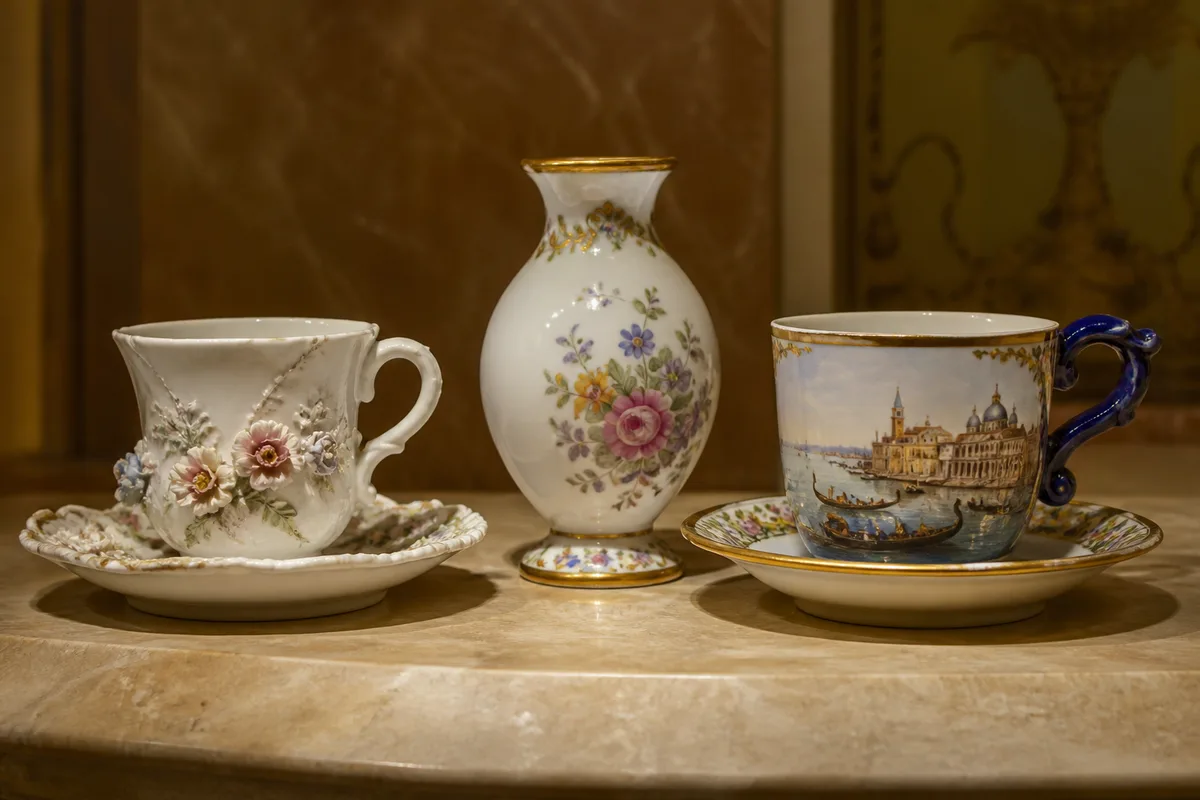
A Closer Look at Italian Porcelains. Visually, Italian porcelain traditions can often be distinguished by style. Capodimonte (Bourbon Naples, 1743–1759) is renowned for its Rococo exuberance: exuberant floral bouquets and vines, vividly painted spring scenes and putti, and sculptural forms (lamps, teapots, centerpieces) that resemble carved marble covered with flowers and gilding. Doccia/Ginori ware started with rococo motifs but later embraced Neoclassical subjects (mythology, heraldries, chinoiserie, botanical studies) in a delicate, realistic style. Vinovo pieces are generally plainer in shape but finely modeled, often painted with soft pastel colors; early Vinovo wares imitated Meissen designs (gentle blue Chinese scenes, bird motifs, floral sprigs) but later gained a distinctive Piedmontese palette. In service design, Capodimonte favored arabesque and shell‐shaped ornament, whereas Ginori services often had buff‑ground earthenware imitating Wedgwood, or later bright enamels on white paste.
Porcelain’s rise in Italy also paralleled decorative trends: porcelain figurines echoed popular sculpture (religious statues, genre bamboccianti, commedia dell’arte characters), while tableware copied silver and glass shapes. For instance, Capodimonte “sea-shell” cups and Nymphaeum tureens took direct inspiration from lavish silver pieces. Both Bourbon Naples and Piedmont courts used porcelain services as diplomatic gifts: Maria Amalia of Naples received Meissen and Vienna services at her wedding, influencing local taste. Over time, Italian porcelain moved from exclusive royal “toys” toward large production of elegant dinnerware for elites. By the 19th century, exports and broader sales under brands like Richard-Ginori made Italian porcelain globally known (e.g. Ginori’s imprints of Gio Ponti or Faenza’s jasperware).
Identifying Antique Italian Porcelain. For collectors, knowing the history is vital. Key clues include marks, paste and glaze, decoration style and provenance. Early Capodimonte pieces (1743–59) may bear the Bourbon lily or a crowned “N” in underglaze blue; later “Ferdinandea” wares used slightly different marks. Vinovo porcelain is usually marked with a turquoise‑blue “V” surmounted by a cross (sometimes with “DG” for Gioanetti). Doccia wares often have impressed or painted factory marks (an asterisk or the word “Ginori” or later “Richard-Ginori”), but some early pieces were unmarked or simply initialed by decorators. However, marks alone are not foolproof (many fakes and modern “Capodimonte” imitations exist). One must also examine paste color and texture: Vinovo’s body is very white and slightly gritty, Capodimonte’s is creamy with crisp modeling, Ginori’s porcelain tends to be translucent with a fine glaze. Style of painting helps too: Capodimonte figures are often more sculptural and baroque in spirit, whereas Doccia figures can be more life‑like or classical. Provenance is essential: original royal factory pieces will rarely appear without documentation. Condition matters: even a minor rim chip can greatly affect value. In sum, authentic antique Italian porcelain is identified by a combination of factors (mark, craftsmanship, materials, style and history). A factory mark should prompt careful research, not blind trust.
Modern “Capodimonte” Porcelain. An especially common confusion: the name Capodimonte today is used by many contemporary manufacturers (often in Europe or Asia) to denote porcelain made in the Capodimonte style. These items bear marks or stickers saying “Capodimonte” but have no link to the 18th‑century factory. Collectors should remember that true Capodimonte porcelain was made only in Naples in 1743–1759 (and a revived Ferdinandea factory after 1771). Thus a modern figurine signed “Capodimonte” is usually a decorative reproduction, not a historic artifact. Careful examination of mark style, material and overall quality is required to avoid misattribution.
In sum, Italian porcelain began as part of Europe’s quest to replicate exotic Chinese ceramics. Early pioneers like Giovanni Vezzi and Carlo Ginori studied Oriental and Meissen methods, striving to make “white gold” in Italy. By mid‑18th century, under royal patronage (Naples and Turin) these efforts bore fruit in richly decorated wares that fused foreign influence with Italian artistry. Capodimonte porcelain epitomized the Rococo taste of Naples’ Bourbon court, while Vinovo and Doccia developed their own identities: Vinovo blending science and refinement, Doccia blending tradition and innovation over generations. Over time porcelain in Italy moved from princely “curiosities” to a sophisticated industry — a legacy still visible in museum collections and antique markets. Today, Italian porcelain remains prized for its beauty and craftsmanship. Knowing the distinct history of each factory — their dates, marks, materials and motifs — is essential for collectors and historians alike. The story of Italy’s “white gold” reminds us how a material once locked in the East became transformed into something uniquely Italian, reflecting shifting tastes from court grandeur to modern design.