
Murano Glass: History, Techniques, and How to Spot Authentic Pieces
A complete guide to Murano glass: Venetian origins, filigree, millefiori and sommerso techniques, antique vs modern markers, and collector tips.
Murano glass is the iconic Venetian art-glass tradition, forged over a millennium on the island of Murano, Venice. Its history spans from early medieval glassmaking through the Renaissance, Baroque extravagance and 19th‑century revival to the 20th century’s design innovations. Today Murano glass is prized for its craftsmanship and rich heritage.
History of Murano Glass
Murano’s glassmaking dates back over a thousand years. The earliest record of a Venetian glassmaker is from 982 AD, establishing Venice (and Murano) as the world’s oldest continuous art‑glass center. By the 1200s, Venice was the premier hub for luxury glass in Europe. In 1291 the Venetian Republic officially moved all glass furnaces from the city to Murano (to prevent fires), cementing “Murano has since been the island of glass” as its sole economic activity. By the late Middle Ages Murano produced everyday wares (beakers, bottles, lanterns) for export: dozens of furnaces operated by the 1400s, marking Venice/Murano as Europe’s glassmaking capital. Importantly, Murano’s craftsmen inherited soda‑glass recipes from Byzantine and Middle Eastern traditions, favoring thin clear-blown forms and bright colors.
Medieval Origins to Renaissance
Early Venetian glassmakers (by 982 AD) drew on Eastern influences. In the 1400s Murano artisans dominated luxury glass: Angelo Barovier (1405–1460) invented nearly transparent cristallo. Renaissance demand for art glass was driven by wealthy patrons; Venetian/Murano glass became Europe’s finest mirrors, vessels and goblets. Glassblowers introduced enamel, engraving (e.g. Vincenzo dal Gallo’s fine diamond‑point engraving, c.1534) and the opalescent vetro lattimo (milk-glass), imitating Chinese porcelain. Filigree techniques also emerged: craftsmen laid slender opaque canes into clear glass, foreshadowing the famed vetri filigranati of later centuries.
Baroque and 18th Century Flourishing
The Baroque era saw both exuberance and challenges. Murano glass became highly decorative, but by the 1600s it was in decline: many glassmakers emigrated to Bohemia and beyond, and Bohemian glass began to undercut Venetian exports. In the mid‑1700s Giuseppe Briati (1686–1772) sparked a resurgence by adopting Bohemian techniques with Venetian flair. He pioneered the classic “chiocche” multi‑arm crystal chandeliers (festooned with glass leaves and fruit) and huge centrotavola table centers. Vetro a specchio (decorated mirrors) and elaborate servizi da tavola (centerpieces) became fashionable. Meanwhile, Murano artisans perfected “mimetic” glasses: vetro calcedonio (banded opaque glass resembling agate, rediscovered mid‑1800s), and the perennial favorite lattimo (white milk-glass) decorated with colored enamels and gold. The Miotti and Bertolini families held a monopoly on gilding Murano glass in the 1730s.
19th Century Crisis and Revival
The fall of Venice (1797) plunged Murano into crisis. By the early 1800s only glass beads (perle di conteria, rosetta, a lume) remained a flourishing industry. A few inventive masters began reviving lost arts: e.g. Domenico Bussolin and Pietro Bigaglia revived filigrana and avventurina work; Vincenzo Moretti (1835–1901) perfected millefiori murrine canes and trompe-l’œil portraits in glass; Lorenzo Radi (1823–1901) chemically re-figured calcedonio (1856). International exhibitions from the 1860s (e.g. First Venice Biennale 1895) showcased Murano’s comeback. New furnaces were founded (Fratelli Toso in 1854, Salviati in 1859) to produce both reproductions for antiques dealers and inventive new styles.
20th Century to Present
Murano glass experienced another golden age in the 20th century via design collaborations. In 1921 Venini brought in Vittorio Zecchin as its first artistic director. Artists like Napoleone Martinuzzi (glass innovator), Guido Balsamo Stella and Carlo Scarpa worked with firms to create Art Nouveau and Art Deco pieces. From the 1940s onward Murano masters experimented boldly: Flavio Poli’s vetri sommersi (layered colored glass, e.g. his 1954 Compasso d’Oro vase), Archimede Seguso’s lace-like filigree “Merletto” (1950s), Laura de Santillana’s organic forms, and Toni Zuccheri’s sculptural vases (1980s) exemplify Murano’s modernist output. Through the late 20th century Murano remained at the nexus of craft and design.
Materials and Techniques
Murano glass is soda–lime glass (with lead in historic cristallo). Artisans developed many special glass materials and techniques unique to Murano:
Cristallo: The ultra-clear glass invented by Angelo Barovier in the 15th century. Made with quartz and minimal impurities, it looks like rock crystal.
Vetro Lattimo: A white, opaque “milk-glass” formulated in the Renaissance to imitate porcelain. Lattimo pieces were often enameled or incorporated into filigree.
Calcedonio: A marbled opaque glass (resembling chalcedony) known since Roman times and revived in the 19th century by Lorenzo Radi. It mixes colored frits (e.g. copper, silver, cobalt) into white or clear glass.
Avventurina (Goldstone): A glass with shimmering copper or mica inclusions invented in the 17th century. The glowing, rust-colored bits create a glitter effect (“aventurine” effect). The formula was lost and recovered multiple times into the 1800s.
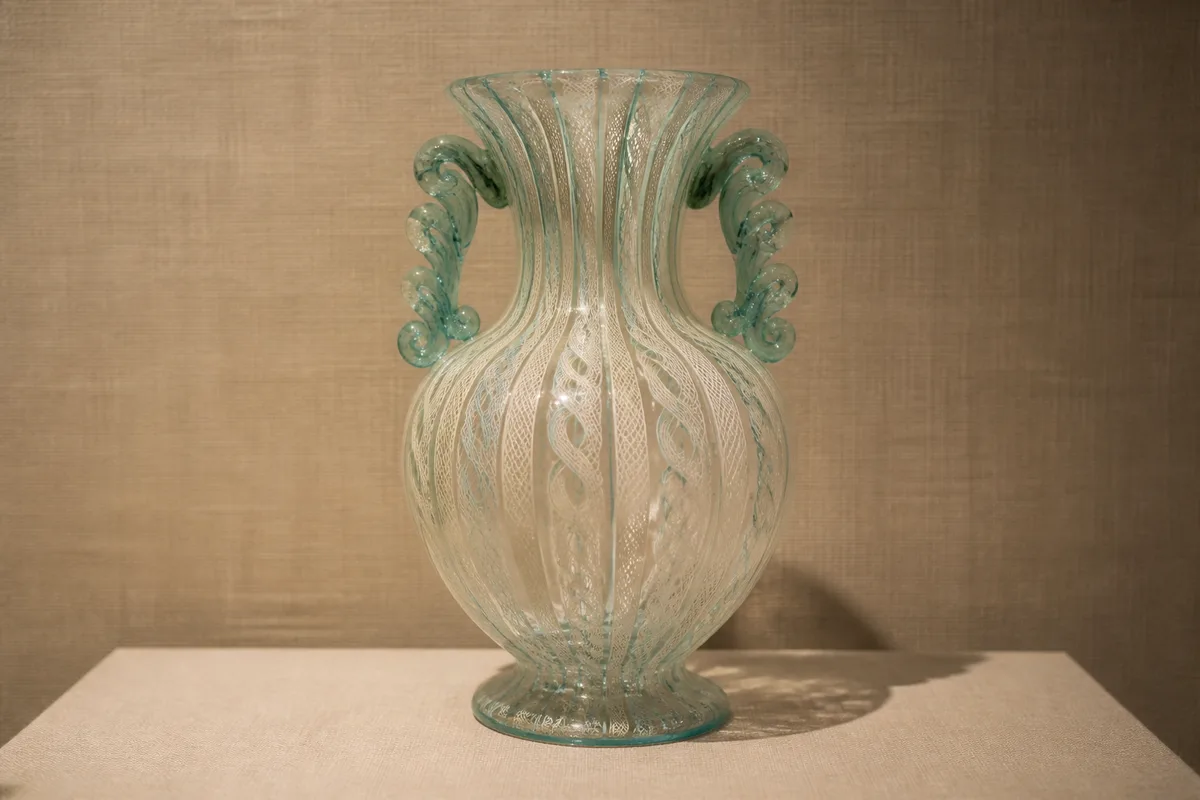
Filigrana (Glass Filigree): Murano’s signature technique of embedding glass threads. In mezza filigrana, canes containing a single white or colored filament are fused into a matrix. In reticello (double filigree), two filigree cylinders (one twisted clockwise, one counterclockwise) are combined to form a net pattern with trapped air bubbles. Zanfirico (also filigrana a retortoli) uses canes whose filaments are twisted into spirals – a method patented in 1527 by Filippo and Bernardo Catani and named after 19th‑c. antiquarian Sanquirico. These techniques produce the fine lace-like threads seen in classic Murano vases.
Murrine (Millefiori): Cane‑slice mosaics. Thick glass canes are built with concentric colored layers (often with a star pattern) and then stretched and cut. The slices (murrine) can be laid like tesserae and heated into colorful patterned glass. Vincenzo Moretti and Giovanni Battista Franchini (mid-1800s) refined millefiori to make ultra-thin canes and even portrait medallions.
Sommerso: Multi-layered “submerged” glass developed in the 20th century (e.g. by Flavio Poli). Two or more transparent layers of different colors are blown together so the inner color appears encased – a technique prized for depth of color.
Incalmo: Hot-blowing separate blown elements and fusing them seamlessly. Common in 20th‑c. Venini work, allowing distinct colors to meet at glass joints.
Pulegoso: Thick bubbly glass invented by Napoleone Martinuzzi in 1925 (Venini). It contains numerous tiny air bubbles (“puleghe”) that give a frothy opalescent look.
Others: Venitian artisans also mastered gold-leaf inclusions, enamel painting, diamond‑point engraving and lost-wax casting. Murano glassblowers still produce chandeliers (lampadari), sculptures, beads and more using these legacy techniques.
Antique vs Modern Murano Glass
Murano glass today ranges from collectible antiques to modern decor. Key differences:
| Feature | Antique Murano (~pre-1950) | Modern Murano (mid-20th C–present) |
|---|---|---|
| Production | Entirely handcrafted, often by small family furnaces; no mechanical processes. | Still handmade, but larger studios and some mechanization. Some pieces machine-finished. |
| Materials/Composition | Traditional soda–lime (or leaded cristallo) recipes; aged patinas. | Similar glass base but may include modern colorants; often clearer/conformant. |
| Weight & Feel | Generally heavier “bullicante” pieces with thicker walls; pontil scar on base. | Many modern pieces are lighter or thinner; bases often polished (no raw pontil). |
| Imperfections | Natural irregularities: tiny bubbles, wavy surfaces, uneven threads. Such “imperfections” indicate handwork. | High-end pieces also have small bubbles, but cheap reproductions can look too perfect (no bubbles) or have casting marks. |
| Decoration Style | Classic forms and motifs (gilding, Rococo or Art Nouveau styles, traditional filigree patterns). | More diverse: abstract shapes, vibrant color contrasts; blends old techniques (e.g. incalmo, filigrana) with new design sensibilities. |
| Markings/Labels | Older pieces lack modern labels. Bases may have ground/polished pontil or metal mounts. | Modern authentic pieces often bear the official “Vetro Artistico® Murano” label/sticker (and a serial code), or manufacturer’s signature/etching. |
| Value & Rarity | Antique Murano (18th–early 20th c) is rarer and sought by collectors; high craftsmanship. | Many mid-century and contemporary Murano items exist; iconic designer pieces are valuable, but mass-market items are less so. |
The table above summarizes typical distinctions. When evaluating a Murano item, look for signs of age (wear on base, glass patina, ground pontil), traditional techniques (hand-rolled threads, cane inclusions) and official marks. Modern Murano producers may affix a Vetro Artistico® Murano sticker (created by 1994 Veneto law) or include an engraved signature. In contrast, a museum-quality antique will never have a printed sticker (that scheme postdates 1994) and will show manual finishing on the base. Overly uniform or bubble-free work on a supposed “antique” piece is suspicious.
Major Product Types
Murano furnaces produced every kind of glass object. Vases and bowls have always been popular showroom pieces. Classic shapes include tall serpentine sommerso vases, baluster-form vases with reticello networks, or squat millefiori bowls.
Figure: 1925 Art Deco Murano vase with spiral handles (designed by Umberto Bellotto, Compagnia Venezia e Murano). This green-and-black blown-glass vase (Corning Museum of Glass) illustrates Murano’s 20th-century modernist style.
Lighting: Murano is world-famous for its lampadari (chandeliers) and appliques. From the 1700s Briati-style multi-arm chandeliers (glass leaves and flowers) to sleek mid-century fixtures, Murano lamps come in myriad styles. Authentic antique chandeliers are heavy, ornately pruned, and often bear an older Venice-regulation date mark (Murano chandeliers were taxed).
Jewelry and Beads: Venice’s perle veneziane (glass beads) were a major export since medieval times. Types include tiny seed beads (conterie), rosetta millefiori beads (invented by Marietta Barovier in the 15th c. and featuring opaque white stars) and lampworked beads (a lume) made by drawing molten glass on a rod. The Murano Glass Museum holds large 19th‑c. bead samples, reflecting Murano’s 19th-century specialization in beads (e.g. Franchini and Bussolin companies). Today Murano beads are collectible (particularly older Rosetta-style).
Sculptural & Decorative Objects: Murano artisans also made animal figurines, goblets, bowls, perfume bottles, and architectural pieces (e.g. Venetian fleur-de-lys topiaries). For example, the museum’s 18th-century desere centrepieces combined glass with ceramics and foliage. Modern art-glass sculture (abstract fish, animals, etc.) often come from Torcello labs (e.g. Barovier & Toso’s “M’ama non m’ama” series).
Authentication and Valuation
Marks and Labels: Look for the official Vetro Artistico® Murano collective trademark. Instituted by Veneto law in 1994, this mark (a serial-numbered sticker) guarantees Murano origin. Genuine artisan Murano firms (Venini, Seguso, Barovier & Toso, etc.) also sometimes sign or etch their name on pieces. However, absence of a modern label is normal on pre‑1990s glass: older authentic Murano was unmarked. Beware “Made in Murano” stickers (often fake) on newly mass‑produced goods.
Pontil and Workmanship: An unground pontil scar (a rough mark where the blowpipe was attached) is typical of authentic hand-blown glass; a fully polished base suggests more recent polishing or machine work. Quality markers: evenly spaced, delicate filigree lines, perfectly formed murrine patterns or polished facet cuts all indicate skilled handwork. Minor bubbles or surface ripples are normal. Conversely, glass pieces with no bubbles, obvious seams, or cheap plastic plaques are suspect imitations.
Age Indicators: Genuine antique glass often shows subtle wear – slight abrasion or darkening of decoration, minute chips in gilding, a slightly “oily” patina on the glass. Odor of sulfur (from old fire clay) or crusty salt on the base can indicate age. Repaired cracks or glued sections devalue a piece. Provenance (documentation or sale history) increases value.
Forgeries and Imitations: Throughout history there have been “à la façon de Venise” copies (e.g. 17th‑c. Bohemian “Venetian style” glass). Today many overseas factories (e.g. China) produce Murano-style glassware. Key differences: often the glass is thinner or contains more flaws, and modern imitations lack the complexity of true Murano work. If a purported antique Murano lamp or vase is offered very cheaply, it is likely a modern fake. Purchasers should insist on certificates of authenticity from reputable Murano outlets.
Price Ranges & Market Trends: Antique Murano (especially 18th–19th c.) is collectible: a rare Barovier goblet or early Salviati vase can fetch thousands of euros at auction. Mid-century Murano (e.g. Venini lamps or Seguso sommerso) are also highly valued by design collectors. In contrast, common 1960s factory pieces or modern tourist-market items sell for modest prices (tens to hundreds of euros). Current trends favor signed artist pieces (Zecchin, Scarpa, etc.) and innovative modern designs (e.g. de Santillana, Zuccheri). Always compare similar items on auction sites or consult an appraiser for precise valuation.
Valuation Checklist: Examine the following to assess authenticity and value:
| Criterion | Check |
|---|---|
| Provenance | Obtain any history of ownership; collector or museum provenance adds value. |
| Condition | Inspect for chips, cracks, or repairs. Mint pieces command premiums. |
| Glass Quality | Look for bright, even color and clarity. Modern chemical flaws (cloudiness) devalue. |
| Workmanship | Evaluate complexity of techniques (fine filigrana, murrine, etc.) – high skill = higher value. |
| Pontil Mark/Base | Rough pontil and ground base grooves indicate hand-blown authenticity. |
| Signatures/Labels | Genuine Murano pieces (post-1990s) bear Vetro Artistico Murano stickers or etchings. Non-Murano forgeries will not. |
| Rarity/Design | Identify unique artists (e.g. signed Barbini, Bosa, Martinuzzi). Unusual colors or forms often sell for more. |
| Comparable Sales | Check auction results or antique dealers for similar items. |
| Price | If price seems “too good to be true” for an antique, be wary – authentic Murano seldom sells for only a few euros. |