
How to Identify 19th-Century Italian Furniture from Renaissance Copies
How to tell 19th-century Italian furniture from Renaissance work, with revival walnut prices at auction and construction tells for later copies.
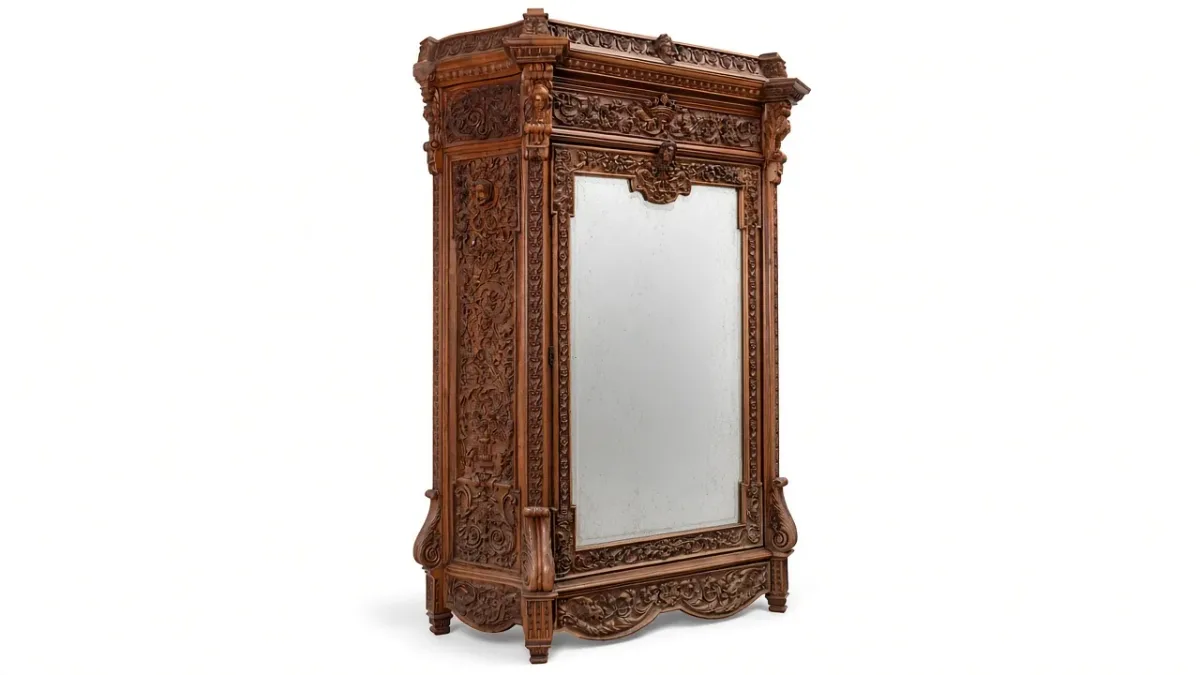
Italian catalogues still print “Rinascimento” on a dark, heavily carved walnut cabinet whose construction is nineteenth century. The vocabulary is Cinquecento: pilasters, masks, paw feet, a dentil cornice. The carcass is not. Circular-saw tracks, machine-cut dovetails, a uniform stain on every inner face, and a large mirror in the principal door belong to the decades after unification, not to 1550.
That later furniture is not automatically a fake. Stile Umbertino and the Neo-Renaissance were the furnishing language of the 1870s–1890s. Named carvers such as Luigi Frullini of Florence signed exhibition pieces. Unsigned provincial suites did not. The market prices them as two different classes. Confusing either with a sixteenth-century credenza, or with an eighteenth-century cassettone, is the error that moves the number.
The figures below are auction results. They vary with condition and the day of sale. They are not a valuation.
What determines value
Maker or workshop comes first when a name can be read. Frullini (Florence, 1839–1897), trained under Angiolo Barbetti and later at 8 via Santa Caterina, inscribed L. Frullini and Firenze, sometimes with a year. The Art Institute of Chicago armchair of 1876 (inv. 1986.1002) is carved L FRULLINI FIRENZE 1876. The Victoria and Albert Museum bought a walnut pilaster panel (acc. 690-1878) from the Paris International Exhibition of 1878 as a specimen of Renaissance Revival carving, and holds a folio stand inscribed LUIGI FRULLINI FIRENZE 1873. Those signed objects sit at the top of the nineteenth-century market. Unsigned historicist walnut, even when dense with masks, is priced as period furniture of 1870–1900, not as Cinquecento. The Florentine walnut tradition of the sixteenth century is a different field.
Period and region are linked. Early-nineteenth-century Italian work follows Empire and Restoration models: mahogany or walnut, gilt-bronze mounts in Turin and Milan, marble tops, comparatively little figural carving. Mid-century Luigi Filippo types take a heavier moulding and turned onion feet. After 1878 the court of Umberto I gave its name to an eclectic domestic style: solid walnut, cherry, olive or oak; commodes with Carrara or dark marble; wardrobes with a central mirrored door; tables with carved friezes and onion feet. Neo-Renaissance and Neo-Baroque run in parallel, especially in Florence, Siena and the Veneto, recycling pilasters, grotesques and alla certosina inlay. Venice in the same decades also produced painted and lacquered historicist cases that borrow eighteenth-century chinoiserie rather than Cinquecento architecture.
Material is usually walnut in the solid for show surfaces, with poplar, pine or another pale secondary wood inside. A revival cabinet stained dark on every unseen face, or built in beech tinted as walnut, is later or cheaper. Alla certosina (geometric tesserae of bone, ebonised wood and fruitwood) on a nineteenth-century cabinet-on-stand is a revival of a Lombard-Certosan technique, not proof of 1500.
Rarity is the named exhibition carver, a documented palace commission, or a complete bedroom or salon suite that has not been broken. Common Umbertino wardrobes and marble-top commodes survive in quantity.
Condition and restoration decide the middle of the range. Replaced marble, a new mirror plate, stripped and re-polished carving, and plywood drawer bottoms are expected on trade pieces and they cap the price. Structural splits, active worm in sapwood, and missing cornice blocks drop it further. A signed Frullini chair with original velvet is a different object from the same model reupholstered yesterday.
Provenance is thin on most lots. An Anglo-American commission of the Château-sur-Mer class, a museum deaccession, or a house sale with a nineteenth-century inventory note will carry a Frullini or Palagi piece. A verbal “from a palazzo” will not.
Size matters in the opposite direction from earlier centuries. Monumental two-part historicist sideboards (over 200 cm) are hard to house and often sell below smaller, cleaner cabinets. A compact alla certosina cabinet-on-stand is easier to place.
Market demand currently pays for signed Neo-Renaissance carving and for early-nineteenth-century consoles with sculptural supports. It is weak for unsigned Umbertino salon suites and for stained revival armoires offered as “Renaissance.” Maggiolini-style marquetry of the nineteenth century is judged against eighteenth-century Parabiago work, not against Frullini.
Prices at auction
Unsigned Italian Renaissance-style walnut, third to last quarter of the nineteenth century, trades in the low thousands of dollars or euros at the international houses, and often in the low hundreds of euros in the Italian rooms when condition is ordinary.
Bonhams Los Angeles, The Elegant Home, 19 November 2019, lot 540, sold an Italian Renaissance Style Carved Walnut Armoire, third quarter of the nineteenth century, 256 × 187 × 73 cm, for US$1,785 including premium. The same rooms, Fine European Furniture, Decorative Arts and Silver, 11 September 2006, lot 396, sold an Italian Renaissance style walnut credenza, last quarter of the nineteenth century, 115 × 145 × 67 cm, with satyr, term and grotesque carving, a gadrooned base and paw feet, for US$4,481.25 including premium.
Dorotheum, Furniture, 9 March 2015, lot 212, sold an imposing Historicist sideboard in a modified Italian Renaissance style, end of the nineteenth century, walnut and softwood, dark stained, two-part, about 227 × 165 × 72 cm, restored, for EUR 2,000 including buyer’s premium and VAT. That is the typical international level for a large unsigned revival case.
The same house shows what a period carcass can still do. Dorotheum, Works of Art, 26 April 2018, lot 507, sold an Italian Renaissance credenza catalogued as Bologna, originally sixteenth century, walnut and pine, splayed Bolognese front with three doors and three drawers, about 119 × 226 × 67 cm, losses and a heavily restored top, for EUR 21,250 including premium and VAT. The comparison is the point: a damaged sixteenth-century Bolognese credenza made more than ten times a complete historicist sideboard of similar bulk.
Italian rooms price ordinary nineteenth-century walnut as domestic furniture, not as Renaissance. Il Ponte, sale 670, 17 September 2024, lot 154, a walnut cassettone with mixed-wood stringing, two drawers and inverted-obelisk legs, nineteenth century, 119 × 90 × 52 cm, defects and restorations, hammered at EUR 600. The same sale, lot 132, a pair of walnut bedside cabinets with fluted drawers and inverted-obelisk legs, 51 × 77 × 35 cm, hammered at EUR 380. Il Ponte, sale 427, 19 September 2018, lot 1046, a walnut and burr-walnut wardrobe with two panelled doors, one drawer and turned front feet, nineteenth century, 158 × 198 × 58 cm, defects, hammered at EUR 300. Il Ponte, sale 706, 18 April 2025, lot 1176, a late-nineteenth-century walnut salon suite (pair of armchairs and a two-seat sofa with carved trophy cresting; sofa 156 × 111 × 54 cm), defects and restorations, hammered at EUR 120.
Signed or strongly attributed Neo-Renaissance carving is a different column. Christie's London, The Collector: Silver and 19th Century Furniture, Sculpture and Works of Art, sale 15491, 24 May 2018, lot 666, a pair of large walnut “curule” throne chairs attributed to Luigi Frullini, Florence, circa 1875, 126.5 × 87.5 × 115.5 cm, realised GBP 25,000. The chairs are hand-carved with griffin arms, X-frame supports and hoof feet. Sotheby’s Paris later cited that result when cataloguing a related pair.
A separate nineteenth-century Italian taste, not Neo-Renaissance, also finds buyers. Bonhams Knightsbridge, The Grand Tour, 20 June to 3 July 2024, lot 43, an Italian nineteenth-century walnut, ebonised, fruitwood and bone alla certosina cabinet on stand, 96 × 51 × 151 cm, sold for GBP 3,840 including premium. Dorotheum, Works of Art (Silver, Furniture), 13 October 2010, lot 786, a decorative Italian console, nineteenth century, partly ebonised softwood with floral gold painting, faun-carved front legs, one drawer and a marble top, 81 × 80 × 50 cm, sold for EUR 11,250 including premium and VAT.
Those results do not license a range for “any Italian Renaissance cabinet.” They separate three markets: unsigned Umbertino and revival walnut at a few hundred to a few thousand; named Frullini-level carving in five figures when the model is ambitious; and genuine sixteenth-century carcasses, even restored, that still outrun the revival copies they inspired.
Authentic or later
The first question is not “is it beautiful.” It is whether the object was made as Renaissance furniture, as nineteenth-century furniture in a Renaissance vocabulary, or as a hybrid assembled to look older than it is.
Construction tells more than style. Period Italian casework of the fifteenth and sixteenth centuries uses frame-and-panel carcasses, hand-cut mortise-and-tenon joints, and secondary woods (often poplar) that oxidise to a dull grey-brown on unseen faces. Drawer bottoms, where they exist, are usually boards, not plywood. Saw marks, if they survive, are straight from a pit or frame saw, not the regular arcs of a circular saw. Nineteenth-century workshops had circular saws, uniform machine planing and, by the last decades, tightly identical dovetails. A “Cinquecento” cabinet whose interior is stained as dark as the façade, whose backboards are machine-planed pine, or whose drawer bottoms are plywood, is later.
Carving tells next. Sixteenth-century ornament is architectural and relatively contained: pilasters, a gadrooned base, a few masks. Revival carving of the 1860s–1890s is encyclopaedic. It fills every rail, repeats the same mask identically on both sides, and often continues around a corner without a corresponding inner member. Frullini’s signed work is the high extreme of that density; unsigned trade work imitates the density without the undercutting. Christopher Payne, 19th Century European Furniture (Antique Collectors’ Club, 1981), remains the standard plate-book for the revival types.
Wear and patina must agree across joints. Genuine age produces shrinkage that opens a pale line of unstained wood at the edge of a panel. A revival or a later marriage often has a continuous dark coating intended to unify new and old wood. The Victoria and Albert Museum’s cassone 7709-1861, purchased in 1861, is catalogued as walnut “with some later elements of chestnut or oak, partly gilded”: a Tuscan chest of the 1560s whose inner box, rear volute and supporting boards include later timber. Dark varnish over mixed woods is a dating clue, not proof of an untouched 1550 carcass.
The hybrid, or “married,” object is the most expensive mistake. Christie's New York, 15 January 2014, sold an Italian Renaissance Revival walnut centre table, late nineteenth century incorporating older elements, 82.6 × 161.3 × 68.6 cm, for US$1,750 realised. Bonhams Los Angeles, 8 December 2014, lot 1284, sold an Italian Renaissance style carved walnut side cupboard “incorporating antique and later elements” for US$2,000 including premium. The Isabella Stewart Gardner Museum now catalogues a cassapanca con schienale (walnut, poplar and pine, 174 × 196 × 53.5 cm) as late nineteenth century, made “to deceive unsuspecting collectors into thinking they were buying a Renaissance object,” combining older fragments with newer wood (Calderai and Chong, Furnishing a Museum, 2011, no. 91). Isabella Gardner bought it as early sixteenth century. The same class of object still appears as “Florentine, 1500, later restorations.”
Typical reproductions and fakes in this field are not plastic. They are honest nineteenth-century furniture offered with a fifteenth-century date, or period panels set into a new box. Common buyer errors: trusting a dark colour; reading a coat of arms as a marriage commission; taking a dealer’s “palazzo provenance” as a date; ignoring the mirror door (a nineteenth-century convenience, rare on a domestic credenza of 1550); and pricing a Frullini-style unsigned armoire as if it were period Florentine walnut.
Marks are scarce. Italian furniture had no civic hallmark system comparable to silver. Frullini and a few contemporaries signed. Umbertino factory suites sometimes carry a paper label or a branded drawer stamp (Prevosti of Varese is one documented name). Absence of a signature does not make a piece sixteenth century. Presence of a nineteenth-century stamp does make it nineteenth century.
FAQ
Is Umbertino furniture a fake Renaissance?
No. Stile Umbertino is a documented Italian furnishing style of about 1878–1895, named for Umberto I. It is later than the Renaissance. It becomes a problem only when a catalogue drops “stile” and prints “XVI secolo.”
How can a credenza of 1550 be told from a revival cabinet of 1880?
Look at the unseen wood, the joints and the carving density before the façade. Period work is architectural and uses oxidised secondary timber. Revival work is over-carved, often mirrored, and finished dark inside. Signed Frullini is still 1860–1897.
Does a coat of arms prove a Renaissance marriage chest?
It proves that someone wanted an armorial. Nineteenth-century carvers and painters added shields to new cassoni and to recased panels. Heraldry has to match construction, not the other way round.
Why do some nineteenth-century Italian consoles outsell revival sideboards?
Sculptural supports, marble and a smaller footprint still find decorative demand. Dorotheum’s faun-legged console of 2010 (EUR 11,250 including premium and VAT) is that market. A two-metre historicist sideboard is harder to house and is priced as surplus walnut.
A professional appraisal is warranted when the date in the catalogue and the construction disagree, when old carved panels have been reset, or when a Frullini-level signature is claimed. A written condition report should record secondary woods, fasteners, saw marks, replacements to marble, glass and veneer, and any inscription. Those notes, not a style name, are what a later sale will be able to use.