
Authentic vs Later Italian Painted Furniture
How to tell authentic Italian painted furniture from later copies by carcass, lacca povera, auction prices and the mistakes buyers still make.
Italian painted furniture is not a single workshop product. It is a carcass of poplar, fir or Swiss pine, sealed with gesso, then either brush-painted, japanned in European varnish, or faced with cut prints under sandarac. Dealers still say “Venetian painted.” Catalogues that matter name the city, the ground and the date of the skin. Those three facts, not a turquoise bombé outline, decide whether a cassettone is period work or later decoration.
A Venetian lacquer commode of the 1700s is one regional system. Piedmontese grisaille and parcel-gilt Louis XVI chests are another. Tuscan and southern painted case furniture, including peasant grounds and later historicist copies, sit further down the same market. This note is about how those objects are priced, and how later paint is told from an eighteenth-century surface.
What the object is
The form that carries most of the money is the cassettone: a table-height chest of drawers, about 85–95 cm high and 110–140 cm wide, with two or three long drawers. English catalogues call it a commode. Italian inventories call it a cassettone. The eighteenth-century cassettone changes by city in outline and in skin. Painted and lacquered examples are the subset whose value is decided by the surface as much as by the box.
Two surface systems ran in parallel in the Veneto and, more rarely, in Piedmont. Painted lacca is freehand tempera on a gessoed carcass, flooded with sandarac, a spirit varnish from the North African sandarac tree (Tetraclinis articulata). Lacca povera, also catalogued as arte povera or lacca contrafatta, substitutes coloured, cut engravings for the painted figures. The Metropolitan Museum of Art holds a Venetian secretary of about 1730–35 (acc. 25.134.1a, b, Fletcher Fund, 1925) whose decoration is exactly that decoupage: pine and linden, carved, painted, gilded and varnished, with prints from French and German plates, not only from sheets made for furniture. The museum acquired it in Venice. Paper edges remain tactile. Losses lift as sheets.
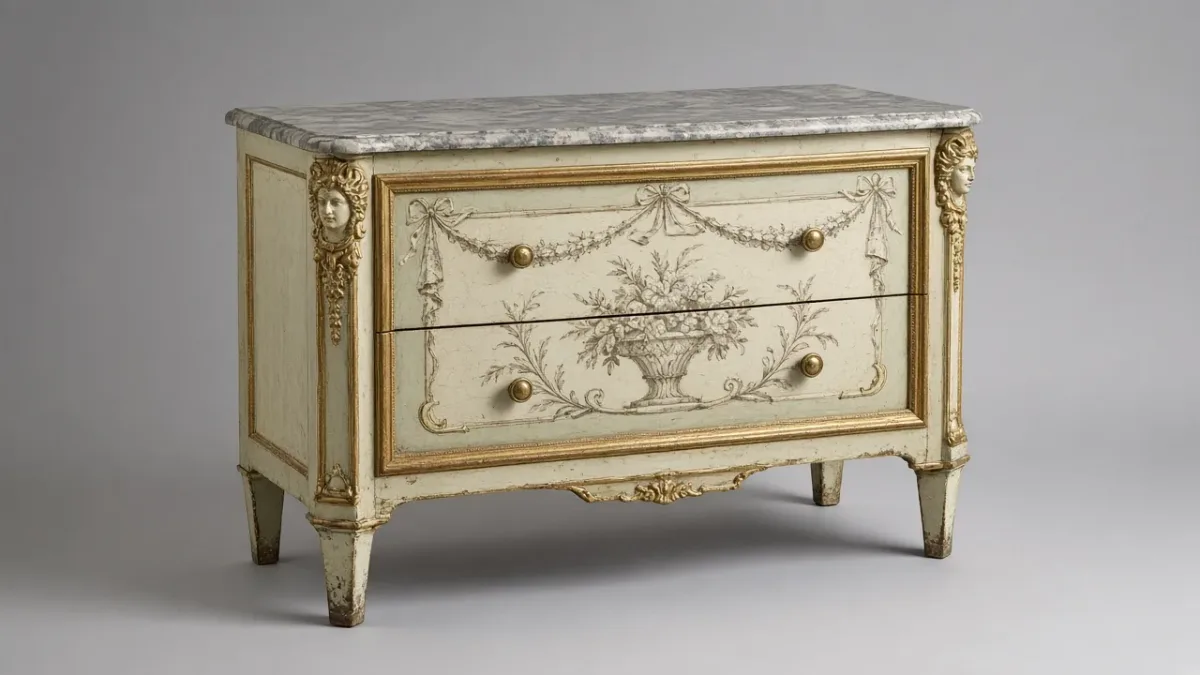
Piedmont used the same European varnish language on a different box. The Met’s painted poplar commode of about 1770, possibly by Francesco Bozelli of Turin (active 1783–93), acc. 47.65, Rogers Fund, 1947, is 92.7 × 110.5 × 58.4 cm. The carcass is rectilinear, classically ornamented, with an imitation-marble top. It is not bombé. That contrast is the first dating tool: a Louis XVI Piedmontese chest is not a Venetian doppia mossa commode with a later coat of cream paint.
Ca’ Rezzonico, Museo del Settecento Veneziano, keeps the Calbo Crotta green-lacquer suite in the Sala delle Lacche Verdi: emerald ground, gilt pastiglia chinoiserie, Louis-quinze outlines. The Palazzina di Caccia di Stupinigi at Nichelino holds Savoy court furniture of the 1780s–90s by Giuseppe Maria Bonzanigo (1745–1820). Those groups are the visual standard. Auction furniture is measured against them, not against a tourist “Venetian painted” chest.
What determines value
Maker or workshop. Named depentori are scarce. Venetian furniture painters belonged to the Arte dei depentori and almost never signed a cassettone. Piedmontese court work can sometimes be argued toward a documented ebanista such as Bonzanigo or, more cautiously, Bozelli. An unsigned provincial chest is priced as a type, not as an author.
Period. Furniture of the 1730s–1790s with an intact layered surface sits at the top of this market. Nineteenth-century historicist chests in “Baroque style,” and twentieth-century tourist painted furniture, occupy a different, cheaper band. Catalogues that print “late 18th century and later” are telling the buyer that the box and the skin do not share a date.
Region. Venetian bombé lacquer with floral or chinoiserie grounds, especially in pairs, still commands the highest prices. Piedmontese grisaille and cream Louis XVI commodes are fewer and more architectural. A chest offered as Venetian that has a flat rectangular carcass and square tapering feet is more likely North Italian neoclassical, or later.
Material. Period carcasses are poplar, fir or cirmolo (Swiss pine, Pinus cembra). Gesso is thick enough to read as a cake at losses. Sandarac yellows. Later work uses plywood, oak, mahogany or a thin sprayed film over bare wood.
Rarity. A documented pair of mid-eighteenth-century Venetian floral commodes is scarce. A single nineteenth-century turquoise bombé chest is not. Piedmontese arte povera on a goat-hoof cabriole carcass is less common than Venetian decoupage on a bombé box.
Condition. Honest wear at handles, feet and the front edge of the top is expected. Replaced marble, later feet, and local retouch are normal catalogue notes. A uniformly bright, unoxidised skin is not.
Restoration. Overpaint, stripping and a modern polyurethane coat destroy the object as a period surface even when the carcass is old. Christie's 2009 Piedmont commode was catalogued with retouched decoration and a later marble; the price still reflected a period box. A fully resprayed chest does not.
Provenance. Furniture from a named palazzo group, or with a published plate in Morazzoni, Levy or Santini, sells above an anonymous house-clearance piece of the same outline. Dealer labels of the twentieth century (Accorsi in Turin, Cassinari in Milan) are evidence of recent trade history, not of eighteenth-century origin.
Size. Bureau-cabinets and pairs outrun single commodes. Small comodini with later paint sit at the bottom of the band.
Market demand. Interior-decorator demand for “Venetian painted” keeps nineteenth-century revival pieces liquid. Collectors paying for an eighteenth-century surface are a smaller group and they buy on construction.
None of the figures below is a valuation. Prices move with condition, fashion and the room. They are published results.
Prices at auction
Christie's London, Important European Furniture, Sculpture & Clocks, 9 July 2009, sale 7745, lot 121, sold a North Italian parcel-gilt, cream, green and grisaille-painted commode, Piedmont, late eighteenth century. Two drawers decorated sans traverse, floral basket and swags, female masks at the angles, square tapering feet, bardiglio marble top with protruding corners. 92.5 × 122 × 56 cm. The decoration was retouched; the marble was later. Price realised GBP 17,500 against an estimate of GBP 12,000–18,000.
That is a period Piedmontese type, not a Venetian bombé chest. Bonhams Cornette de Saint Cyr, Paris, The CLASSICS, 22 April 2026, lot 157, sold a Piedmont painted wood slightly curvilinear commode, late eighteenth century, ivory ground with branches, foliate scrolls and Greek-key, two drawers, cabriole legs, painted top, 122 × 54 × 88 cm, for €2,176 including premium. The outline is provincial. The 2009 Christie's chest had marble, masks and a King Street audience. Those two numbers bound ordinary to good Piedmontese painted commodes in recent trade; they are not a rule.
Venetian eighteenth-century lacquer still sits above that band when the surface is dense and the form is right. Capitolium Art, Brescia, sale 460, 11 June 2024, sold a pair of Venetian eighteenth-century light-lacquered shaped commodes with polychrome floral garlands and faux-marble tops, 85 × 142 × 67 cm, for EUR 37,800 including auction rights. The same sale sold an exceptional red-lacquered and parcel-gilt Venetian bureau-cabinet with chinoiserie garlands for EUR 94,500 including rights. Those are period skins on period boxes, from a Veneto house group.
Nineteenth-century historicist pieces, catalogued honestly as “Baroque style,” occupy a middle band that buyers still confuse with the Settecento. Dorotheum, Vienna, Furniture; Works of Art; Glass & Porcelain, 23 October 2024, sold a Venetian chest of drawers in Baroque style, nineteenth century: bombé softwood, turquoise painted with floral motifs, one small and two large drawers, gilt carved décor, about 85 × 120 × 63 cm, restored, for EUR 4,940 including buyer’s premium and VAT. The same rooms, 21 October 2025, sold a Venetian chest of drawers in Baroque style with late-nineteenth-century chinoiserie on a strongly curved hardwood body, red lacquer, gilt landscapes and hunting scenes, two drawers, about 88 × 138 × 62 cm, for EUR 9,100 including premium and VAT. Both lots were described as style, not as eighteenth-century lacca.
Christie's, 27 November 1996, sold an Italian lacca povera commode catalogued as nineteenth century: serpentine outline, cream-painted with green mouldings, simulated marble top, three long drawers, bracket feet, 131 cm wide × 81 cm high × 62 cm deep, for GBP 5,175 (estimate GBP 2,000–4,000). Decoupage on a later box is still lacca povera as a technique. It is not a 1730s Venetian secretary.
Bonhams, Knightsbridge, Collections, 24 November 2020, lot 187, sold a North Italian late eighteenth- or early nineteenth-century painted commode, three drawers with foliate and neoclassical motifs and landscapes, square tapering legs, 108 × 60 × 95 cm, for £4,845 including premium. The same rooms, 6 March 2019, lot 39, from the Alain Morvan collection, sold a North Italian painted commode catalogued “late 18th century and later,” simulated marble top, three drawers, 115 × 53 × 100 cm, for £3,187.50 including premium. The phrase “and later” is the price signal.
Il Ponte, Milan, sale 675, 25 October 2024, lot 887, sold a small bombé lacquered commode with polychrome flowers in reserves, two drawers, shaped marble top, catalogued as eighteenth century, 73 × 86 × 40 cm, with defects and restorations, hammer EUR 650. Scale, losses and a thin market for unrestored small pieces explain a figure that looks implausible next to the Capitolium pair. Condition and size move the needle more than a century label.
The published results support a ranking, not a price list. Period Venetian pairs and bureau-cabinets can reach the mid-to-high five figures including fees. Period Piedmontese painted commodes have realised from about €2,000 including premium to GBP 17,500. Nineteenth-century “Venetian Baroque style” chests at Dorotheum have realised about EUR 5,000–9,000 including fees. Small or heavily restored pieces at Italian houses can hammer in the hundreds of euros. A bright turquoise bombé chest is not, by that colour, an eighteenth-century object.
Authentic or later
Work from the inside of the box.
Carcass woods. Period Venetian and Piedmontese painted furniture is built in poplar, fir or cirmolo. Oak, mahogany, tropical hardwoods and plywood are later. Drawer linings that are machine-planed to a uniform millimetre thickness, with circular-saw marks, belong after the late nineteenth century. Hand-cut dovetails are slightly irregular. Identical machine pins are not.
Ground. A period surface is a sandwich: canvas over joints on many Venetian boxes, thick gesso, paint or paper, sandarac. Losses are stepped. The gesso reads as a white or grey cake. A later film is thin, sits on raw wood, and chips as a skin. Piedmontese grounds are often thinner than the Venetian cake; they are still gesso, not emulsion on oak.
Lacca povera versus painted copies. Raking light or a fingertip finds the raised edge of a print. Printed hatch remains visible under the colour. Losses lift as paper. A “lacca povera” chest whose figures are only brushwork is painted, whatever the catalogue says. Remondini of Bassano issued, from 1729, sheets prepared for pasting onto furniture; other Veneto printers supplied the same trade. A plate mark or a border that continues under a mount is a period tell. A laser-printed chinoiserie is not.
Wear and patina. Sandarac yellows. Blues drift toward green. Handles, lock plates and the front rail of the top show local abrasion. A surface that is evenly bright, with no yellowing and no wear at the points of use, is suspect. Craquelure that follows the movement of a softwood carcass is expected. A regular, all-over crackle from a crackle medium is later.
Construction versus skin. The authentic versus later Venetian trumeau problem is the same here: an old carcass can wear a new coat. Japanning that stops at the edge of a later mount, or chinoiserie that does not continue under original handles, is later paint. A marble top that is perfectly rectangular on a serpentine carcass is a replacement; date the box, not the slab.
Typical later objects. Nineteenth-century Venetian-style bombé chests in turquoise, cream or red, with gilt carved panels, are honest historicist furniture. Dorotheum catalogues them as “Baroque style” and dates the chinoiserie when it can. Twentieth-century tourist painted chests, often from the Veneto and sold as “18th century Venetian,” add Phillips screws, plywood dustboards and a sprayed varnish. Overpainted walnut credenze and cabinets dressed as lacquer are a third class: the carved carcass is sometimes older than the paint.
Common buyer mistakes. The first is to read bombé plus flowers as Venice, 1750. The second is to ignore the words “style,” “and later,” and “nineteenth century” in a serious catalogue, then to pay a period price for a Dorotheum-type revival chest. The third is to treat a dealer’s “lacca povera” as a date: the technique was used in the eighteenth century and revived afterwards. The fourth is to restore first and ask afterwards. Stripping a yellowed sandarac film to brighten the ground removes the evidence that made the object period.
A Renaissance cassone or walnut chest is a different object. Do not date a painted cassettone by comparison with fifteenth-century marriage chests.
When a specialist report is warranted
Seek a written condition report, and if the hammer is expected in five figures a furniture conservator’s note, before buying any chest offered as eighteenth-century Venetian or Piedmontese painted furniture. The report should name carcass woods, record whether joints are canvassed, say whether ornament is paint, pastiglia or paper, and photograph drawer sides, backboards and the underside. Ultraviolet and raking light separate original tempera from later oil or acrylic.
If the piece is in Italy, export still follows the Codice dei beni culturali (legislative decree 42/2004). Ivory or tortoiseshell on related Piedmontese court furniture adds wildlife paperwork. Neither stamp is a certificate of date. An appraisal is a description of construction and condition on a given day, not a promise of what the next sale will bring.
FAQ
Is Venetian painted furniture the same as lacca veneziana?
No. Lacca veneziana is a dated layered technique: gesso, tempera or paper, sandarac. “Venetian painted” in the trade often means any bombé chest with flowers, including nineteenth-century revival pieces. Ask which system the surface is.
How do I tell Piedmontese painted furniture from Venetian?
Start with the box. Venetian mid-century commodes are bombé in plan and elevation, often with carved wooden handles and a shaped marble or faux-marble top. Piedmontese late-century commodes are closer to French Louis XVI: rectilinear or only slightly curved, square tapering or cabriole-with-block feet, grisaille or cream grounds, parcel gilt, sometimes goat-hoof feet on rococo examples. The Met Bozelli commode and the 2009 Christie's lot 121 are the published Piedmont types.
Does lacca povera mean the piece is eighteenth-century?
It means cut prints were pasted and varnished. The Met secretary of about 1730–35 is the museum type. Christie's 1996 commode was catalogued as nineteenth-century lacca povera and sold as such. Technique is not a date.
Why do some eighteenth-century commodes sell for a few hundred euros and others for tens of thousands?
Size, pair status, density of the original surface, and whether the house will stand behind an eighteenth-century date. Il Ponte's small restored floral commode hammered at EUR 650. Capitolium's pair of Venetian floral commodes sold for EUR 37,800 including rights. Both can be “eighteenth century” on paper. They are not the same object.
Are nineteenth-century Venetian-style painted chests fakes?
Most are historicist furniture made for a decorative market that wanted the Settecento look. They become deceptive only when sold as period lacca. Dorotheum's 2024 and 2025 “Baroque style” lots were catalogued honestly and sold in the EUR 5,000–9,000 band including fees, not in the period-pair band.