
Savonarola Chair Worth: Auction Prices and Later Copies
What a Savonarola chair is worth at auction: period walnut versus 19th-century copies, construction tells and verified prices. Not a valuation.
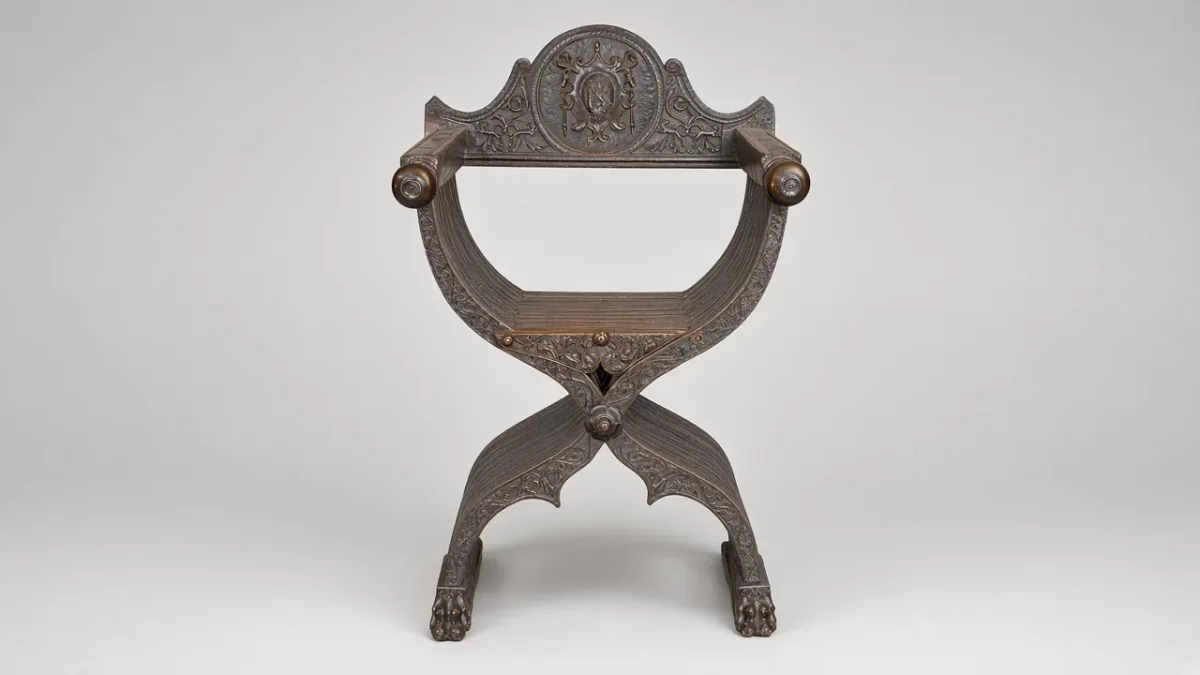
Most chairs sold as Savonarola chairs are not fifteenth-century furniture. They are walnut X-frames, often folding, named in the nineteenth-century trade after the chair shown in Fra Girolamo Savonarola's cell at San Marco in Florence. Treccani records the type as frequent in the fifteenth century and enriched with carving in the sixteenth, including the example associated with Ferdinando I de' Medici in the Palazzo Vecchio. The Victoria and Albert Museum is blunter: dealers attached Savonarola's name to the form; the friar (1452–1498) is unlikely to have sat in one, and from about 1880 the type was copied until it became a cliché. Price follows that gap. A period folding frame with matching slats, pegged joints and honest wear still finds specialist buyers. A Renaissance-revival armchair with machine-regular carving, a cameo of Savonarola, or a leather seat nailed on in the 1880s is a different object, usually worth a few hundred euros or pounds, not a Renaissance one.
The related dantesca is a conventional name, not a Dante autograph. Treccani distinguishes it from the Savonarola: four wide curved legs in an X rather than a bundle of slats, with seat and back in leather, velvet or cloth fixed by large studs, often on lion paws. Auction houses mix the labels. Identify the construction first, then the century.
What determines value
Maker or workshop. These chairs were joiners' work, not signed cabinet-makers' pieces. A documented Florentine or central-Italian origin, a coat of arms that can be read, or a palazzo provenance moves the price. A dealer caption "Tuscany, Renaissance" does not.
Period. Fifteenth- and sixteenth-century folding frames are the scarce end of the market. Seventeenth-century examples still count as period. Nineteenth-century revival chairs, including those built from mixed older slats, are the volume of what survives. The V&A's own chair (accession 7191-1860) was assembled in 1800–1840 from sixteenth-century parts; the Metropolitan Museum catalogues comparable Lehman Collection frames as nineteenth century with earlier elements.
Region. Walnut from Tuscany, Umbria and the Marche is the expected timber. Lombard nineteenth-century examples often add pewter, ivory or mother-of-pearl inlay; that inlay is a dating tell, not a Renaissance luxury upgrade. North of the Alps, Swiss and Tyrolean scissors chairs share the X but not the Italian trade name.
Material. Period frames are walnut, sometimes mixed with oak or beech in the runners. Bone lozenges, grotesque fruitwood inlay and a carved portrait of Savonarola on the back are revival vocabulary. Fresh high-gloss varnish over pale, even-coloured walnut is a warning.
Rarity. A folding chair that still folds, with its detachable backrest, original rods and sled feet, is rarer than a rigid "Savonarola" that never moved. Pairs and sets of four are almost always later production.
Condition. Replaced runners, scarfed arm ends, new seat slats and filled worm are normal and, if described, need not kill a period frame. Iron pins through the pivot, circular-saw marks on hidden faces, and a backrest mortised from a different chair are structural problems. Over-restoration (stripped, stained, and given a mirror polish) costs more than it returns.
Restoration and marriages. The V&A examination of 7191-1860 is a collector's checklist in one object: replaced rods, a scarfed back, rear ends of both arms replaced, a tipped foot, mixed old and new seat ribs, and arms that lack a mortise for the rearmost S-rib, proving feet and arms came from different chairs. Museums keep such hybrids as documents of nineteenth-century collecting. The trade should price them as assembled objects.
Provenance. A San Marco, Bargello, Palazzo Vecchio or Soulages-type history is exceptional. Most lots have none. A twentieth-century castle refurnishing, such as the eighteenth-century "savonarola" chairs bought for Gradara in 1921–23, is interior decoration, not Renaissance furniture.
Size. Typical period chairs run about 85–105 cm high and 60–75 cm wide. Monumental carved revival armchairs over a metre high with heavy acanthus are later display pieces.
Market demand. Seat furniture in Italian walnut of the Renaissance and Grand-Ducal workshops still sells when the timber and joinery are right. Demand is weaker for tourist-grade X-frames than for cassoni, cassettoni or a documented eighteenth-century credenza. Completeness of the folding mechanism matters more than a carved friar on the splat.
Prices at auction
Figures below are published hammer prices or realised prices as the house printed them. They are comparanda, not a valuation. Condition, restoration, region and the week's room change the result.
Dorotheum, Vienna, Collection Reinhold Hofstätter, 10 May 2017, lot 5: a low Renaissance scissors chair, so-called Savonarola, Italy, seventeenth century, folding walnut with rails on runners and a detachable rest, realised EUR 7,250 including buyer's premium and VAT.
Dorotheum, Vienna, Collection Reinhold Hofstätter, 26 September 2017: a Renaissance X-frame chair, so-called Savonarola, Italy, sixteenth century, folding walnut, runners replaced and some parts supplemented, realised EUR 5,800 including premium and VAT.
Il Ponte, Milan, sale 401, 27 October 2017, lot 1450: a wooden Savonarola armchair, central Italy, sixteenth century, restorations and losses, hammer EUR 2,000.
Christie's, London, 4 November 2010: a pair of Italian walnut X-frame Savonarola armchairs, late sixteenth or seventeenth century, folding frames with scrolled supports, sledge paw feet, restorations, GBP 8,125 realised.
Bonhams, London, New Bond Street, 15 December 2011, lot 13: an Italian Renaissance X-frame walnut Savonarola armchair, removable back lined with red velvet, restorations, 92 cm high, GBP 2,250 including premium.
Those five lots are the period (or period-catalogued) band: roughly EUR 2,000–7,250 for a single chair at Italian and Central European houses, more for a documented pair in London. Restorations are disclosed in every case.
The later market is another scale. Christie's, Amsterdam, 5 April 2007: a set of four Italian Savonarola chairs, second half of the nineteenth century, acanthus arms on X-supports, red velvet, EUR 960 realised for the four. Bonhams, London, Knightsbridge, 7 July 2009, lot 361: a late-nineteenth-century Italian walnut Savonarola chair inlaid with bone lozenges and fruitwood grotesques, the back centred by a cameo of Savonarola, GBP 240 including premium. Il Ponte, sale 529, 12 November 2021, lot 1594: a pair of Savonarola chairs, Lombardy, nineteenth century, pewter filets, ebonised reserves inlaid with ivory, mother-of-pearl and metal, hammer EUR 800. Il Ponte, sale 319, 31 March 2014, lot 7: a pair of Savonarola chairs, hammer EUR 40. Christie's, 1 June 1993: an Italian Renaissance-style walnut "Savonarolla" chair upholstered in gilt-tooled leather, USD 575 realised.
A four-chair nineteenth-century lot at EUR 960 is about EUR 240 a chair; a period Hofstätter example at EUR 7,250 is not the same category. Ranges belong only where the catalogues support them: revival singles and pairs commonly close from tens of euros to the low thousands; period frames with disclosed repairs have recently closed from about EUR 2,000 to just over EUR 7,000 at the houses named above, with a London pair higher. Prices vary with condition and market and are not a valuation.
For how nineteenth-century Italian workshops reused Renaissance ornament on case furniture, see how to separate 19th-century walnut from Renaissance copies. Seat furniture is a parallel problem, not the same typology as those credenze and armadi.
Authentic or later
Start with the name. Savonarola, dantesca, sedia a tenaglia, faldistorio and curule chair are not interchangeable. A true folding Savonarola is a bundle of S-curved slats, pegged into arms and sled feet, crossing at a central pivot, with a wooden slat seat and a backrest that often lifts off so the frame can close. A dantesca has four substantial curved legs, a leather or textile seat, and does not fold like a scissors stool. A giltwood armchair of the eighteenth century is a different trade entirely; see carved giltwood chair prices.
Period tells. Hand-sawn slats of slightly varying thickness; pegs that are not perfectly round; a pivot worn oval; runners rubbed on the underside; worm that follows the grain and has been stopped, not drilled as decoration; a backrest whose tenons match the arm mortises; tool marks that change direction in the carving. The front-most ribs may carry low-relief foliage; the inner slats stay plain. Walnut that has oxidised for centuries is dark in the recesses and a little warmer on the arrises.
Later tells. Circular-saw arcs on the hidden faces of slats; identical machine-cut profiles; Phillips screws or bright steel pins at the pivot; a backrest carved with a portrait of Savonarola, rampant lions in high relief, or a shield that does not belong to a family; bone and ivory grotesques in Lombard revival taste; velvet or tooled leather seats with modern tacks and no earlier nail lines; a chair that looks new at the joints but "antique" only on the show surfaces. The Isabella Stewart Gardner Museum catalogues a walnut example of this revival class as late nineteenth century. Many chairs will not fold even though the silhouette is an X; rigidity is not proof of age, but a frame advertised as Renaissance that cannot close, and never had a detachable rest, is usually revival.
Hybrids. Nineteenth-century restorers and dealers built chairs from mixed sixteenth-century salvage. The V&A example is the published type: arms from one chair, feet from another, new seat ribs next to old ones. Look for mortises with no matching tenon, slats of two different walnuts, and a back panel thicker or thinner than the arms. Such a chair is not a fake in the sense of a 1970s tourist carving. It is not a single Renaissance object either.
Common buyer mistakes. Treating the San Marco cell chair as a maker's model rather than a later nickname. Paying period money for a set of four matching chairs. Reading lion-paw feet as proof of the sixteenth century (revival makers used them constantly). Confusing a Chiavari light chair, a Ligurian construction of 1807, with an X-frame; the Chiavarina is a different joinery problem. Assuming Italian walnut equals Florence; the same silhouette was made across the peninsula and in the Alps. For the broader language of Italian case-work and later "in stile" production, see the antique Italian furniture guide.
FAQ
Is a Savonarola chair the same as a Dante chair?
No. In Italian specialist use the Savonarola is the slat-built folding X; the dantesca is the heavier four-leg X with a leather or textile seat. Auction English often uses Savonarola for both.
Did Savonarola own this chair type?
The trade name comes from a chair displayed in his cell at San Marco. Treccani records that origin. The V&A treats the dedication as a nineteenth-century label, not a documented sitting.
How can I tell if mine folds?
A period Savonarola has a detachable backrest and slats that scissor on a central pin. Do not force a rigid revival frame. Photograph the pivot, the arm mortises and the underside of the runners before anyone oils or glues them.
Are 19th-century examples worthless?
No. They are revival furniture. Recent lots closed from EUR 40 for a rough pair to several hundred euros or pounds for better Lombard or Florentine-style carving. They should not be invoiced as Renaissance.
Should replaced runners lower the price?
Disclosed replaced runners appear on period chairs that still reached EUR 5,800–7,250 at Dorotheum in 2017. Undisclosed iron reinforcement and mixed arms and feet should be priced as a marriage.
A Savonarola chair is worth what its construction, timber and century support, not what the nickname implies. If the frame, the backrest and the feet do not agree, or if a four-figure asking price rests only on the friar's name, a furniture conservator or a specialist in Italian Renaissance and revival seat furniture should write a condition report before money moves. That report is not a valuation and does not replace due diligence on export from Italy for any chair of claimed artistic interest.