
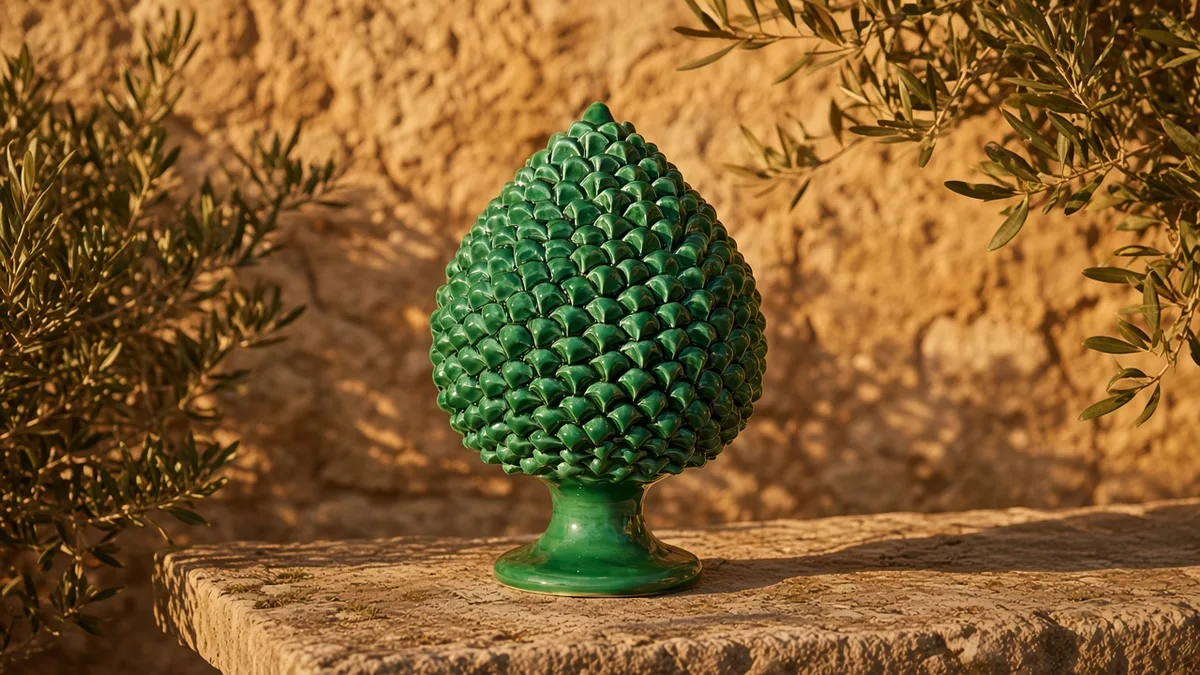
Sicilian Pigna Ceramics: Meaning, Caltagirone Craft & Why It’s Trending
Sicilian ceramic pigna: ancient symbolism, Caltagirone handcraft, fertility meaning, and why these pine cones dominate Mediterranean décor now.
The Sicilian pigna—a glazed ceramic pine cone—sits on gate pillars, balconies and gift tables across the island. It is not a souvenir invented for tourists. It is a Mediterranean fertility emblem that Sicilian ceramic centres, above all Caltagirone, turned into a durable, hand-built object. Understanding it means separating three layers: ancient symbolism, local craft practice, and a recent international décor boom.
Origins: an ancient emblem, a Sicilian object
Official Italian tourism copy (Italia.it; Visit Sicily) places the pine cone’s symbolic roots in the Greek and Roman Mediterranean: life, regeneration and continuity, read from an evergreen tree whose cone holds many seeds. Sicily absorbed that reading as a crossroads culture. Under Christianity the motif kept associations of rebirth and hope and entered architecture and decorative arts—gate finials, church ornament, garden sculpture—without becoming a single liturgical object.
Comparative craft writing also notes pine-cone imagery far beyond Sicily (Egypt, Assyria, classical Dionysus with a pine tip on the thyrsus, a large bronze pine cone now in the Vatican Museums’ Cortile della Pigna). Those parallels explain why the form feels “universal.” They do not prove that every Caltagirone workshop piece descends from a named classical prototype. For collectors, the useful origin story is local: Sicily made the pine cone a household and gift emblem, then ceramic towns made it portable and colourful.
Caltagirone’s pottery identity is older than the souvenir trade. The town’s Arabic-derived name is commonly glossed as related to a “castle of jars,” signalling a ceramic economy already established before 1000 CE. Arab rule also matters technically: glaze and tin-opacified traditions reshaped Sicilian pottery after classical earthenware. Later centuries, especially the eighteenth-century revival of maiolica centres, gave workshops the palette and bravura that still mark island ceramics. The ceramic pigna as a standardised gift form sits inside that craft history rather than replacing it. For broader Italian maiolica context, see our collector’s guide to Italian ceramics and the parallel Umbrian tradition in Deruta ceramics.
Characteristics of the ceramic pigna
Construction. Workshop descriptions agree on a labour-heavy build: a thrown or modelled core, then individual scale-like bracts applied by hand, followed by drying, decorating, glazing and firing. Because each scale is placed separately, no two pieces share identical surface rhythm. Bases may be simple cylinders, footed drums or architectural plinths suitable for outdoor pillars.
Palette. Traditional Caltagirone colours repeatedly cited in regional sources include deep green, ochre yellow, blue and white—read locally as sun, sea and vegetation. Contemporary makers add red, black, pink and patterned grounds. Colour folklore (green = hope, blue = protection, yellow = wealth) circulates in gift marketing; treat it as popular symbolism, not a workshop dating system.
Scale and finish. Pieces range from tabletop ornaments to large garden cones. Quality signals include crisp scale edges, even glaze without crawling on the tips, coherent colour layering, and a base heavy enough for outdoor wind. Soft mould-cast tourist versions often show flat, repeated scales and thin walls.
Relation to other Sicilian ceramics. The pigna shares Caltagirone’s bright maiolica language with teste di moro and other gift forms, but it is a different typology: botanical, usually without narrative faces. Pairing them in a modern interior is a décor habit, not a historical rule. See our Sicilian Moor’s Heads guide for the anthropomorphic side of the same craft towns.
Meaning in Sicilian use
In island custom the ceramic pine cone functions as a portafortuna—a wish object rather than a talisman with fixed ritual text. Core meanings repeated by Italia.it, Visit Sicily and Sicilian ceramic houses:
- Fertility and abundance — many seeds inside the natural cone
- Prosperity and family continuity — gift for marriages and new households
- Hospitality and welcome — placement at entrances and on balconies
- Protection / good auspice — folk reading of the threshold ornament
- Longevity — evergreen association
Gifting occasions commonly listed: weddings, housewarmings, shop openings, anniversaries. Peasant tradition is also described as placing pine cones in newlyweds’ rooms as a fertility wish. None of this requires believing the glaze “brings luck.” It does explain why blank ceramic pine cones sell poorly compared with ones framed as meaningful gifts.
Why it is trending now
The recent visibility of the Sicilian pigna is commercial and visual more than archaeological.
Mediterranean décor cycle. International interiors have recycled Sicilian colour—cobalt, lemon, green glaze—through social media and lifestyle retail. The pine cone photographs clearly, stacks well in product grids, and reads as “Sicily” faster than unmarked pottery.
Gift economy online. Wedding and housewarming markets moved partly to platforms where symbolic objects outperform anonymous décor. Sellers emphasise Caltagirone handwork and fertility meaning; search interest follows the gift calendar.
Diaspora and tourism. Sicilian and Italian-American buyers treat the pigna as a portable identity marker. Tourist towns sell it beside teste di moro; returning travellers then reorder larger pieces online.
Design crossover. Contemporary ceramists issue monochrome, gold-leaf and oversized architectural versions. That keeps the form in design press without abandoning the traditional polychrome type.
For antiques-minded readers the trend has a caveat: most market supply is new craft, not nineteenth-century archaeological recovery. Older architectural pine cones in stone or metal on villas are a separate collecting category from glazed Caltagirone giftware. Judge age by construction, glaze wear and workshop documentation—not by Instagram saturation.
Buying and identification notes
1. Prefer named Caltagirone (or other Sicilian) workshops with clear maker marks or invoices.
2. Check scale application: hand-built pieces show irregular, dimensional bracts.
3. Ask whether the piece is outdoor-rated; freeze–thaw and thin glaze fail on balconies.
4. Separate symbolic colour stories from dating evidence.
5. Compare prices against labour: dense hand-applied scales should not match mass-import pricing.
Condition issues: chipped scale tips, glaze crazing from outdoor exposure, unstable bases. Repairs on tip edges are common and acceptable if disclosed.
FAQ
Is every Sicilian ceramic pine cone from Caltagirone?
No. Caltagirone is the best-known centre, but other Sicilian towns produce them. Caltagirone remains the reference for traditional polychrome style.
Is the pigna an antique form?
The symbolism is ancient; most ceramic gift pigne on the market today are modern studio work. Older outdoor finials may be stone or earlier ceramics—evaluate case by case.
Why gift one at a wedding?
Fertility, abundance and household prosperity—seed-rich cone as metaphor.
How does it differ from a teste di moro?
Different subject (botanical vs human head), overlapping craft towns and gift occasions.
Conclusion
The Sicilian ceramic pigna concentrates Mediterranean pine-cone symbolism into a Caltagirone-centred craft object used as a threshold ornament and gift. Its current trend rides décor fashion, online gifting and identity retail. Collectors should read meaning and market heat separately from age, and buy the construction—hand-applied scales, coherent glaze, documented workshop—rather than the luck story alone.