
Murano Glass Techniques: Millefiori, Avventurina, Sommerso & Lattimo
Explained: millefiori, avventurina, sommerso, and lattimo — how each Murano technique is made, how to recognize it, and why it affects value.
Millefiori (Murrine): A Thousand-Flower Glass Mosaic
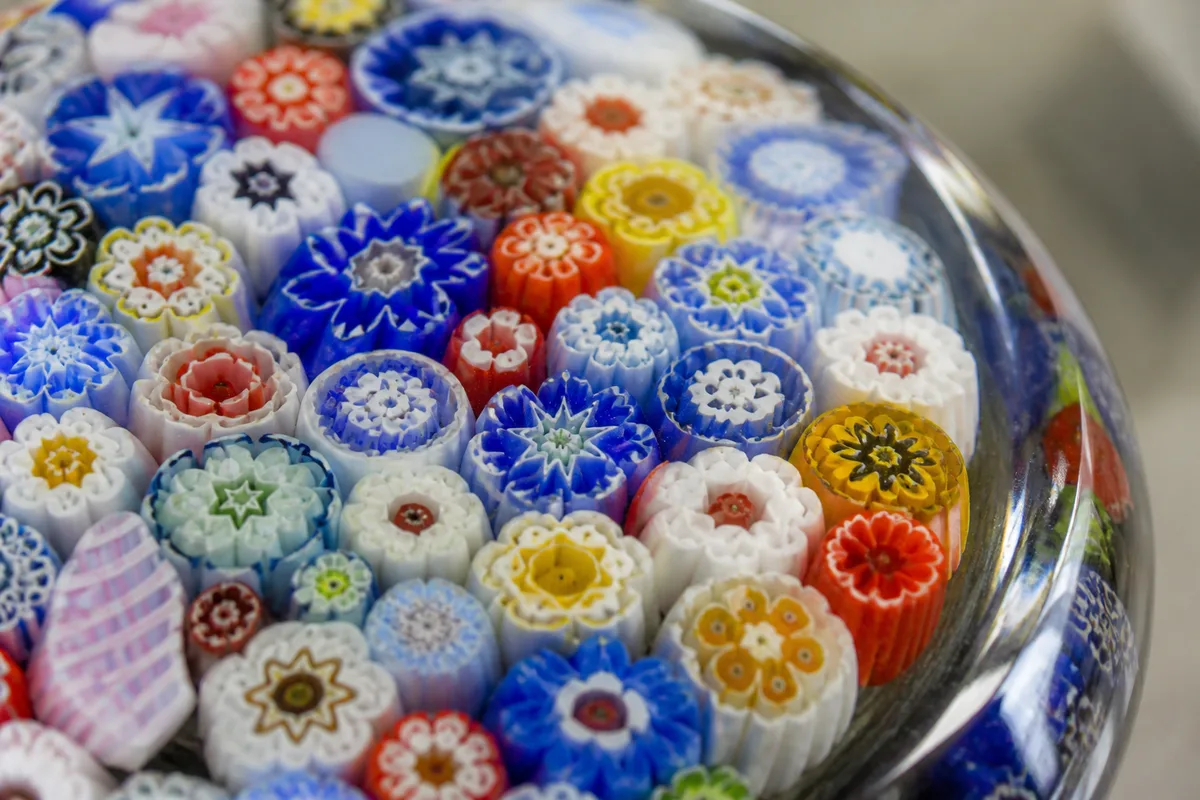
“Millefiori” means “thousand flowers”, describing glass decorated with patterns of dozens or hundreds of tiny colored rods. In Murano glass, millefiori derives from the ancient murrine technique revived in the 19th century. To make it, glassmakers first create glass canes or rods with multiple colored layers and patterns: for example, a rod might have concentric bands (like a star or flower) of different colors. After heating and stretching, these rods are cut into short sections called murrine or murrina. Each slice reveals the same decorative cross-section pattern. These murrine are then arranged into a mosaic (while cold) on a refractory surface and heated until they fuse. Finally the fused murrine “disc” (or cane bundle) is gathered on a blowpipe and blown or shaped into a vessel or object, embedding the tiny motifs in the glass. The result is a body of glass covered in countless miniature geometric or floral designs.
Historically, Venetian glassmakers began using concentric rosetta canes (canna rosetta) decorated with star-like layers as early as the 15th century. The 19th-century revival brought new virtuosity. Murano masters like Vincenzo Moretti and the Franchini family pushed millefiori to extremes: for example, Giovanni Battista Franchini invented ever more intricate rods and even produced rod portraits – slices of cane showing human faces or famous figures – which he incorporated into vases. In short, millefiori glass is made by fusing pre-formed colored glass segments, then shaping the fused mass into the final piece.
For collectors, authentic millefiori Murano glass can be identified by the quality of the fused mosaic and the crispness of the patterns. The millefiori technique was never abandoned; it enjoyed particular popularity at the end of the 19th century and during Art Nouveau (Liberty) times. Objects made this way often appear as vases or bowls with all-over, finely repeated patterns. Modern Murano makers still produce millefiori pieces, but true vintage millefiori – or work by named designers (like Fulvio Bianconi for Venini) – can be especially valued by collectors.
Filigrana (Filigree): Threads of Colored Glass
Filigrana is the Venetian “filigree” technique, invented in Murano around the early 1500s. It uses slender rods of glass (called canne or bastoncini) that contain one or more thin threads (fili) of white or colored glass. A common form is reticello: two sets of spiral-twisted canes are crossed, trapping minute air bubbles in the resulting work.
The process begins by preparing the canes: a glass gather is stretched into a long cane while incorporating threads (straight or twisted) of opaque white (lattimo) or color inside. These canes are then cut into segments. To create a filigrana vessel, a glassblower gathers hot cristallo (clear glass) on the pipe and rolls or dips it through the prepared cane segments. Then the mass is blown into shape. The imbedded threads or spiral filaments create a delicate, linear pattern throughout the glass.
Classic Murano filigrana vases often look almost like lace: fine white or colored lines twist or spiral through the transparent body. This technique was revived and refined especially in the 19th and 20th centuries. Even today, Murano masters frequently use filigrana to produce glass with regular threads or reticulated patterns. The Museo del Vetro notes that the recovery of such Renaissance filigrana was a key factor in Murano’s 19th-century renaissance.
Collectors can recognize filigrana by the visible threads inside the glass. Authentic Murano filigrana often has very precise and uniformly spaced threads, as this requires skillful control during the blowing process. Misaligned or irregular threads may indicate amateur work or repair. Because filigrana can be labor-intensive, high-quality antique filigrana pieces (especially with clear, even lines) are more valuable.
(Internal link suggestion: See our article on how Murano glass is made for details on glassblowing techniques.)
Avventurina (Stardust Glass): Copper Sparkle
Avventurina (also called aventurine or stellaria) is a Murano specialty known for its shimmering “stardust” effect. The glass contains countless metallic copper flakes (very fine copper crystals) that glint in the body. According to the Museo del Vetro, these metallic shards precipitate during cooling and give avventurina glass its characteristic sparkle.
Making avventurina is notoriously tricky. It involves adding copper salts to the molten glass mix and carefully controlling the cooling so that copper crystallizes in tiny plates. Historically, the recipe for true avventurina was lost after the 17th century and only rediscovered in the 18th century by Vincenzo Miotti. Modern Murano avventurina (often called “foglia oro” if gold leaf is used) follows similar principles, ensuring a uniform distribution of bright flakes throughout the glass.
Visually, avventurina pieces are typically colored (green or brownish) and filled with bright metallic sparkles. When collectors inspect a Murano avventurina object, they look for an even shimmer and the absence of melting irregularities. Original antique avventurina from Miotti’s workshop or 19th-century glassworks is rarer and highly sought after.
Sommerso (Submerged Glass): Layered Color
Vetro sommerso (literally “submerged glass”) is a layered glass technique developed in 20th-century Murano. It produces striking multi-layered objects where one or more inner colored cores appear to float within a thick, clear or differently colored outer layer. The effect is of one color “submerged” in another. According to Museo del Vetro, sommerso is made by immersing a glass gather into crucibles of different colors, so the finished piece has multiple transparent layers. In practice, a glassblower will gather, say, hot colored glass, shape it into an interior form, then reheat and dip it into clear or contrasting glass, and finally blow or shape the entire assembly.
Sommerso became especially popular after World War II. Designer Flavio Poli at Seguso Vetri d’Arte was famous for elegant sommerso vases: for example, a 1954 deep violet sommerso vase by Poli (now in Museo del Vetro) exemplifies the aesthetic. In the 1950s–60s, sommerso became one of Murano’s signature modern techniques.
Collectors can spot sommerso by looking at the edges of the glass: often the interior color is clearly visible through the outer layer’s thickness. Cuts on the base sometimes reveal the boundary between layers. True sommerso pieces have very clean, unmixed layers and no bubbles between them. Because sommerso requires precise timing (glass must be hot enough to fuse but not to mix), flawlessly made vintage sommerso is prized.
Incalmo: Merging Separate Glass Blows
Incalmo is the method of joining distinct blown sections into one piece. Incalmo (meaning “seamed”) allows a glass object to incorporate different colors or shapes in separate zones. The technique became a hallmark of Venetian glass art in the 20th century.
To make an incalmo piece, a glassblower first creates and shapes one section of glass (for example, the top of a vase in one color). They then reheat and, while both parts are still hot, attach a second section (perhaps in clear glass or a contrasting color) to the first, fusing them into one continuous object. After reheating for a final blow or shape, the joint line remains as a crisp change of color.
Carlo Scarpa at Venini and others used incalmo to create striking two- or three-color vases. Incalmo requires excellent control; if the pieces are not perfectly matched or the glass cools too quickly, the joint will crack. For collectors, a smooth, seamless join in a vintage incalmo vase indicates an authentic period piece. In contrast, a sloppy or filled join usually means a later repair or lower-quality reproduction.
Lattimo and Opalino: Imitating Porcelain
Lattimo (from latte, “milk”) is opaque white Murano glass that resembles porcelain. Opalino (or opaline) is similar, a milky glass often with blue-green tints. These opaque glasses were popular in the 16th–17th centuries as Venetians tried to imitate imported Chinese porcelain. Murano glassmakers opacified the glass using additives like tin or lead-stannate to create the whitish effect.
Classic Lattimo glass often has decorative enamel painting or filigrana on the white background. By the 20th century, Lattimo was revived for its aesthetic versatility (e.g. the white portions of millefiori or chandeliers). A true antique Lattimo piece may show a slightly creamy or off-white tone and occasional bubbles (residue of the opacifier). Collectors note that Murano Lattimo is usually heavier and less perfectly opaque than porcelain, and its color may vary slightly with age.
Pulegoso: Bubble-Covered Glass
Pulegoso is a Murano term for a bubbly, opal-like glass invented by Napoleone Martinuzzi around the 1920s for Venini. The name comes from puleghe (“pimples” or “bubbles”). In this technique, the glassmaker deliberately traps thousands of tiny gas bubbles in the molten glass. The effect is a matte, porous surface covered in fine pits – almost like the glass has been peppered with tiny holes. Pulegoso pieces often appear solid in color (any base color can be used), with a satin or frosted look.
According to Museo del Vetro, Martinuzzi’s pulegoso consisted of an opaque, heavily bubbled glass giving “plastic” form to vases and sculptures. Authentic pulegoso glass is identified by its uniform bubble density and slightly rough feel. Cheap imitations might try to mimic bubbles with surface etching or screens, but real pulegoso has bubbles throughout the glass. Vintage Venini or Seguso pulegoso pieces are collectible for their textural effect and rarity (Martinuzzi was a leading designer of this style).
Battuto, Rostrato and Balloton: Textured Glass Surfaces
Murano glassmakers developed several ways to texture the surface of glass, often giving it a chiselled or patterned finish. The main techniques include:
Battuto (Hammered Glass): The glass surface is ground with an abrasive wheel to create many small, rounded pits (like tiny dents), giving the appearance of having been hammered like metal. The result is a subtle pebbled texture. It is commonly used on clear (cristallo) glass to catch light.
Rostrato: Similar to battuto but with faceted, pointed facets rather than rounded pits, producing a highly sparkling “ice-like” surface. (The term rostrato is used by some modern Murano makers; it was innovated in mid-20th-century Italy.)
Balloton: This is a patterned effect achieved by blowing glass inside a special mold with tiny square-based pyramidal indentations. The mold imprints a regular, raised geometric relief on the glass. The process may trap thousands of micro-bubbles between layers (if the blown gather is then cased in clear glass). If gold leaf is applied to a ballotton surface and then brushed away from the indentations, a gold-honeycomb or lattice effect appears. Balloton vases have a finely faceted, cross-hatched surface that glitters with trapped bubbles and highlights.
Each of these techniques leaves telltale signs. For example, battuto glass has a consistently roughened matte finish, while ballotton pieces have a clear repeated pyramid motif. Collectors look at the uniformity and execution: original Murano battuto or ballotton pieces (especially from famous makers like Venini) will have perfectly regular patterns and fine sparkle. A textured effect that looks crude or machine-made is a warning sign.
Lampworking (Vetro a Lume) and Beadmaking
Some Murano objects are not made at the main furnace but with a flame (“a lume”) on a bench. Lampworking (or vetro a lume) involves melting glass rods with a torch and shaping them, allowing very fine detail and small scale that is impossible in the big furnace. This technique is used, for example, for glass beads, figurines, and small flowers or decorative elements.
Historically, paternosters (glass beads) were made by blowing large canes and cutting them, but in the 18th–19th centuries many beads were shaped by flame. As Museo del Vetro notes, perle a lume are formed by heating a glass rod on a metal mandrel and rotating it, sometimes adding lace or thread decorations by dripping in very fine canes. The basic lampworking process is: a solid glass cane is heated in the flame, making the end molten; it is wound or tapered around a metal mandrel (wire), then cools into a bead or shape. By varying the flame and speed, artisans create round beads, elongated shapes, or even complex multicolor designs. Many decorative Murano beads and small figurines (e.g. the famous Murano Venetian figure collane a goccia, millefiori beads) are produced this way.
For collectors, lampworked pieces can often be identified by very fine details and seams from mandrel removal. Authentic Murano lampworked beads usually bear no obvious mold markings and show layers of applied glass. Because flame-worked beads were still common in the 19th and 20th centuries, original signed Venetian bead necklaces (e.g. in retail trade or antique sales) can be valuable, but require careful provenance checks (as “a lume” beads were also made elsewhere).
(Internal link suggestion: See our How Murano Glass is Made article for more on basic glassblowing and gathering techniques.)
Enamel Painting, Patina and Engraving
Many Murano glasses are further decorated after blowing. Common surface treatments include enamel painting and engraving:
Enamel (Smaltatura) and Painting: In Murano, painters often apply colored enamel (a fusible glass powder mixed with pigment) to the glass surface with a brush. The object is then reheated so the enamel fuses and becomes permanent. This technique (used since at least the late 13th century in Venice) allows detailed scenes or patterns to be painted. Antique examples include painted enamels on goblets or figural decanters. Signs of true Venetian enamel work include slightly raised, opaque painted areas and the faint “sandpapery” feel of dried enamel. Poorer copies might use printed decals or acrylic paint – genuine enamels only appear polished glass after firing.
Engraving (Incisione): Murano uses both wheel engraving and sometimes (historically) acid etching. Acid engraving (using hydrofluoric acid) is largely obsolete today due to safety, but Venetian glassmakers did use it to produce a frosted surface. More common is wheel engraving: the glass surface is cut with rotating copper or stone wheels, carving lines or patterns into the surface. This technique dates from the 17th century and later. The effect is crisp, white-etched designs on clear glass. On some Murano pieces, engravings range from geometric cut facets to romantic scenes. Collectors note that deeply cut, hand-engraved glass (with tiny copper wheel marks visible under magnification) indicates artisan work. Machine-cut patterns lack the subtle variations of real Murano engraving.
Murano Chandeliers: Composed Masterpieces
Murano glass chandeliers illustrate many techniques at once. Starting in the 17th century, Murano masters like Giuseppe Briati pioneered glass chandeliers that were assembled from dozens or hundreds of individual parts. Each decorative flower, leaf, arm and glass drop was blown separately and then assembled onto a metal frame.
A typical Murano chandelier has a central metal column (or “bundle”) covered by one or more blown glass tubes. Metal arms for candles or lights are also covered in tubular glass. Then the artisans attach lamps, beads, drops, and flowers – all hand-crafted – using hooks or threads. The assembly is entirely manual: one piece at a time is fitted to the metal frame. For example, one chandelier description notes that “glass artisans create one glass part at a time … then assemble the entire design from the metal base elements (with the wiring) and the glass pieces, which are used both to cover the metal and for decoration”.
Decorative Murano chandeliers often use crystal-clear cristallo glass or white lattimo, and may include techniques like millefiori or gold leaf. Historical grand chandeliers (like the multi-tiered Rezzonico at Ca’ Rezzonico) became centerpieces of palaces. Today, Murano chandeliers are electrically wired, but the glass-making and assembly process remains traditional. Collectors evaluating a Murano chandelier look for signs of handcraft: each piece should be unique (no two leaves exactly alike), and the connections should be riveted or wired, not glued. A signed or certified chandelier (some makers label frames) is prized, since the craftsmanship is extremely labor-intensive.
Antique vs. Modern Production
Many of these techniques – for example, blowing, filigrana, and millefiori – have been practiced continuously for centuries. Antique Murano glass often looks very similar to high-quality modern Murano. The differences lie in subtleties of composition, equipment and context.
Traditional Murano furnaces (coal or wood-fired) yielded glass with slight color variations or minute impurities; modern electric/gas furnaces produce very clear, consistent glass. Some old techniques (like mixing the batch or hand-drawing rods) may be done slightly differently today, but the core methods are the same.
Collectors should be aware that modern “Murano-style” glass can be mass-produced or even made outside Italy. The true distinction is whether a piece was made in Murano by trained maestros using traditional methods. Authentic vintage pieces will generally feel heavier (due to thick layers) or have hand-roughened pontil marks on the base. Modern Murano ateliers still handcraft pieces, but they often mark or tag them.
Collectors’ Notes: Technique, Attribution and Value
For collectors, technique often drives value. Knowing how a Murano piece was made helps with attribution and condition assessment. For example:
Complexity: A vase requiring multiple techniques (e.g., a millefiori-patterned vase with filigrana threads and a polished incalmo join) involved many steps and skilled hands, and is thus more valuable than a plain one-color glass.
Authenticity: Certain techniques are unique to Murano (like antique filigrana patterns or Vincenzi canes). If a piece purports to be Murano but lacks convincing evidence of these methods, collectors should be skeptical.
Marks: Many 20th-century Murano pieces were etched or labeled with the manufacturer’s mark (e.g., Venini’s V-box logo, or barovier seals). However, the absence of a mark doesn’t mean a piece isn’t authentic, and marks can be forged. Technical details matter more.
Condition: Technique affects fragility. For instance, heavy sommerso vases are quite thick and durable, but finely blown Cristallo is fragile. Chips or polishing on incalmo joins reduce value.
Design and maker: When technique is combined with a famous designer’s signature style (such as a Fulvio Bianconi Fazzoletto form or a Carlo Scarpa incalmo composition), the glass becomes especially collectible.
In summary, an understanding of Murano’s methods – from millefiori mosaics and sweetly mottled pulegoso, to crystal-clear battuto and layered sommerso – is key for appraisal. A technique isn’t just a decorative trick; it tells the story of a master glassblower’s work.