
Authentic Trapani Coral: Workshops, Value and Later Mounts
How to identify authentic Trapani coral: gilt-copper mounts, retroincastro, auction prices for capezzali and holy-water stoups. Not a valuation.
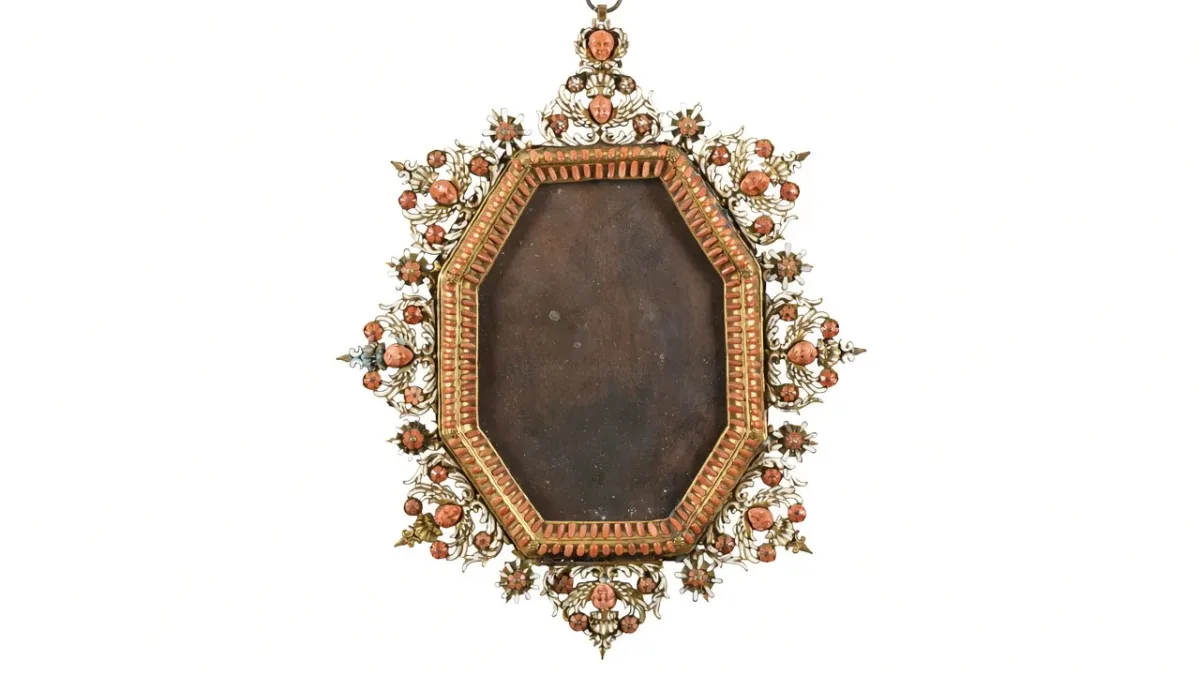
A capezzale hung above the bed. An acquasantiera held holy water beside a chapel door. In seventeenth-century Trapani both were often made of the same materials: Corallium rubrum cut into olives, commas, tongues and tiny heads, set into pierced gilt copper, sometimes with enamel, silver filigree or mother-of-pearl. These are not the coral necklaces associated with later Torre del Greco jewellery. They are architectural mounts for private devotion, church plate and, at the high end, gifts to viceroys and princely Wunderkammern.
The Museo Regionale Agostino Pepoli, in the former Carmelite convent beside the sanctuary of the Madonna of Trapani, still holds the largest public group: chalices, hanging lamps, crucifixes, rosaries, reliquaries, nativity groups and capezzali. Auction rooms treat the same types as a distinct Sicilian market. Completeness of the coral field, the mounting technique, losses and later replacements decide the price more than the word “Trapani” on a label.
The mastranza, 1628–1750
Coral working is recorded at Trapani from the fifteenth century. The statutes that collectors meet in the literature are later. On 26 May 1628 the local masters drafted Capituli for the ars corallariorum; a notarial version followed on 11 July 1628; the text was issued on 30 August 1633, registered by the Giurati the next day and approved by the viceroy on 23 September. Forty masters and lavoranti, in as many shops, signed the 1628 draft. The 1633 version carries thirty-six masters’ names and none of the workmen. The statutes covered raw-coral precedence, workshop inspection, tools, and a ban on slaves working coral. The corporation placed itself under the Blessed Sacrament and St Philip Neri, and from 1619 it maintained the Mistero of the Transport to the Sepulchre in Trapani’s Holy Week sequence.
In 1666 the sculptors in precious materials obtained a separate corporation, splitting sculptores coralli from the bead-cutters. Production did not stop. It did change hands. The urban rising of 1672–73, which the coral workers helped to lead against famine and the civic elite, was followed by an exodus. Maria Concetta Di Natale has traced Trapani corallari who then worked with Palermo silversmiths, among them the circle around Francesco Palumbo, whose 1678 holy-water stoup with Santa Rosalia is a documented collaboration. The same diaspora reached Naples.
The later seventeenth century is the period of the densest gilt-copper fields: octagonal backplates, architectural niches, God the Father above an Immaculate Virgin, engraved reverses. In the eighteenth century the Tipa family shifted the centre of gravity toward small sculpture in mixed materials. Andrea Tipa (born 24 January 1725, died 1766) and his brother Alberto (1732–1783) were described in the period as sculptors “in tenero e in piccolo”: coral, ivory, alabaster, amber and shell. The Pepoli museum attributes two nativity mountains in marine materials to Andrea’s shop. Wannenes has catalogued an altar cross of about 1750 under his name; that lot was published with an estimate only and is not used here as a price.
Fra Matteo Bavera, a Conventual Franciscan, stands earlier. The hanging lamp in gilt copper, coral and enamel made for the altar of St Francis in Trapani is inscribed and dated 1633 (SERAFICUS ORDO MIN. CONV. … FRA M. BAVERA A.D. 1633). The Pepoli crucifix given to him, about 23 cm, is carved from one coral branch except the arms; Rocco Pirri already called it singular in 1733. Auction houses still attach “Bavera” to unsigned pieces on the strength of an “M.B.” punch or a Franciscan subject. Di Natale and Sergio Intorre have warned that Bavera’s documented activity runs from about 1607 into the first half of the seventeenth century. A late-century date and a Bavera name on the same ticket should be read as a catalogue hope, not a fact.
Retroincastro and cucitura
Two mounting methods date the field.
Retroincastro is the older. The gilt-copper sheet is pierced to the pattern; coral olives, dots, tongues and rosettes are pushed in from the reverse and bedded in pitch and wax. Christie's, cataloguing a Trapani stoup, described the method as the earliest used by the Trapani craftsmen and noted the Arab-Islamic geometry of many grounds. A genuine seventeenth-century back still shows that bedding, the punched openings, and, often, an engraved reverse: foliage, a saint, occasionally a grotesque mask.
Cucitura appears from the late seventeenth century. Separate coral flowers and leaves are sewn or pinned to the metal with wire. Mother-of-pearl is common on this later group. Intorre uses the change to place many inkwells, frames and capezzali between the last years of the seventeenth century and the first decades of the eighteenth.
Look at the reverse before you look at the front. Period gilt copper is engraved or at least finished. A modern sheet with glue blobs, epoxy, or a plywood back is a later mount, even if some of the coral is old. Losses in a retroincastro field leave empty sockets of a consistent shape. Random gaps filled with plastic, dyed bone or reconstituted coral are the usual repair.
Coral colour on period Trapani work is Mediterranean red, often with white pith at the drill. Uniform “salmon” beads of identical size are more typical of nineteenth-century and later jewellery production, including Torre del Greco, and of tourist mounts that borrow the octagon without the technique.
What determines value
Applied to this material, the usual drivers are specific.
Workshop and period. A dense retroincastro field of the first half of the seventeenth century, with enamel and an engraved reverse, is the type that international rooms still chase. Mixed-material Tipa-period sculpture is a different collector, and a different price band. Unsigned nineteenth-century stands with sparse coral and glue are another market again.
Region. “Sicilian coral” is not an attribution. Trapani’s octagonal gilt-copper architecture, enamel rosettes and coral cherub heads are the local grammar. Palermo filigree stoups with a Trapani coral figure, after 1672, are collaborations and should be catalogued as such.
Material. Corallium rubrum on gilt copper is the standard. Silver, enamel, lapis, ivory and mother-of-pearl raise the object only when they belong to the original campaign. A later silver corpus on an older cross, or a replaced cup on a coral-mounted chalice (Intorre notes a Giovanni Caltagirone mark of c.1800 on an earlier stem), is a condition fact, not a bonus.
Rarity. Full architectural acquasantiere with a font, predella figures and a cupola are scarce. Empty frames and incomplete crucifix arms are not.
Condition and restoration. Missing olives, replaced enamel, modern screws through a font, and a later ebonised frame around a period plate are the usual deductions. Houses now flag CITES on Corallium rubrum; export outside the EU can fail even when the object is old.
Provenance. Named collections (Whitaker, Tirenna, March, Pepoli treasury) still move the room. A parish label without an export licence does not.
Size. Height around 40–50 cm for a stoup or capezzale is the documented sweet spot. Monumental church lamps (Bavera’s is 150 cm) barely appear at auction. Small 15–20 cm fragments sell as decorative coral, not as Trapani sacred work.
Demand. The buyer is a decorative-arts collector, not a jewellery client. Confusion with Torre del Greco beads, or with wooden crucifixes that happen to have a coral rosary attached, is how lots are mispriced in mixed sales.
Prices at auction
Figures below are as published by the houses. They are not a valuation. Condition, completeness, licence and the room on the day all move the result.
Christie's London, 6 July 2006, Important European Furniture, Sculpture and Tapestries, lot 199: an octagonal silver, gilt-copper, enamel and coral-mounted holy-water stoop, Trapani, first half of the seventeenth century, 49 cm high, the Immaculate Virgin in the central niche. Price realised GBP 72,000 (estimate GBP 40,000–60,000).
Christie's Paris, 15 June 2016, Sculpture & Objets d'Art Européens, lot 62: a coral and gilt-copper holy-water stoup, Trapani, seventeenth century, the Baptism of Christ on the front, a martyr saint engraved on the reverse, 44 × 22 cm (61 × 52 cm in a later giltwood frame). Price realised EUR 121,500 (estimate EUR 40,000–60,000). Provenance: Christie's Milan, 20 November 2002, lot 539.
Pandolfini, Florence, 19 October 2021, Sculture e oggetti d'arte. The house published three Trapani lots from one group: a seventeenth-century capezzale, lot 269, at EUR 81,250 (more than four times the asking price); a Cristo alla colonna composition, lot 263, at EUR 21,250; a cylindrical vase, lot 266, at EUR 27,500, from a EUR 5,000 start.
Il Ponte, Milan, 22 October 2015, sale 351, lot 1028: Trapani manufacture, late seventeenth to early eighteenth century, an octagonal gilt-bronze plaque with enamels and red coral, 22 × 23 cm, Virgin and Child in the niche, saints in prayer, the damned in the lower register, losses. Hammer EUR 47,000 (estimate EUR 7,000–8,000). Naples export licence stated.
Il Ponte, Milan, 28 October 2025, sale 732, lot 82: Trapani, second half of the seventeenth century, octagonal gilt copper with coral frame and enamels, 36 × 27 cm, the reverse engraved with stylised leaves and flowers, defects. Awarded EUR 18,000 (estimate EUR 10,000–12,000).
Dorotheum, Vienna, 7 March 2025, lot 45: a 32 cm standing cross, metal with coral mounts and a carved corpus, “probably Trapani, 19th century,” glue and age traces. Hammer EUR 300, excluding buyer’s premium and VAT. The lot is useful as a floor, not as a period comparable.
The spread is the point. A complete seventeenth-century stoup with enamel and an engraved reverse has made high five and low six figures in euros at Christie's. An octagonal plaque with losses still made EUR 47,000 hammer in Milan in 2015. A later, glue-repaired stand made EUR 300. Ranges quoted without those distinctions are marketing.
Wannenes has offered several Trapani crucifixes with estimates between EUR 8,000 and EUR 18,000 (sales 459 and 492, 2023). Those pages do not publish hammers, so they are types, not prices. Bertolami, Rome, 23 May 2024, offered a late-seventeenth to early-eighteenth-century capezzale in a tortoise-shell case at EUR 35,000–45,000; the lot was unsold.
Authentic or later
Buyers confuse four things: period Trapani mounts, Palermo-Trapani collaborations after 1672, eighteenth-century Tipa mixed-media sculpture, and nineteenth- or twentieth-century coral on new metal.
1. The reverse. Period plates are engraved or at least worked. Glue, filler and a raw copper sheet are later. Christie's 2006 stoup still had a reverse “richly engraved with scrolls and figures.” Il Ponte 2025 lot 82 was catalogued with an engraved floral reverse. If the seller photographs only the front, wait.
2. The sockets. Retroincastro leaves a regular pierced grid. Coral glued onto an unpierced surface is a later application, even if the beads are old.
3. The grammar. Octagon, coral olives in a continuous inner row, enamel star-flowers, coral cherub heads, architectural niches. A round jewellery frame with scattered twigs is not that grammar.
4. The figure. A coral Virgin or saint should be carved, not a cast resin painted salmon. Arms added to a single-branch corpus are period on the Bavera type; arms glued with visible modern adhesive are not.
5. Assemblages. Intorre records capezzali whose central ivory group, coral frame and outer wood do not belong to one campaign. A beautiful centre in a mismatched border is two objects.
6. Church plate conversions. A coral-mounted stem with a later cup, or a reliquary theca set into a Trapani plate, needs a sentence in the catalogue. So does a rosary of coral beads sold as “Trapani” without a gilt-copper mount.
7. CITES and dye. Mediterranean coral is regulated. Uniform dyed colour, especially on beads with no pith and no drill wear, is a jewellery tell. Period olives show tool facets and colour variation.
The common mistake is to pay a 2006-stoup price for an empty, incomplete frame, or to dismiss a damaged but coherent retroincastro plate because a few olives are missing. Another is to treat Sicilian silver and Trapani coral as one trade. Palermo and Messina silver hallmarks identify metal; they do not date coral.
FAQ
What is a capezzale?
A hanging devotional plaque, usually octagonal, made to sit above the bed. In Trapani it is a gilt-copper plate with a coral-mounted frame and a small sacred figure or empty niche, not a wooden headboard.
How do Trapani coral objects differ from Torre del Greco coral?
Trapani’s seventeenth-century output is architectural: coral cut into small elements and mounted on metal for churches and palaces. Torre del Greco, from the nineteenth century, is primarily carved jewellery and cameos. The two share a material, not a workshop.
Did every piece come from a named master?
Very few. Bavera’s 1633 lamp is signed. Palumbo’s 1678 stoup is inscribed. Most auction lots are “maestranze trapanesi.” Treat a Bavera or Tipa name without a signature, a close museum comparison, or a coherent date as provisional.
Can coral be restored?
Olives can be replaced. A restorer who matches drill, colour and bedding is doing conservation; a restorer who floods gaps with dyed paste is making a later object. Ask for a written condition report that separates original coral from replacements.
Why do some lots fail to sell?
Incomplete mounts, CITES uncertainty, and estimates set against the 2006–2016 Christie's stoups rather than against incomplete frames. Unsold high estimates are not secret hammers.
When to seek an appraisal
If the object is complete, has an engraved reverse, and is being offered as seventeenth-century Trapani, commission a specialist condition report before bidding: coral, metal, enamel, and a map of replacements. For export, ask the house in writing whether a CITES document and an Italian attestato di libera circolazione already exist. A parish provenance without those papers is not a bargain. None of the prices above is an offer to value a specific piece.