
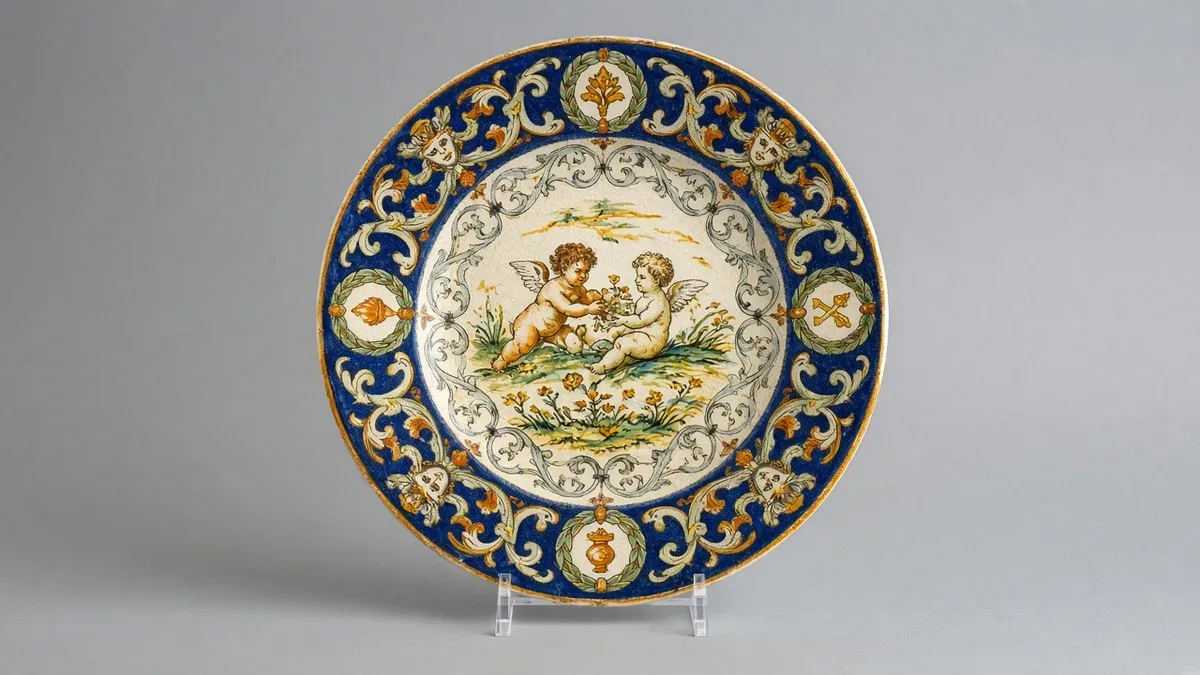
Signs Your Istoriato Plate Is Cantagalli, Not Renaissance
Spot Cantagalli maiolica versus Renaissance istoriato by the cockerel mark, glaze and footring, with verified auction prices. Not a valuation.
A tin-glazed plate painted with putti, grottesche and a coat of arms will often be offered, in a mixed house sale, as Urbino, sixteenth century. Turn it over. A crowing cockerel in blue, manganese or lustre is not a Renaissance workshop inscription. It is the pun of the Manifattura Figli di Giuseppe Cantagalli of Florence: cantare plus gallo. Ulisse Cantagalli (Florence, 18 June 1839 – Cairo, 29 March 1901) made that bird the factory mark after the 1878 relaunch. The Gardiner Museum in Toronto reads the cockerel as evidence that the kiln, as a rule, did not set out to deceive. Later vendors ground it off. The market now prices a marked Cantagalli as nineteenth-century art pottery. It prices an unmarked “istoriato” that is in fact Cantagalli as a problem.
Cantagalli is tin-glazed earthenware, maiolica in the Italian sense, not Victorian English majolica with coloured lead glazes. The factory copied Urbino istoriato, Deruta and Hispano-Moresque lustre, Iznik, and della Robbia relief. It is a different field from Faenza berettino and from Pesaro’s eighteenth-century kilns. The question for a buyer is not whether a cockerel-marked plate is “real maiolica.” It is. The question is whether the object is a Florentine revival piece of 1880–1930, a later cooperative ware, or a sixteenth-century dish whose story will not survive a specialist’s lamp.
What determines value
Maker and workshop come first. Ulisse and his brother Romeo inherited the family furnace and, in 1878, traded as Manifattura Figli di Giuseppe Cantagalli. Treccani records that Ulisse had already run the firm from 1872; 1878 is the art-pottery relaunch. Painters were sent to study museum pieces in Florence, Arezzo, Pesaro and Loreto. Ulisse himself worked from the Bargello and from the South Kensington and British Museum collections, and kept up correspondence with C. D. E. Fortnum, Henry Wallis, Julius Lessing and Wilhelm von Bode. The Milan industrial exhibition of 1881 gave the factory a gold medal for revival wares at prices “accessible to the generality of buyers.” That cheapness still shows in the rooms. Ordinary floral tulipieres and globular vases at Il Ponte hammer in two or three figures. Exhibition lustre and large istoriato vases do not.
Period splits the factory. The 1880s and 1890s are the revival years: istoriato, Iznik, Valencian lustre, Robbian white-and-blue. After Ulisse’s death in 1901 the widow Margherita Tod and the children Lorenzo, Flavia and Berta kept the historicist line and, at Flavia’s urging, added modern forms by A. Cigheri, C. Guerrini, R. Pazzini and A. Menegatti, later also A. Maraini, G. Balsamo-Stella and G. Vagnetti. The firm became a società anonima in 1927. Commercial trouble in the 1930s, a spell under Aubrey Adams and the Melamersons, and absorption in 1941 by the Consorzio italiano maioliche artistiche di Deruta, change the product. A 1920s blue underglaze figure is not an 1890 Gozzoli vase. A post-1954 cooperative plate with a loose cockerel is not Ulisse’s workshop. Treccani notes that good examples of the historicist ware are in the Museo Internazionale delle Ceramiche, Faenza.
Region is Florence. The body is a nineteenth-century earthenware, usually paler and more regular than a sixteenth-century Urbino biscuit. Tin glaze is the painting ground. Ruby and copper lustres, which William De Morgan praised to the Royal Society of Arts on 31 May 1892 as “the best I have even seen,” are a factory specialty. They are not a Gubbio workshop finish on a ducal plate. The Victoria and Albert Museum bought a copper-red lustre footed bowl, diameter 32 cm, crowing-cockerel mark in lustre, at the Italian Exhibition, London, 1888 (acc. no. 1674-1888). That purchase dates the lustre campaign to Ulisse’s lifetime.
Rarity is the large, fully istoriato presentation vase after a named painting, or a museum-quality lustre dish, not the 25 cm Iznik-style charger that Bonhams sells as Islamic-department overlap. Christie's, London, King Street, 22 April 2008, sale 7658 (Italian Ceramic Art 1400–1900), lot 126, sold a compressed two-handled oviform vase, circa 1890, 18⅝ in. (47.3 cm) high, painted after Benozzo Gozzoli’s Journey of the Magi, with ruby and copper lustres and gilding, blue cockerel mark, the foot cracked through and re-bolted, for GBP 19,700 realised. That is an exhibition object. It is not the price of a floral pair.
Condition is read against that lot: a structural repair did not kill the Gozzoli vase. Il Ponte, by contrast, routinely notes difetti on cheap florals and still sells them. A ground-off cockerel, a replaced footring, or a rim spray that sits over craquelure is a different defect. It is a dating problem, not a chip.
Provenance moves the needle when a museum is the vendor. Christie's, 2 September 2009, sold an 11½ in. (29 cm) Italian majolica plate, underside marked with a blue rooster, “possibly for Cantagalli,” from the Cummer Museum of Art & Gardens, for USD 9,375 realised against an estimate of USD 500–700, offered without reserve. The possible mark and the museum ticket together explain the jump. They do not make the plate sixteenth-century. The Metropolitan Museum of Art’s own Cantagalli plate (Rogers Fund, 1909, acc. no. 09.36.1), 23.8 cm, tin-glazed, is catalogued as twentieth-century Florence. A museum accession is a date, not a Renaissance certificate.
Size matters for the sculptural pieces more than for plates. Christie's, 30 October 2001, sold a large two-handled istoriato presentation pedestal vase, late nineteenth century, about 84 cm high, mythological scenes, winged-mermaid handles, for EUR 1,292 realised. A 40 cm Iznik-style dish at Bonhams is a different market from a 27 cm one.
Market demand is split. English and American ceramic sales still take large marked vases and Iznik copies. Italian Friday sales take the rest. Prices vary with condition and the day of sale. They are not a valuation of any object in hand.
Prices at auction
Il Ponte’s recent hammers set the Italian floor. Sale 723, 23 September 2025, lot 58, a Cantagalli tulipaniera painted “al tacchiolo,” marked under the base, height 48 cm, with defects, made EUR 100 hammer. Sale 657, 23 April 2024, lot 1899, a floral tulipaniera with serpent handles, 20 × 27 × 20 cm, with defects, made EUR 40 hammer. Sale 627, 22 September 2023, lot 918, a Ligurian-style blue pilgrim flask with satyr handles, height 40 cm, with defects, made EUR 150 hammer. Sale 603, 22 February 2023, lot 583, a pair of early-twentieth-century globular floral vases, diameter 32 cm, height 34 cm, with defects, made EUR 300 hammer. Sale 680, 14 November 2024, lot 714, three 1920s allegorical Seasons in blue underglaze, signed P.S., maximum height 45 cm, with defects, made EUR 150 hammer. The exception on that list is sale 627, 22 September 2023, lot 1078: a pair of polychrome griffin candlesticks supporting the Medici arms, raffaellesche tripod bases, height 33 cm, with defects, EUR 600 hammer. Modelled heraldic sculpture outperforms a floral vase of the same date.
Christie's London, South Kensington, 9 March 2010 (Interiors, Masters and Makers), sold a late-nineteenth-century two-handled oviform vase, blue cockerel mark, serpent and mask handles, istoriato figures before buildings in a river landscape, 16¼ in. (41.3 cm) high, for GBP 6,250 realised. The same rooms, 10 November 2005, sold a blue-and-white centrepiece with serpent handles, blue cockerel mark, 17⅜ in. (44.2 cm) wide, for GBP 420 realised, and a globular drug-jar with a soldier’s profile, cockerel mark and a manganese 4, 10 in. (25.4 cm), for GBP 456 realised. Those two lots are ordinary factory maiolica. The 41 cm istoriato vase is not.
Christie's, New York, 9 June 2014, lot 253, sold a late-nineteenth-century Renaissance-style trefoil wine basin (vasca), black painted cockerel mark and 3, faint blue printed mark, three mask handles, Biblical scenes on the exterior, crustaceans and fish inside, paw feet, 14½ in. (37 cm) wide, for USD 6,000 realised. A sculptural form with interior painting still finds American buyers.
Bonhams, London, New Bond Street, Islamic and Indian Art Online, 2–12 June 2025, sale 31243, lot 32, sold a nineteenth-century Iznik-style dish, raised red, cobalt and green on white, cockerel mark, 26.8 cm diameter, for GBP 768 including premium. The same department, 1–9 December 2025, sale 31318, lot 70, sold a larger Iznik-style dish, late nineteenth or early twentieth century, lotuses, carnations and saz leaves, cockerel mark integrated with initials, 39.8 cm diameter, for GBP 1,280 including premium. Those prices are for marked Orientalist copies, catalogued among Islamic pottery, not for claimed sixteenth-century Iznik.
Dorotheum, Linz, 1 June 2021, sold a Cantagalli wine jug, 19th/20th century, maiolica, leopard cartouche, beak spout, height about 37 cm, base mark, footring chipped, for EUR 260 excluding buyer’s premium and VAT.
These figures describe sales of specific lots. A plate in different condition, with the cockerel ground off or with a modern spray, will not match them. They are not an appraisal.
Authentic or later
Marks first. The factory mark is a crowing cockerel, usually painted, not stamped. It appears in cobalt, manganese, black or lustre, often on the reverse of a plate or under the foot of a vase. Numbers (a painted 3 or 4) and, less often, a printed secondary mark sit beside it, as on the 2014 New York basin. The V&A Hispano-Moresque-style dish of about 1900 (acc. no. 1459-1904, diameter 51 cm) carries a cockerel in blue. Absence of the bird is not proof of a sixteenth-century date. It is the first thing a dishonest vendor removes. Look for a ground patch, a glaze puddle that stops short of a smooth oval, or a later tin-white splash over the reverse.
Construction second. A Cantagalli plate is thrown or moulded in a regular nineteenth-century earthenware. The footring is even. Wear, if honest, is light and sits on the glaze, not through four centuries of cupboard abrasion. Sixteenth-century Urbino biscuit is a buff, slightly granular body; the reverse of an istoriato plate is often paler and less finished than the front, with kiln scars and a hand-cut foot. A reverse that is fully glazed, glassy and unused, then dressed with a calligraphic “Urbino 1528” in round modern capitals, is a warning. Compare the handwriting with the workshop formulae on dated Urbino reverses.
Palette and drawing third. Revival istoriato follows a print or a museum photograph more literally than a 1530s painter who adapted Marcantonio. Flesh is even, skies are a flat blue, and the grottesche on the rim are a repeating stencil rhythm rather than a drawn invention. Lustre on Cantagalli can be excellent. It can also sit as a uniform wash, without the pooling and iridescence of a Gubbio or Deruta firing. Iznik copies use a raised red and a saz-leaf vocabulary on a white ground; they are Florentine Orientalism, not Ottoman.
Typical reproductions, in the strict sense, are of two kinds. The first is honest Cantagalli, still marked, sold as “Renaissance style,” which is the correct description. The second is the same object with the cockerel removed, or a later Deruta-consortium or cooperative plate given an old-looking footring. Common buyer mistakes are to read a cockerel as a town mark, to treat a Gozzoli subject as a fifteenth-century date, to confuse Cantagalli tin glaze with English majolica, and to pay Urbino-istoriato money for a 48 cm tulipaniera.
Forms that barely exist in the sixteenth century are a tell of their own: the large two-handled presentation vase with mermaid or satyr terminals, the tulipaniera, the griffin candlestick with Medici arms as a pair for a sideboard. Those are nineteenth-century display objects. A tondino with putti can be either date. The reverse decides it.
FAQ
Is a cockerel-marked plate a fake?
No. It is a Florentine factory plate of about 1878–1940, or later if the painting is coarse and the mark is weak. Fake, in this field, means a revival object offered as a sixteenth-century one. The mark is the factory’s own warning against that offer.
Does grinding off the cockerel make the plate more valuable?
It makes it unsaleable to anyone who can read a footring. A specialist will price the object as damaged Cantagalli, not as Urbino.
How does Cantagalli lustre differ from Deruta or Gubbio?
The chemistry was recovered in the nineteenth century and can be of high quality, as De Morgan and the V&A bowl of 1888 show. The body, the footring and the cockerel still date it. A sixteenth-century Deruta lustre basin has a different weight, a different reverse, and no Florentine bird.
Why do Iznik-style dishes appear in Islamic sales?
Because the factory copied Ottoman models as well as Italian ones. Bonhams catalogs them with a cockerel mark and a European origin. They are not Iznik.
A plate offered as Urbino, Castel Durante or Deruta, with a subject taken from a museum-famous composition, a glassy unused reverse, or a ground patch where a cockerel would sit, should be seen by a maiolica specialist before money changes hands. Ask for a written condition report that photographs the reverse and the footring, describes any lustre restoration, and states whether a mark is present, overpainted or absent. That report is a description of the object. It is not a price.