
Italian Silver Photograph Frame Prices at Auction
What an Italian silver photograph frame is worth at auction: 800 hallmarks, Buccellati punches, and how later plate copies are sold as silver.
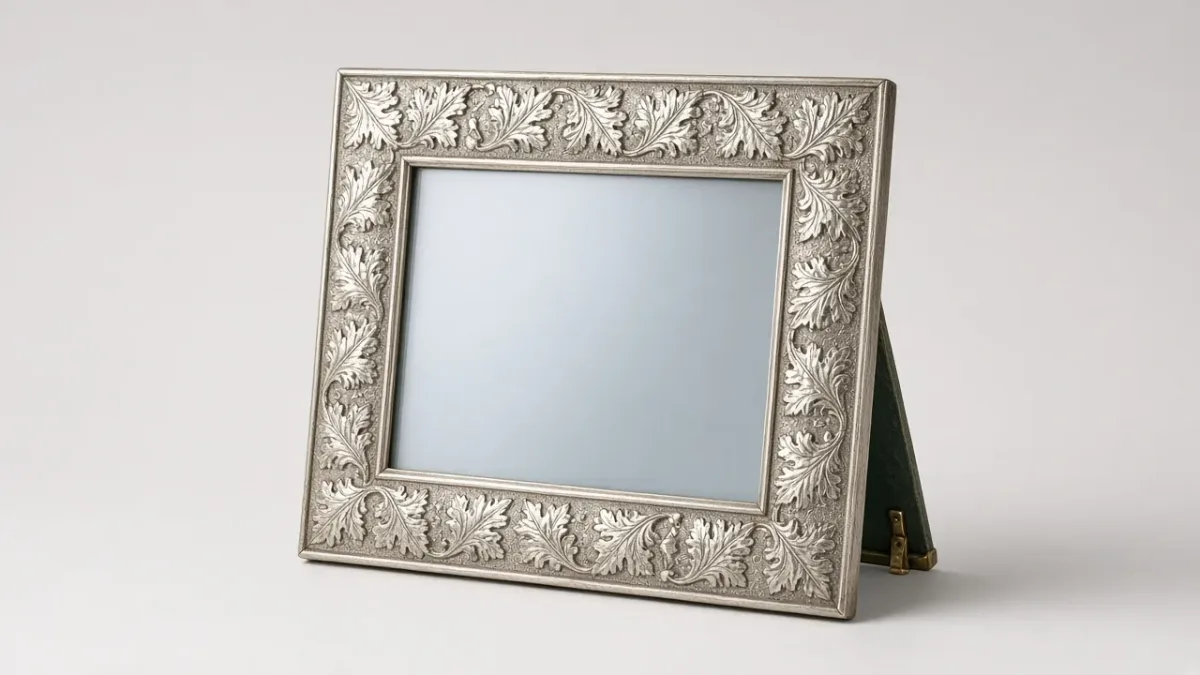
Italian catalogues list the object as a cornice portafoto or cornice portaritratti: a standing picture frame with a silver surround, a glazed window and a hinged easel. It is not a giltwood picture frame. Wood and gesso are a different trade. It is also not a matching silver centrepiece. A frame is priced as a small object of vertu, not as table silver sold by the kilo.
Most examples on the market are twentieth-century Milanese or Florentine work. The silver is a thin sheet, chased or cast, mounted on a wooden core. The back is covered in leather, velvet or chamois. A strut lets the frame stand in portrait or landscape. Glass, wood and fabric are included in any published “gross weight.” They are not silver.
The market pays for a named retailer, a readable national mark, an original case and a back that still belongs to the surround. It discounts electroplate stamped ARG 800, replaced struts, mixed lots of plate and metal, and frames whose only “Buccellati” is a later stamp. The figures below are auction results. They vary with condition and the day of sale. They are not a valuation.
What determines value
Maker and workshop come first, and they are not the same thing. Mario Buccellati took over the Beltrami and Besnati shop in Via Santa Margherita, Milan, in 1919. Frames later sold under that name, or as Gianmaria Buccellati or Federico Buccellati, carry a retailer stamp on the silver edge. The compulsory maker’s mark is a numbered lozenge or star punch of the workshop that actually struck the metal. Mario Buccellati srl is registered in Milan as 15 MI. Many objects retailed as Buccellati, Tiffany or Puiforcat were made by Ilario Pradella of Milan, registered 26 MI. Il Ponte, Milan, Important Silver, 30 October 2026, sale 802, lot 1005, catalogued a Gianmaria Buccellati rectangular frame with an embossed leaf border as manufactured by Clementi of Bologna. A name on the front is a shop. The number is the smith.
Period and region follow the national hallmark sequence. Law 5 February 1934, n. 305, as summarised by the Camera di Commercio di Napoli, required an oval fineness punch (800 or 925) and a lozenge with the maker’s number, a two-letter province code and the fasces. Decreto legislativo luogotenenziale 26 October 1944, n. 313, removed the fasces. Law 30 January 1968, n. 46, replaced the lozenge with a pointed rectangle and a five-pointed star. A frame with 1168 MI or 763 MI, as on the Federico and Gianmaria examples in Bonhams Knightsbridge sale 28269, lot 88, is post-1968 Milan. A Florentine iris frame at Dorotheum, 25 March 2026, lot 93, was marked Florence after 1968 and 925. Earlier civic punches (a Venetian lion in moleca, a Roman papal sequence, a Neapolitan NAP) belong to miniature and ecclesiastical frames, not to the easel photograph type.
Material is the first split a buyer can make with a loupe. Italian law works in parts per thousand. 800/1000 is the historic working standard for Italian silver; 925/1000 is sterling, common on export frames and on Buccellati’s later line. The punch sits on the lower edge of the surround, not on the wooden back. A frame is silver-fronted, not a solid block. Legislative Decree 22 May 1999, n. 251, governs filled objects; a photograph frame is a wood core with a silver skin, which is why published weights at Finarte and Wright include glass.
Rarity is a named model and a complete set of punches, not age as such. Buccellati leaves, shells, Rouche, bead-and-reel and matted bands are catalogue types. An unsigned 800 rectangle of the same size is a different object. Pairs and groups bring more than singles, which is why Knightsbridge sold eight frames as one lot and Wright sold a Rouche example with a triangular-leaf companion.
Condition is the back as much as the face. Crisp chasing in the leaf recesses, an unsplit silver skin, original silk or leather, a working hinge and an uncracked glass plate are what the rooms describe as “like new” or “minor defects.” Dents in thin repoussé are hard to raise. A loose catch, as on the Dorotheum 800 frame of 13 March 2026, is ordinary wear. Overpolishing erases the only dating evidence the object has.
Restoration and later parts move the price. A converted mirror, catalogued as such in the Knightsbridge group, is no longer a photograph frame. A replaced easel in modern plywood, a new velvet that does not match the wear on the silver, or a glass cut to a different rebate are later. Il Ponte’s Gabriella Crespi Nastro frame of 1957, sale 426, lot 68, was awarded below estimate with defects and losses; the Archivio Crespi paper did not cancel the damage.
Provenance that the rooms print is a fitted case, a guarantee card, a Japanese retailer stamp such as Wako on the Wright pair, or an archive declaration. A family photograph still in the window is not provenance.
Size is measured as the outer rectangle, then as the visible photograph opening. A 13.5 × 10.5 cm Buccellati at Finarte and a 46 cm Federico frame at Knightsbridge are not the same market. Giovanni Raspini’s 16 × 19 cm animal frame at Il Ponte, 14 October 2022, sale 581, lot 861, weighed 500 g: cast 800, not a leaf-thin skin, and priced accordingly.
Market demand sits with the Milanese names in London, New York, Hong Kong and Milan, and with unsigned 800 frames in the Austrian online rooms. The first group is a luxury object. The second is a small silver lot. Confusing them is how plate is sold as Buccellati.
Prices at auction
These figures are published sale results. They vary with condition, attribution and the day of sale. They are not a valuation of any private frame.
Il Ponte, Milan, Important Silver, 30 October 2026, sale 802, lot 1005: Gianmaria Buccellati rectangular silver photograph frame with an embossed leaf border, manufactured by Clementi, Bologna, 20 × 16 cm, original case, minor defects. Estimate EUR 160–180. Sold, fees included, EUR 768.
Finarte, Milan, Argenti Antichi e da Collezione, 17 December 2025: Buccellati cornice porta fotografia, Italy, twentieth century, 925, relief leafy motifs on a burnished ground, original box and guarantee, 13.50 × 10.50 cm, 196 g gross including glass. Estimate EUR 150–200. Sold EUR 490 including buyer’s premium.
Finarte, Milan, Silver, 20 November 2023: Buccellati sterling photograph frame, 925, leafy square relief, blue leather and wood back, original box and guarantee, 1.071 kg including glass and non-silver insert. Sold EUR 1,097 including buyer’s premium.
Bonhams, London, Knightsbridge, Silver and Objects of Vertu, 18 October 2023, sale 28269, lot 88: eight Italian silver photograph frames marked Buccellati, Federico Buccellati or Gianmaria Buccellati, green material easel backs, heights from 20.2 cm to 46 cm, including post-1968 Milan marks 1168 MI and 763 MI. Sold GBP 4,096 including premium.
Bonhams, Los Angeles, Modern Design | Art, 21 October 2021, sale 26867, lot 96: Buccellati photograph frame, 1980s, sterling, glass, leather, stamped 925 Buccellati on the lower edge, 20 × 16 cm. Sold USD 956.25 including premium.
Bonhams, Hong Kong, Silver, Jade Object and Jewellery, 25–31 March 2025, sale 30597, lot 845: five Gianmaria Buccellati / Buccellati sterling frames with original cases, marks including MC 925, 16.0 × 20.0 cm and 10.8 × 13.2 cm. Sold HK$21,760 including premium, catalogued as-is and untested. Lot 846 in the same sale: two Gianmaria Buccellati frames, 22.8 × 27.8 cm, original cases. Sold HK$14,080 including premium.
Wright, Chicago, Objet, 30 April 2026, lot 227: pair of Gianmaria Buccellati sterling frames, second half of the twentieth century, one Rouche and one with triangular leaves, 13 × 10 cm and 20 × 16 cm, 23.68 ozt gross, one original box; marks Gianmaria Buccellati Sterling 925 Wako and Buccellati Sterling Italy. Result USD 2,048.
Il Ponte, Milan, 14 October 2022, sale 581, lot 861: 800 silver frame with animals in relief, Giovanni Raspini, 16 × 19 cm, 500 g, minor defects. Estimate EUR 450–500. Awarded EUR 1,100.
Il Ponte, Milan, 19 June 2018, sale 426, lot 68: Gabriella Crespi, Cornice model Nastro, Milan, 1957, 800 silver sheet with hand engraving, 21 × 16 cm, defects and losses, Archivio Gabriella Crespi declaration. Estimate EUR 180–200. Awarded EUR 150.
Dorotheum, Vienna, Silver, 13 March 2026: Italian photograph frame, silver, wooden easel back, rectangular, glazed, 17.5 × 12.5 cm, Italian assay, 800, twentieth century, small dents, loose back catch. Realized EUR 150 excluding buyer’s premium and VAT.
Dorotheum, Vienna, 20th Century Works of Art, 25 March 2026, lot 93: sterling frame with iris and ribbon relief, Florence after 1968, 925, brown velvet back, 18.8 × 23.7 cm. Realized EUR 260 excluding buyer’s premium and VAT.
Il Ponte, Milan, 31 March 2014, sale 319, lot 249: five mixed silver and silvered-metal frames, slight defects. Estimate EUR 20–30. Awarded EUR 80.
Sotheby’s, Design 17/20, 5 April 2023, offered five Mario Buccellati Milan frames with cloth-wrapped hinged backs, heights 16.5–21.3 cm, marked 26-MI (three, 925) and 15-MI (one 800, one 925), estimate USD 5,000–7,000. No hammer is published on the lot page; the marks are cited here as a catalogue type only.
Read those results as two bands, not a single “Italian silver frame” price. Named Milanese frames with cases, in London, Milan, Hong Kong and Chicago, sold from the high hundreds of euros or dollars into the low thousands for a single or a small group. Unsigned 800 easel frames in Vienna sold at EUR 150–260 hammer. Mixed plate groups in Milan sold for tens of euros. A Raspini cast 800 frame at 500 g sat between those bands because the metal is heavy, not because it is Buccellati.
Authentic or later
The first tell is the punch, read with a 10× loupe on the silver edge. After 1934 a genuine Italian frame should show an oval 800 or 925 and a maker’s lozenge or star with a province code. Star at left means after 1968. Fasces means 1934–1944. Lozenge without star or fasces means 1944–1968. A naked 800 can be earlier workshop practice under the optional assay of the law of 2 May 1872, n. 806; it is not by itself a fake. Letter stamps such as ARG 800, ARG 1000, EPNS or silverplate are plate. They imitate a hallmark. They are not one. The same grammar used to date candlesticks and Florentine assay marks applies here; the punch simply lives on a narrower rim.
The second tell is construction. Lift the back. A period frame has a wooden chassis, a fabric or leather covering, a metal hinge and a strut that folds both ways. The silver skin is thin. You can often see the wood at the rebate. Cast Raspini work is thicker and heavier; it still has a back, but the surround is not a leaf-thin sheet. Electroplate on brass or white metal is light, and wear at the corners shows a yellow or grey base. A laser-etched “Buccellati” on an otherwise unmarked 800 rectangle is a later addition. The registered number will not match 15 MI, 26 MI, 763 MI or 1168 MI.
The third tell is wear. Honest tarnish sits in the punched ground between leaves. The high points of a bead-and-reel or a Rouche border soften. The easel leather darkens and the silk lining frays at the clips. Uniform bright-dipped silver with a brand-new green velvet and a stiff modern hinge is either unused stock or a marriage. Reproductions copy the leaf pattern in shallow, repeated stamps; the veins do not undercut. Tool traces on a chased Buccellati-type frame are irregular. On a later copy they repeat every few centimetres.
Typical fakes and later copies that the rooms already separate: mixed lots of silver and silvered metal, as in Il Ponte sale 319, lot 249; English plate sold beside Italian 800; frames converted to mirrors; unsigned 800 skins given a Buccellati box that does not fit; retailer names without a maker’s star. A common buyer’s mistake is to weigh the object, divide by the silver price, and treat the result as value. Finarte’s 1.071 kg and Wright’s 23.68 ozt are gross. Another mistake is to read 26 MI as a date. It is Pradella’s Milan registration. A third is to take “Made in Italy” on a Tiffany or Wako piece as a substitute for the star punch; it is a retail line, not an assay.
FAQ
Is an 800 photograph frame solid silver?
The surround is 800/1000 silver. The core is wood. The back is fabric or leather. The glass is glass. Italian law treats the silver skin as the precious-metal part. It is not sterling, and it is not a solid ingot.
Where are the marks?
On the lower edge of the silver surround, sometimes repeated on the inner rebate. They are not on the easel. Do not polish the rim before you photograph it.
Does a Buccellati stamp mean Mario made it?
It means the shop sold it. The maker’s number may be 15 MI, 26 MI (Pradella), Clementi of Bologna as on Il Ponte sale 802, lot 1005, or another registered smith. Gianmaria and Federico are later family stamps. Match name, number and fineness before you pay a Milanese price.
Why do auction weights look so high?
Catalogues quote gross weight: silver plus glass plus wood. A 13.5 cm frame at 196 g gross is not 196 g of silver.
What should a later copy look like?
Shallow repeated leaves, ARG 800 or no oval fineness, a plywood back, a hinge with Phillips screws, and a name stamp that is sharper than the chasing. Unsigned 800 frames can still be honest shop work; they are not Buccellati.
A professional appraisal or a written condition report is warranted when the punches are incomplete, when a Buccellati or Crespi attribution rests on a box alone, when the back has been replaced, or when a group is offered as a matching set. Ask the room for a photograph of the marks and of the hinge before bidding. The report is a description of the object in hand. It is not a price.