
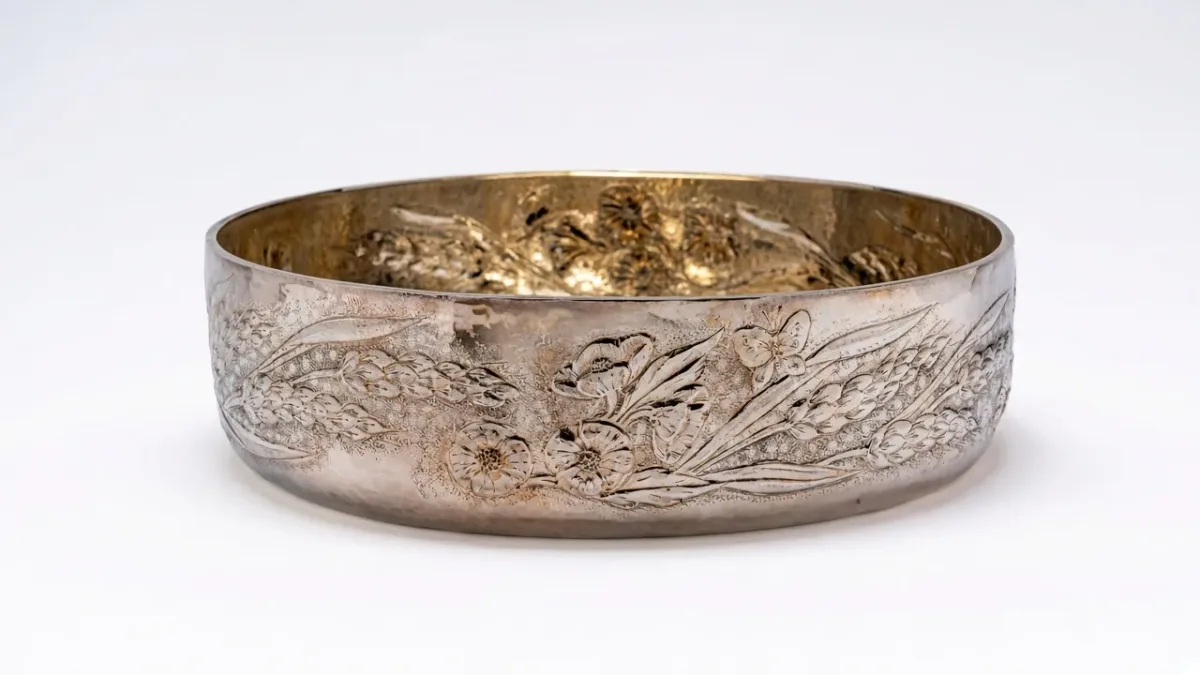
What Makes an Italian Silver Centerpiece Valuable
What an Italian silver centerpiece is worth at auction: maker, weight, 800 marks, Buccellati versus unsigned table bowls, and how to spot later copies.
The Italian table centrepiece is not one form. Catalogues use centrotavola for a low bowl that sits in the middle of a dining table, alzata for a raised dish on a foot or spool knop, trionfo da tavola for a figural group, and epergne for a branched stand with hanging baskets, a type more English than Italian. Weight, punches and the name on the mark move the price more than the English word on the invoice.
A Genoese alzata of 1778 and a Milanese Buccellati fruit bowl of the 1960s occupy the same place on a table and different markets. The first is dated by a city assay. The second is dated by a registered maker's lozenge and by demand for a named naturalistic model.
What determines value
Maker or workshop. Mario Buccellati, registered in Milan, is a separate price band from unsigned 800 table bowls. Christie's lot essays cite Martina Corgnati, Mario Buccellati: Prince of Goldsmiths (1998), for the seahorse-foot bowl. Milanese twentieth-century names that appear on ordinary table bowls include Miracoli and Boggiali. They do not command Buccellati money. An eighteenth-century city punch (Genoa torretta, Naples NAP, Venice leone in moleca, Rome crossed keys) dates the object and can outweigh a later unsigned 800 bowl of greater weight.
Period. Pre-unification table silver is scarcer in the rooms than twentieth-century 800 hollowware. Scarcity does not always mean a higher hammer. The Genoa 1778 alzata at Il Ponte was estimated at EUR 450–500 and hammered EUR 1,500 with scratches and dents. Named Buccellati bowls, made in the same century as a modern dining table, have realised tens of thousands of dollars in New York.
Region. Genoa's civic punch, the torretta, a stylised castle of three towers, marked silver in the Republic until about 1826. The Musei di Genova goldsmiths' collection at Palazzo Tursi is built around that punch. Naples used NAP, NAPL or NA, then Parthenope punches. Florence and Milan dominate twentieth-century table bowls in Italian sales. A Florentine mid-century chased circular bowl is a different object from a Venetian lion-marked dish.
Material. Italian table silver is usually 800/1000, not sterling. Giorgio Busetto's survey for the Association of Small Collectors of Antique Silver records that after the law of 2 May 1872 silversmiths rarely sent work to the optional official assay. An unofficial "800" punch, oval, rectangular or with no outline, is what most late-nineteenth- and early-twentieth-century hollowware actually carries. 925 appears on Buccellati export work and on later sterling-marked pieces. Punches such as ARG 800 refer to silverplate, not silver.
Rarity. A documented eighteenth-century alzata with a dated city punch is uncommon. A mid-twentieth-century circular 800 bowl with wheat and flowers is not. Buccellati naturalistic models (seahorse feet, fruit wreaths, cabbage leaves, mermaid chariots) were produced in series, yet remain scarce at this scale and weight.
Condition. Dents at the rim, pushed feet, splits in pierced work, and later interior gilding cut the price. Il Ponte's Genoa 1778 piece was catalogued with scratches and dents and still doubled its estimate. A Miracoli circular bowl in the same rooms, 5 February 2026, sale 754 lot 491, 1,000 g, diameter 34.5 cm, was catalogued with defects and hammered EUR 1,400.
Restoration. Replaced hanging baskets on an epergne, later glass bowls on figural stems, and filled bases must be stated. Decreto Legislativo 22 May 1999 n. 251 requires an R in a square on riempito (filled) precious-metal objects, with a gram weight of the silver skin. A heavy-looking centrepiece that is mastic-filled is not a solid-silver weight.
Provenance. Christie's New York, 9 May 2018, sold a Buccellati shell-form bowl of 1965, 33.3 cm, 1,232 g, for USD 40,000 against an estimate of USD 5,000–8,000. The bowl had been an anniversary gift to David Rockefeller from Peggy Rockefeller, acquired from Mario Buccellati, Inc., New York, in May 1965. Provenance of that kind is not transferable to an unsigned 800 bowl of similar size.
Size. Gram weight is the first number in an Italian silver catalogue. A Boggiali basket of 850 g and a Buccellati mermaid chariot of 21,940 g are not comparable on style alone. Diameter without weight is not a price.
Market demand. New York and London named-maker sales set the top. Italian houses (Il Ponte, Finarte, Pandolfini, Wannenes, Cambi) absorb the unsigned 800 table bowls that furnish dining rooms. The figures below are results for those lots. They vary with condition and with the room. They are not a valuation of any other bowl.
Prices at auction
Verified results, currency as published.
Il Ponte, Milan, 6 April 2016, sale 362, lot 20. Silver alzata, Genoa 1778, circular stepped and moulded foot, spool knop, plain dish with shaped rim. Torretta and assay punches. Height 10 cm, diameter 26 cm, about 730 g. Scratches and dents. Hammer EUR 1,500 (estimate EUR 450–500).
Il Ponte, Milan, 22 April 2021, sale 503, lot 569. Shaped basket centrepiece, scrolls, hammered interior. Maker Boggiali, 800. Maximum length 40 cm, 850 g. Hammer EUR 500 (estimate EUR 550–600).
Dorotheum, Vienna, 16 May 2019, Silver and Russian Silver, lot 269. Italian three-part centrepiece set, twentieth century, 800, interior gilding, rectangular central bowl 27.5 × 23 cm, two shell bowls 15 × 13 cm, seahorse legs, 2,040 g. Realised EUR 2,176 including buyer's premium and VAT (estimate EUR 1,800–2,400).
Finarte, Milan, 22 November 2021. Circular Miracoli centrepiece, pierced floral rim, 1.389 kg, diameter 37 cm, height 7 cm. Sold EUR 832 including auction rights (opening bid EUR 250).
Finarte, Milan, 29 September 2026. Circular Florentine mid-twentieth-century centrepiece, chased band of wheat, flowers and butterflies on an engraved naturalistic ground, plain well, 1.355 kg, diameter 33 cm, height 9.5 cm. Sold EUR 1,400 including auction rights (estimate EUR 1,200–1,300).
Il Ponte, Milan, 5 February 2026, sale 754, lot 491. Circular plain Miracoli centrepiece, stepped rim, Milan, 1,000 g, diameter 34.5 cm, defects. Hammer EUR 1,400 (estimate EUR 1,100–1,200).
Christie's New York, 21 May 2014, lot 26. Buccellati mermaid-chariot centrepiece bowl, Milan, twentieth century, 925, marked \*763 MI, 925, Sterling and BUCCELLATI ITALY. Length 75 cm, gross weight 21,940 g. Realised USD 75,000 (estimate USD 50,000–80,000). Christie's realised prices include buyer's premium.
Christie's New York, 21 October 2011. Buccellati cabbage-leaf oval bowl, signed M. BUCCELLATI, also marked 15MI and 800, 47.6 cm, 3,847 g. Realised USD 37,500 (estimate USD 20,000–30,000).
Christie's New York, 19 October 2012. Buccellati seahorse-foot oval bowl, 44.5 cm, 3,908 g. The model is illustrated in Corgnati 1998, p. 147. Realised USD 32,500 (estimate USD 20,000–40,000).
Christie's New York, 21 October 2011. Milanese figural centrepiece, circa 1900, classical female figure and putto supporting a cut-glass bowl, Russian import marks on finial and base, 45 cm high, 2,454 g weighable silver. Realised USD 8,125 (estimate USD 4,000–6,000).
Christie's London, 19 March 2009. Monumental enamel, silver, gilt and patinated bronze centrepiece attributed to Eugenio Bellosio, Milan, circa 1900, made for the Paris Exposition Universelle. Realised GBP 289,250 (estimate GBP 30,000–50,000). This is exhibition metalwork, not a dining-table bowl. It is cited so that a Bellosio or "1900 Milan" label is not used to price an ordinary 800 centrotavola.
A working picture supported by those results, not a valuation: unsigned or modestly marked twentieth-century Italian 800 table bowls of about 0.8–2 kg commonly hammer or realise in the high hundreds to low thousands of euros in Milan and Vienna. Named Buccellati naturalistic bowls in New York have realised from about USD 20,000 to USD 75,000 depending on model, weight and provenance. An eighteenth-century Genoese alzata with a dated torretta, even dented, can outrun its estimate without approaching Buccellati money. Condition and the room still decide each lot.
Authentic or later
Marks first. Look under the foot, on the reverse of the well, and on any detachable bowl. A genuine punch displaces metal. Edges are slightly irregular. A later "800" cut with a burin, or a cast-in fake lozenge, sits on the surface.
The sequence after unification, as Busetto sets it out on silvercollection.it, is the dating grid for most table bowls now in trade:
- 1872–1934: optional official assay. Most table silver carries only an unofficial 800.
- Law 5 February 1934 n. 305: oval 800 or 925 plus a lozenge with maker number, fasces, and two-letter province code (MI Milan, FI Florence, RM Rome, NA Naples, VE Venice).
- Legislative decree 26 October 1944 n. 313: fasces removed. Number and province remain.
- Law 30 January 1968 n. 46 and D.P.R. 30 December 1970 n. 1496: polygonal mark with a star at left. 800, 835 or 925 in an oval.
A "baroque" centrepiece with a star-and-MI polygon is 1968 or later, whatever the chasing. A fasces lozenge dates 1934–1944, or a punch reused with the fasces cancelled. Neither is an eighteenth-century city piece.
City punches for earlier work: Genoa torretta (to about 1826); Venice leone in moleca with assayer's initials (to 1812); papal crossed keys for Rome; NAP, NAPL or NA for Naples. Read the national guide to Italian silver hallmarks before trusting a single motif chased on the body. A walking lion chased on a bowl that also bears a national 800 is decoration, not a Venetian assay.
Construction. An eighteenth-century alzata is raised in sheet, with a seamed or soldered foot and a knop that can be a separate element. A twentieth-century factory bowl is often spun, with even wall thickness and a soldered wire rim. Hammer marks on the exterior of a mid-century Florentine bowl are planishing, not proof of 1750.
Tool traces. Chasing on period work cuts into the silver and leaves a corresponding boss on the reverse. Cast "chasing" on a later copy is the same on both faces of a thick wall, or is a stamped skin soldered to a liner.
Wear. A table bowl used for fruit or flowers takes abrasion on the inner well and on the resting foot. Even tarnish with no wear at those points, plus a mirror polish in the recesses of the chasing, is consistent with a recently made or heavily refinished object. Later interior gilding is common and should be described. It is not a date.
Typical reproductions and fakes. Electroplate marked ARG 800. Filled (riempito) bowls with an R in a square, or with no mark and a suspiciously high weight for the wall thickness. English or German epergnes catalogued as Italian because a later 800 punch was added. Buccellati-type fruit wreaths without a registered Milan number, without the 800 or 925 oval, and without a struck BUCCELLATI. Multi-part sets whose seahorse legs and bowls do not share punches.
Common buyer mistakes. Paying Buccellati money for an unsigned 800 fruit bowl. Treating 800 as a defect; it is the historic Italian table standard. Dating from style alone when a 1968 star is on the foot. Confusing a silver tray with a centrepiece: a tray is for service, a centrotavola is for the middle of the table. Pairing an eighteenth-century foot with a later dish. Ignoring filled bases on centrepieces and candlesticks alike.
Florentine twentieth-century punches belong to a different series from Grand-Ducal assay. For that earlier Tuscan language see dating Florentine silver.
FAQ
Is Italian table silver 800 or 925?
Most antique and twentieth-century Italian hollowware is 800/1000. 925 appears on jewellery, on some export hollowware, and on Buccellati pieces marked Sterling. 800 is not a downgrade from "real silver."
Does a Buccellati signature guarantee the high prices above?
No. Christie's sold a small Mario Buccellati fruit-form basket, 17.8 cm, 738 g, for USD 2,250 on 21 October 2011. Model, weight and condition decide. An unsigned copy of a fruit wreath is a different object.
How can a filled centrepiece be told from solid silver?
Italian law since 1999 requires an R in a square on filled precious-metal objects, with a gram weight of the silver skin. Tap the wall. A mastic fill sounds dull. A base that cannot be opened, with no R mark and a weight far above the visible sheet, needs a conservator, not a bid.
Are eighteenth-century Italian centrepieces always more valuable than twentieth-century ones?
The Genoa 1778 alzata hammered EUR 1,500. Several unsigned twentieth-century 800 bowls in the same Italian rooms have sold in the same band. Named Buccellati bowls have sold far above both. Period is one factor. It is not a hierarchy.
A centrepiece that will be insured, exported or offered at a named sale should be seen by a silver specialist with a condition report: punches photographed, weight recorded, any fill, later gilding, replaced parts and splits in pierced work described. The figures above are auction results for specific lots. They are not an appraisal of any other bowl.