
Genoese Velvet and the Ligurian Silk Workshops, 1432–1700
How Genoese velvet was woven in Liguria, how to tell authentic ciselé silk from later copies, and what Italian period panels sell for at auction.
Genoese velvet is a pile-warp silk. An extra set of warps is drawn over brass rods during weaving; the loops are then cut, left standing, or mixed in the same pass. French inventories called the type velours à la façon de Gênes. English catalogues still say Genoa velvet for a polychrome ciselé furnishing silk, whether or not the loom stood in Liguria. The name is a quality claim. It is not, by itself, a place of manufacture.
This is a workshop study of the Ligurian silk trades that made that claim stick, from the Arte della Seta statutes of 1432 to the jardinière furnishing velvets of the late seventeenth century. Identification still starts with the pile. Value follows from period, metal, selvage and condition, not from the word Genoa on a dealer ticket.
The Arte della Seta, 1432
Silk was already moving through the port in the thirteenth century: Calabrian, Sicilian and Spanish yarn on the way to Lombardy and the fairs north of the Alps. Weaving on the spot is later. In 1303 two Lucchese merchants are recorded in Genoa making zendado, a light silk near taffeta. By the end of that century the Lucchese seterij in the city numbered twenty-three, political exiles from their own republic.
The Arte della Seta received statutes in 1432. Giuseppe Morazzoni published the text in 1941. The guild sat above the other crafts because it employed many hands and because its export paid. Notarial acts of 1424–43, cited by Federico Alizeri in 1874 and again by Marzia Cataldi Gallo, record the Lucchese designer Baldo Franceschi supplying “modelli de’ lor broccati o velluti” to a group of Genoese setaioli: Giacomo Peirolero, Triadano Lomellino, Francesco di Loreto, and Giovanni, Giacomo and Bartolomeo Borlasca. Those names appear on the first council of the Arte. The contract bound Franceschi to sixty designs a year and forbade both sides from farming the work out. Other Tuscan draughtsmen followed: the Florentine Giovannetto and the Lucchese Leonardo Franceschi and Leonardo da Bettino.
By 1555 the city itself counted 145 velvet looms. Many more stood on the two riviere: 250 at Levanto, 80 at San Lorenzo della Costa. Velvets alone were more than half of Genoese textile exports through the fairs. A customs register of 1510 implies about 360 cases a year. The Palazzo Ducale exhibition Arte e lusso della seta a Genova dal ’500 al ’700 put the late-sixteenth-century workforce at about 15,000 weavers and about 38,000 people touching the trade, in a city of some 60,000. French and English workshops that could not match the Ligurian product sold their own velvets as velours de Gênes or Genoa velvet.
How the pile is built
Velvet is not a finish applied to cloth. It is a second warp. The ground weave, often satin, is made by one set of warps and the weft. A pile warp is lifted over thin brass rods as the cloth advances. When the rod is withdrawn, a row of loops remains. Cut those loops and the surface is velluto rasato or plano. Leave them and it is riccio or soprarizzo. Mix cut and uncut in one colour and the same dye reads as two tones under raking light. That mixed face is velluto cesellato, ciselé velvet, the Ligurian speciality Jean Bezon said the Genoese had been “sans rivaux” in for some centuries.
Voided velvet leaves the satin ground exposed around the pile motifs. Pile-on-pile, altobasso or controtagliato, stacks two or three heights of pile; the Cleveland Museum of Art’s silk velvet with gold in a pomegranate pattern (acc. 1940.596), Italy, possibly Florence, 1450–1500, is cut pile in two heights plus uncut loops and gold-thread loops. Allucciolato raises a gold or silver weft on the face and twists it into loops or small spirals with an iron. The Metropolitan Museum of Art associates the richest metal bouclé especially with Florence, while noting that every major centre used it. A Ligurian attribution cannot rest on gold loops alone.
Width is a dating tool. Luxury silks of this class were woven about 54–60 cm across, a loom width that still shows as a seam or a selvage on a hanging pieced from several drops. The Victoria and Albert Museum, recording a green-and-gold furnishing velvet of about 1570–1629 (acc. 147-1880), notes that under the best conditions a weaver advanced no more than about 60 metres in a year. Solid velvets sat at the bottom of the wage scale; pile-on-pile with brocaded gold sat at the top, at roughly three times the pay.
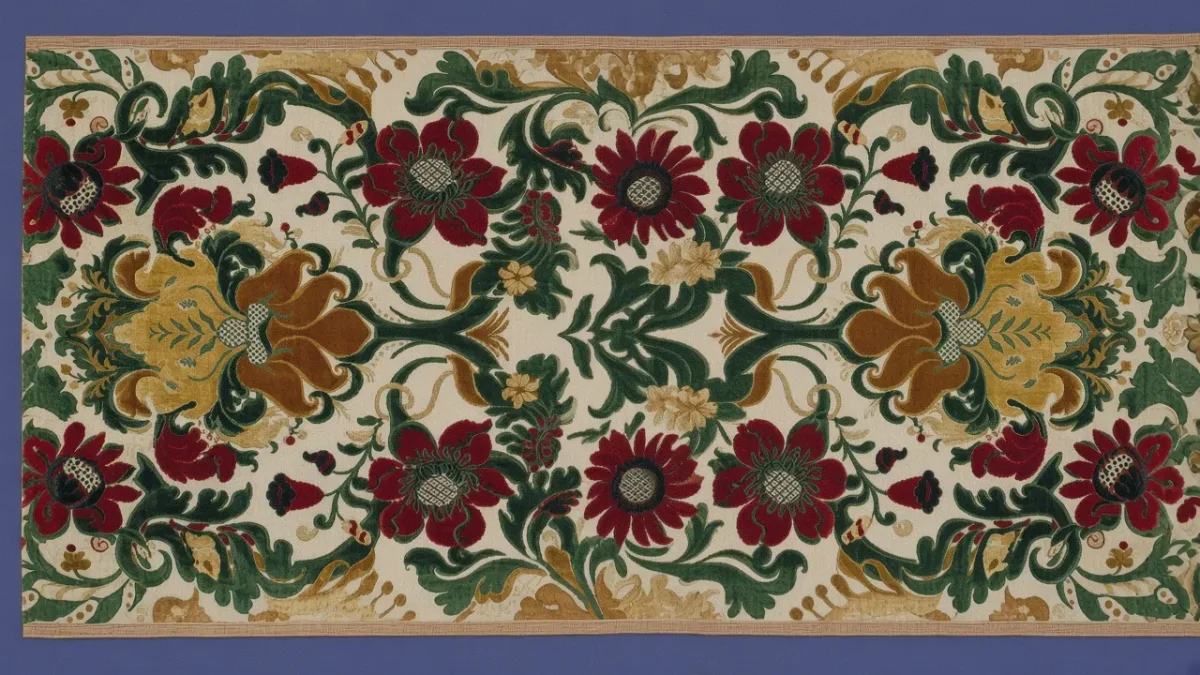
The late-seventeenth-century furnishing type is velluto giardino, jardinière velvet: large flowers and scrolling leaves arranged symmetrically across the full width, often in four or more pile colours on a pale satin ground. The Met’s piece 38.182.2, Italian, Genoa, about 1700, is that design. So is the V&A’s six-colour ciselé velvet 339-1891, probably Genoa, 1650–1700, silk pile on a ground of silk and silver-gilt weft. These are furniture silks, not dress lengths. They belong with wall hangings and seat covers, not with a fifteenth-century pomegranate chasuble.
Genoa, Venice, Florence, Milan
Venice, Florence and Genoa are the three names on every museum label. The Met’s essay on Renaissance velvet textiles adds Milan from the mid-fifteenth century, under Visconti and Sforza patronage, with statutes that told Milanese weavers to model themselves on Florence. Seaports sold east and west. Inland centres sold design.
In the sixteenth century even Venetian rivals conceded the superiority of Genoese black velvet. Black and bright white are the colours that survive least well: the dyes that produced them attacked the silk. Crimson, from insect kermes or later cochineal, was the commercial red. Green and sapphire followed. Liguria’s later fame is the polychrome floral ciselé on a light ground, the jardinière type that Lyons and Spitalfields copied for upholstery.
Florence is the design centre in the literature, and the place most often attached to Medici armorial velvets. Venice is the other seaport. A motif tied to a documented family is stronger evidence of origin than a modern “Genoa” in a catalogue. Guild rules stipulated selvage colours and warp counts as quality marks. The Cleveland panel retains a striped green and ivory selvage, “the equivalent of a label, required by law,” recording fibre, quality and quantity. Those stripes are not a reliable city punch. Competitors copied one another’s top goods. Industrial espionage was normal. Without a document, “Genoese” is a technical description: ciselé pile, dark-on-satin or polychrome jardinière, loom width in the Ligurian range.
Liturgical use kept earlier types in service long after furnishing fashion had moved on. A pomegranate voided velvet on a chasuble may be sixteenth-century cloth reused in a later cut. An orphrey embroidered separately and applied is a different object from the velvet field. Italian embroidery and tapestry are not pile weaves. If the weft turns at every colour boundary, the cloth is an arazzo. If an extra warp built the surface, it is velvet.
What determines value
Workshop and city. A documented Ligurian loom, or a technical match to the cesellato type the French called façon de Gênes, outranks a later length sold under the same name. Honest revival weaving from Tessitura Luigi Bevilacqua in Venice (a nineteenth-century revival of eighteenth-century looms) or from the Fondazione Lisio in Florence (1906) is twentieth-century work. It is not a fake. It is misdescribed if dated 1600.
Period. Fifteenth-century pile-on-pile with gold, sixteenth-century pomegranate voided velvet, and late-seventeenth-century jardinière furnishing silk are three markets. A nineteenth-century historicist length in a fifteenth-century pattern is a fourth.
Region. Genoa, the riviere, Venice, Florence and Milan are not interchangeable. A Spanish velvet, or a Lyon copy, can share a pattern and none of the Ligurian dye or sett.
Material. All-silk pile; silk pile on a metal-thread ground; wool velvet for furniture. Remaining gold loops matter. Mixed fibre and later cotton linings do not.
Rarity. Full loom widths with both selvages, uncut repeats, and unused furniture lengths are scarcer than cut-down vestment backs. Polychrome ciselé in six or seven pile colours is scarcer than monochrome crimson.
Condition. Pile crush along old folds, splits in the satin ground, insect loss, and the crumbling of iron-dyed black decide the price more often than the pattern. A later lining can hide those losses.
Restoration. Replaced orphreys, patched repeats, rewoven pile and modern fringes are common on church textiles. A complete re-cut of a hanging into cushions is a different object.
Provenance. A palace or sacristy inventory, a museum deaccession, or a labelled length such as the Gardner Museum’s late-seventeenth-century Genoese furnishing fabric (ciselé voided silk velvet, 101.6 × 45.7 cm) is worth more than an anonymous fragment.
Size. Dealers price by the complete repeat and by the square, not by the romance of a small scrap. A hanging pieced from several drops should be measured drop by drop.
Demand. Liturgical collectors and furniture dealers do not bid for the same lots. Jardinière panels still move with Italian furniture as wall and seat silk. A chasuble is a vestment. Bobbin lace from Cantù and needle lace from Burano are adjacent luxury textiles, not substitutes for pile.
Prices at auction
These are published results, not a valuation. Condition, lining, metal loss and the cut of a vestment move the figure. Premiums and VAT are stated as the houses published them.
Christie’s, London, South Kensington, 11 June 1996, sold a chasuble of two Genoese velvets: one woven with palm fronds, wheatears, olive branches and cornucopiae of grapes in red and yellow; the other, used as the orphrey, a velluto giardino with iris and other flowers in red, green and white. Genoese, third quarter of the seventeenth century, catalogued as worn. Estimate GBP 800–1,200. Price realised GBP 3,220.
The same sale included a dalmatic of crimson velvet cut to reveal a shot-gold ground with crowns, Tudor roses and large-scale flowers and leaves, Genoese, third quarter of the seventeenth century, worn. Price realised GBP 1,610, against an estimate of GBP 400–600.
Dorotheum, Vienna, 24 September 2018, Oriental Carpets, Textiles and Tapestries, lot 55, sold the back of a silk velvet chasuble with embroidered cross and a matching stole. Italy, last third of the fifteenth century; chasuble about 132 × 77 cm, stole about 240 × 8 (21) cm. Green cut silk velvet in relief with an elliptic pattern; orphreys of silk and gold embroidery applied to an already embroidered ground; later cotton backing. Realised EUR 4,500 including buyer’s premium and VAT, from a starting bid of EUR 1,000.
Dorotheum, Vienna, 28 February 2018, the same department, lot 126, sold a cope hood with orphreys. Italy, sixteenth century, about 55 × 58 cm. Red liturgical silk velvet with three applied chasuble-orphrey fragments, two in gold and silk embroidery, the middle fragment older and without gold; linen backing. Realised EUR 1,188 including premium and VAT, from a starting bid of EUR 500.
Christie’s, London, South Kensington, 15 March 2005, sold four lengths of crimson Genoese-style voided velvet, with further blue and olive-green voided lengths, twentieth century in a fifteenth-century style, the largest 152 × 62 cm, plus a reproduction of an Islamic Andalusian silk. Price realised GBP 480, estimate GBP 300–500. That lot is the market for honest historicist weaving, not for period Ligurian cloth.
Bonhams, London, New Bond Street, 21 November 2018, lot 57, offered a late-sixteenth or early-seventeenth-century Genoese ciselé hanging, 264 × 374 cm, voided gold satin ground with flowering cornucopias, later nineteenth-century backing and repairs, estimated at GBP 10,000–15,000. The house did not publish a hammer. The estimate is a type, not a result.
Prices vary with condition and with the market. They are not an appraisal of any object not in those rooms.
Authentic or later
Start with a 10× lens, raking light, and the reverse.
The pile of a period velvet is an extra warp. Loops or cut ends stand out of the ground cloth. Flock, printed “velvet,” panne, and machine plush do not. Ciselé work shows cut and uncut pile in the same motif; a later print that imitates the contrast will sit in one plane.
Selvages, when they survive, are woven with the cloth. A stitched-on tape is a later edge. Striped quality selvages record density and fibre; they do not, by themselves, name Genoa.
Repeats on a jardinière silk of about 1650–1720 are large and usually fill the loom width. Twentieth-century copies often reduce the scale, regularise the drawing, and use aniline colours that sit too evenly. The 2005 Christie’s lengths were catalogued as twentieth century in a fifteenth-century style. That honesty is rarer in private sales.
Lyon and English “Genoa velvets” of the eighteenth and nineteenth centuries can be fine weaving. They are later European silks, not Ligurian cinquecento cloth. Bevilacqua and Lisio revival velvets are still made on historical looms. Look for modern width, paper labels, and a pile that has not been in use for three centuries.
Common mistakes: calling every floral voided velvet Genoese; treating a cut-down chasuble back as a complete hanging; ignoring a replaced lining that hides splits; confusing gold embroidery applied to the field with woven metal pile; dating a black velvet by its colour when the dye has already eaten the silk.
A vestment is a composite. Velvet field, embroidered orphrey, lining and later patches can be four dates. Unpicking them without a conservator destroys the object you were trying to read.
FAQ
How do I tell Genoese velvet from Venetian or Florentine?
By construction and documents, not by a floral pattern. Ciselé pile on a satin ground, especially polychrome jardinière, is the Ligurian type the trade named. Florence is more often linked to metal bouclé in thick pile and to Medici devices. Venice is the other seaport. Selvage colour is a quality mark. A family arms in the field, or a palace inventory, is stronger than a modern city in the title.
What does ciselé or cesellato mean?
Cut and uncut pile used together, so one colour reads as two textures. It is a weave, not a brand. Genoa specialised in it; other cities copied it.
Are nineteenth-century “Genoa velvets” fakes?
No, if they are sold as nineteenth-century furnishing silk. Yes, if they are dated to the sixteenth century. Historicist lengths, including the 2005 Christie’s group, are later weaving in an earlier pattern.
Should I unpick a chasuble to “free” the velvet?
No. The cut, the orphreys and the lining are part of the object’s history. A condition report from a textile conservator comes before any separation.
A professional appraisal or a written condition report is warranted when the cloth still has metal thread, when both selvages survive, when a vestment has not been opened, or when the asking price assumes a Ligurian cinquecento loom rather than a later European copy. A photograph of the face is not enough. The reverse, the selvage and the pile under raking light are the evidence.