
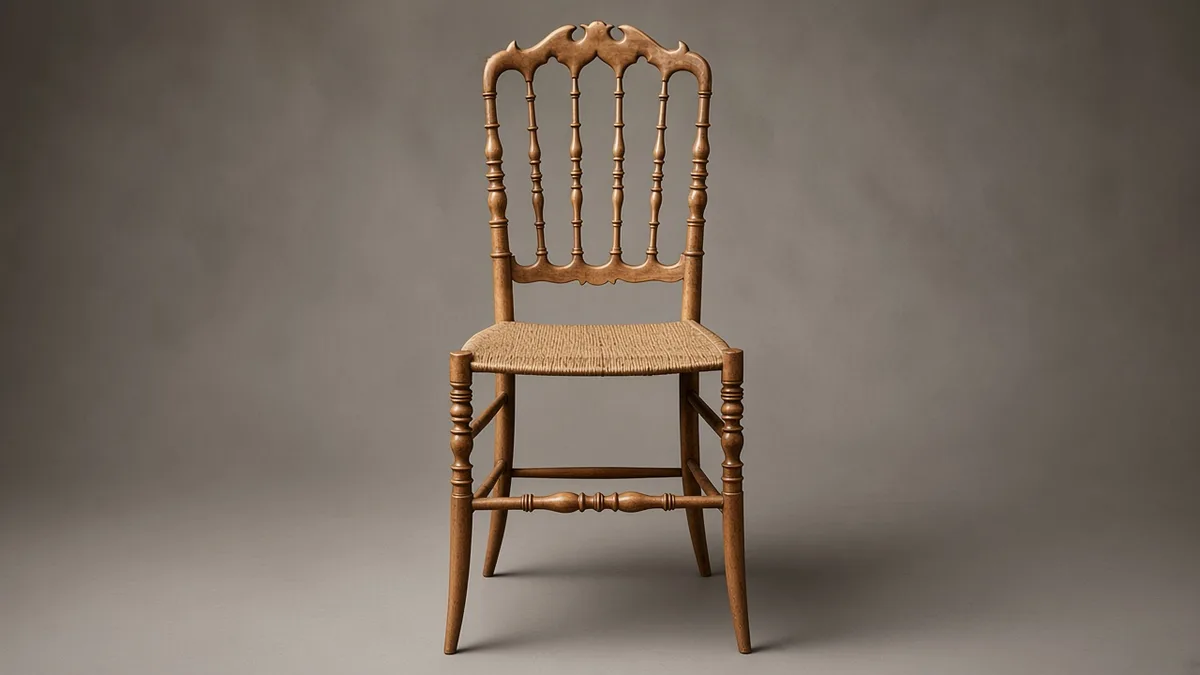
Chiavarina Chair Identification: Campanina Construction & Copies
How to recognise a Chiavarina chair: Descalzi’s 1807 campanina, willow seats, Ligurian woods, district variants, and how it differs from Ponti’s Superleggera.
The chiavarina—also called the sedia leggera di Chiavari or campanina—is a Ligurian side chair developed in Chiavari (province of Genoa) in 1807. It is not a generic “Italian country chair.” It is a specific structural system: minimum wood section, interlocking joinery without nails or screws, and a hand-woven willow seat. Later workshops multiplied models and markets; twentieth-century industry then borrowed the same problem—lightness without collapse—most famously in Gio Ponti’s work for Cassina. Collectors need to keep those layers separate.
Origins: Descalzi, Rivarola and the Società Economica
Giuseppe Gaetano Descalzi (1767–1855), known as il Campanino from a family of bell-ringers, trained as a woodworker in Chiavari. The Dizionario Biografico degli Italiani (Treccani) records a silver medal for two chests at the Società Economica di Chiavari exhibition in 1796, and a workshop opened with his brother around 1795 after a long apprenticeship. The chair itself belongs to a later, targeted commission.
In 1807, Marquis Stefano Rivarola, then linked to the Società Economica’s programme of improving local crafts, returned from Paris with a light French chair made for a 1798 Directory exhibition: open back, cane or wicker seat, reduced mass. Descalzi did not copy it. He redesigned the skeleton—thinner members, rounded and curved bearing parts, a back shaped to follow the shoulders—and invented a seat weave of very fine willow strips. Italian sources call the result the campanina. The type name chiavarina later stuck to the whole Chiavari light-chair family.
Royal and elite attention followed the workshop more broadly. Treccani notes visits and purchases involving Carlo Felice and Francesco di Borbone (1825), admiration attributed to Canova, Carlo Alberto’s recognition of the factory as a royal manufactory (1838; coat of arms privileges 1841), medals at Genoa (1846), mention at the London Crystal Palace exhibition (1851), and, after Descalzi’s death, Napoleon III’s supplier patent to his son Giacomo (1866). Local narrative also places Carlo Alberto and Napoleon III among admirers of the chair trade. Treat court anecdotes as workshop prestige, not as automatic dating tools for an unmarked seat in a market.
By Descalzi’s death in 1855, specialist literature cited by Italian encyclopaedic and regional sources counts on the order of 600 workers in the Chiavari chair trade and neighbouring communes—a district, not a single atelier.
Construction: why it is light and why it holds
Italian technical descriptions agree on the same engineering idea: each member is sized for its load path; joints are cut to lock without metal fasteners. Treccani stresses joints conceived without pegs or dowels in the classic Descalzi system, executed to very tight tolerances. Surviving craft practice in Chiavari (for example the Levaggi workshop tradition reported by Confartigianato) still emphasises hand turning, interlocking assembly, and no nails or screws.
Woods. Early production used local inland timber: wild cherry and maple first; later beech and sometimes ash. Seasoning mattered as much as species. Softwood substitutes and coarse commercial birch frames are red flags on pieces sold as “original chiavarina.”
Seat. Descalzi’s seat used willow strips about 1 mm thick, woven on the chair frame in warp and weft and knotted in his system, producing a fine, cloth-like pattern (Italian sources compare it to gingham/percale weave effects). The weave is structural, not upholstery cover. Re-woven seats are common and acceptable if the frame is sound; a crude plastic or flat cane replacement changes both look and behaviour.
Weight and load. Fine early examples are repeatedly described as under 700 grams while carrying loads on the order of 150 kg in workshop demonstrations. Do not expect every later district chair to hit that weight: variants thickened, fashion models proliferated, and many nineteenth-century pieces are simply heavier cousins of the same idea.
Compare frame logic with broader Italian furniture reading—joinery, later replacements, and “in stile” claims—in our Italian furniture notes.
Models and the nineteenth-century district
Once the type existed, Chiavari and nearby towns produced named variants that keep the light skeleton while changing the back: Italian regional accounts list forms such as campanina, tre archi, parigina, filippa, tre spade / spadina, rocchetto and gotica. G. B. Canepa, Descalzi’s brother-in-law, is cited for a 1843 neo-Gothic arched back and for brightly painted examples (white, yellow, black). Model names help catalogue entries; they do not by themselves prove Descalzi workshop origin.
Competition and decline followed two waves Italian sources emphasise: Austrian Thonet bentwood, cheaper and demountable for shipping; then mid-to-late twentieth-century factory seating. Confartigianato’s 2017 portrait of the Fratelli Levaggi (workshop active from 1963) already described only a handful of small firms still making traditional chiavarine by hand—orders partly for export, with local Ligurian demand largely saturated by inherited sets.
Gio Ponti: continuity, not the same chair
Gio Ponti returned to the Chiavari problem with industrial tools. Italian design writing places his Cassina collaboration from 1949, a Leggera shown at the Milan Triennale in 1952, and the Superleggera (Cassina project 699) crystallising in the mid-1950s (sources give 1955 / production maturity around 1957): ash structure, triangular leg sections about 18 mm, weight on the order of 1.7 kg. Ponti’s chair is a modern industrial descendant of the same lightness programme. It is not a chiavarina, and selling a Superleggera as a nineteenth-century Campanino—or the reverse—is a category error.
For other Italian decorative-arts contexts where workshop labels and city trades matter more than tourist attributions, see parallel identification habits in our notes on Italian silver hallmarks and period Italian ceramics.
How to identify and what to ask
Positive signals
- Slender turned members with sections that change by function, not one thick stock throughout
- Clean interlocking joints; no nail heads on primary connections
- Fine willow (or historically consistent cane) weave on the frame; even tension
- Ligurian woods with honest wear on feet, crest and front rail
- Documented Chiavari / Levante workshop provenance when claimed
Common mistakes
- Calling any light Italian café chair a chiavarina
- Dating by “Napoleon III owned one” stories alone
- Ignoring a re-glued or screwed repair that hides failed joints
- Confusing Ponti/Cassina Superleggera (or later design reissues) with Descalzi-type seats
- Accepting painted “Gothic” novelty backs as early Campanino without construction proof
Condition. Willow seats stretch and break; frames crack at mortises if stored damp or overloaded sideways. Italian makers still replace seats while keeping frames. Ask what is original: crest, stretchers, feet tips, weave. Photograph joints before purchase.
Buying. Prefer dealers who state model name, wood, and whether the seat is original. In Liguria, the Museo Guido e Anna Rocca della Sedia Leggera project (Società Economica / former Rocca workshop, Via Piacenza, Chiavari) is the local reference collection for types and tools—useful calibration before spending on a “rare Descalzi.”
FAQ
Is chiavarina the same as campanina?
Campanina names Descalzi’s type and nickname tradition; chiavarina is the broader Chiavari light-chair family that grew from it.
How light should an antique example be?
The finest early descriptions stay under about 700 g. Many honest later district chairs weigh more. Judge construction first, weight second.
Are metal fasteners ever acceptable?
Classic Descalzi joinery is without nails or screws. Later repairs sometimes introduce them; disclose them, do not hide them.
Did Gio Ponti design the chiavarina?
No. He designed industrial light chairs for Cassina inspired by the same Ligurian problem.
Where was it made?
Chiavari and neighbouring Ligurian communes, using inland woods and a specialised district of turners and seat weavers.
Conclusion
The chiavarina is a Chiavari structural invention of 1807, refined in a nineteenth-century craft district and later echoed—not replaced—by Ponti’s Superleggera. Buy the frame logic: wood species, joint quality, seat weave, and a clear separation between Campanino-type chairs, later named variants, and mid-century design. Court patronage and modern workshop survival explain reputation; they do not replace looking at the chair in hand.