
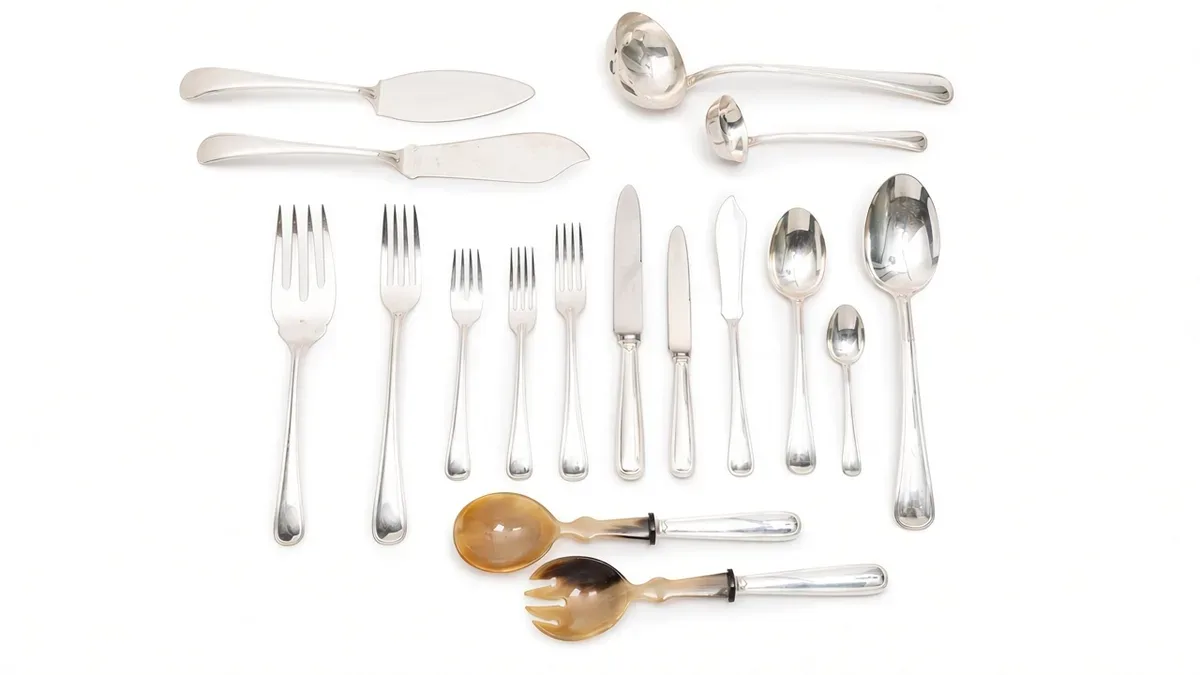
Italian Silver Cutlery Worth: 800 Hallmarks and Auction Results
Italian silver cutlery prices at auction rest on 800 marks, maker, weight and a matching service. Mixed later pieces sell lower. Not a valuation.
Italian inventories call table forks, spoons and knives posate. Auction catalogues in English use cutlery or flatware. The object is the same: a matching service for twelve or more covers, plus fish, fruit, dessert and serving pieces. Most Italian table silver is 800/1000. Sterling 925 is the export and luxury standard, not the household default. Weight is a floor. The market pays for a readable punch, a single workshop, a complete cover count and steel knife blades that belong to the pattern.
A twelve-place 800 service from Alessandria or Milan is table silver. A named 925 service from Buccellati is still table silver, at a different price. Confusing plate, mixed later replacements and a coherent factory service is the usual expensive error.
What determines value
Maker or workshop comes first when the punch can be read. Cesa of Alessandria, founded in 1882 and producing a dedicated posata Cesa line from 1898, and Fratelli Broggi of Milan are factory names that catalogues treat as identifiers, not as guarantees of rarity. Gianmaria Buccellati 925 is a different band: the name is the point of the lot. An unsigned 800 fork with only a free-stamped title is weighed and sold as metal with a pattern. A famous name on a mixed, incomplete service does not restore missing covers.
Period and region are read from the punch system, not from style. Pre-unification civic assays — crowned NAP in Naples, the lion of St Mark in Venice, Papal marks in Rome, Grand-Ducal punches in Florence — appear on earlier spoons and forks more often than on full dining services. The national law of 2 May 1872, n. 806, made state assay optional; most later table silver carries only a title stamp. Law 5 February 1934, n. 305, made the maker’s lozenge compulsory: a number, the provincial letters, and, until 1944, the fasces, beside an oval 800 or 925. Decree 26 October 1944, n. 313, removed the fasces. Law 30 January 1968, n. 46, introduced the polygonal punch with the star of the Republic, still in use. A fasces lozenge dates a fork to 1935–44. A star polygon dates it after about 1971. Neither mark is a civic assay of the old kind.
Material is almost always silver. Italian table services are usually 800. Some Cesa prestige patterns and most Buccellati flatware are 925. Knives in a dining service almost always have steel blades on silver handles; catalogues quote net or weighable silver excluding those blades. Silvered metal stamped ARG 800 or ARG 1000 is plate. It is not priced as silver.
Rarity follows a documented workshop and a complete, matching cover count more than sheer weight. A 213-piece 925 Cesa Risorgimento service is scarce as a single lot. A random dozen 800 forks is not. Original fitted cases with ebonised wood profiles add a little; they do not turn a factory service into plate from a city assay office. Armorial engraving, if original, is a provenance layer. Later-cut crests leave a pale oval on the stem and usually cut the price.
Condition is judged at the tines, bowls and ferrules. Bent outer tines, sharpened steel blades, split horn salad bowls and replaced knife handles are normal defects on used services. Heavy polishing that has taken the punch to a ghost is worse than honest tarnish. Restoration of a few matching replacements from the same workshop is tolerated. A service assembled from three makers is catalogued as mixed.
Provenance is thin on table silver. A named Milan or Alessandria factory, a retailer stamp on the case, and a continuous family history are the usual claims. Export to the United States, where 800 is less familiar than sterling, can lift or flatten a lot depending on whether the hallmarks are still legible.
Size, in this field, means cover count and weighable grams, not length of a single fork. Twelve, eighteen and twenty-four covers are the commercial units. Serving pieces — ladle, fish slice, salad servers with horn bowls — move the lot more than a few extra teaspoons.
Market demand sits with complete 800 factory services for the table and with named 925 services for collectors. Incomplete lots, rubbed punches and mixed Clementi or anonymous 800 forks added to a Buccellati box are discounted. These figures are auction results, not a valuation. Prices vary with condition and with the market on the day.
Prices at auction
Finarte, Milan, 26 June 2023, sold a 117-piece Gianmaria Buccellati service in 925 silver, net weight about 5.190 kg excluding blades and non-silver inserts, for €6,390 including buyer’s premium.
The same house, Milan, 15 April 2025, sold a Cesa Alessandria Risorgimento service of 213 pieces in 925 silver, gross 15.990 kg and net 11.900 kg, for €10,230 including premium. That is the upper published band for a large, named Italian factory service in sterling title. It is not a price per gram that can be applied to an unsigned 800 dozen.
Il Ponte, Milan, 13 October 2022, auction 581, lot 713, sold a twelve-place 800 service, Alessandria, about 1940, silversmith A. Cesa, 5,500 g, minor defects, for a hammer of €2,200 against an estimate of €2,400–2,600.
Il Ponte, 9 April 2019, auction 445, lot 112, sold a smooth 1930s-design 800 service with fasces punches, Fratelli Broggi, Milan, in a contemporary case with ebonised wood, about 4,690 g, slight defects, hammer €2,200 against €1,600–1,800.
Il Ponte, 22 June 2026, auction 781, lot 139, sold a Cesa Alessandria service part — twelve forks, twelve spoons, eleven knives, fish and fruit covers, dessert spoons, teaspoons and five serving pieces, weighable 4,800 g, minor defects — for €6,400 including fees against €5,000–5,500.
Bonhams Skinner, Marlborough, Massachusetts, 9–20 March 2024, lot 71, sold an Italian 800 flatware service with rubbed hallmarks, about 196.3 troy ounces weighable, for US$3,840 including premium.
Bonhams, Los Angeles, 5 April 2022, lot 20, sold an incomplete Italian sterling service marked Buccellati, with two similar sterling forks and one 800 fork by Fabbrica Argenteria Clementi di Giovanni & Mantel of Casalecchio di Reno, about 106 ounces troy weighable across 86 pieces, for US$4,462.50 including premium. The catalogue itself records the mix. That is the discount the market applies when the box is not a single workshop.
Ranges follow those lots. A complete twelve-place 800 factory service with a readable Cesa or Broggi punch has recently hammered in Milan around €2,000–2,200 for about 4.7–5.5 kg, and has reached the mid-thousands including fees when the cover count and serving pieces are fuller. Named 925 services of a hundred pieces and more have sold in Milan including premium at €6,390 and €10,230. Incomplete or mixed lots, and lots whose punches are rubbed, sit lower even when the weighable silver is substantial. None of these figures is a valuation of an uncatalogued service.
Authentic or later
The first tell is the punch on the back of the stem, just above the bowl or the heel of the fork. On 800 Italian table silver after 1934 you should find an oval title and a lozenge (later a polygon) with a maker number and a provincial code. Cesa of Alessandria is 1 AL. Clementi of Casalecchio di Reno is associated with 1 BO. A free-stamped 800 without a lozenge is typical of 1872–1934, when the maker’s mark was not compulsory. It is not, by itself, a fake. A fasces in the lozenge is a date, 1935–44, not a political ornament added later. Punches with the fasces chiselled out appear just after 1944, when the symbol was removed from seals.
Steel knife blades are original to the dining service. They are not a later cheapening. Catalogues state net weight excluding those blades. A magnet on the blade is expected. A magnet on a fork bowl is not: that piece is not silver.
ARG 800 and ARG 1000 mark silverplate. They are sometimes offered as “800 silver.” Wear on the high points of a handle that shows yellow base metal, or a grey copper blush inside a bowl, confirms plate. Solid 800 does not wear to brass.
Mixed services are the common later assembly. Handles of the same pattern from two factories, one 800 and one 925, or a Buccellati box padded with Clementi and anonymous forks, are catalogued as mixed. Count the covers. Twelve dinner forks, twelve spoons and eleven knives is a service part, not a complete twelve. Fruit and fish pieces should match the dinner pattern, not a near pattern from another shop.
Typical reproductions are not Renaissance forgeries. They are later 800 or plate services in historicist thread, shell or olivo patterns, sometimes with a newly struck 800 that lacks a provincial lozenge, or with a lozenge number that does not correspond to the name on the case. Compare every piece. A single replacement teaspoon with a star-polygon punch in a fasces service is a later refill, not a reason to condemn the rest, but it should be described.
Buyers often weigh the knives with the rest and treat the gross as silver; they miss the steel. They treat 800 and 925 as interchangeable. They buy a “Buccellati” service whose catalogue already lists foreign forks. They read a fasces punch as a fake. The guide to Italian silver hallmarks sets out the 800/925 and lozenge sequence; the same punches appear on candlesticks and on tea services, where the objects differ but the dating method does not. Trays are a separate market, discussed in what an antique Italian silver tray is worth.
FAQ
Is Italian 800 silver a lower standard than sterling?
It is a different legal title. Law 1934 fixed 800 and 925 as the silver titles. Most Italian table cutlery is 800. Sterling 925 is used on some factory prestige lines and on Buccellati. Price follows maker, completeness and weighable silver, not a simple conversion from 800 to 925.
How do you date a fork from the punch?
A free 800, with or without initials, is consistent with 1872–1934. A lozenge with number, fasces and province is 1935–44. The same lozenge without fasces is post-1944. A polygon with a star, number and province follows the 1968 law and is in use from the early 1970s. Style of the handle can lag the punch by a decade.
Why do catalogues give two weights?
Gross includes steel knife blades and any horn or wood inserts. Net or weighable silver excludes them. Compare lots on the net figure.
If the punches are rubbed, the cover count is incomplete, or the box mixes workshops, a condition report from the saleroom or an independent silver specialist is the next step before bidding or selling. An appraisal is a written opinion of a named object on a named date. It is not implied by the auction results above.