
What Is an Italian Giltwood Mirror Worth?
What an antique Italian giltwood mirror is worth at auction: Piedmont specchiere, mercury plates, later gilding, and how to spot later copies.
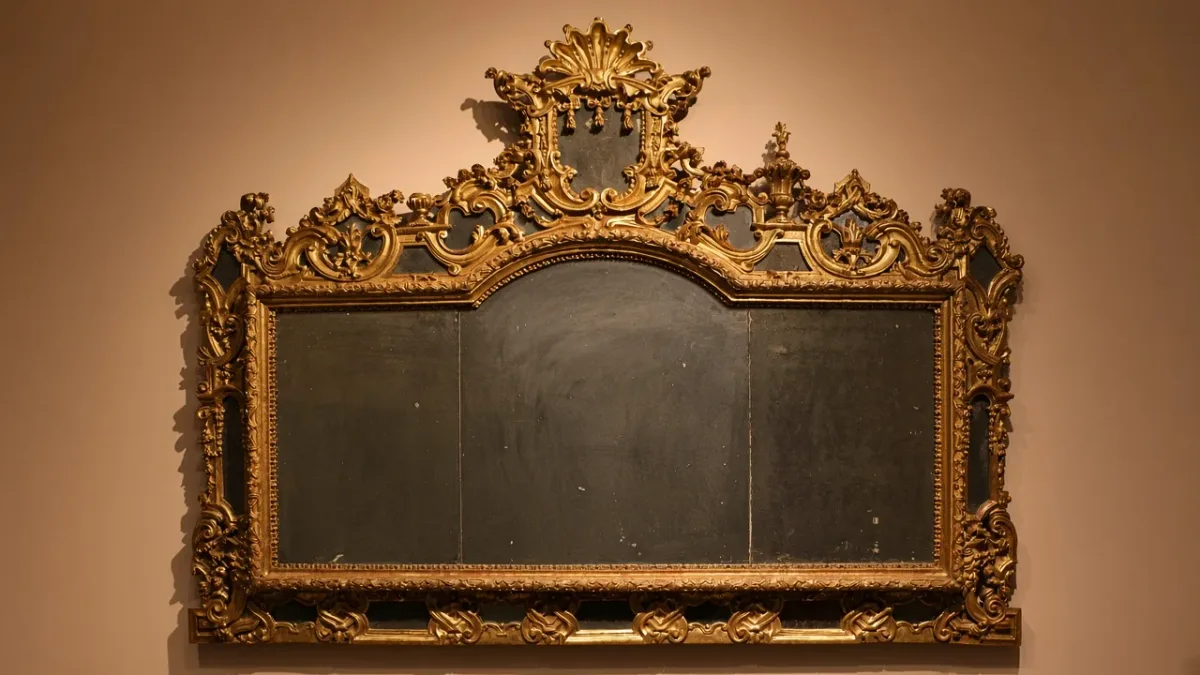
Italian inventories call the object a specchiera: a looking glass in a carved wooden frame, often gilt, made to hang as furniture. English catalogues say giltwood mirror, pier glass, or overmantel. The plate is the point of the object. A Venetian glass-framed mirror is a different trade. A giltwood picture frame from Rome or Florence can share bole, gesso and leaf with a specchiera and still be a surround for a painting, not a looking glass.
The market pays for region, scale and an unrestored amalgam plate. It discounts later gilding, replaced glass and nineteenth-century Baroque-style carving sold as eighteenth-century. The figures below are auction results. They vary with condition and the day of sale. They are not a valuation.
What determines value
Maker or workshop is rarely named. Italian specchiere almost never carry a punch of the kind used on silver. Attribution is to a city or a court: Piedmont, Florence, Rome, the Veneto, occasionally Naples. Enrico Colle’s Il mobile rococò in Italia (Electa, 2003) treats Piedmontese rococo looking glasses as a distinct group, with mistilineo double frames, pierced leafy crests and console feet ending in scrolls (pp. 466–467, the pages Christie's and Wannenes cite). Roberto Antonetto, in Il mobile piemontese nel Settecento (Turin, 2010), related such frames to preparatory drawings now in the Biblioteca Nazionale di Torino for Savoy interiors from about the mid-eighteenth century. A documented Accorsi provenance, as on the north Italian glass Christie's sold in 2011, is a workshop-level substitute for a name.
Period and region move the price more than floral density. A Piedmontese glass of about 1750 with divided plates and mirrored borders is one band. A Florentine two-light specchiera of the third quarter of the century, the type catalogued at the Museo degli Argenti in Palazzo Pitti (163 × 88 cm, carved giltwood, made to sit above a console), is another. Lombard and Veneto frames of ordinary scale are a third. A mid-nineteenth-century Tuscan “Baroque” carving is not a seventeenth-century object even when the outline is restless.
Material is wood plus glass. The carcass is usually poplar (pioppo) or another pale softwood; lime is used for applied ornament. Water gilding on gesso and bole is the expected finish on a serious piece. Gold-painted softwood, the finish Dorotheum often describes as goldgefasst, is a cheaper campaign and catalogues say so. The plate, until the late nineteenth century, should be tin-mercury amalgam. The Museum of Fine Arts, Boston, CAMEO entry, following Per Hadsund’s 1993 study in Studies in Conservation, places Venetian amalgam mirrors from 1507 and treats them as the dominant looking-glass until silver-backed plates replaced them at the end of the nineteenth century. Liquid mercury pooling at the bottom, irregular foxing and tin oxidation in air pockets are deterioration, not damage in the furniture sense. They are also evidence.
Rarity follows a large, architecturally complete frame with original cresting and an unrestored plate, not the mere presence of rocaille. Pairs are scarcer than singles. Overmantels with three plates, the Novara type Bonhams catalogued in 2013, are a different object from a tall pier glass meant to stand over a console.
Condition is read at the crest, the applied leaves and the amalgam. Lost putti, replaced candle branches, a recut rabbet and a plate with sharp-edged modern silvering all leave money on the table. Honest wear of leaf to bole is preferable to a uniform regilding. Il Ponte’s 2019 lot whose catalogue already said “gilding of a later date” hammered below several ungilded-later comparables of similar size.
Restoration is expected on objects two metres high. Replaced mirror borders, consolidated worm, in-gilding of losses: catalogues absorb those when the carving campaign is one. Substituted plates, the warning Wannenes printed on a 230 cm Piedmontese frame in 2020, change the object. The frame can still be period. The looking glass is not.
Provenance is thin except at the top. Pietro Accorsi in Turin, a named palazzo, a Roman collection as on the Dorotheum pair of 2018: those notes lift a lot. A house-of-Savoy story on a pair already marked “G. Dalleizette & Co. / Roma” on the reverse, as at Christie's in 2014, did not turn late nineteenth-century work into eighteenth-century work. The lot sold as late.
Size is height by width, and whether the plate is divided. Museum and palace examples run from about 160 cm to well over 260 cm. Trade lots in Milan often sit between 140 and 200 cm. A 305 cm Florentine glass is a different commission from an 85 cm pair.
Market demand is for Piedmontese and Florentine rococo of palace scale with original plates, and for decorative eighteenth-century frames that still read as furniture. Historicist nineteenth-century giltwood finds buyers. It should not be priced as if the catalogue date were 1750.
Prices at auction
Il Ponte, Milan, 22 February 2023, auction 603, lot 761, sold an eighteenth-century Lombard-Venetian carved giltwood specchiera, 200 × 140 cm, with loss to the mercury layer more extensive than the catalogue photograph, defects and restorations, for a hammer of €2,800 against an estimate of €2,800–3,000.
The same sale, lot 423, a Lombardo-Veneto eighteenth-century carved giltwood glass of 140 × 110 cm with defects, hammered at €1,900 against €1,800–2,000.
Il Ponte, 23 October 2019, auction 459, lot 289, a Veneto eighteenth-century carved and giltwood mirror, 150 × 100 cm, defects, hammered at €2,200, matching the estimate.
Il Ponte, 9 April 2019, auction 445, lot 161, an eighteenth-century carved giltwood of 188 × 116 cm whose catalogue stated defects and gilding of a later date, hammered at €1,800 against €1,400–1,600. Later leaf did not kill the lot. It kept it in the low thousands.
Il Ponte, 12 April 2022, auction 554, lot 91, an eighteenth-century carved giltwood of 205 × 160 cm with inner bud moulding, volutes and a leaf crest, defects and restorations, hammered at €9,000 against €10,000–12,000. That is the upper published Milan band in these results for a large, unrestored-looking eighteenth-century frame, not a typical lot.
Nineteenth-century work occupies a lower but not trivial band. Il Ponte, 25 March 2025, auction 700, lot 13, a nineteenth-century carved and gilded wood mirror, 149 × 125 cm, defects, restorations and losses, hammered at €3,300 against €450–500. Il Ponte, 15 June 2011, auction 285, lot 301, a large Baroque-shaped carved giltwood from Tuscany, mid-nineteenth century, 135 × 145 cm, hammered at €2,500 against €3,000–3,500. A later date is not a zero. It is a different object.
Dorotheum, Vienna, 25 April 2024, lot 839, a large Italian Baroque wall mirror catalogued “18th century and later,” gold-painted softwood, rocaille, cartouche crest, plate with blind spots, about 222 × 148 cm, realised €3,960 including buyer’s premium and VAT, against an estimate of €3,000–5,000. The same house, 25 November 2024, sold an imposing Italian Baroque glass, eighteenth century, gold-painted softwood with a putto in the cresting, about 210 × 110 cm, for a hammer of €4,000, published excluding premium. A pair of smaller Italian eighteenth-century wall mirrors, gold-painted softwood, about 85 × 40 cm, from a Roman collection, realised €4,750 including premium and VAT at Dorotheum on 25 October 2018.
Christie's London, 8 December 2011, sold an Italian giltwood mirror, Piedmont, circa 1750: divided cartouche-shaped plate, mirrored borders, plume finial, pierced shell apron, 236 × 127 cm. The published price realised was £13,750 against an estimate of £5,000–8,000. The catalogue pointed to a related specchiera in Colle, p. 467.
Christie's London, 7 July 2011, sold a north Italian giltwood mirror of the second quarter of the eighteenth century, 268 × 147.5 cm, rectangular plate with mirrored border, lambrequin carving, armorial shield and a floral-basket crest. Provenance: by repute the Sanvitale family, Reggia di Colorno, and Pietro Accorsi, Turin. The published price realised was £85,250. The catalogue note recorded a virtually identical pair from the Patiño collection at Sotheby's Paris, 22–23 September 2010, lot 264, at €114,750 with premium. That is palace furniture with a named dealer, not the Milan trade band.
Christie's South Kensington, Les Trois Garçons, 5 March 2014, lot 22, an Italian giltwood mirror, Rome or Florence, late seventeenth or early eighteenth century, 146 × 110 cm, boldly carved scrolling acanthus, some re-gilding, realised £21,250 against £8,000–12,000. The same sale offered a pair of late nineteenth-century Italian giltwood mirrors, 140 × 104 cm, one reverse marked “G. Dalleizette & Co. / Roma,” later gilt, which realised £8,750. Late work with a Roman retail name can outsell an ordinary eighteenth-century Milan lot. It should not be catalogued as 1750.
Christie's London, 10 June 2015, European Furniture and Works of Art, sold a Florentine mid-eighteenth-century giltwood mirror of large scale, arched divided plate, rocaille, pediment cresting and female busts at the sides, 305 × 170 cm, for a published £22,500 against £20,000–30,000. On 10 December 2015 the same rooms sold another Florentine mid-eighteenth-century glass, 181 × 125 cm, with winged caryatids, flower baskets and a female mask, for £31,250 against £25,000–40,000.
Bonhams, London, New Bond Street, 12 December 2013, auction 20857, lot 46, sold a Piedmontese late eighteenth-century architectural carved and polychrome three-panel overmantel, probably Novara, 160 × 145 cm, for £4,000 including premium.
Wannenes, 23–24 June 2020, auction 314, offered a large Piedmontese eighteenth-century gilt carved specchiera, 230 × 114 cm, with possible plate substitutions, at an estimate of €2,800–3,500. No hammer was published. The lot is useful for the literature it cites, not as a price.
The ranges that follow those results are narrow enough to state. Ordinary eighteenth-century Lombard, Veneto or generic Italian giltwood specchiere of about 140–200 cm have recently hammered in Milan around €1,800–2,800, with later gilding at the lower end of that group. A large, complete eighteenth-century frame can reach a hammer of €9,000 in the same rooms. Gold-painted “Baroque” glasses catalogued with later elements have realised about €4,000 in Vienna, premium included or as hammer depending on the sale. Named Piedmontese and Florentine palace examples in London have realised from the low tens of thousands of pounds to £85,250, and a documented pair at Sotheby's Paris reached €114,750 with premium. Nineteenth-century historicist giltwood has hammered in Milan at €2,500 and €3,300 in the lots above. None of these figures is the value of an uncatalogued glass.
Authentic or later
The first tell is the plate. A tin-mercury amalgam, described by Hadsund and CAMEO, shows irregular grey and black maps, denser toward the lower edge where liquid mercury migrated, and a slightly warm reflection. Modern silvering, after Liebig’s 1835 chemical deposit, fails with sharper islands, a cooler tone and, at a lifted corner, a painted or filmed reverse. A perfectly bright, undistorted float plate in a “1750” frame is a replacement. Christie's 8 December 2011 Venetian polychrome example was catalogued with a later plate; the distinction belongs in the description, not in a footnote the buyer skips.
The second tell is the gilding. Period water gilding sits on coloured bole. Wear exposes clay, often dark red or brown. Oil gilding is matte and cannot be burnished. Bronze paint and Dutch metal sit thick in the recesses and oxidise toward orange. A single, even gold campaign over sanded gesso on an otherwise old carcass is later leaf. Il Ponte already prices that fact. Recut ornament filled with composition, which shrinks along mould seams, is not carved poplar.
The third tell is construction. A Piedmontese specchiera of the third quarter of the eighteenth century, as in the Catalogo generale record for a pair, has a wooden back structure, plates held with metal bosses, and applied gilt floral carving on the glass. Joints at the corners should be mitred and keyed or half-lapped. The reverse should show oxidised timber, old iron tabs and tool marks. Machine-planed softwood, bright screws and a rabbet recut for a smaller modern plate are later. The same joinery culture appears on period painted furniture; a specchiera is not exempt because it is gilt.
Typical later objects are not fantasy fakes. They are mid-nineteenth-century Tuscan or Roman Baroque-style frames, mecca (silver leaf under yellow lacquer) sold as gold, English or French copies of Piedmontese outlines, and hotel-scale reproductions with composition crests. Candle branches are often missing and later wired. Crestings are reversed, as Christie's noted on the Patiño pair that had been hung upside down to hide a concave end. Borders of small mirror plates can be later additions around an older central glass.
Common buyer mistakes: calling every etched bathroom mirror “Murano” or every gilt looking glass “Venetian”; treating foxing as a reason to resilver before the sale; ignoring a catalogue line that already says “18th century and later”; reading a Dalleizette Roma stamp as an eighteenth-century workshop; pricing a 150 cm Veneto frame as if it were the Accorsi-Colle palace type.
FAQ
How does a specchiera differ from a Venetian mirror?
A specchiera in this market is a wood-framed looking glass. The classic specchio veneziano builds the frame from glass. Wood-framed plates made in Venice exist. They are still not the glass-on-glass type.
Does original mercury glass always survive?
No. Plates crack, fox and get replaced. An honest later plate in a period frame should be described as such. Resilvering destroys the amalgam evidence Hadsund mapped.
Is later gilding fatal?
It is a discount, not a proof of forgery. A recarved composition crest with new leaf is a later object. In-gilding of losses on a period carcass is conservation. Catalogues that already say “some re-gilding” have done the work; the price should reflect it.
Can a nineteenth-century Italian giltwood mirror be worth buying?
Yes, as nineteenth-century work. The Milan hammers of €2,500 and €3,300 above are real. They are not eighteenth-century prices.
If the plate has been replaced, the cresting is a marriage, the gilding is a single modern campaign, or the regional attribution rests only on a salesroom adjective, a written condition report from the auction house or an independent furniture conservator is the next step before a bid or a sale. An appraisal is an opinion on a named object on a named day. It does not follow from the lots listed here.