
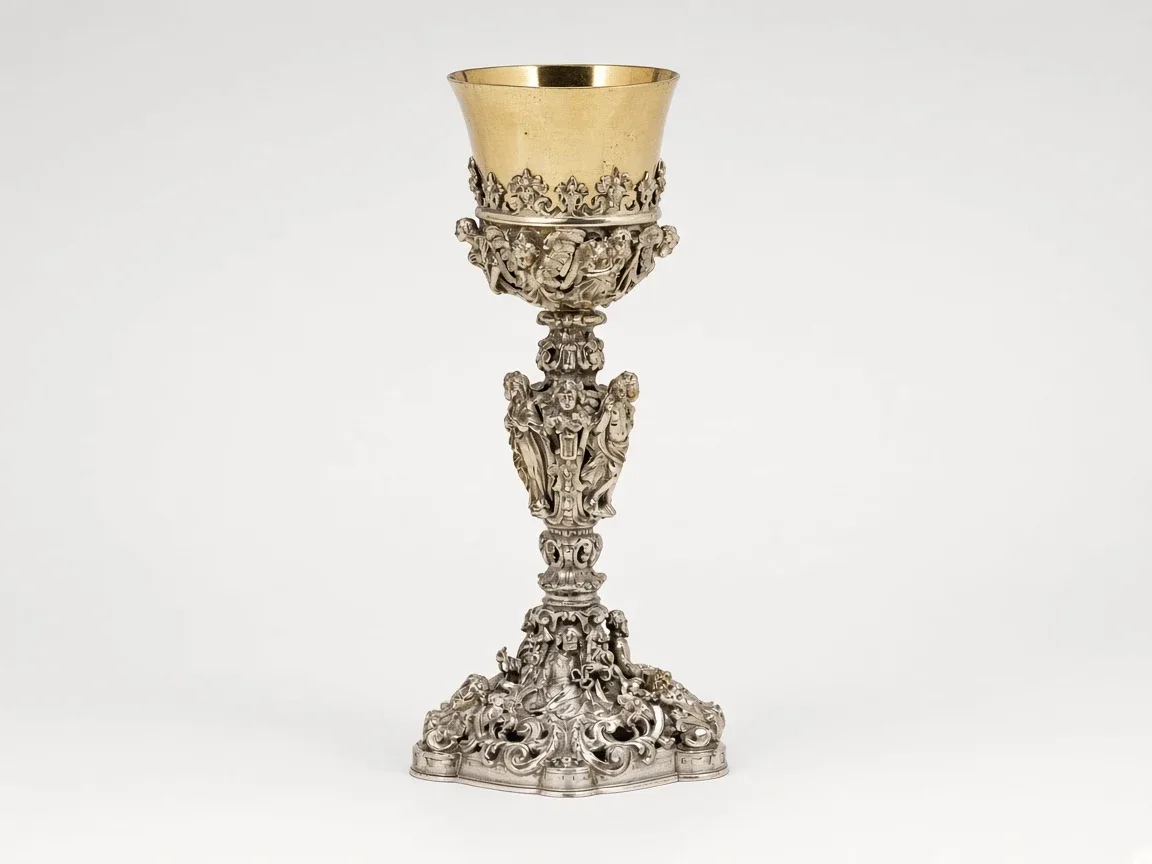
Italian Ecclesiastical Silver of Naples, Genoa and Rome
Italian ecclesiastical silver at auction: what chalices and monstrances from Naples, Genoa and Rome workshops are worth, and how to tell later copies.
Italian church plate is a goldsmith's problem before it is a liturgical one. A chalice, a ciborium and a monstrance share a construction grammar of cup, knop, stem and foot, screwed or pinned so that a worn bowl can be replaced. The market prices that grammar by city, by punch and by whether the silver is the original campaign. Naples, Genoa and Rome are the three centres that still appear with readable marks on lots sold in Milan and Vienna. Venice and Sicily produced church silver too; their punches are a different file.
This is not a valuation. The figures below are published auction results. Condition, later cups, missing rays and the room on the day all move the hammer.
Naples, after the Prammatica of 1690
The viceroyal Prammatica of 19 August 1690 is the document collectors still meet on a Neapolitan calice. It fixed a legal standard of ten ounces fine in twelve, about 833/1000, and required three punches: the guild's crowned NAP with a date, the consul's initials plus C, and the maker. The Basilica of Santa Croce at Torre del Greco holds a dated demonstration. A parcel-gilt chalice of 1694 carries AF•B•C• for the consul Alfonso Balsamo, a crown over 94 for the Arte, and M•D•M for Michelangelo di Massa. The same sacristy keeps a chalice and ciborium of 1795 by Giuseppe Fumo, a later cup by Marcantonio Cancelliere with +N8 and M:C (the +N8 guild punch is the 1808–1832 form), and a neoclassical example of about 1830 signed G. IACCARINO for Gennaro Iaccarino.
Those names belong to a trade that supplied parish churches as well as the Tesoro di San Gennaro. The Victoria and Albert Museum's unmarked Naples chalice of about 1700 (M.42-1951, 285 mm) shows why the type is heavy: the calyx, stem figures and foot are cast separately and soldered. Angels hold the Instruments of the Passion around the bowl; the Redeemer, the Virgin and St John occupy the openwork stem. Corrado Catello's Tre secoli di argenti napoletani (Castel Sant'Elmo and Capodimonte, 1988) remains the catalogue against which auction rooms still check that sculptural manner.
How to read the punches, including the later Parthenope heads, is set out in the Neapolitan silver hallmarks note. Church plate uses the same system. A calice with a gilt interior and a crowned NAP is not thereby 1700; the date digits under the crown, or their absence, come first.
Genoa and the turret
Genoese goldsmiths had a long run in both sacred and secular silver. The Museo Diocesano di Genova places a peak between the second half of the sixteenth century and the first decades of the seventeenth, when American silver reached the Republic in quantity. The same museum notes that late-eighteenth-century requisitions stripped many churches and that the surviving Ligurian church plate is still, on average, of a high workshop standard. Palazzo Tursi holds later chalices and monstrances given by popes and cardinals; those are treasury objects, not the parish type that comes up at auction.
The civic punch collectors look for is the torretta, the turret, usually with a date. Christie's Geneva, 19 May 1998, lot 135, was a plainish Genoese chalice of 1735, 20.5 cm, 325 g, marked on base and bowl, sold for CHF 4,600. That is a different object from a Neapolitan Baroque calice of the same date: stepped circular foot, vase-shaped baluster, moulded bands on the bowl, no applied angels. Wannenes has catalogued turret-marked chalices and pixes as types; those pages often carry estimates only, so they are not used here as prices.
Rome: Agricola, Valadier, papal assay
Roman church plate of the later eighteenth century is a goldsmith's architecture reduced to a cup. The Metropolitan Museum holds a parcel-gilt chalice by Giuseppe Agricola (1745–1804), about 1775, 29.2 cm (acc. 26.219.2), and another by Giovanni Valadier (1732–1805, working after 1763), 29.4 cm (acc. 25.15.26). Both are silver with parcel gilding, not the fully gilt Neapolitan cast type. The punches sit in the papal assay system: keys, consul or assayer, maker. That sequence is the subject of the Roman silver hallmarks guide.
Il Ponte, Milan, 22 October 2019, sale 459, offered two Roman monstrances in the same session. Lot 9, inscribed for a priest in 1770 and given to Giuseppe Bartolotti of Rome, 1750, 62 cm, about 1,265 g, was hammered at EUR 1,800. Lot 6, Papal States, Rome, eighteenth century, 60 cm, about 1,535 g, made EUR 1,400. Named maker and a dated dedication moved the room; size alone did not.
Forms the trade still uses
A calice holds the consecrated wine. Its bowl is often a separate, later cup screwed into an earlier calyx; liturgical wear on the lip is expected. A pisside or ciborium is a covered cup for the reserved host. An ostensorio (monstrance) raises a glass theca in a sunburst, usually with a cross above and a knopped stem below; rays, cherubs and clouds are the Italian Baroque vocabulary, not proof of date. Thuribles, incense boats, altar crosses and sanctuary lamps are the same trade in different silhouettes.
Reliquaries overlap the sacristy but are a different object: a theca, a seal, often mixed materials. Trapani coral mounts are another sacred market again, gilt copper and Corallium rubrum, not hallmarked silver; see Trapani coral workshops.
What determines value
Applied to Italian ecclesiastical silver, the usual drivers are specific.
Maker or workshop. A documented punch (Massa, Cancelliere, Bartolotti, Agricola, Valadier, a Genoese turret with a readable date) is the first split. Unsigned parish plate is catalogued by city and century.
Period. Cast Neapolitan Baroque of about 1680–1740, with applied angels, is one collector. Smooth Genoese turret work of the 1730s is another. Neoclassical Roman cups of the Valadier generation are a third. Nineteenth-century historicist ostensori recycle the sunburst without the earlier weight of metal.
Region. Naples, Genoa and Rome are not interchangeable silhouettes. A buyer who treats every cherub-head calice as Neapolitan will misread Lombard and Macerata work.
Material. Solid silver, usually parcel-gilt at the cup, is the standard. Silver on copper, electroplate and gilt metal with a silver lip are later or cheaper constructions. Stones and glass in a raggiera add little unless they belong to the original campaign.
Rarity. A complete ostensorio with its original theca, rays and cross is scarcer than a chalice. Sets (chalice, paten, ciborium) are scarcer still.
Condition and restoration. Replaced cups, resoldered knops, missing rays, later donor inscriptions and overpolished punches are the usual deductions. Dorotheum's 2024 Neapolitan chalice was catalogued with a donor engraving of 1801 on a piece dated about 1700; that is a later campaign, not a bonus.
Provenance. A parish inventory or an export licence is information. A story of a suppressed convent without papers is not.
Size. Chalices cluster around 20–30 cm. Monstrances of 55–65 cm are the auction norm. Monumental processional ostensori rarely leave churches.
Demand. Decorative-arts buyers, not liturgical furnishers, set the room. Confusion with secular Italian silver of the same punches is how a coffee-pot turret and a chalice turret get priced as if they were one object.
Prices at auction
Figures are as published. They vary with condition and market. They are not a valuation.
Dorotheum, Vienna, Silver, 19 June 2024, lot 53: a Neapolitan Baroque chalice, parcel-gilt, about 1700, volutes and foliate décor, sculptural angel busts on foot, knop and bowl, later donor engraving 1801, 24.5 cm, 526 g, master's mark C.C.C., assayer's puncture, Neapolitan hallmark. Realised EUR 3,640 including buyer's premium and VAT.
Dorotheum, Vienna, Silver and Russian Silver, 14 December 2021, lot 24: an Italian chalice, second half of the eighteenth century, gilt rim and interior, repoussé angel heads, 26.3 cm, 484 g, master's mark MD, mis-struck hallmark. Realised EUR 2,304 including premium and VAT.
Christie's Geneva, 19 May 1998, lot 135: an Italian silver chalice, Genoa 1735, circular stepped domed base, vase-shaped baluster, moulded bowl, marked on base and bowl, 20.5 cm, 325 g. Price realised CHF 4,600.
Il Ponte, Milan, 22 October 2019, sale 459, lot 33: a silver monstrance, Macerata, first half of the eighteenth century, Dionisio Boemer, baluster stem with cherub heads, partly gilt raggiera, 58 cm, about 1,675 g, losses, defects and restorations. Hammer EUR 2,400 (estimate EUR 600–650).
Same sale, lot 9: Giuseppe Bartolotti, Rome 1750, 62 cm, about 1,265 g, hammer EUR 1,800. Lot 6: Rome, eighteenth century, 60 cm, about 1,535 g, hammer EUR 1,400. Lot 14: a nineteenth-century ostensorio, 55 cm, about 1,275 g, hammer EUR 1,400.
Bonhams, London Knightsbridge, British and Continental Silver, 31 July 2013, lot 119: an Italian silver-on-copper chalice and paten, 24.5 cm. Sold for GBP 625 including premium.
The spread is the point. A marked Neapolitan Baroque calice has made low four figures in euros with premium in Vienna. A named eighteenth-century ostensorio has made EUR 2,400 hammer in Milan. A nineteenth-century sunburst of similar height made the same hammer as an unsigned Roman eighteenth-century example. Silver on copper is a different, lower class. Sotheby's London, 27 May 2009, Genoese Silver and Furniture from a Private Swiss Collection (L09769), lot 62, a silver-gilt Genoa chalice of 1765, was published with an estimate of GBP 3,000–4,000 only; no hammer is used here.
Wannenes has offered Genoese pixes and ostensori with estimates in the high hundreds. Those lots are types, not prices.
Authentic or later
Buyers confuse four things: period city plate with its punches, later cups on earlier stems, nineteenth-century historicist ostensori, and silvered metal.
1. The punches. Photograph the foot rim and the bowl in raking light. Naples wants three strikes after 1690. Genoa wants the turret and a date. Rome wants the papal sequence. A single worn rectangle is not a city. A bright, sharp 800 or 925 on a "Baroque" calice is later Italian national plate or a later stamp on an older cup.
2. Construction. Period chalices come apart. Cup, calyx, knop, stem and foot are separate. Modern one-piece castings, or a bowl glued rather than screwed, are later. The V&A Naples example is a warning in the other direction: heavy cast parts, soldered figures, no marks at all. Unmarked is not fake; it is incomplete evidence.
3. Metal. A magnet that finds an iron core, a copper blush at a bruise, or a seam of plate lifting at the lip is silver-on-copper. Bonhams catalogued that construction in 2013; the price followed.
4. The raggiera. Original rays are silver, often parcel-gilt, with chasing that continues onto the clouds. Stamped sheet rays of even thickness, glued glass jewels and a cross that does not match the stem are later restorations or a later object.
5. The cup. A later vermeil bowl in an earlier calyx is the common church repair. Record it. Do not date the whole object from the cup, or from the stem alone.
6. Inscriptions. A donor line can be original, as on Il Ponte's Bartolotti ostensorio, or added, as on Dorotheum's 1801 engraving. Letter-cutting that cuts through wear, or a date later than the punches, is a second campaign.
7. The usual mistake. Paying a 2024 Neapolitan Baroque price for a nineteenth-century sunburst of the same height, or treating an unmarked copper-cored cup as "workshop of Valadier" because the silhouette is Roman.
The national hallmark systems after Unification are a later overlay. They date a repair or a historicist piece; they do not turn a parish calice into Agricola.
FAQ
What is the difference between a chalice and a goblet?
A chalice is church plate: gilt interior, knop, iconography of the Passion or the Eucharist, often a paten. A secular goblet of the same date has no liturgical cup and is punched and priced as table silver.
Do Italian churches still own the best pieces?
Yes. Auction lots are the surplus: parish replacements, suppressed houses, private oratory plate. Treasury objects of the San Gennaro class are not the comparables for a 25 cm calice.
Is coral-mounted church silver Trapani work?
Only if the mount is gilt copper with coral in retroincastro or cucitura. A silver calice with a few coral beads glued to the knop is an assemblage.
Can punches be added later?
Yes. A crisp NAP on a foot that has been heavily polished elsewhere, or a turret that sits on a patch of later silver, is a red flag. Compare the strike with the surrounding wear.
What about export from Italy?
Ecclesiastical objects can carry a cultural-heritage restriction. Ask the house in writing whether an attestato di libera circolazione already exists. A sacristy provenance without papers is not a discount; it is a problem.
When to seek an appraisal
If the object is offered as seventeenth- or eighteenth-century Naples, Genoa or Rome, and the price assumes that date, commission a silver specialist's condition report before bidding: punches, solder, whether the cup is original, and a map of replaced rays or stones. For anything said to come from a church, ask in writing about Italian export papers. None of the prices above is an offer to value a specific piece.