
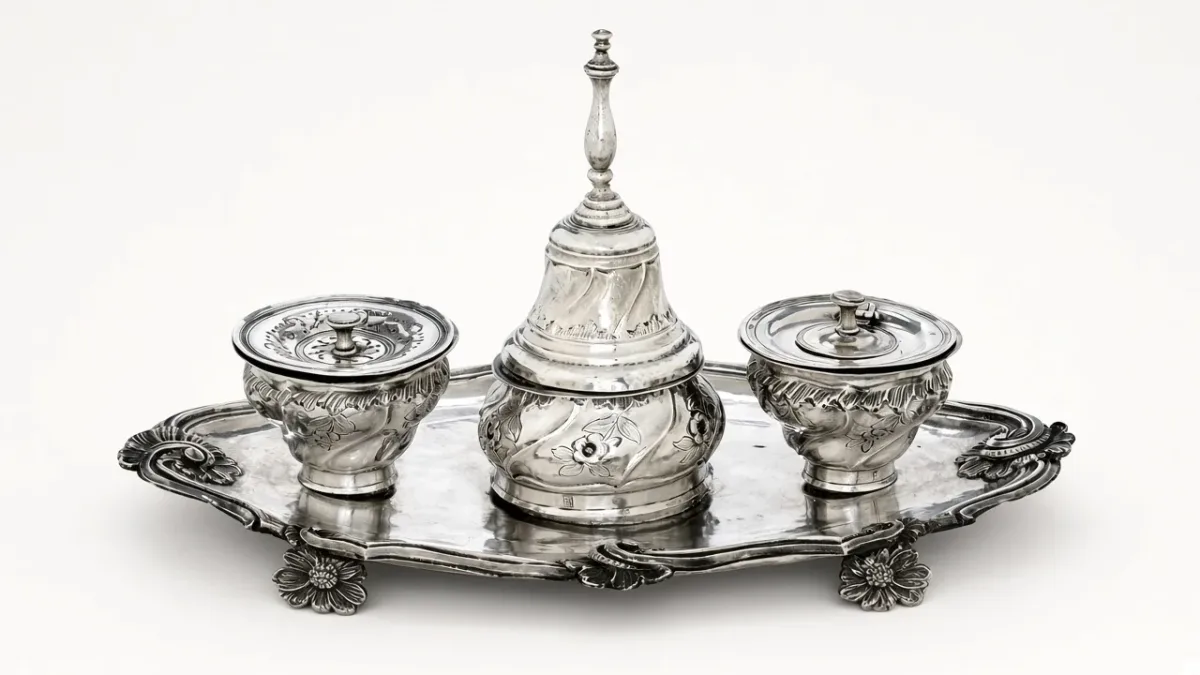
Italian Silver Inkstands and Writing Sets, 1700–1870
What an antique Italian silver inkstand is worth: city assay marks, later assembled writing sets, and verified auction prices for the calamaio.
Italian catalogues call the object a calamaio or a servizio da scrittoio. It is a writing set in silver: a tray, an inkpot, a sander for pounce, usually a bell, and often a pen rest. It is not a tea or coffee service. The same city marks appear on hollow-ware and on church plate, but the form, the wear and the market are different.
From the early eighteenth century until the Kingdom of Italy made hallmarking optional in 1872, each state ran its own assay. A Genoese rococo stand, a Roman gallery tray with a wooden liner, a Turinese court piece with Savoy arms, and a Neapolitan 833 inkstand of the 1830s are four different objects. The collector who dates them from style alone pays for marriages: a later bell on an older tray, glass liners cut to a new well, a torretta struck on a repaired foot.
How the set is built
The Italian writing set is an assembly, not a single casting. The tray is raised and chased. Feet, galleries and handles are cast and soldered. One cover is pierced; that is the sander (portasabbia or portapolvere). The other is solid, sometimes with a glass liner. The bell is a separate raising, fitted to a central socket. A pen holder may be a column, a trough, or two quill tubes.
Roman Restoration workshops often set the tray over a wooden controfondo. Christie's Rome catalogued that backing, with distortions, on a Vincenzo Contini inkstand with marks of 1815–70. The wood is original construction. It is also dead weight in any printed gram figure. Milanese and Turinese stands of the 1820s–1840s more often sit on four cast feet. Genoese rococo trays are thin raised silver with openwork scroll feet; the 1763 King Street example measured 29.3 cm and 930 g, marked under the base and under the containers.
Eighteenth-century chasing is cut with a small punch, the matted ground irregular. Nineteenth-century mechanical gadrooning repeats at even intervals. Electroplate shows a yellow or grey core at a worn foot. A glass liner with a ground pontil can be period. A machine-polished tumbler in a stretched collar is later.
Workshops by city
Genoa
The Corporazione dei Fraveghi is documented from 1248. The city mark collectors call the torretta is a stylised castle, still struck through the French occupation and until 1824. The Kingdom of Sardinia then used the crowned eagle (950/1000) or the cross of Saints Maurice and Lazarus (800/1000), with a dolphin for the Genoa office, until 1872. The sequence is set out on silvercollection.it.
Genoese calamai of the 1760s–1780s follow a tight type: shaped oval tray, rocaille rim, four openwork feet, inkpot, sander and a central bell with a baluster handle. Christie's cited two parallels in Giuseppe Morazzoni, Argenterie Genovesi (Milan, n.d.), plates 217 and 218. Cambi, Genoa, 10 June 2025, offered a complete servizio with the torretta and date (1)770, 32 × 22.5 × 18 cm, 850 g, as an estimate only. The 1763 King Street lot is the documented hammer for the type.
A turret on a writing set is a city guarantee, not a decorative castle. The same punch appears on Genoese coffee pots of the 1750s–1760s.
Rome
Luigi Valadier (1726–1785) and his son Giuseppe (1762–1839) dominate the Roman literature, but they were not the only shops making writing sets. Vincenzo Belli I, patented in Rome in 1741, used VB. Costantino G. Bulgari and Anna Bulgari Calissoni remain the concordance for numbered lozenges after the Bando of 7 January 1815. The papal assay sequence of tiara and crossed keys, or the wolf for the first title, dates a Roman calamaio more reliably than a Victory finial.
The Galleria Borghese holds a writing set associated with Camillo Borghese (inv. DCIV). The rock-crystal, malachite and gilt-bronze inkwell and the gold pen were not made as one group. The pen carries Giuseppe Valadier's silversmith mark and a bollo camerale that Bulgari Calissoni dates to 1807–1809. The museum notes that the pen holder and the sander from that Borghese desk service are lost. The entry is useful for two reasons: a famous name does not make every component contemporary, and a Roman writing set of this class can mix silver, hardstone and gilt bronze.
Sotheby's, Treasures, Paris, 11 December 2024, lot 120, catalogued a silver-gilt Valadier inkstand, Rome, circa 1795, jasper top, 49 cm, 2,900 g weighable, Massimo provenance, estimate EUR 40,000–60,000, with no published hammer. The marks described there (town, maker, VALADIER/ROMA, assay under the bases) are the reading a buyer should demand.
Turin
Turinese court silver of the mid-eighteenth century is French in grammar and Savoy in arms. The Metropolitan Museum of Art, acc. 1997.151.1, holds a silver-gilt inkstand, circa 1753, design attributed to Francesco Ladatte (1706–1787), probably executed by Andrea Boucheron (d. 1761). The Savoy arms are engraved on the stand beneath the bell. Lorenzo Lavy, trained in Paris in the Germain workshop and court silversmith in Turin from 1750, used the assay of Bartolomeo Pagliani (Turin Mint, 1753–1775) on related work.
After 1824 the Sardinian eagle (950) and the bull's-head Turin office mark replace the older town punches. Carlo Agostino Balbino (1777–1824, master 1798) supplied the House of Savoy. Bonhams Knightsbridge catalogued a Balbino inkstand, Turin circa 1820, 950, Savoy armorial, 23 cm high, on 18 October 2023, sale 28269, lot 89, estimate GBP 1,000–1,200, without a published hammer. Pietro Borrani of Turin made octagonal gallery stands with Greek-key gadroons around 1830; Christie's Rome described one with the arms of the Duke of Genoa, 28 × 17.5 cm, 1,585 g, as a type only, the sale date not being on the public lot page.
Naples and Milan
Neapolitan silver of the writing-set class follows the same punches as other hollow-ware: crowned NAP with a date until 1808, then Parthenope with fineness numerals, and from 1832 a profile Parthenope with N, still at the statutory 833/1000 of the 1690 Prammatica. Bertolami catalogued a rectangular Naples inkstand, 1832–1872, silversmith GP, 24 × 19.5 cm, 977 g, with a complete punch set, as a type without a published hammer.
Milan in the Restoration and the later nineteenth century is the volume market: Francesco Ceppi with the goat, Francesco Liverti, Tommaso Panizza (active 1849–1868). Trays are rectangular, often with a vine or anthemion border, vase-shaped pots and a central taper or a figural bell. These are the objects Italian rooms still see in quantity. They are not Genoese rococo and they are not Valadier.
What determines value
Maker and workshop come first. A documented Valadier, Boucheron or Lavy stand is a different lot from an unsigned Milanese 800 tray of 1840. The name must match the punch. A later VALADIER stamp on mid-nineteenth-century sheet is a dealer mark, not Luigi's shop.
Period and region are read from the national and pre-unification punches, not from the presence of a bell. A dated torretta is Genoa before 1824. A Sardinian eagle is 1824–1872. A Roman numbered lozenge with tiara and keys is 1815–1870. A Parthenope with N is Naples 1832–1872. After law no. 806 of 2 May 1872, assay was optional; a bare 800 can be honest workshop practice, not an eighteenth-century guarantee.
Printed weight often includes wood, glass, gilt bronze or hardstone. The Met inkstand is silver-gilt; most market calamai are white silver at 800, 833 or 950.
Rarity is a complete original set with matching marks on tray, pots and bell. Missing sanders and replaced bells are common. A full Genoese three-piece of the 1760s with marks under each container is scarce. An incomplete Milanese stand of 1830 is not.
Condition is solder at the feet, splits in thin rococo rims, overpolish that has taken the matting out of the ground, and whether the pierced sander lid still belongs to its pot. Restoration of a gallery, foot or finial should be in the note. Il Ponte's Parma–Piacenza stand of 28 October 2025 was sold with defects declared; the hammer still reached the lower estimate because the object is large (3,560 g gross) and the 1809–1814 Piacenza guarantee is readable.
Provenance that the rooms print is a coat of arms, a palace inventory, a named collection. Size is the tray, then height to the bell. A 29 cm Genoese oval and a 34 cm Empire tray are not interchangeable. Court pieces such as the Met's 33 cm gilt stand sit outside the ordinary dealer range.
Demand is split. Eighteenth-century Genoa and documented Roman or Turinese court work bring four and five figures in London and Paris. Ordinary Milanese and 20th-century 800 stands with crystal pots sell in Rome and Milan in the low hundreds of euros. Treating those bands as one price is how later copies are overpaid.
Prices at auction
These figures are published results. They vary with condition, completeness and the day of sale. They are not a valuation of a private writing set.
Christie's, London, King Street, 12 June 2006: Italian silver inkstand, Genoa, 1763, shaped oval stand with foliate and rocaille rim, four openwork scroll feet, inkpot, sander and central bell, marked under the base and under the containers, 29.3 cm long, 930 g. Estimate GBP 3,000–5,000. Price realised GBP 6,240.
Il Ponte, Milan, 28 October 2025, sale 732, lot 14: neoclassical silver inkstand with gilt-bronze details, stepped tray with pierced gallery, Duchy of Parma and Piacenza, early 19th century, Piacenza guarantee 1809–1814 and GM in a lozenge under the central basin, 34.5 × 26.5 × 12.5 cm, 3,560 g gross, defects. Estimate EUR 6,000–7,000. Awarded EUR 6,000.
Il Ponte, Milan, 12 April 2022, sale 554, lot 27: 19th-century Milan silver inkwell, Francesco Ceppi, goat mark, 546 g. Estimate EUR 650–750. Awarded EUR 550.
Finarte, Milan, Argenti Antichi e da Collezione, 17 December 2025: Francesco Liverti, calamaio with bell, Milan, circa 1830, rectangular tray with vine border, two classical vase pots, central two-headed eagle and a putto-musician bell, missing a small glass liner, 29 × 19 × 21 cm, 1.130 kg. Estimate EUR 1,000–1,200. Sold EUR 1,548 including buyer's premium.
Finarte, Milan, same sale, 17 December 2025: calamaio, Milan, circa 1830, rectangular tray with chased side grips, fluted ink pots, lantern-form bell support with three animal heads, 34 × 15 × 23 cm, 914 g. Estimate EUR 1,200–1,400. Sold EUR 1,290 including buyer's premium.
Bonhams, London, Knightsbridge, 16 April 2014, sale 21681, lot 160: two 19th-century Italian silver inkstands, the first by Tommaso Panizza, Milan, active 1849–1868, the second with distorted marks, the first 20 cm high, 41 oz. Sold GBP 875 including premium.
Christie's, New York, 11 December 2018: Italian silver inkstand, mark of Mario Buccellati, Milan, circa 1950, shaped base on pilasters with berried swags, two fixed pots and a candle sconce, 26.6 cm wide, 1,337 g gross. Price realised USD 2,375.
Finarte, Rome, Incanti d'Arte: 20th-century 800 calamaio, 14 × 32 × 23 cm, 1,090 g, 20–21 February 2024, sold EUR 516 including premium (estimate EUR 300–600); 19th-century eclectic calamaio, 21 cm, 526.5 g, missing one glass inkpot, 17–18 November 2021, sold EUR 358 including premium; 20th-century 800 calamaio with crystal inkpot, 6 × 25 × 17.5 cm, 21–22 February 2023, sold EUR 245 including premium.
The dated results fall in three bands. An 18th-century Genoese three-piece with marks under the pots realised GBP 6,240 including premium in 2006. A large Napoleonic-period Piacenza stand, 3.56 kg, was awarded EUR 6,000 in 2025. Restoration and later Milanese stands sold between EUR 550 hammer and about EUR 1,550 including premium. Twentieth-century 800 trays with crystal pots sold in Rome between EUR 245 and EUR 516 including premium. A mid-century Buccellati inkstand in New York, USD 2,375, is a named 20th-century object, not a proxy for 1760.
Cambi's Genoa 1770 servizio (estimate EUR 2,600–3,000, 10 June 2025) and Sotheby's Valadier (estimate EUR 40,000–60,000) are cited as types. No hammer is used from those pages.
Authentic or later
Marks first, then joints. On a Genoese stand the torretta should be under the tray and repeated under the pots and the bell socket. A single punch on the tray and none on the containers is a warning. On a Roman Restoration piece the numbered lozenge and the tiara-and-keys guarantee should appear on more than one component. A Ceppi goat or Liverti mark on the tray only, with unmarked urns, is a marriage until proved otherwise.
Period inkpots may have grey glass liners seated in a soldered collar. A bright modern tumbler in an enlarged well is later. Sand-cast 20th-century copies repeat the rococo rim from a mould; the reverse of the tray is granular, not planished. Electroplate wears through on the piercing and shows a copper bloom. Wear on an honest 18th-century bell is on the handle and on the rim that sits in the socket. A bell that does not fit, or that sits on a solder blob, is a replacement.
Typical later objects: 20th-century 800 stands with crystal bottles sold as "Empire"; Sheffield plate mixed into an "Italian" lot; a putto bell screwed onto an older tray; a torretta or tiara beside a 1934 oval 800 and a starred maker's lozenge. The modern marks make the metal legal to sell. They do not make the object pre-1872.
Common mistakes: weighing a Roman stand with its wooden liner as if the grams were silver; reading a 20th-century 800 as an 18th-century standard; paying a Valadier price for a later stamp; treating a missing sander lid as trivial. The pierced cover is one of the two diagnostic parts of the set.
FAQ
What is the difference between a calamaio and a servizio da scrittoio?
In Italian rooms the terms overlap. Calamaio can mean the inkpot alone or the whole stand. Servizio da scrittoio usually means the complete set: tray, inkpot, sander, bell and pen furniture. Ask which pieces are present and which are marked.
Is every Italian inkstand 800 silver?
No. Genoese and Turinese court work often sits at a higher local standard (Savoy 950 after 1824). Naples held 833/1000 by statute from 1690. Roman titles after 1815 include 947/1000 and 889/1000. National 800 after 1872 is the common market standard, not a dating tool by itself.
Where should the marks sit?
Under the tray, under each pot, on the bell or its socket, and sometimes on a gallery. A punch on a solder repair or on an inserted disc is not original to the body.
Does a wooden underside mean a fake?
On Roman Restoration stands a wooden controfondo is workshop practice. On a Genoese rococo tray it is not. Match the construction to the city, then read the punches.
A professional appraisal or a written condition report is warranted when the punches are incomplete, when a Valadier, Boucheron or Lavy name is the only evidence, when pots and tray do not share marks, or when a wooden backing makes the silver weight uncertain. Ask the room for photographs of every punch and of the socket under the bell before bidding. The report describes the object in the hand. It is not a price.