
How Murano Glass Is Made: From Furnace to Finished Artwork
Step-by-step look at Murano glassmaking: furnace work, blowing, shaping, decoration, annealing, and what makes a piece truly handmade.
Murano glass is admired throughout the world for its extraordinary colors, elegant forms and remarkable technical precision. Yet the fascination of a Murano glass object does not lie only in its finished appearance. Much of its value comes from the complex process behind it, a process that combines intense heat, precise timing, traditional tools, carefully prepared materials and the experience of the maestro vetraio, the Murano glass master.
For centuries, glassmakers on the island of Murano have transformed molten glass into vases, sculptures, drinking glasses, chandeliers, beads and countless other objects. Some of these pieces are made using techniques that have been practiced for hundreds of years, while contemporary artists continue to reinterpret the same traditions through new forms, colors and designs.
Understanding how Murano glass is made is therefore essential for anyone interested in Venetian glass, antique glass, collecting or Italian decorative arts. The production process explains not only the appearance of a piece, but also why two objects made from the same material can differ so greatly in complexity, quality and value.
What Is Murano Glass?
Murano glass refers to the artistic glassmaking tradition associated with the island of Murano, located in the Venetian Lagoon.
Glassmaking in the Venetian area is documented as far back as the tenth century. One important document from 982 mentions a fiolario, a craftsman who produced hollow blown-glass vessels. Archaeological discoveries have also provided evidence of early glassmaking activity in the Venetian lagoon.
By the late Middle Ages, glass production had become increasingly concentrated on Murano. In 1291, the Venetian authorities ordered the demolition of glass furnaces located in Venice, effectively moving the industry to the island. Over the following centuries, Murano became internationally associated with Venetian glassmaking.
The expression “Murano glass” therefore refers to more than a particular material or place of manufacture. It represents a long tradition of craftsmanship, specialized techniques and knowledge passed down through generations.
Where Is Murano Glass Made?
Traditional Murano glass is made in glass furnaces, known in Italian as fornaci, on the island of Murano.
Historically, the furnace was the center of the entire workshop. The glassmaker had to work close to it because molten glass remains workable only for a limited amount of time. As it cools, it gradually becomes more rigid and eventually impossible to shape.
The same principle remains fundamental today. In a traditional Murano workshop, the maestro and his assistants work around the furnace, repeatedly heating, shaping and reheating the glass. The process is fast and highly coordinated. Every movement must be carefully timed because the material is constantly changing.
This close relationship between heat, timing and manual skill is one of the defining characteristics of Murano glassmaking.
The Raw Material: How Glass Begins
Before a vase, sculpture or drinking glass can be shaped, the raw material must first be prepared and melted.
Historically, Venetian glassmakers developed sophisticated recipes based on silica-rich materials, fluxes and other ingredients. The exact composition of the mixture influenced the transparency, hardness, color and working properties of the finished glass.
Color has always played a particularly important role in Murano glass. Different mineral compounds and metallic oxides can be added to the glass mixture to create specific colors and effects. Some colors are more difficult to produce consistently than others, which makes the preparation of the material an important part of the glassmaker’s expertise.
Although modern furnaces and materials may differ from those used centuries ago, the basic principle remains unchanged. The raw ingredients must be transformed into a homogeneous mass of molten glass that can be gathered, shaped and decorated.
The Murano Glass Furnace
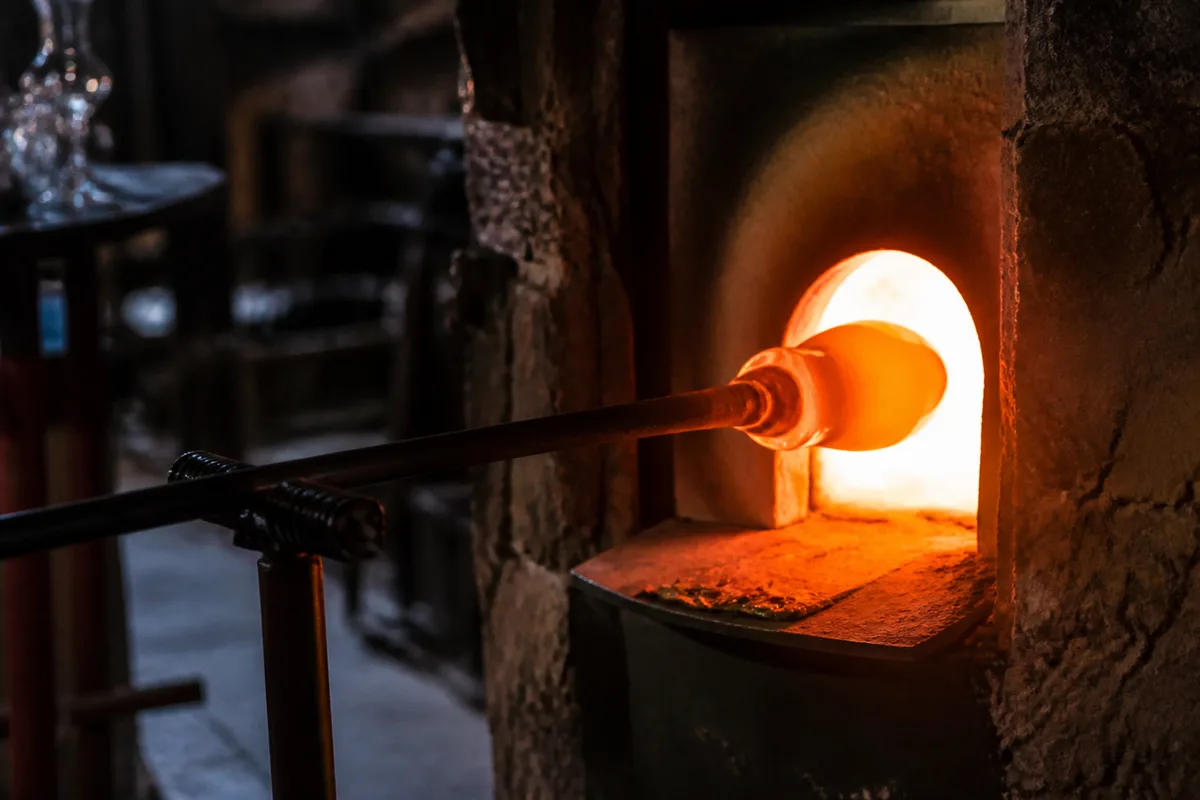
The furnace is where the transformation from raw material to artwork begins.
Inside the furnace, the glass is maintained at extremely high temperatures. The glassmaker does not simply melt a quantity of glass and use it immediately. In a traditional workshop, the material must remain at a temperature that allows it to be gathered and worked repeatedly.
The furnace therefore serves two purposes. It melts the glass and keeps it workable throughout the production process.
The opening through which the glassmaker gathers or reheats the material is traditionally known as the bocca. Murano glassmaking has its own specialized vocabulary, much of which refers to the furnace, the tools and the different stages of production.
During the creation of an object, the glassmaker repeatedly returns it to the furnace to restore its temperature. For this reason, traditional glassmaking can be understood as a continuous dialogue between the craftsman and the furnace.
Gathering the Molten Glass
The first visible stage in the production of a blown-glass object is known as gathering.
The glass master uses a long, hollow metal tube called a canna da soffio, or blowpipe. After heating the end of the pipe, he introduces it into the molten glass. A quantity of viscous glass adheres to the end of the tube, forming the initial mass from which the object will be created.
In traditional Murano terminology, this gathered mass may be called a bolo or posta.
The amount of glass collected at this stage is extremely important. If the glassmaker gathers too little, there may not be enough material to create the intended object. If he gathers too much, the piece may become heavy and difficult to control.
The correct quantity is judged largely through experience. A master glassmaker can assess the material by observing its appearance, movement and consistency, often making decisions in a matter of seconds.
Marvering the Glass
After gathering the molten glass, the craftsman rolls it over a flat metal surface known as the bronzin.
This operation, traditionally called marmorizzare, helps control the initial shape and temperature of the glass. By rolling the material across the metal surface, the glassmaker can create a more regular cylindrical or pear-shaped form before beginning the main shaping process.
At this point, the object is still only the beginning of the final piece. Its shape will change considerably as it is blown, rotated, reheated and manipulated with tools.
Blowing the Glass
Glassblowing is the stage most commonly associated with Murano glassmaking.
The glassmaker blows air through the blowpipe into the molten glass. Because the material is still soft and viscous, the air creates a cavity inside it. By controlling the pressure of the breath and continuously rotating the pipe, the craftsman gradually enlarges this cavity and begins to form a hollow vessel.
Blowing alone, however, does not determine the final shape. The glassmaker must rotate the blowpipe constantly while manipulating the hot glass with specialized tools. The speed of rotation, the amount of air introduced and the position of the glass all influence the final result.
The process requires extraordinary coordination. The master must control the shape while also monitoring the temperature and thickness of the glass. In many workshops, an assistant may help blow into the pipe or manage the piece while the master concentrates on shaping it.
The Role of the Servente
Traditional Murano glassmaking is often a collaborative process.
The maestro vetraio is supported by assistants known as serventi. Their work may include managing the blowpipe, reheating the object, preparing tools and helping coordinate the different stages of production.
This division of labor becomes particularly important when creating large or complex objects. A large vase, sculpture or chandelier component may require several people working together in precise coordination.
The finished object is therefore often the result of a workshop tradition rather than the work of one person acting alone. The master’s experience remains central, but the assistants play an essential role in maintaining the rhythm and efficiency of the process.
Shaping the Molten Glass
While the glass remains hot, it can be manipulated with a variety of traditional tools.
One of the most important is the borsella, a type of metal pincers used to shape the glass. Different forms of borselle are designed for different operations. They can pinch, cut, open, compress or stretch parts of the material, and they can also create ridges and other decorative effects.
The glassmaker may also use shears, pincers, measuring tools and other implements. Each tool is used at a precise moment, often while the glass is rotating on the blowpipe.
This is why it is misleading to say that a Murano vase is simply “blown.” Blowing creates the internal cavity, but much of the character of the finished object comes from the subsequent manipulation of the hot glass. The shape of the rim, the curve of the body, the thickness of the walls and the presence of decorative details all depend on the glassmaker’s control of the material.
Reheating the Glass
As the glass is shaped, it gradually loses heat.
If it becomes too cold, it can no longer be manipulated safely and may crack. The glassmaker must therefore return the piece to the furnace several times during production.
This is one of the most demanding aspects of the craft. The glass must be hot enough to remain workable, but not so fluid that it becomes impossible to control. The craftsman must constantly judge its condition and decide when it needs to be reheated.
The production process is therefore not a straight sequence of operations. It is a continuous cycle in which the glass is gathered, heated, shaped, reheated and shaped again.
Using the Pontello
At a certain point, the glassmaker needs to work on the area of the object that is still attached to the blowpipe. This is when the pontello becomes important.
The pontello is a metal rod used to support the piece after it has been transferred from the blowpipe. A small amount of glass is used to attach the rod to the object. The blowpipe can then be detached, allowing the craftsman to finish the opening or other areas that were previously connected to it.
This transfer gives the glassmaker greater freedom during the final stages of shaping. It also leaves a small mark on the base of many traditionally made objects, where the pontello was attached and later removed.
Creating Decorative Effects
Murano glass is famous for the variety of decorative techniques developed by Venetian glassmakers.
Decoration is often incorporated into the glass while it is still hot rather than simply painted onto the surface afterward. Colored rods, layers, threads, bubbles and sections of glass can be combined to create patterns and optical effects that become part of the structure of the object.
Some techniques produce delicate linear designs, while others create bold geometric patterns or the appearance of suspended colors. Many objects combine several techniques in a single piece.
Among the best-known methods are Millefiori, Murrine, Filigrana, Lattimo, Avventurina, Sommerso, Incalmo, Balloton, Pulegoso, glass mosaic, enamel decoration and engraving.
Millefiori and Murrine
Millefiori is one of the most recognizable Murano glass techniques.
The process begins with the creation of multicolored glass canes containing geometric or floral patterns. These canes are heated and stretched, reducing the size of the internal design while preserving its original pattern along the length of the cane.
Once cooled, the cane is cut into small sections known as murrine. These sections reveal the same pattern on their ends and can be arranged together to create elaborate mosaic-like surfaces.
The murrine can then be incorporated into another piece of hot glass. Depending on how they are arranged, they may form flowers, stars, geometric motifs or more complex compositions.
Murano glassmakers revived and developed the ancient murrine tradition during the nineteenth century. This revival played an important role in the renewed success of Venetian artistic glass during a period of strong competition from Bohemian and English glass.
Filigrana
Filigrana is another important Venetian technique.
It uses delicate glass canes, often containing white or colored threads, which are incorporated into the glass to create linear, spiral or lattice-like patterns. When the canes are twisted or arranged in particular ways, they can produce extremely refined designs.
The technique has deep historical roots and was successfully revived in Murano during the nineteenth century. Its continued use demonstrates how traditional methods have remained relevant even as Murano glassmakers have developed more modern forms.
Sommerso
The Italian word sommerso means “submerged.”
In this technique, different layers of colored glass are combined so that one color appears to be suspended inside another. The result can be a strong contrast between the outer and inner layers, often with a clear separation between colors.
Sommerso became especially important in twentieth-century Murano glass. It was used to create heavy, sculptural objects as well as elegant vases with sharply contrasting layers.
Incalmo
Incalmo involves joining separate sections of glass while they are still hot.
The technique allows the glassmaker to combine different colors, shapes or sections within a single object. For example, a vase may have a colored upper section joined to a transparent or differently colored lower section.
The two parts must be heated to the correct temperature and joined with great precision. If their temperatures or dimensions are not properly matched, the object may crack or become distorted.
Incalmo became an important feature of modern Murano design and was reinterpreted by manufacturers such as Venini during the twentieth century.
Lattimo
Lattimo is an opaque white glass with a soft, milky appearance.
Historically, it was particularly valued because it could resemble porcelain. The development of opaque white glass was one of the important achievements of Venetian glassmaking, alongside the production of exceptionally clear glass.
Lattimo can be used on its own or combined with transparent and colored glass to create contrast.
Balloton
Balloton is an optical technique that creates a regular geometric relief on the surface of the glass.
The glassmaker blows the hot material into a metal mould containing small raised pyramidal elements. The pressure of the glass against the mould transfers the pattern to the surface.
Balloton can also be combined with other effects, including trapped bubbles, colored layers and gold decoration. The result is often a richly textured surface that changes appearance as it reflects light.
Cutting, Pinching and Adding Glass
Not every Murano object is created entirely through blowing.
While the glass is still hot, the craftsman can add new sections, cut the material, stretch it, twist it or pinch it into shape. Handles, stems, feet, flowers, leaves and other decorative elements may be made separately and attached to the main body of the object.
This method is particularly evident in elaborate Venetian chandeliers. Historical Murano chandeliers could contain hundreds of individual glass components assembled around a structural framework.
The ability to create and combine many separate hot-glass elements is one of the reasons Murano glass can achieve such elaborate and sculptural forms.
Working the Glass “a Lume”
Another important technique is vetro a lume, or lampworking.
Instead of gathering large quantities of molten glass directly from a furnace, the craftsman works with glass rods heated by a flame. This allows much more precise manipulation of small quantities of material.
Lampworking is particularly suitable for beads, miniature objects and highly detailed decorative work. It requires considerable technical ability because the glassmaker must control the flame, the temperature of the rod and the shape of the material at the same time.
Although it uses a flame rather than the traditional furnace-gathering process, lampworking is an important part of the wider Murano glassmaking tradition.
Finishing the Object
Once the main form has been completed, the object may require several finishing operations.
Edges can be cut, ground and polished. Surfaces may be engraved, and additional details can be attached or refined. Some pieces receive enamel decoration, which involves applying a mixture containing powdered glass, pigments and metallic oxides. The object is then reheated so that the decoration becomes fixed to the surface.
Other pieces may be polished to improve their clarity or to soften particular areas. These final operations can significantly influence the appearance of the finished object, especially when they involve the rim, base or decorative surface.
At this stage, the piece begins to change from a mass of hot glass into a finished work of art.
Annealing: The Crucial Final Stage
One of the most important stages in making Murano glass takes place after the object appears to be finished.
The glass must be cooled slowly and in a controlled way. This process is known as annealing.
When glass cools unevenly, internal stresses can develop within the material. If a newly made object is allowed to cool too quickly, these stresses may cause cracks or even complete breakage.
To prevent this, finished pieces are placed in an annealing furnace, where the temperature is gradually reduced. The exact cooling process depends on the size, thickness and composition of the object.
A vase or sculpture is not truly finished when it leaves the glassmaker’s tools. It must first pass successfully through controlled cooling. Annealing is therefore essential to producing a stable and durable piece.
How Long Does It Take to Make Murano Glass?
There is no single answer because the time required depends on the size, design and technique used.
A small and relatively simple object may be completed in a short period. A large vase, sculpture or elaborate decorative piece may require much longer and the coordinated work of several people.
Complex techniques can also add considerable preparation time. Millefiori canes, for example, must be constructed, heated, stretched and cooled before they can be cut into murrine sections and incorporated into another object.
Filigrana, sommerso and incalmo may also require careful preparation and several reheating stages. The apparent simplicity of a finished Murano vase can therefore conceal a long sequence of specialized operations.
Traditional Murano Glassmaking and Modern Production
Modern Murano glassmaking uses technologies and materials that have evolved considerably, but many workshops continue to rely on traditional hot-glass techniques and the knowledge accumulated over generations.
The distinction between traditional and modern Murano glass should not be understood as a simple opposition between handcraft and technology. Contemporary production often combines traditional furnace work with modern equipment, new glass compositions, experimental colors and contemporary design.
The twentieth century provides many examples of this relationship between tradition and innovation. Manufacturers such as Venini worked with designers and artists while continuing to reinterpret techniques including blown glass, incalmo, engraving, filigree and murrine.
Modern Murano glass is therefore not merely a reproduction of historical objects. It is also a living artistic tradition that continues to evolve.
Why Murano Glass Is So Difficult to Make
The difficulty of Murano glassmaking comes largely from the behavior of the material itself.
Molten glass is constantly changing. As it cools, it becomes progressively less fluid, yet the glassmaker may need to manipulate it through several different stages. At the same time, the object must remain balanced, symmetrical and structurally stable.
The craftsman must control the temperature, rotation, air pressure, quantity of glass, viscosity, timing and pressure of the tools. He must also judge the thickness of the walls and decide when the piece needs to return to the furnace.
These decisions are made quickly and are based largely on experience. A master glassmaker is not simply operating equipment. He is continuously observing the behavior of the material and adapting his movements to it.
What Makes Murano Glass Different?
The uniqueness of Murano glass does not come from one secret ingredient.
It comes from the combination of material knowledge, specialized techniques, craftsmanship and design traditions developed over many centuries.
Murano glassmakers have historically achieved exceptional control over transparency, color, pattern, optical effects and form. Their work can range from almost weightless transparent vessels to massive sculptural pieces.
During the twentieth century, Murano became an important meeting point between traditional craftsmanship and modern design. Manufacturers and designers experimented with new forms while continuing to use techniques inherited from earlier generations.
This combination of historical knowledge and creative experimentation is one of the main reasons Murano glass remains so influential.
How Ancient Techniques Became Modern Murano Glass
One of the most fascinating aspects of Murano glass is that innovation often comes through rediscovery.
During periods of difficulty, glassmakers repeatedly looked back to historical techniques and adapted them to contemporary tastes. This was particularly important during the nineteenth century, when Murano faced strong competition from Bohemian and English glass.
Manufacturers revived older Venetian methods such as filigrana, murrine and mosaic glass. These techniques were not simply copied from the past. They were studied, modified and used to create objects that appealed to modern markets.
The same pattern continued during the twentieth century, when traditional techniques became the foundation for modernist design. Murano’s history is therefore not a simple progression from old methods to new ones. It is a continuous exchange between tradition and experimentation.
Is Every Murano Glass Piece Handmade?
Not necessarily in exactly the same way.
The word “handmade” can describe different levels of production, and modern Murano workshops may combine manual craftsmanship with machinery and industrial processes.
Many traditional artistic objects, however, involve substantial manual work by skilled glassmakers. The important question for collectors is not simply whether a piece contains any machine-made component. It is more useful to consider where the object was produced, which workshop made it, who designed it, which techniques were used and how much handwork was involved.
The existence of a known maker, documented production or reliable provenance can also be important, especially when evaluating older Murano glass.
From Molten Glass to Collectible Artwork
The production process explains why Murano glass occupies such an important position in the history of decorative arts.
A finished object may contain evidence of several different skills at once. A vase might combine blown glass, incalmo, filigrana and engraved decoration. A sculpture may be assembled from several separately produced components. A millefiori piece may contain hundreds of carefully arranged glass sections.
A chandelier may consist of individually formed flowers, leaves, arms and decorative elements, all assembled around a central structure.
The finished object is therefore much more than a container or decorative accessory. It is the visible result of a highly specialized production system in which material, technique and human skill are closely connected.
The Importance of the Maestro Vetraio
At the heart of the traditional process is the maestro vetraio.
This title reflects expertise acquired through years of practical experience. The master must understand how glass behaves at different temperatures and how quickly its consistency changes during production.
He must also know how to coordinate with assistants and how to translate a design into a sequence of physical operations. A successful piece depends not only on technical ability, but also on timing, judgment and the ability to respond to the material.
The specialized vocabulary associated with Murano glassmaking is itself evidence of how deeply the craft is rooted in the island’s history. Many of the traditional names for tools and procedures are still used today.
Frequently Asked Questions About How Murano Glass Is Made
Is Murano glass blown by hand?
Much traditional Murano artistic glass is produced using hand-operated techniques, including glassblowing. The glassmaker gathers molten glass on a blowpipe and shapes it through blowing, rotation and manipulation with specialized tools. However, not every object described as Murano glass is necessarily made entirely by hand.
What temperature is Murano glass made at?
Glass is melted and worked at very high temperatures, but there is no single temperature that applies to every stage of production. The working temperature depends on the composition of the glass, the type of object and the operation being performed.
What tools are used to make Murano glass?
Traditional tools include the blowpipe, or canna da soffio, borselle or shaping pincers, shears, the bronzin or marvering plate, measuring tools and the pontello. Each tool has a specific role in gathering, shaping, supporting or finishing the glass.
How is Millefiori Murano glass made?
Millefiori begins with specially constructed multicolored glass canes. These canes are stretched to reduce the size of their internal pattern and then cut into small sections. The sections, known as murrine, can be arranged and incorporated into other glass objects.
How is Murano glass cooled?
Finished objects are placed in an annealing furnace and cooled gradually. Controlled cooling reduces internal stresses that could otherwise cause cracking or breakage.
Why is Murano glass so expensive?
The price of Murano glass can reflect the amount of skilled labor involved, the complexity of the technique, the quality and rarity of the object, the reputation of the maker or designer, its age, condition, provenance and collectibility.
Can modern Murano glass still be handmade?
Yes. Contemporary Murano workshops continue to use traditional hot-glass techniques while experimenting with modern forms, materials, colors and designs. Modern Murano glass is not simply a reproduction of historical glass; it is also a living design tradition.
From Furnace to Artwork
The making of Murano glass is a remarkable transformation.
It begins with raw materials and a furnace. A glassmaker gathers a quantity of molten glass onto a blowpipe and begins to manipulate it while it is still extremely hot. Through blowing, rotation, reheating, cutting, pinching, stretching and the addition of colored glass, the original mass gradually becomes an object.
Techniques such as millefiori, murrine, filigrana, sommerso and incalmo can add further layers of complexity. Finally, the piece is annealed, finished and polished.
What emerges from the furnace is therefore the result of much more than heat and glass. It is the result of centuries of accumulated knowledge.
That is ultimately what makes Murano glass so fascinating to collectors. Every exceptional piece represents the meeting of material, technique, design and human skill.
For anyone interested in the subject, understanding the production process is also one of the best ways to appreciate why authentic Murano glass can vary so greatly in appearance, complexity and value.