
Venetian Chandeliers: Rezzonico Style, Identification & Collector's Guide
Identify antique Venetian chandeliers by Rezzonico ciocca form, Giuseppe Briati's workshop, and 19th-century revival construction. A collector's dating guide.
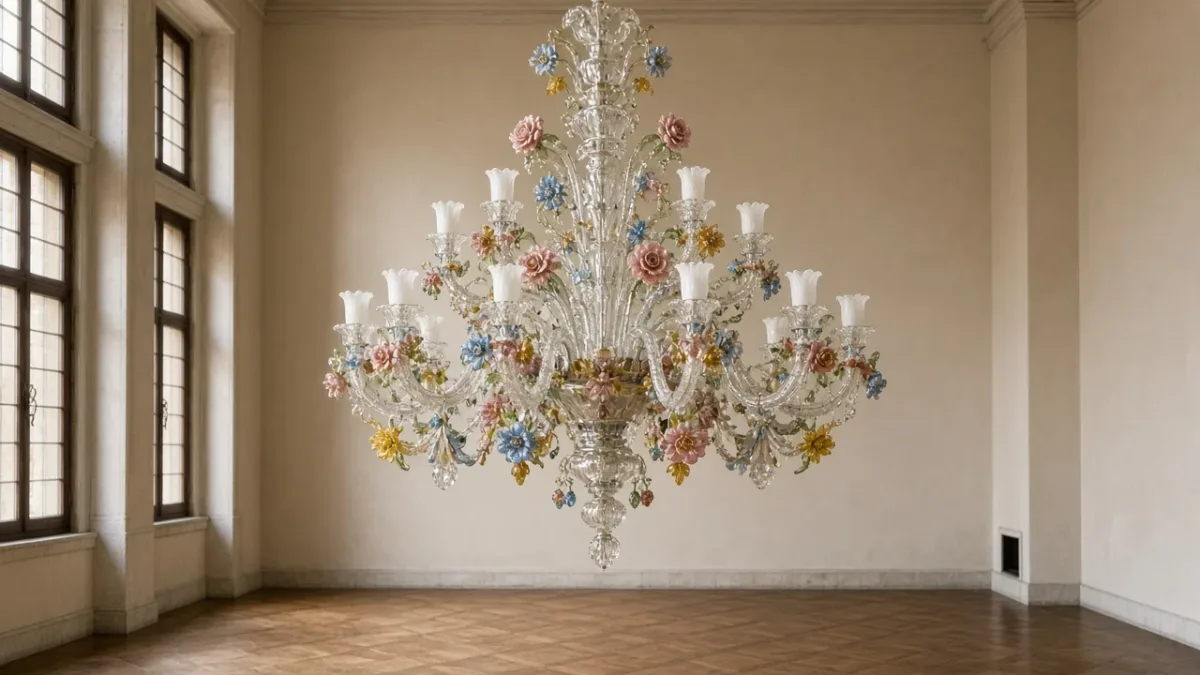
The surest way to identify an antique Venetian chandelier is not a hang-tag that says Murano. It is a construction. A true lampadario a ciocca is a forged metal skeleton dressed in separately blown parts: scrolling arms, candle-cups, leaves, flowers, pendants, and a terminal drop. The glass hides the iron. The flowers are not cut crystal drops in the Bohemian manner; they are a bouquet. Ciocca means a bunch of flowers.
This is a lighting problem before it is a glass problem. The furnaces that made tableware on Murano also made hanging lights, but a chandelier is assembled like furniture: a smith’s frame, a glassmaker’s cladding, later an electrician’s wiring. Collectors who treat every colourful hanging light as “Murano glass” miss the type. The type has a name in the trade — Rezzonico — and a documented inventor in the eighteenth century: Giuseppe Briati. Originals from his lifetime are rare. Most of what the market calls antique is a nineteenth- or early-twentieth-century revival of his idea.
A hanging light, not a vessel
Venetian palaces were lit long before anyone hung a glass ciocca. Oil lamps of cup form — cesendelli — still hang in the Procuratie at San Marco. The ballroom at Ca’ Rezzonico, now the civic Museo del Settecento Veneziano, keeps its original gilded wooden chandeliers. Those are carved lighting, not glass.
The glass chandelier that concerns collectors is the eighteenth-century answer to Bohemian crystal: a hanging candelabrum whose arms are blown, not cut, and whose ornament is polychrome. For the material history of the island’s furnaces, start with our Murano glass history and authenticity guide. This article is about the fixture: how it is built, how the Rezzonico type got its name, and how to date what you are offered. The same interiors held walnut and inlay — see the antique Italian furniture guide — and lagoon table silver, a hallmark problem treated in Venetian silver hallmarks.
How a ciocca is built
The civic Museo del Vetro on Murano is explicit about the method. The chandeliers in its main hall are worked con il sistema di investimento: a metal structure clad with blown-glass pieces. The iron takes the weight. The glass is the dress.
Typical parts, named as the museum names them: a central stem of stacked glass sleeves over the iron rod; scrolling arms (bracci) in one or more tiers, ending in candle-cups (coppette reggicandela); leaves, flowers, and fruit in coloured glass paste or blown colour; pendants as spheres or grape-clusters; a crest (cimiero) and a bow or drop (fiocco) at the base.
Each part has to fit the next. An oversized flower will not seat between two arms; a short sleeve will leave iron showing. Restoration that swaps unmatched later flowers is visible once you look for it: colour that does not belong, sockets that sit proud, wire where a glass collar should close.
Bohemian and English crystal chandeliers of the same centuries work the opposite way. Their drama is faceted drops and a relatively plain metal armature. Venetian work of the Briati type keeps the metal invisible and spends the labour on colour. If the hanging light is a cascade of cut prisms with no flowers, it is not a Rezzonico ciocca, however “Venetian” the dealer’s caption.
Wall lights from the same workshops are lumiere: paired sconces with the same floral vocabulary. They are easier to hang, easier to fake, and often more complete than a twenty-arm ceiling piece that has lost half its blossoms.
Giuseppe Briati and the eighteenth-century type
Giuseppe Briati was born on Murano on 8 January 1686 into a family inscribed in the island’s Libro d’oro of glassmaking lineages. Elena Bassi’s entry in the Treccani Dizionario Biografico degli Italiani is the account to trust. He sat on Murano’s minor council and held offices in the glassmakers’ scuola of San Nicolò. Success as a maker came late.
By the 1670s and 1680s, Bohemian crystal was already competing with Venetian glass on European tables. A later tradition, which Bassi flags as undocumented, says Briati went to Bohemia in 1733 and learned crystal-working inside a foreign furnace. What the documents show is a petition to the Council of Ten on 11 December 1736 for a ten-year privilege to continue work in “cristallo finissimo,” granted on 23 January 1737 and later extended to 1757.
In 1739 he was threatened with death by fellow Muranesi — Bassi notes that his father and uncle had already been killed in a trade feud — and he obtained permission to open a furnace in Venice itself, beside the church of the Carmini, on the fondamenta that now bears his name. Furnaces had been confined to Murano since 1271 because of fire. The same year he won the right to buy potassium saltpetre, used to stiffen colourless glass, at the government’s price, which undercut Bohemian crystal on cost.
Bassi is clear that hanging chandeliers of this kind are an eighteenth-century object. Briati took the Bohemian idea and characterised it with polychrome flowers, chinoiserie pagoda motifs then in fashion, and arms that terminate as dolphins. His furnaces also made deser (dessert centrepieces) and the wall lumiere that became a Venetian speciality. He died in Venice on 18 January 1772 and asked to be buried in Santo Stefano on Murano (destroyed in 1810). Treccani dates the Carmini factory to 1808. Related objects are shown at the Museo del Vetro, Ca’ Rezzonico, and the Museo Correr.
Later house names on twentieth-century lighting — including firms in our Murano masters article — belong to a different chapter. They made chandeliers. They are not Briati.
What “Rezzonico” actually names
In the trade, Rezzonico is a shape: a multi-tier hanging ciocca with floral arms, named after Ca’ Rezzonico. It is not, by itself, a workshop mark, a date, or proof that the light hung in that palace in the 1750s.
The example in the Brustolon Room is the one museum labels use as the type-piece. The Fondazione Musei Civici di Venezia describes a crystal chandelier with twenty flames in two rows, decorated with brightly coloured glass-paste flowers, produced toward the mid-eighteenth century by Giuseppe Briati’s Murano factory, and “the most extraordinary example of its kind to have come down to us intact.” Civic-museum educational texts add that this chandelier entered the collection in 1934, when the Italian state bought objects for the new museum of eighteenth-century Venice. The palace gives the style its name. The 1934 accession is why you should not assume every “Rezzonico” is palace furniture that never left the Grand Canal.
The Museo del Vetro hangs related eighteenth-century types attributed only as “probably” Briati’s factory, mid-century: a ciocca alla chinese (chinoiserie) with candle-cups, flowers, leaves, and pendants as spheres and grape-clusters; and a ciocca a colonna with four twisted columns and twenty-four arms on two tiers, twenty ending in dolphin heads. Palazzo Mocenigo also shows ciocche of the type. Seeing the civic examples is worth more than any dealer’s photograph.
Napoleon’s occupation of the Republic in 1797 broke the court and guild economy that had paid for this labour. Production of ambitious chandeliers fell with the rest of the island’s luxury trades.
The 1860s revival is what you will actually buy
Most chandeliers offered as “antique Venetian” or “antique Murano” were made after the mid-nineteenth-century revival, not in Briati’s lifetime. That does not make them worthless. It makes the date the first fact to get right.
In 1864 Murano held its first glass exhibition. The gold-medal piece — still the centrepiece of the Museo del Vetro’s main hall — is a sixty-light crystal chandelier on four tiers: 398 cm high, 226 cm in maximum diameter, 330 kg, 356 parts. Design and direction: Angelo Serena, assisted by Vittore Zanetti, with crystal paste by Isidoro Barbon at the Società Fabbriche Unite. The same chandelier went to the Exposition Universelle in Paris in 1867.
That object is a public statement, not a typical private commission, but it dates the revival: mid-1860s Murano could again build monumental lighting and send it abroad. Antonio Salviati’s workshops, opened in Venice in 1859, are the other documented engine. The Victoria and Albert Museum bought a Salviati candelabrum of about 1862 (museum no. 9042-1863), shown at the London exhibition of that year. Salviati’s later Compagnia Venezia e Murano kept lighting in the historicist repertory through the rest of the century.
Auction cataloguing follows the same split. Christie’s has described an early-twentieth-century Venetian polychrome twelve-light chandelier removed from Palazzo Taverna in Rome — a palazzo provenance, a revival date. North Italian gilt-metal and cut-crystal lights, including Genoese examples of the second half of the eighteenth century, are catalogued separately. Do not collapse Genoa, Venice, and a 1905 tourist ciocca into one “Italian chandelier” lot.
How to identify and date a piece
Work in this order, with the light photographed from below and from the side, before anyone rewires it.
1. Name the construction. Investimento over a metal frame, blown arms, applied flowers: Venetian ciocca. Cut prisms on a visible gilt armature: Bohemian, English, or North Italian crystal, not Rezzonico. Carved giltwood: Venetian, but not this article.
2. Count tiers and lights, then look at the stem. An eighteenth-century museum type is two rows of candle-arms, not a four-tier exhibition piece. Mismatched sleeves, or a brass tube replacing glass, usually mean later assembly.
3. Read the flowers as separate objects. Handmade blossoms vary. Mould-identical roses in a hard, even pink are later. Replaced flowers are normal; a whole garland in one later palette is a reconstruction.
4. Check terminals. Dolphin heads and chinoiserie pagoda notes appear on documented mid-eighteenth-century types. They were also copied. A dolphin arm on a light with modern electrical candles is not a Briati.
5. Treat electrification as a condition note, not a date. Almost every hanging ciocca that has lived in a house has been wired. Original candle-cups adapted for Edison bulbs are expected. A brand-new ceramic socket farm with no old cups is a modern build or a heavy rebuild.
6. Do not demand the Vetro Artistico® Murano trademark on an antique. Veneto regional law 23 December 1994, no. 70, created that collective mark for glass made on the island of Murano; Consorzio Promovetro administers licences for living firms. A holographic sticker is evidence for new production. Its absence on an 1880 chandelier proves nothing. Its presence on a piece sold as “eighteenth century” is a contradiction.
7. Price the hours and the completeness. A twenty-arm ciocca is hundreds of parts. Missing arms, later flowers, and a shortened stem all cut value.
8. Ask which city. “Venetian chandelier” and “Murano chandelier” are used interchangeably in English. Genoese and other North Italian crystal lights are a third group. Provenance beats a lagoon adjective.
Condition, hanging, and restoration
These objects are heavy. The Museo del Vetro’s 1864 chandelier weighs 330 kilograms; private revival pieces of twelve to twenty-four lights are lighter but still a structural load. A plaster ceiling rose in a modern flat is not a palazzo beam. Have someone who has dismantled investimento work look at the iron before you hang it.
Expect losses. Flowers snap, cups chip, and nineteenth-century restorers swapped parts between lights. Honest conservation replaces a broken arm with a blown match and says so. A “perfect” eighteenth-century ciocca with every petal intact and no wear on the iron collars is the piece to walk away from. Do not soak a wired chandelier. Dismantle only with numbered photographs of every sleeve.
Export of documented historic lighting from Italy can fall under cultural-property rules that do not apply to a new licensed ciocca. A palace-provenance light is a heritage object, not a decorative accessory.
What to collect, and where to look
Train the eye at Ca’ Rezzonico (Brustolon Room) and the Museo del Vetro before you buy a “Rezzonico” online. Palazzo Mocenigo adds further hanging examples in a domestic scale. Then decide which century you are actually shopping.
Museum-quality mid-eighteenth-century ciocche barely leave civic collections. The practical antique market is the 1860s–1930s revival: two-tier floral lights, sometimes with a palazzo or dealer provenance, often electrified, often with replaced flowers. Pairs of lumiere are a separate, more hangable collecting line. New production from licensed Murano firms is a third line, and should be bought as new, with the 1994 mark, not as a stand-in for Briati.
A lace collar from the same lagoon is a stitch problem, not a lighting one — see Burano lace. Do not flatten glass, silver, textiles, and hanging lights into a single “from Venice” story.
FAQ
What is a Rezzonico chandelier?
In museum and trade language it is a multi-arm Venetian glass ciocca of the type associated with Ca’ Rezzonico: crystal arms, candle-cups, and polychrome glass flowers. The Brustolon Room example is a twenty-flame, two-tier light attributed to Giuseppe Briati, mid-eighteenth century. The word is a type-name, not a signature.
Who was Giuseppe Briati?
A Murano-born glassmaker (8 January 1686 – 18 January 1772) who obtained a Council of Ten privilege in 1737 to make fine crystal and, in 1739, a rare permission to run a furnace in Venice at the Carmini. Treccani credits his workshop with characterising the hanging chandelier as a polychrome floral triumph in competition with Bohemian crystal.
How can I tell an eighteenth-century ciocca from a revival?
Originals of Briati’s lifetime are rare; civic museums treat even their own related lights as “probably” his factory. Revival pieces from the 1860s onward are common, often larger, often already wired, and often mixed in the parts. Date by construction, comparanda, and provenance — not by the presence of flowers.
Does a missing Vetro Artistico Murano label mean a fake?
No, not on an antique. The mark is a 1994 geographic licence for living island producers. It is the right question for a new chandelier and the wrong one for a nineteenth-century ciocca.
Can an antique Venetian chandelier be electrified?
Most already have been. Concealment of the wiring inside the investimento stem, retention of old cups, and a competent earth are what matter.
Are Venetian and Murano chandeliers the same thing?
In English retail, yes: both names point at lagoon glass lighting. Historically the furnaces were on Murano (with Briati’s documented city exception). A “Murano-style” light made far from the lagoon is neither.
Conclusion
An antique Venetian chandelier is a frame dressed as a bouquet. Learn investimento as the method, ciocca as the floral type, Rezzonico as the palazzo name for that type, and Briati as the documented eighteenth-century workshop — then remember that the 1864 gold-medal light in the Museo del Vetro taught Europe the revival. Without that sequence you are buying colour on a ceiling. With it, you can tell a mid-eighteenth-century two-tier museum type from a Paris-exhibition column, a Genoese crystal from a lagoon ciocca, and a 1994 licensed new piece from a story that claims the 1730s.