
Masters of Murano Glass: Barovier, Venini, Seguso & Iconic Makers
Meet the legendary Murano glass artists and houses — Barovier, Venini, Seguso — their techniques, signature works, and collector value.
Famous Murano Glass Artists and Makers: The Masters Behind Venetian Glass
Murano glass cannot be attributed to a single artist or style. Instead, it reflects centuries of collaboration between Murano’s skilled maestro vetrai (master glassblowers), visionaries and designers. On the island of Murano, glassblowing was a family tradition passed down through generations. From the earliest documented glassworkers in the 13th century to today’s studio artists, each maker added new techniques and aesthetics. For collectors and art historians, knowing these names is crucial: a vase marked “Venini” tells a different story than an anonymous Murano bowl, even if they look similar.
1. Origins: The Barovier Dynasty and Early Murano (13th–19th Centuries)
The Barovier family is woven into Murano’s very origins. The Baroviers appear in Venetian records by the 14th century as glassmakers – by 1343 one Barovier is identified as a “phyolarius” (blower of hollow vessels). In the 15th century, Angelo Barovier (c.1424–1460) became famous for technical innovation. He developed a remarkably clear crystalline glass, literally experimenting like a scientist to improve clarity. Under his hand, Venetian glass reached new heights of purity. Angelo’s daughter Marietta Barovier continued the legacy, creating the famous rosette beads (multi-layered star-patterned glass pearls) that were exported worldwide.
Murano’s reputation grew as its glassmakers refined furnaces and recipes. By the late Middle Ages, Venice even decreed that all glass furnaces must move to Murano (a measure of how central the island had become). This guild-like control over the industry, formalized in Murano’s mariegola (corporate charter), preserved both secrecy and quality.
The Barovier family name endured. In 1936 the Vetreria Artistica Barovier merged with Ferro Toso (another historic Murano family) to form today’s Barovier & Toso. This company – often cited as one of the world’s oldest family businesses – still operates on Murano. In the 20th century, designer Ercole Barovier (1889–1974) led the firm to new creative achievements (see the table below). Barovier & Toso became known for combining Barovier’s legacy of clear, iridescent glass with contemporary aesthetics.
Despite that modern evolution, the Renaissance roots are still celebrated. Angelo Barovier’s breakthroughs are considered a turning point: Murano glass began to rival the appearance of rock crystal, and Venice won a reputation in Europe as a top glass center. This spirit of technical innovation and artistry underlies everything that followed.
2. Early 20th-Century Transformation: Zecchin, Martinuzzi and the Rise of Art Glass
The 1900s brought a renaissance in Murano glass. Companies realized that innovation often came from collaborating with outside artists and designers. “Murano glass found its way to innovation in the 1900s when the companies with more acumen began working with artists and designers,” notes the Murano Glass Museum. A striking example came in 1921, when the newly founded Cappellin & Venini factory (soon to be just “Venini”) created the role of artistic director and appointed the painter Vittorio Zecchin. This was unprecedented: for the first time, a master of fine art shaped Murano glass design. Zecchin’s 1920s and ’30s works for Venini and others are described as characterized by “purity, transparency and lightness”, blending Venetian techniques with the elegance of Art Nouveau and early Modernism.
When Zecchin left Venini in 1925, sculptor Napoleone Martinuzzi took over as artistic director. Martinuzzi (1892–1977) was a former pottery sculptor turned glassmaker. He introduced a revolutionary style called pulegoso glass. A “pulegoso” vase is made with intentionally bubbled, opaque glass. Martinuzzi’s formula trapped countless small air bubbles (puleghe) in a thick, milky glass, giving the finished piece a rough, tactile surface. These heavily textured vessels were the opposite of Venice’s famed clear crystalware – yet they found admirers for their organic, almost stone-like appearance.
Other Murano workshops also embraced new collaborations. The 1920s saw names like Guido Cadorin, Alfredo Barbini, Umberto Bellotto and even Carlo Scarpa contributing to glass pieces alongside traditional maestros. Displayed at international exhibitions, these works won prizes and helped revive interest in Venetian glass during a challenging era.
In short, by mid-century Murano was no longer just preserving medieval recipes. It was actively engaging in the wider arts scene. Glassmakers and designers explored Deco and modernist trends, fusing Murano techniques with contemporary art. This set the stage for the next, even more transformative phase with Paolo Venini.
3. Paolo Venini and the Murano Design Revolution
If Barovier represents Renaissance Venice, Paolo Venini embodies modern Murano. A Milan-born lawyer turned entrepreneur, Venini co-founded the Murano furnace Venini & Cappellin in 1921. His vision was radical: treat Murano glass as a design object. Instead of just continuing old forms, he invited artists and architects into the workshop. Under Venini’s leadership, Murano became a laboratory for Italian design.
Venini’s strategy was vindicated early. Zecchin’s directorship at Venini (1921–25) created groundbreaking vases (like the “Libellula”) that carried the flair of fine art. Later, Venini made an even bolder move by hiring Carlo Scarpa (1906–1978) as art director from 1932 to 1947. Scarpa – famous as an architect – approached glass with architectural precision. He pioneered new uses of incalmo (fusing two blown pieces), experimented with layering and engraving, and combined glass with other materials. Scarpa’s Venini pieces include heavy layered “Sommerso” vases, intricate filigree, and the beginnings of strong linear forms that would appear post-war.
After the war, Venini continued to innovate. In 1948 Fulvio Bianconi (1915–1996), a former illustrator, became Venini’s lead designer. Bianconi’s imagination brought whimsy to Murano glass. His famous Fazzoletto (Handkerchief) vase of 1949, for example, looks like a fabric blown by the wind and frozen in glass. He also created cheerful Commedia dell’Arte figurines and Tiepolo scenes that became iconic. Though they appear almost spontaneous, Bianconi’s pieces required elaborate glassblowing and assembly – he literally redefined what shapes Murano glass could take.
Venini never abandoned traditional craft. The furnace remained famous for its technical mastery: “the Venini glass factory…focused innovatively on traditional techniques, with blown glass worked using the ‘flying hand’ or the ‘incalmo’ (joining separate pieces)… or engravings, filigree, murrine, etc.”. Under Scarpa and Bianconi, Venini’s output was almost unparalleled in variety: nearly every major technique (murrine, millefiori, filigree, battuto, lattimo, pavone, etc.) was employed in new, experimental ways. The museum notes that Venini collaborated with countless designers over the years (Italian talents like Ludovico de Santillana, Toni Zuccheri and foreign names like Tapio Wirkkala).
In sum, “Venini glass” came to symbolize a golden age of Murano design, even though Venini was not one person’s name but a brand. Today, a collector might look for Venini incised signatures or labels, but more importantly they look at form and style – a system streamlined by Venini’s partnerships with artists. A piece is often called Venini because it was made at that studio, but its character is tied to designers like Scarpa and Bianconi.
4. The Great Maestro Vitrai: Seguso, Poli, Barbini and the Artisan Tradition
Parallel to the Venini/design story is another thread: Murano’s maestro vetrai, the master glassblowers who honed their craft generation-to-generation. These craftsmen kept traditional techniques alive and often innovated within that tradition.
A great example is Archimede Seguso (1909–1999). Born into a glassmaking family, Seguso co-founded Seguso Vetri d’Arte in 1933, with partners including Barovier and Ferro (see MUVE). Seguso himself was a celebrated blower. He specialized in filigrana (filigree) glass – embedding thin glass canes in the blown object. The museum notes that Archimede “specialised in different experiments with filigree and produced… original vertical thread vases, created in a single blow”. These vases, with delicate white (or colored) threads spiraling inside clear glass, are instantly recognizable and technically demanding. Seguso’s name became associated with such exquisite precision and clarity.
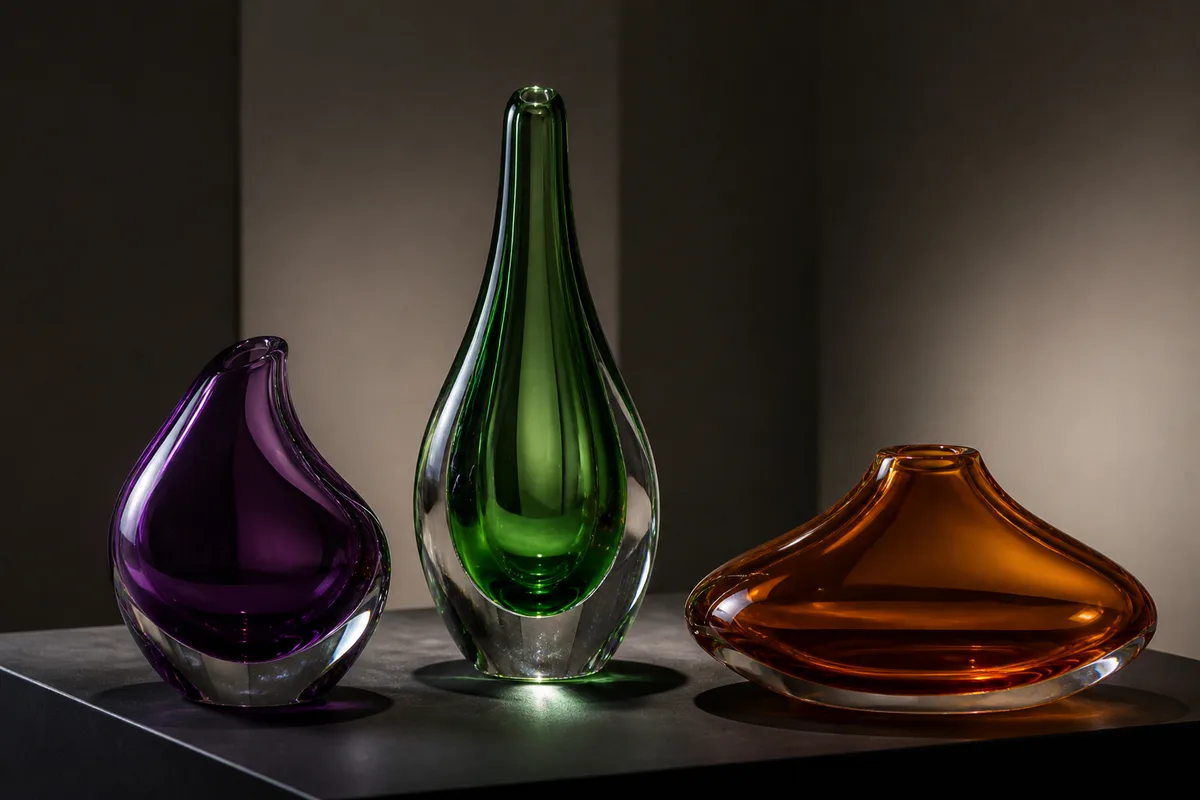
Working alongside Archimede at Seguso was Flavio Poli (1900–1984), an innovative designer who joined the firm in 1934. Poli developed what is now a signature Murano look: sommerso or “submerged” glass. He layered bold colours inside one another. For instance, a vase might have an inner core of cobalt blue, encased in a thick wall of clear glass, so that the color appears suspended. The museum highlights Poli’s Sommerso creations for Seguso as iconic post-war Murano pieces. Indeed, by 1954 Poli’s work had won international acclaim (a Seguso vase designed by him won a Compasso d’Oro award that year). Seguso Vetri d’Arte, under Poli’s influence, achieved global recognition in the 1950s; “from 1948 the furnace exported worldwide, and soon the greatest museums began acquiring the artistic glass from its furnace designed by Flavio Poli”. Examples now sit in institutions like London’s Victoria & Albert and New York’s MoMA.
Another master was Alfredo Barbini (1912–2007). Whereas Seguso/Poli often produced light, airy forms, Barbini delighted in massive glass. He used large volumes of colored glass to create sculptures that look almost like stone or metal. (A 1950s silver and gold ‘folaga’ duck by Barbini, for example, is a prized collector’s piece.) The Murano museum mentions that Barbini was drawn to “heavy glass to create almost sculptural forms”. His use of sommerso and bold juxtapositions of color (including large stacks of colored blocks) exemplified a robust, expressive Murano style. Barbini’s work also garnered awards and remains highly collectible.
We should also acknowledge other masters. Carlo Moretti (b.1935) founded a Murano workshop in 1958. Moretti focused on tableware and interior objects; MUVE notes his elegant yet bold production of glasses and bowls. Fratelli Toso and Lavorazione Artistica (Cappellin) were other historic furnaces that continued Murano traditions through mid-century, often overlapping with the names above. What matters is that, in contrast to Venini’s designer-led approach, the legacy of Seguso, Barbini and their peers comes from deep technical mastery of glassblowing. These maestros showed that Murano techniques could produce both delicate filigree and weighty sculpture, without losing the island’s artistic soul.
5. Post-War Explosion of Colour and Experimentation
After World War II, Murano glass entered a period of creative ferment. The island’s glassworks and designers explored ever more extreme uses of color, pattern and scale. Notable figures included:
Dino Martens (1894–1970): Originally a painter, Martens became the art director for Aureliano Toso in 1939. He was known for daring color combinations and energetic surfaces. His 1950s “Axolotl” and “Oriente” series for Toso mixed pure colors in chaotic, almost pointillist patterns. These works are technically stunning and reflect a confident post-war Italian style.
Gino Cenedese (1907–1973): Founder of Gino Cenedese & Figlio (1946), he ran a workshop that increasingly embraced contemporary art. In the 1950s, Cenedese collaborated with Napoleone Martinuzzi and later hired Antonio Da Ros. Cenedese’s showroom became an art hub on Murano. As MUVE recounts, Cenedese’s company worked with sculptors and launched new techniques, blending craft with modernist aesthetics (see MUVE [Seguso archives] which also mention Cenedese’s partners).
Antonio Da Ros (1932–2014): A prolific designer for Cenedese and others, Da Ros developed playful, organic forms (e.g. “soft” shaped vases, lamps with tentacle-like arms) often in vibrant, sometimes pastel hues. His compositions often looked almost like blown-up cells or flowers.
Carlo Moretti (b.1935), as mentioned above, made Murano tableware fashionable. He hired international designers and pushed bold color (bright yellows, blues, magentas) into everyday glass.
Aureliano Toso (company) also played a role with designs from artists like Enzo Mari and Dino Martens that featured graphic decorations and layering.
These years saw the maturing of techniques: avventurina glitter, lattimo opalescence, bold millefiori patterns, and complex incalmi. Murano combined tradition and avant-garde. As MUVE observes, “it was the quality, the painstaking studies, endless experimentation…that made twentieth-century Murano glass a cult object for glass lovers and collectors.” The variety was astonishing: vases could be ultra-light or massively thick; colors ranged from pure clear to opaque pastels to multi-layered rainbows. This diversity means many collecting niches today (e.g. some collectors specialize in Dino Martens/Toso pieces, others in Poli/Seguso sommerso, etc.).
6. From Maestro to Contemporary Artist: Tagliapietra, Giampaolo Seguso, Simone Cenedese
In recent decades, some Murano glassmakers have become solo artists on the international stage, rather than anonymous workshop masters.
Lino Tagliapietra (b.1934) is the most famous living Murano glass maestro. Trained since childhood in the Bay section of the Galliano furnace, he achieved the rank of maestro by 1957. In the late 1960s Tagliapietra began signing his own works. He moved to the US in 1979 and started creating unique sculptural pieces blending Murano techniques with abstract painting and geometry. Today he’s an art superstar; his signed glass sculptures can sell for tens of thousands. His career shows how Murano’s traditional skills can evolve into purely artistic expression. (MUVE recently highlighted Tagliapietra as one of Murano’s internationally influential figures.)
The Seguso story continued too. Giampaolo Seguso, son of Archimede, joined the family business in the 1960s. In later years he moved the name into art pieces and small editions. His works are often thoughtful, conceptual creations – engraved glass plaques, figurative blown sculptures, and more. Giampaolo founded Seguso Viro Murano in 1993 (with three sons) to express a personal artistic vision. Because of this multi-generational complexity, collectors must distinguish “Archimede Seguso (filigree master, mid-20th c.),” “Seguso Vetri d’Arte (Poli’s era),” and “Seguso Viro (Giampaolo’s company),” as each label implies different times and styles.
Lastly, Simone Cenedese (b.1941), Gino’s grandson, represents the current wave. Maestro at age 14, Simone took over Gino Cenedese & Figlio in the 1970s. He became known for fantastical lighting and modern art glass. His chandeliers can have dozens of twisted glass arms, all hand-blown and assembled. Simone has collaborated with contemporary designers and continues to innovate (the Murano museum has exhibited his work too).
These contemporary figures underscore that Murano glass is a living art. New technologies and global influences blend with time-honored craft. Yet the connection to Murano’s lineage remains: Tagliapietra and Simone, for example, learned the same basic skills that were taught to their grandparents.
7. Why the Maker Matters to Collectors
When collecting Murano glass, the who and when often matter as much as the what. Two vases may look alike, but if one is a rare 1950s Venini by Carlo Scarpa and the other a mass-produced 1980s souvenir, their significance and price will differ hugely.
Designer vs. Maker vs. Factory: Always ask: who designed it, who physically made it, and which workshop produced it? In mid-century Murano this could be four different names. For example, a “Scarpa vase” means designed by Carlo Scarpa; a “Venini glass” might just mean made at Venini’s factory (perhaps after Scarpa, maybe during Bianconi’s tenure); a “Seguso” piece might be made by Archimede under Flavio Poli’s designs, or later by a Seguso family member. Each layer adds information.
Signature Styles: Many top Murano artists had recognizable styles or signatures. Ercole Barovier favored iridescent glass and murrine patterns; Fulvio Bianconi has characteristic asymmetrical forms (like the Fazzoletto); Flavio Poli’s sommerso vases have thick colored cores; Lino Tagliapietra often uses painterly veils of color (his “Canne in vetro” technique). Noticing a signature technique can point you to the maker.
Period and Rarity: A known designer’s authentic piece from the 1950s (for example, a Massimiliano Schiavon bowl for Aureliano Toso, or a Bianconi clear Fazzoletto) can command tens of thousands at auction. In contrast, generic Murano glass from today or pieces made after the artists’ peak usually cost much less. Provenance is key: if the piece came from a respected collector or has museum history, it adds trust and value.
Signatures and Labels: Many Murano pieces are unsigned. Sometimes makers used etched signatures (e.g. “Vetri Murano” or a symbol), or paper labels like the famous red “Venini V” sticker. A label saying “Seguso Vetri d’Arte” or an etched “Barovier” can help confirm origin. But beware: labels can be counterfeit, and some originals were removed over time. Always consider marks as clues, not proof.
Our Murano glass collecting guide (see especially the section on signed Murano glass) explains in detail how to interpret marks and authenticate Murano. In general, the maker’s name can transform how we see an object. Two similar vases: one anonymous 1970s Murano and one known as a 1954 Venini design, will sit in very different collector categories.
In short, the identities behind Murano glass objects greatly affect their cultural and monetary value. That’s why a guide to Murano glass artists is not just art history—it’s practical knowledge for anyone interested in these objects.
8. How to Identify the Maker of a Murano Glass Piece
Attribution can be challenging, but these steps can help:
Study Style and Technique: Compare the piece’s style with known works. A weighty block vase with one color inside another suggests sommerso (Flavio Poli/Seguso or Scarpa/Venini). A delicate vase with glass “threads” (canes) indicates a filigrana technique (possible Seguso or Barovier piece). A twisted “spiral” vase might be a Toni Zuccheri for Venini. Matching form to historical models often yields clues.
Check for Marks: Look for any etched signatures, symbols or labels. Venini pieces often have “V. Venini Murano Italia” etched or a “MVM Cappellin Venini” monogram. Barovier & Toso sometimes put paper labels or a signature on bases. Seguso works sometimes bear a sticker saying “Seguso Vetri d’Arte” or a star logo. There are identification guides (print and online) that list known marks.
Provenance and Documentation: If the piece comes with paperwork (a gallery invoice, old catalog, or museum catalogue entry), that’s strong evidence. Auction house listings can be useful references too.
Dimensions and Manufacturing Details: Authentic Murano items often have a heavy weight and crisp pontil marks on the bottom. If a piece is extremely lightweight or has inconsistent bubbles, it might be modern or imitation. Measuring dimensions (height, width, rim thickness) and comparing to documented examples can confirm if it matches a known model.
Consult Experts: For valuable pieces, experts can help. The Murano Glass Museum (MUVE) in Venice offers research services. Renowned appraisers and historians often have deep knowledge of specific designers.
No single factor is foolproof. A signed signature can be forged and an unsigned piece can still be authentic. That’s why understanding the broader context is so important. By referencing our Murano Glass and Murano glassmaking guides, and by focusing on whether a piece fits the style of a known master, you’ll greatly improve your chances of correct attribution.