
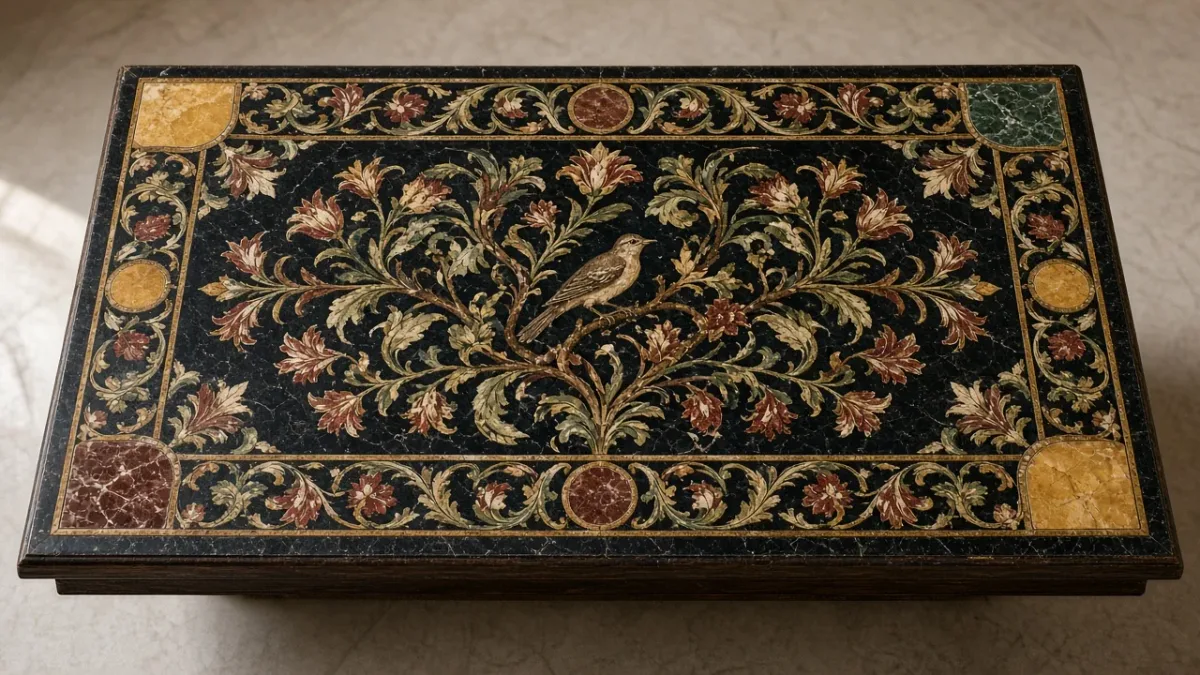
Italian Scagliola in Carpi and Tuscany, 1600–1800
Italian scagliola from Carpi and Tuscany, 1600–1800: gypsum inlay technique, workshop practice, and how collectors distinguish it from pietra dura.
Scagliola is a gypsum inlay, not a stone. Italian workshops mixed calcined selenite, animal glue and pigments to imitate coloured marbles and Florentine pietra dura. The craft took hold in Carpi, north of Modena, in the early seventeenth century. In the eighteenth it shifted toward pictorial tabletops made in Tuscany for local houses and for Grand Tour buyers. Collectors still confuse the two materials. The distinction is physical.
The Italian word comes from scaglia, the flake of selenite (calcium sulphate dihydrate) from which the plaster is ground. In Emilia the stone is also called pietra di luna. Pronounced ska-LYO-la, with a silent g, the term names both the powder and the finished inlay.
Carpi, 1611–1680
Italian tradition credits the architect and engineer Guido Fassi (Carpi, 1584–1649) with introducing coloured scagliola to his native town. A portrait in the civic museum at Carpi bears the inscription “Guido Fassi da Carpi inventore dei lavori in Scagliola colorita e macchinista 1616.” That claim of invention does not survive modern comparison. Scagliola of a developed kind is documented in Bavaria from the 1580s. Blasius Pfeiffer is recorded from 1582. The Reiche Kapelle in the Munich Residenz received scagliola decoration between 1607 and 1630. Carpi lies about thirty miles south of Mantua, where German stucco teams had worked for the Gonzaga. Fassi remains the first Italian name firmly attached to a local school of religious furnishings in the material.
The earliest dated scagliola in Carpi is a memorial slab to Cristoforo Priori in the cathedral, 1611, often given to Fassi’s circle. Two architectural altar surrounds by Fassi survive: the altar of the Assumption (later Our Lady of Sorrows) in Carpi Cathedral, 1629, and the altar of the Immaculate Conception in San Niccolò, 1633. Both imitate coloured marbles in pedestals, Corinthian members and pediments. The inlaid altar fronts now on those altars are later.
Pandolfini has published a table top signed by Pietro Baseghini of Mirandola and dated 1629, presented as the oldest signed and dated Italian scagliola top. Carlo Francesco Gibertoni, another figure in Fassi’s orbit, signed work in the 1640s. A polychrome fragment dated 1646 is cited in the same literature.
The first generation of Carpi inlayers moved beyond marble imitation. Annibale Griffoni (c. 1618–1679), Fassi’s nephew and pupil, developed a black-and-white technique that mimics copperplate etching and the ivory-and-ebony panels then fashionable on cabinets. The design was transferred onto a finished white scagliola surface by prick-and-pounce. The black ground was cut away, the drawing lines carved, and a thin black coat laid over the whole. When sanded back, the white design appeared inlaid. The method is the reverse of what the eye assumes. Signed work by Griffoni is recorded at Cavezzo, near Modena, and at San Niccolò in Carpi. The tripartite paliotto, a reference to the Trinity inherited from embroidered altar cloths, remained the standard format until the last quarter of the century.
Giovanni Gavignani (Carpi, 1632–1680) worked almost exclusively in black and white. His masterpiece is the paliotto of the altar of St Anthony of Padua in San Niccolò, signed and dated 1652, when he was twenty. The outer panels carry flower vases. The central scene of St Anthony with the Christ Child follows a print by Simone Cantarini. Lace-pattern borders, acanthus friezes and candelabra strips are cut with a control of cross-hatching that later Carpi work rarely equalled. Gavignani reused cartoons. Fourteen years after the San Niccolò St Anthony front he supplied an exact copy to the church of the Madonna of Lourdes at Reggiolo.
The Musei di Palazzo dei Pio in Carpi hold a substantial civic collection of these objects, formed around paliotti and related furnishings of the Este period (1527–1859). In the town’s churches, scagliola remains in situ as altar architecture, not only as portable tops.
Technique: selenite, meschia, polish
Workshop practice is consistent enough to be diagnostic, even when unsigned.
Selenite was taken from Emilian, Lombard and Calabrian deposits, calcined at about 128°C, pounded and sieved to a white powder. Mixed with water it re-forms gypsum, which is weak. Binders, usually diluted animal glue (acqua di colla), were added. Pigments were those already known from fresco: natural and burnt earths, iron oxides, and a limited set of vegetable lakes. Scientific analysis of Emilian altar fronts, published in Studies in Conservation (2009) and in related University of Modena work, has identified minium, vermilion, lazurite, orpiment, red and yellow ochres, lead white and lampblack, with dyes including indigo and saffron, in an animal-glue matrix.
A wooden board received a bed of scagliola, then an armature of marsh reeds (canne palustri), wood or brick fragments, then a covering coat (coperta). Drying to the point at which the slab could be lifted took 15–20 days. The cartoon was pounced. Recesses were cut with V-, C- and U-gouges, deep for the main design, shallower for shading, then filled with coloured pastes. Levelling used beech or willow charcoal. The final polish was olive and walnut oil, worked until the surface resisted moisture. A medium paliotto or table top took about three months.
The paste itself was called meschia. Later Tuscan pictorial work often used a thin black coperta on a stone support, etched a few millimetres deep and filled in successive liquid campaigns, then polished with pumice, oils, waxes and shellac. That is the method described for the Russborough tabletops associated with Don Pietro Belloni.
Colour, pietre dure and the second generation
From the later seventeenth century Carpi absorbed the ornamental vocabulary of Florentine hardstone mosaic. Pietro Paolo Corbarelli had moved to Padua in the 1640s. In 1681 Benedetto Corbarelli was called by the Duke of Modena to direct a pietre dure workshop. Carpi makers kept black-and-white for pictures and lace borders, and returned colour to the field: parrots, flower bunches, and simulated giallo antico, verde antico and porphyry.
Giovanni Leoni (1639–1710) and Ludovico Leoni (Carpi 1637–Cremona 1727) carried the technique into Lombardy. Giovanni signed and dated a pair of cabinets “Gio. Leone F. 1680–81,” now at Konopiště Castle and formerly associated with Mantuan Este property. Ludovico’s tabletops, often with a bird on ribbon-tied branches, scrolling foliage and geometric marble-imitation borders, appear with some frequency in the London and Milan trade. Christie’s has catalogued early-eighteenth-century tops under his name, citing Graziano Manni’s I Maestri della Scagliola in Emilia, Romagna e Marche (Modena, 1997).
The same decades saw a Lombard school in the Val d’Intelvi. The earliest documented northern Italian works there are paliotti by Don Carlo Belleni at Santo Stefano, Gottro, 1664.
Naples produced its own scagliola in the later seventeenth and eighteenth centuries, including altar fronts at the Certosa di Padula. Those southern objects are a separate identification problem and should not be forced into a Carpi attribution on colour alone.
Tuscany in the eighteenth century
By the eighteenth century the centre of gravity for secular work had moved to Tuscany. Carpi continued. Florence, already the capital of hardstone commesso, wanted a cheaper pictorial equivalent that could carry landscape and figure.
Enrico Hugford (Florence, 1695–1771), a Vallombrosan monk of English family, learned the craft from Father Salvatore Perrier at Santa Reparata in Marradi, which he entered in 1711. Marradi sits on selenite. Four of Hugford’s scagliole were shown at the Accademia del Disegno exhibition in the cloister of Santissima Annunziata in 1737. In 1742 he was in Florence as master of novices at San Pancrazio. That year Sir Horace Mann, the British resident, paid him 25 zecchini for a table top destined for Horace Walpole. The Mann–Walpole letters record a failed first slab, when the stone support split, and Hugford’s reluctance to start again.
Giovanni Targioni Tozzetti, visiting Vallombrosa in 1761, wrote that Hugford’s figures, animals, buildings and countryside had been carried in quantity to “the most cultured provinces of Europe.” Surviving Vallombrosan work draws on Anton Domenico Gabbiani, Giuseppe Zocchi’s Tuscan vedute, and earlier graphic sources (Cantagallina, Bazzicaluva, Stefano della Bella). An altar in scagliola tiles was erected at San Fedele, Poppi, in 1749 for the relics of Blessed Torello.
Hugford’s pupil Don Pietro Belloni signed tabletops that English and Anglo-Irish travellers ordered as furniture, not as church fittings. A top sold at Woolley & Wallis is signed “Petro. Belloni. Vallumbrosa. A Florenta. F. Anno. D 1754.” Related pairs went to Joseph Leeson at Russborough (commission discussed by Mann in 1747; signed work 1750), to Ralph Howard at Shelton Abbey (1750), and to Sir Matthew Fetherstonhaugh at Uppark (1754). Typical layout: a central landscape in a scrolled cartouche, floral and shell borders, sometimes Commedia dell’arte figures in the corners, on a black ground.
Lamberto Cristiano Gori (1730–1801) pushed the medium further toward painting, using the brush where earlier men used the spatula. An ICCD record transcribes a signature “LAMBERTUS CHRISTIANUS GORI FECIT FLORENTIAE A.D. 1762.” Examples are at the Opificio delle Pietre Dure and Palazzo Pitti. Gori’s series of artist portraits after the Serie degli Uomini Illustri entered the Pitti guardaroba. A document of 31 March 1794 records one transfer, and the 1802 inventory lists a room of scagliola paintings.
Grand Tour buyers who walked the Oltrarno for hardstones and furniture, as described in our Florence antiques walking guide, often left with scagliola in the same packing case as Roman micromosaics. The two souvenirs answer the same demand for portable, highly finished Italian surface.
How to tell scagliola from marble and pietra dura
Hold three possibilities in mind: a continuous marble slab; a hardstone commesso; a gypsum inlay.
Marble is cold to the touch and, in chips or on the reverse, stone throughout. Joints between slabs are masonry joints. Translucency at thin edges is mineral, not varnish.
Pietra dura is a jigsaw of actual stones (lapis, agate, marble, alabaster) cut and fitted into an excavated ground. Under magnification the seams are stone-to-stone. Losses show the depth of the scasso, typically several millimetres of real mineral. Weight is high. For workshop practice in Florence see the pietra dura collecting guide. Related inlaid furniture in wood, not plaster, is a different craft: Maggiolini marquetry.
Scagliola has a plaster body. Damage at corners and edges reveals a white or grey gypsum substrate under the colour coat. Hairline cracks are common. A tap often sounds duller than stone. The reverse, if accessible, may show reed impressions, a wooden former, a slate or stone support, or later canvas and plaster repairs. Simulated marbles (porphyry, verde antico) are recipes of pigmented gypsum, sometimes with alabaster chips for local translucency, not slices of the named stone.
Nineteenth-century and later restorations are frequent. Painted-in losses, plaster fills and modern varnish or polyurethane read as a continuous pictorial skin and can fool a photograph. Abrasion through the colour coat leaves blank gypsum patches that cannot be polished back into existence.
Do not wet the surface to test gypsum. Water etches runs, brings calcium sulphate to the face as efflorescence, and can delaminate the colour coat. Outdoor use is not historically appropriate and will destroy the object.
Italian marble sculpture of the same centuries is a useful tactile control. Carrara and statuary marbles have a crystalline glitter that scagliola never has.
Signatures, condition and the market
Signatures, when present, are usually painted or inlaid along a border or on the reverse of a pictorial slab. Expect Latinised names and dates: Fecit, Florentiae, Vallumbrosa, Anno D. Carpi paliotti in churches are more often documented by local historians (Cabassi, Garuti, Manni) than signed on the face. Unsigned tabletops are attributed by design. Black-and-white lace borders and tripartite sacred pictures point to seventeenth-century Carpi. Birds, scrolling flowers and simulated marble reserves point to the Leoni generation. Landscape cartouches on black grounds point to Vallombrosa.
Condition notes that matter: corner and edge chips exposing the grey core; restored breaks with metal splines on the underside (recorded on auctioned Carpi tops); yellowing oil; mould in damp storage; overpaint. A later stand is normal. Tops were often separated from original bases.
Il Ponte sold an eighteenth-century Carpi top, 78 × 130 cm, on a later table, for €2,500 in 2020, against an estimate of €2,800–3,000. Sotheby’s catalogued an early-eighteenth-century top given to Ludovico Leoni at £10,000–15,000 in 2013. A signed Belloni top of 1754 was estimated at £20,000–30,000 at Woolley & Wallis. Those figures describe different schools and states. They are not a price guide. What they show is that scagliola, once sold as a cheaper substitute, now trades on the same international furniture market as the stones it imitated, with a wide spread according to signature, pictorial quality and structural integrity.
FAQ
Is scagliola the same as fake marble paint?
No. Scagliola is a solid gypsum body, cut and filled, then ground and oiled. Marbling paint sits on a surface. The two can be combined in later restorations, which is why a loupe and a look at losses matter more than a photograph.
Did Guido Fassi invent scagliola?
Carpi said so, and the 1616 portrait inscription repeats it. Bavarian work is earlier. Fassi’s importance is as the organiser of an Italian ecclesiastical school whose inlaid paliotti, especially in black and white, are distinct from Munich marble-imitation.
Are Italian scagliola tabletops always from Carpi?
No. Carpi dominates seventeenth-century sacred inlay. Eighteenth-century pictorial tops are as likely to be Tuscan (Hugford, Belloni, Gori) or Lombard. Naples produced its own. Attribution from colour photographs alone is unsafe.
Can the material be cleaned with water?
Not as a household method. Gypsum reverts in water. Cleaning belongs to a conservator who can distinguish original oil polish from later coatings.