
Italian Antique Clocks: History, Identification & Collector's Guide
A practical collector's guide to Italian antique clocks: Campani night clocks, regional pendole, signatures, and how to date cases and movements.
Collectors looking for Italian antique clocks often start with the wrong comparison. An English oak longcase and a French gilt cartel are well mapped types. Italian work is not a provincial version of either. The peninsula’s distinctive contributions are earlier public astronomy, a short seventeenth-century burst of silent night clocks, and later regional pendole whose cases follow local furniture more closely than Paris or London.
The market still mislabels. A walnut hood with a later Swiss movement becomes “Italian eighteenth century.” A painted altar-form clock with a revolving hour disc is catalogued as a generic mantel. The type that matters has a name in Italian — orologio notturno — and a documented workshop in papal Rome. Most of what you will actually be offered is later: a regional longcase, a lacquered Venetian table clock, or a nineteenth-century case fitted with a French or Swiss movement. Date the construction before you date the story.
The same rooms that held these clocks held walnut cabinets and inlay. For the furniture language of those interiors, see the antique Italian furniture guide and the Maggiolini marquetry guide. Night-clock cases sometimes carry hardstone slabs; that technique is a separate Florentine trade, treated in Florentine pietra dura.
Public clocks before the domestic pendulum
Italy’s earliest surviving reputation in timekeeping is civic, not domestic. In Padua, Jacopo Dondi built a public astronomical clock in 1344. His son Giovanni Dondi dall’Orologio finished a far more ambitious machine, the Astrarium, in 1364: seven faces, 107 moving parts, driven by a single weight, showing the Sun, Moon, and the five planets then known, together with the calendars of the day. Giovanni documented the design in the Tractatus astrarii. The original clock is lost; reconstructions exist, including one associated with the Museo Nazionale della Scienza e della Tecnologia Leonardo da Vinci in Milan.
That medieval ambition is not what you buy at auction. It is the reason Italian collectors still treat tower clocks (orologi da campanile) as a serious line, and why a later provincial maker who also built church movements — Bertolla in Trentino, Ferracina in the Veneto — sits higher than a nameless mantel with a pretty hood.
Galileo, Huygens, and what Italy actually invented
Galileo Galilei described the near-isochronism of the pendulum and, late in life, tried to put it in a clock. Vincenzo Viviani’s letter of 20 August 1659 to Prince Leopoldo de’ Medici, preserved in the Museo Galileo’s account of the episode, is the source to use. In 1641 at Arcetri, already blind, Galileo explained to his son Vincenzio a scheme for regulating weight-driven and spring clocks with a pendulum. He died on 8 January 1642. Vincenzio did not begin a model until April 1649. Christiaan Huygens independently produced a working pendulum clock in 1656–57.
Italy therefore has a documented theoretical claim and an unfinished family prototype. It does not have priority for the domestic pendulum clock as a European commodity. What Rome did invent, within a few years of Huygens, was a different bedroom object: a clock you could read in the dark without a ticking verge keeping you awake.
The night clock: Campani, Callin, and the painted face
David Thompson’s catalogue note on a British Museum night clock by Pietro Tommaso Campani (Rome, 1683) is the clearest English account. In 1655 Cardinal Farnese was ordered to provide Pope Alexander VII Chigi with a clock that would show the hours at night — not by setting a candle in front of an ordinary table clock. Three brothers from San Felice in Umbria, Giuseppe, Pietro Tommaso, and Matteo Campani, were working in Rome as clockmakers to the pope. In 1656 one of their clocks was presented to the cardinal. They received a privilege, later contested, and went on making the type.
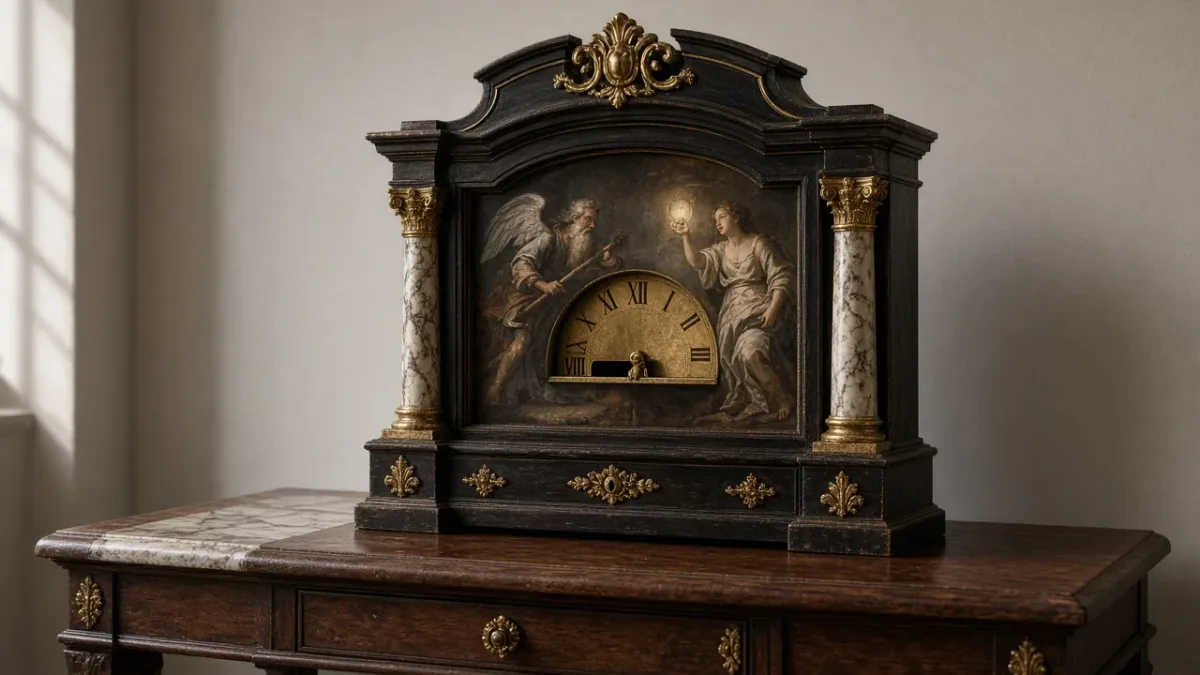
The construction is specific. Hours are not read from hands on a conventional chapter ring. A revolving disc, with two apertures opposite each other, turns behind a semicircular opening. An oil lamp inside the case lights the disc. The Campani workshop also developed a silent escapement so the bedroom clock would not tick. The British Museum example is inscribed Petrus Thomas Campanus Inventor Rome 1683. Its case is typical late-seventeenth-century Roman work: ebony veneer, gilt-brass mounts, slabs of semiprecious stone, columns painted to imitate blue marble, a complex double pediment, and a concealed drawer for the winding key. The painted dial shows the four ages of man, the four times of day, and Chronos.
The Museo Poldi Pezzoli in Milan holds the most important public collection of antique horology in Italy — about five hundred pieces, enlarged in 1973 by Bruno Falck’s gift of 129 mechanical clocks. Its altar clock by Giovanni Pietro Callin (about 1660–70) is the type in a civic vitrine. The ebonised case follows a Counter-Reformation altarpiece. Discs showing the hours revolve in a semicircular opening. The painted face, attributed to Giovan Battista Gaulli (Baciccio), shows Truth holding the sun, winged Time, and Falsehood in shadow. The museum is explicit that painting the face, typical of Italian clocks, begins only between 1660 and 1670.
Silvio Bedini’s monograph on Giuseppe Campani records that more clocks by Giuseppe survive than by any other seventeenth-century Italian maker. He was also an optical-instrument maker of European rank. For collectors that matters in one practical way: a signed Campani night clock is a museum object. A later painted “altar clock” with a conventional French movement and a nineteenth-century canvas is not.
Eighteenth-century regional makers
Once the pendulum was ordinary, Italian clockmaking looked like Italian furniture: regional workshops, Latinized signatures, cases that follow local wood and lacquer.
Bartolomeo Antonio Bertolla (1702–1789) was born at Mocenigo di Rumo in the Trentino. At seventeen he apprenticed in Austria with Johann Georg Butzjäger at Neulengbach; a guild diploma dated 27 December 1722 from Sankt Pölten is held by the Museo della Scienza e della Tecnologia in Milan. Back in the Val di Non he built and repaired tower clocks for Trentino campanili and made domestic longcase and mantel clocks for the Trentino and Tyrolean aristocracy — carved, gilt, and inlaid wooden cases. With the priest-astronomer Francesco Borghesi he built astronomical pendulums; the most important, presented to Maria Theresa of Austria, is now in the Smithsonian. Signed work uses his name, sometimes with Rumo; one museum piece carries the monogram ABB. In 1959 the museum acquired and reconstructed his entire workshop.
Bartolomeo Ferracina (Solagna, 1692–1777) is the Veneto counterpart. Treccani lists him as an engineer who rebuilt Palladio’s wooden bridge at Bassano after the 1748 flood and also designed clocks and hydraulic machines. He made tower clocks across the Bassano hinterland and table clocks signed in Latin as Bartholomeus Ferracina in Venetia. Dealer records of a mid-century Venetian table clock from the Poldi Pezzoli orbit describe a barocchetto lacquered case and a three-train movement — the same lagoon taste that produced painted furniture and, in other rooms, Venetian chandeliers.
Mario Gambelli, active by 1766, is documented at the Metropolitan Museum of Art by a tall Italian longcase. The Latinized form Marius Gambelli Bononiensis on a related lantern clock points to Bologna; the Museum’s example names Montalboddo, the former name of Ostra near Ancona. The Met’s own catalogue is usefully cautious: the walnut hood is eighteenth-century; the trunk appears later and too short for a full day’s run. That is the Italian longcase problem in one object — a fine hood, a compromised or associated body.
Christie’s has catalogued the same mismatch in reverse: an Italian walnut longcase, the case possibly Veneto, housing an associated English lantern movement signed George Clarke of Leadenhall Street. An Italian case does not make an English movement Italian. An English signature does not make a Venetian hood English.
How to identify an Italian clock
Work in this order. Photograph the dial, the movement plates, the case joins, and the pendulum before anyone “tidies” the piece.
1. Name the type. Painted architectural case, revolving hour disc in a lunette, lamp chamber or soot traces inside: night clock / altar clock. Tall wooden case with a pendulum behind a trunk door: pendola a cassa lunga. Smaller case for a chest or console: pendola da mensola. A gilt bronze cartel with a silk-thread suspension is usually French, not Italian.
2. Read the face as a painting problem. Italian night clocks of the 1660s–80s treat the dial as a small altarpiece. A later replacement canvas, or a printed scene under glass, is not Campani-period work. Conventional Roman chapter rings with two hands belong to later pendulum clocks.
3. Prefer the movement to the dial. Signatures on the back plate or cock are harder to fake than a painted name on the chapter ring. Italian makers often Latinized: Petrus Thomas Campanus, Bartholomeus Ferracina, Marius Gambelli. A French movement stamped in the nineteenth century inside an “Italian baroque” case is a marriage.
4. Match the case to a furniture region. Roman night clocks: ebony or ebonised wood, gilt mounts, sometimes pietra dura. Venetian table clocks: lacquer, barocchetto carving, painted grounds. North Italian longcases: walnut, break-arch hoods, shorter trunks than an English eight-day clock. A Maggiolini-type inlaid case is Lombard furniture taste applied to a clock, not proof of a famous cabinet-maker.
5. Do not treat “Made in Italy” as an antique mark. Country-of-origin stamps belong to later import law. Their absence on an eighteenth-century clock proves nothing. Their presence on a piece sold as 1680 is a contradiction.
6. Ask whether case and movement grew up together. Screw holes that do not align, a pendulum too short for the trunk, a seatboard cut down, or a French silk-suspension movement in a night-clock case are the usual tells.
Condition, restoration, and export
Night clocks are lamp objects. Soot, heat stress, and replaced painted panels are expected. Honest conservation keeps the architectural case and says when the canvas is later. A “perfect” seventeenth-century night clock with a bright, uncracked oil painting and no wear on the gilt mounts is the piece to walk away from.
Pendulum clocks need a horologist who has seen Italian plates, not only English two-trains. Do not oil a dirty movement. Do not shorten a pendulum to make a later trunk “work.” Wooden cases follow the same rules as other Italian furniture: original varnish and old repairs beat a stripped walnut shine.
Export of documented historic clocks from Italy can fall under cultural-property rules that do not apply to a twentieth-century mantel. A signed Campani, a Bertolla from a palazzo, or a civic tower movement is a heritage object. Budget time for attestato paperwork before you assume it can leave the country.
What to collect
Train the eye first at the Poldi Pezzoli Clock Room in Milan and, for the workshop rather than the finished luxury object, at Bertolla’s reconstructed bottega in the Museo della Scienza e della Tecnologia. The Museo Galileo in Florence is the place for the pendulum claim, not for shopping.
Museum-quality Campani and Callin night clocks barely leave civic collections. The practical antique market is eighteenth-century regional pendole — signed Bertolla or Ferracina when you can find them, unsigned walnut longcases and lacquered Venetian table clocks more often — and nineteenth-century Italian cases with French or Swiss movements, which should be bought as that, not as “Baroque Rome.”
A pair of later mantel clocks in Empire taste is a decorative line, closer to Venetian silver on a dining table than to a papal night clock. Do not flatten tower clocks, bedroom notturni, and a 1900 Paris movement in a Florence-bought case into one “Italian clock” lot.
FAQ
What is an Italian night clock?
An orologio notturno is a seventeenth-century table clock, usually in an altar-shaped ebonised case, designed to show the hour in the dark. A revolving disc turns behind a semicircular opening; a lamp inside the case lights the disc. The Campani brothers in Rome developed the type for Alexander VII; painted allegorical faces become common from about 1660.
Did Galileo invent the pendulum clock?
He conceived a pendulum-regulated clock in 1641 and described it to his son; Viviani recorded the episode in 1659. Vincenzio Galilei started a model only in 1649. Huygens produced the first widely adopted working pendulum clock in 1656–57. Credit Galileo with the idea, not with the finished European type.
How do I tell an Italian clock from a French or English one?
Start with the type. A painted lunette with a revolving hour disc is Italian. A tall oak longcase with a false pendulum aperture and a London signature is English unless the case is demonstrably later Italian. A gilt bronze cartel with a silk-thread suspension is usually French. Then check whether the movement and the case belong to the same shop and century.
Are Italian longcase clocks valuable?
Signed eighteenth-century examples by documented makers (Bertolla, Ferracina, and a few others) are collected. Unsigned walnut cases with associated English or Swiss movements are furniture with a clock inside; price the case and the movement separately. Completeness of the pendulum, seatboard, and hood matters more than a dealer’s “baroque” caption.
Should I restore the painted dial on a night clock?
Not as a first step. The painting is part of the object’s date. Overpaint destroys evidence. A conservator who treats small-format Baroque painting — not a furniture stripper — is the right trade if the panel is actively flaking.
Can I export an antique clock from Italy?
Often yes for later, undocumented pieces; not automatically for signed seventeenth- or eighteenth-century work of artistic interest. Ask for export documentation before you pay, especially on night clocks and named regional makers.
Conclusion
An Italian antique clock is a type problem before it is a brand problem. Learn the night clock as Rome’s seventeenth-century invention — silent, lamp-lit, painted like a small altar — then learn the eighteenth-century pendola as regional furniture with a Latinized signature on the plate. Galileo belongs in the science paragraph, not on a sale ticket. Huygens made the pendulum ordinary; Campani, Callin, Bertolla, and Ferracina made the Italian objects you can still hope to identify. Without that sequence you are buying a hood and a story. With it, you can tell a 1683 Roman notturno from a married French movement, and a Trentino longcase from a Venetian lacquered table clock that only looks like one.