
Authentic vs Later Volterra Alabaster: What Collectors Miss
Authentic Volterra alabaster is gypsum from Tuscan nodular beds. Learn how workshop pieces differ from later tourist copies and calcite lookalikes.
Volterra alabaster is gypsum, a fine-grained hydrated calcium sulphate taken from nodular beds in the hills around the Tuscan town. Auction catalogues still call later tourist vases, dyed busts and resin casts by the same name. The earlier objects that matter to collectors are Etruscan cinerary urns, sixteenth-century church fittings, and the export wares of the late eighteenth and nineteenth centuries. Those groups do not share one workshop method. They do share one stone.
The identification problem is physical before it is stylistic. Gypsum alabaster yields to a fingernail (Mohs 1.5–2). Calcite, the so-called Egyptian or Oriental alabaster used for pharaonic vessels, does not. Marble is harder still and crystalline. Heat, dye and polyester can close that gap on a photograph. They do not close it in the hand.
Gypsum, not marble
The Volterran mineral is CaSO4·2H2O, the same chemistry as plaster of Paris. It formed as compact ovoid blocks (arnioni or ovuli) inside Messinian gypsum, the panchina of local quarry speech. The Consorzio Turistico Volterra dates those evaporites to roughly 26–7 million years ago. Clay and iron oxides were expelled toward the skin of each nodule; dark veins are their trace. Typical working blocks weigh 100–500 kg. Larger arnioni occur. They are taken in pieces because internal fracture ruins a turning.
Workshop names for the varieties remain in use:
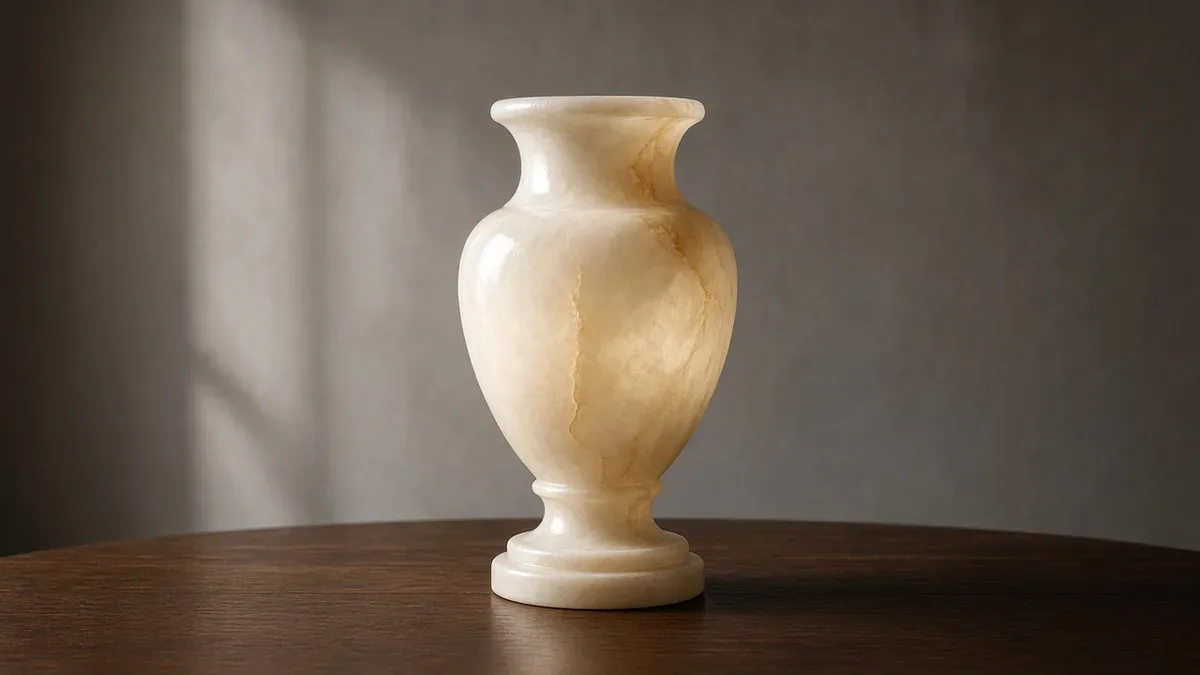
- Scaglione: the common white stone, more or less translucent, the usual body for vases and lamps.
- Agata: the hardest and scarcest, yellow to deep amber; a red stone in this group is no longer extracted.
- Bardiglio: grey, beige or orange, veined enough to be read as marble at a glance.
- Pietra a marmo: white ground with light grey, red or green veins, compared locally with Calacatta.
- Cinerino (cenerino): ash-grey, often opaque.
- Pietra gialla: a bright yellow, uncommon.
The finest white, historically taken around Castellina Marittima as well as Volterra, went to Florence for figure work. Commoner grades were turned in town into vases, lights and small ornaments, then shipped through Livorno, Pisa and Florence. Oxford’s Corsi notes treat Volterra and Castellina as the Tuscan gypsum sources and keep them distinct from banded calcite travertine sold as oriental alabaster.
A useful comparison in the same Tuscan gypsum family is Italian scagliola. Scagliola is a mixed paste. Volterra alabaster is the stone itself.
Etruscan urns and the long gap
The Etruscans of Velathri met gypsum marl by the late eighth century BC. The Tomba di Badia uses slabs of that marl. Carved funerary monuments in true alabaster begin only in the third century BC, possibly under Greek-trained hands. For three centuries the stone was reserved for cinerary chests and lids. Civil objects are almost absent. Exceptions cited in Volterra are a crater and a small group of a woman with child, both still funerary.
The Museo Etrusco Guarnacci holds more than 600 Etruscan urns in local “tufa” (a limestone, not volcanic tuff), terracotta and alabaster. Alabaster was the dearer material from the later third century: chests 60–100 cm long, cut in low relief, sometimes painted in mineral colours and occasionally gilt. The preferred stone was warm, ivory, lightly veined, close to marble in effect. Etruscan carvers did not “boil” the stone, the later heating used to kill translucency. Ancient workings have been traced at Ulignano and Gesseri, close to the town. Castellina has old cuttings that local tradition calls Etruscan; distance makes regular ancient traffic from that quarry unlikely.
Production declined under Rome, when Apuan marble displaced the local gypsum, and nearly stopped in the Middle Ages. Two small twelfth-century capitals, probably from San Giusto or its monastery, are the documented medieval survivors: a two-tailed siren and eagles with a scroll, now read as fragments of a ciborium or ambo.
Church fittings, then export wares
The modern craft begins in the mid-sixteenth century with sacred objects. Bartolomeo Rossetti is recorded in 1549 with a pair of alabaster candelabra given by a Volterran to a Florentine church. His brother Giovan Paolo and their father Francesco worked the same stone; turning on the lathe is credited to this circle. Leonardo Franceschini made a tabernacle for San Pietro in 1567. Cammillo Spenditori added candelabra there in 1575. The large ciborium of Sant’Andrea (1574) is now in the Museo d’Arte Sacra.
Seventeenth-century output stayed ecclesiastical until the second half of the century, when cheaper private wares appeared: classical copies, busts, vases, and small chamber lamps that held a candle inside a translucent vessel. Late-eighteenth-century tobacco boxes sold well. A quieter staple was the anima, an alabaster bead sent to Rome to be coated as a false pearl for rosaries and dress.
The organisational break is the Officina Inghirami, opened in 1791 by Marcello Inghirami Fei in the suppressed monastery of San Dalmazio. The works employed about one hundred hands and ran a drawing-and-sculpture school. A French-language manifesto addressed amateurs of ancient art. The list was largely reproductive: the Farnese Hercules, the Apollo Belvedere, Leda, clock cases, vases for neoclassical rooms, small arches and obelisks. Each piece was supposed to carry a mark of interlaced initials for Fabbrica Marcello Inghirami Fei Volterra. French occupation of Tuscany in 1796 cut Livorno traffic. The factory closed in 1799. Surviving marked pieces are scarce. An interlaced Inghirami punch is evidence when present. Its absence proves nothing.
After 1815, men trained in that shop opened their own rooms. The decades 1850–1870 were the strongest of the century. Travelling merchants (viaggiatori) accompanied cases from Livorno to London and then to North and South America, India and the Far East. Enrico Fiumi and later ministerial reports name firms such as Falchi, Tangassi, Giovannoni and Topi among those sending agents abroad. Giuseppe Viti (1816–1860), whose house is now Palazzo Viti, is the best-documented of that group. The family biography records childhood years in the United States, a profitable South American voyage ending in 1845, and a last journey from 1846 to Lucknow, where Wajid Ali Shah bought the stock. Viti returned in 1849 and bought the Palazzo Incontri. The later Volterran style of “Emir of Nepal” belongs to that house tradition and should not be written into a catalogue as an independent office.
His brother Amerigo Viti developed commesso volterrano: alabaster hardened by heating and quenching, then stained and sliced for tabletops that imitate Florentine pietra dura with a simpler floral and geometric vocabulary. Contacts with the Opificio delle Pietre Dure are documented from 1852. In 1858 Leopold II awarded a first-class industrial decoration. A rare hardened-alabaster table remains in Palazzo Viti, together with two candelabra nearly four metres high, made for Maximilian of Mexico by the Tangassi firm with town-wide help and never shipped after his fall.
Nineteenth-century forms follow the same Grand Tour taste that filled Florence antiques shops: vases all’etrusca with festoons, Ariadne cups, copies after Canova (the Three Graces, the Apollo, the Venus, the Arrotino), and mixed orientalising ornament (lotus, dragons) on classical bodies. Inghirami’s earlier clock cases sit in the same decorative field as Italian antique clocks, though the case is gypsum, not marble or wood.
How a Volterra piece is made
Four trades still divide the work. Squadratori square and plane. Tornitori turn circular and spherical forms on the lathe (once a pole lathe, later a treadle or powered wheel). Ornatisti cut relief ornament. Scultori take figures from the block, freehand or from plaster casts. The incoming nodule is cut to a cylinder, mounted, and reduced with tools closer to woodworking than to marble pointing. Finish is oil (today often a petroleum jelly) rather than a marble polish. Thin walls on lamps and vases are deliberate: the stone is sold as a light-bearing material.
Construction clues that support a workshop date:
- Tooling. Continuous lathe rings on interiors and undersides; chisel and rasp tracks in recesses that a mould cannot copy.
- Joins. Larger candelabra and composite vases are sectioned and glued. Old hide-glue seams darken and creep. Modern epoxy is glassy in a chip.
- Weight and temperature. Gypsum is cooler and lighter than a marble object of the same size. Resin casts are lighter still and warmer.
- Translucency. A torch at the lip or foot of scaglione shows a warm, even glow with cloudy patches. Heat-treated “marmo di Castellina” is deliberately opacified. Resin glows uniformly, often with trapped bubbles.
- Marks. Inghirami interlaced initials are rare. Giuseppe Bessi (Volterra, 1857–1922; workshop from 1879) signed busts Prof. G. Bessi, Prof.re G. Bessi, or Studio Prof. G. Bessi, sometimes with Made in Italy or a title cut on the plinth. His studio issued replicas in his lifetime. “After Bessi” and unsigned salon busts in mixed white and stained stone are a later, crowded field.
Christie’s has catalogued the standard late type without a maker: an Italian alabaster urn lamp, circa 1900, the body with classical figures in low relief, 41.3 cm high. That description fits hundreds of unsigned export pieces. Relief quality, wall thickness and the stone variety matter more than the word “Italian” in a lot title.
Authentic stone, later objects
“Later” in this market covers several different things. They are not all fakes. They are not all Volterra.
Heat-treated gypsum sold as marble. Workshops immerse carvings in water and raise the temperature almost to boiling. Partial dehydration reduces translucency and yields a dead, marble-like white (marmo di Castellina). Done badly, the surface goes chalky. A fingernail still scratches it. Italian marble sculpture of the same period has a crystalline sparkle and will not take that scratch. The test belongs on an already bruised foot or the underside of a base, never on a face.
Dyed and stained alabaster. The stone is porous. Full immersion in heated pigment produces coral-like reds, greys and violets used on Bessi-type busts and on cheaper fruit and figure groups. Colour that sits in a skin and stops at a chip is dye. Colour that continues through a break is more likely a natural oxide.
Calcite and onyx-marble. Banded Egyptian or Mexican calcite (“oriental alabaster,” “alabaster onyx”) is a carbonate. It resists a fingernail and fizzes with dilute hydrochloric acid. Gypsum does not. Do not put acid on a finished object. Use the scratch test on a hidden point, or leave the chemistry to a conservator.
Spanish and other gypsum. Aragonese deposits supply much of the modern trade. English medieval alabaster (Nottingham, Chellaston) is the same mineral in a different grain and a different iconography. Neither is Volterran by origin. Nodular structure, warm ivory scaglione and a documented Tuscan workshop trail are the local signatures. A Spanish architectural slab or an English tomb panel is a different object even when the Mohs number matches.
Cast powder and resin. Volterran shops themselves have long distinguished carved stone from figures poured in alabaster dust bound with polyester. Mould lines, identical multiples, air bubbles and a soapy sheen are typical. The material does not scratch like gypsum and does not show a crystalline or cloudy interior when chipped.
Serial tourist wares. From the late nineteenth century the trade split what the alabastrai called opere di pregio from roba commerciale: Leaning Towers, inkwells, small animals, and lamps cut for electric fittings. Electrified urns of older form often have a later drilled well, a brass rod and a 20th-century socket. The stone may be period. The lamp is not.
Studio and tourist “Bessi.” Signed lifetime work by Giuseppe Bessi, who directed the Volterra art school, is one category. Workshop replicas from his models are another. Unsigned mixed-marble-and-alabaster maidens with laurel and a romantic title are a third, still common in the trade. Treat the signature, the stone, and the carving of hair and eyelids as three separate questions.
The Società Cooperativa Industriale Magazzino di lavori in alabastro was founded in 1895 (472 members and 35 apprentices) to warehouse and vet work; it took the name Artieri in 1908 after Gabriele D’Annunzio’s visit. Umberto Borgna, appointed technical-artistic director in 1933, shifted the cooperative toward designed lamps, boxes and frames for a bourgeois interior. Those 1930s objects are authentic Volterra products. They are not nineteenth-century neoclassical export wares. A later guarantee mark associated with the Consorzio Produttori dell’Alabastro appears only from the early 1980s.
Reference collections in town keep the sequence visible: Etruscan urns at the Guarnacci; tools, pole lathes and later design at the Ecomuseo dell’Alabastro in Palazzo Minucci-Solaini, via dei Sarti 1, beside the Pinacoteca; high nineteenth-century furnishings at Palazzo Viti.
Condition
Gypsum is slightly soluble. Household washing dulls a polished face and turns it chalky. High heat drives off water of crystallisation and leaves opaque anhydrite; that is why thin window sheets and lamp bowls fail near hot bulbs. Outdoor use is not historical for this stone and will etch it. Old oil finishes yellow. Hide-glue joins creep in damp rooms. Losses at rims and feet are expected. A restorer can tone a gypsum fill. A polyester fill photographs as a dead patch.
Do not wet a surface to prove it is gypsum. The scratch test on an already damaged spot, a raking light across lathe rings, and a look through a thin lip are enough for a first sort.
FAQ
Is Volterra alabaster the same as Egyptian alabaster?
No. Volterra stone is gypsum. Most ancient Egyptian “alabaster” vessels are calcite. The shared English word is a collector’s trap, not a mineral fact.
Did every old workshop piece carry a mark?
No. The Inghirami interlaced mark was specified for a factory that lasted eight years. Most nineteenth-century export vases and lamps are unsigned. Bessi signatures belong to a later salon-sculpture practice and are widely copied.
How can I tell a resin cast from carved gypsum?
Chip, weight and light. A cast is lighter, often warmer, and may show mould seams or bubbles. Carved scaglione shows cloudy translucency and, in a loss, a sugary gypsum interior that a fingernail marks.
Can alabaster be cleaned at home?
Not with water, detergent or commercial stone soap. Those strip oil and raise the grain. Dust only. Any wash belongs to a conservator who can separate original oil from later varnish.
Are heat-treated pieces fakes?
Not if sold as treated gypsum. They are misleading if offered as Carrara or statuary marble. The fingernail test on the underside settles the material. Style and construction still have to settle the date.