
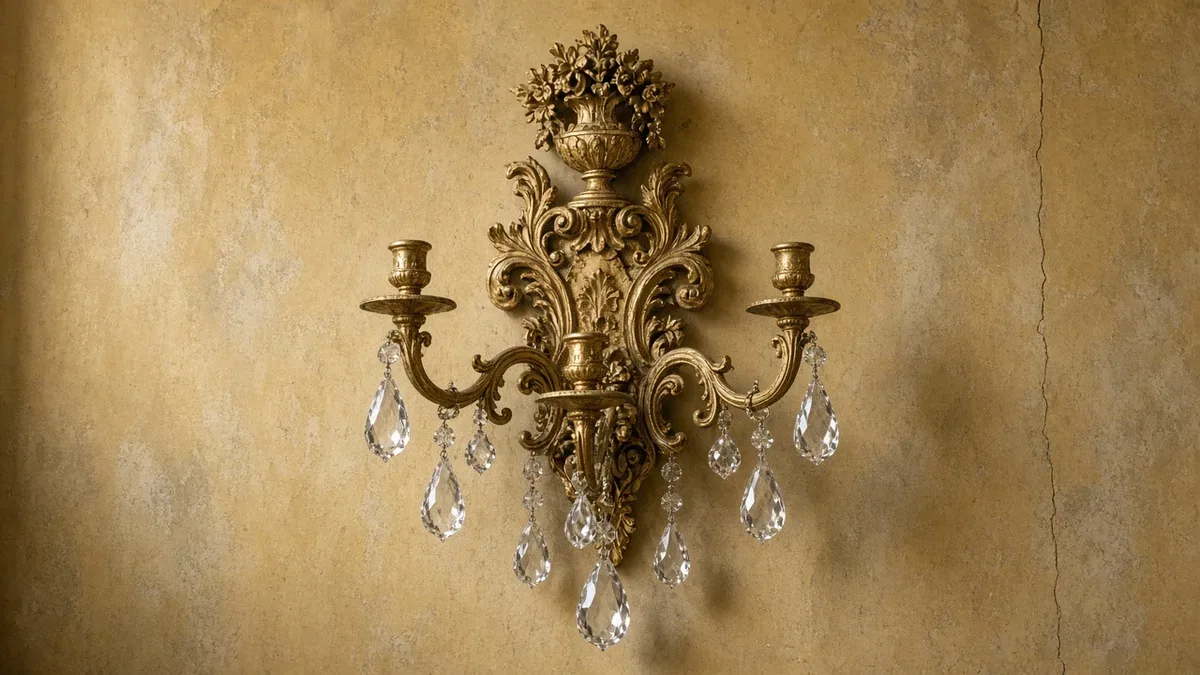
Italian Antique Lighting: Wall Lights and Lanterns, 1700–1850
Italian antique lighting identified through Genoese appliques, Tuscan iron lanterns, silver lucerne, assay punches and later electric conversions.
Italian lighting in the trade is too often reduced to a Murano ciocca. That type is real, and it has a documented construction of its own. Most of the lights that actually furnished Italian rooms between about 1700 and 1850 were not glass bouquets. They were wall arms, table lucerne, silver bugie, iron lanterns, and hanging sanctuary lamps. The materials are wood, iron, gilt metal, silver, and, where a Ligurian palazzo could afford it, rock crystal.
A collector who can name a Rezzonico chandelier but cannot read a Genoese applique is working with half a vocabulary. This note sets out that other half.
Types and terms
Italian inventories and later catalogues do not use one word for “lamp.” The distinctions matter because they are also dating tools.
A lucerna (plural lucerne) is an oil lamp. In eighteenth-century Genoa the table form can be a tall silver stem with a reservoir, a wick, and a set of tools. Earlier, in Padua and the Veneto, the same word covers small bronze lamps made for a humanist studiolo. A bugia is a low chamber candlestick with a drip pan and a handle; it is meant to be carried. A doppiere is a two-light candlestick, often of some weight, for a table or a console. An applique or braccio is a wall light, one or more arms fixed to a backplate. A lampadario is a hanging chandelier. A fanale or lanterna is a lantern: a lamp inside a cage, usually of iron, sometimes of wood and glass. A lampada pensile is a hanging lamp, almost always ecclesiastical, suspended on chains over an altar or a shrine.
Electrification is not a type. It is a later intervention. Christie's and other houses routinely catalogue eighteenth-century Italian lights as “fitted for electricity,” with replacements to nozzles, drops, and wiring. The conversion does not by itself make a piece modern. It does mean that original candle-cups, drip-pans (bobeches), and suspension hardware have to be examined separately from the twentieth-century flex.
Genoa: the best-documented school
For domestic lighting outside Venice, eighteenth-century Genoa is the centre that museums and auction houses have actually catalogued. The rooms were large. Light had to be multiplied along walls and into corners. The resulting appliques are often right-angled, made to sit on the meeting of two walls. Sotheby's, selling a pair of giltwood angle appliques of about 1750 from the Giordano collection in 2024, noted that construction and pointed to comparable corner lights still in situ in the Salon of the Marriage of Cupid and Psyche at the Galleria Nazionale di Palazzo Spinola, Genoa. Those Spinola examples take a dragon form. They are published in Ezia Gavazza's survey of eighteenth-century Ligurian painting and decoration (2000).
The carved backplates are giltwood, sometimes with lacquered colour. The arms are frequently gilt iron or gilt metal, not a single carved timber member. Flower-filled urns, masks, and sunbursts appear at the crest. Drops may be glass or rock crystal. The distinction is not academic. Rock crystal is quartz. It is heavier, colder to the touch, and more expensive than cut glass. Dealers use “crystal” for both. A collector should not.
Christie's sold, from the Piaggio collection of a Genoese villa, a pair of giltwood and rock-crystal three-branch corner wall-lights, Genoa, first half of the eighteenth century (89 cm high; London, 19 September 2019, lot 176, £12,500). A related pair of twelve-light gilt-metal, rock crystal and cut-glass chandeliers from the same collection (about 122 cm drop, 94 cm diameter) was catalogued as mid-eighteenth-century Genoa, the structure covered in small facetted beads and headed by a corona. The house essay placed that type in the Ligurian and Piedmontese barocchetto, from the late seventeenth century into the mid-eighteenth, and cited a comparable chandelier in the Gabinetto cinese of the Palazzo Reale, Turin, published in Vittorio Viale's Mostra del Barocco Piemontese (1963).
Pairs are a problem. Christie's has catalogued “a pair” of Genoese neoclassical giltwood two-branch wall lights in which one arm is late eighteenth century and the other of later date, both subsequently regilt. Completing a survivor with a modern mate is standard workshop practice. Measure both. Compare the carving of the guilloche, the undercutting of the leaves, and the colour of the bole under the gold. A later arm is often a millimetre or two off, and the gesso is cleaner in the recesses.
Giuseppe Morazzoni's Il mobile genovese (1949; later edition 1962), L. Canonero's Barocchetto genovese (Milan, 1962), and Alvar González-Palacios's Il mobile in Liguria (Genoa, 1996) remain the furniture literature against which these lights are judged. They are furniture with a lighting function, not a separate “lamp” industry.
Silver made to give light
Silver lighting is easier to date than giltwood because Genoa punched it. The civic assay is the Torretta, a tower, usually with a date. Franco Boggero and Farida Simonetti's L'argenteria genovese del Settecento (Allemandi, 2007) is the reference. The same scholars curated Per allumare. Argenti per la luce del Settecento genovese at the Galleria Nazionale di Palazzo Spinola (14 December 2007–30 March 2008). The exhibition gathered about eighty objects from Italian private collections: candlesticks, doppieri, table lucerne, appliques, bugie, and wick-trimmers (smoccolatoi). It was occasioned by the gift of four Torretta-punched candlesticks from the collection of the Genoese antiquarian Severino Crosa.
The catalogue list is specific enough to be useful. Table lucerne in the show stood between about 67 and 77 cm high; one example, punched Torretta 1778 or 1779, weighed around 6 kg. Bugie of the 1760s–80s are small (roughly 5–6 cm high at the pan, 20–27 cm long) and sometimes carry engraved arms or owner initials. A bugia of 1721 in the exhibition bore the arms of the Mambilla family. Ambra Giacomini, writing on the wall lights in that catalogue, described the arms becoming more asymmetrical as the century advanced, the foliage treated as a vine, and the ornamental repertory expanding to include singeries.
A pair of three-branch silver appliques punched with the Torretta and the date 1767, 33 × 39 cm, 3,500 g the pair, appeared at Cambi, Genoa, in 2018. The house cited Giacomini and published the pair as among the rare surviving silver lighting made for a palazzo rather than a church. Compare Neapolitan silver hallmarks and the Venetian lion and assay system: Genoa's tower-and-date combination is local. It is not interchangeable with NAP, the lion of St Mark, or the later national 800/925 marks.
Church silver is a different market. The Catalogo generale dei Beni Culturali records a Ligurian hanging lamp of 1778 (national catalogue 0700204263) with a vase-shaped reservoir, repoussé vegetation, three chains interrupted by pierced medallions, and the Torretta with date 778 struck in seventeen places. The compiler compared it with a lamp from the sanctuary of Nostra Signora dell'Olivo at Chiavari. Nineteenth-century southern examples are signed more openly. A hanging lamp of 1839 at Santa Domenica Talao (Cosenza) is engraved as the work of the Neapolitan silversmith Raffaele Perretti, two years after a cholera outbreak, with a civic dedication to St Joseph (catalogue 1800007030). A Milanese lamp by Francesco Ceppi in Piacenza, third quarter of the nineteenth century, carries the Milan territorial mark used from 1812 to 1873 and Ceppi's goat workshop punch (catalogue 0800380513).
These ecclesiastical lamps leave the church only through documented deaccession or theft. Most collectors will meet them as photographs in the catalogue, not as stock.
Iron lanterns in Tuscany
Street and palace lanterns are a Tuscan, not a Ligurian, speciality in the literature. Giuseppe Ardinghi's Antichi fanali lucchesi di ferro battuto (Maria Pacini Fazzi, Lucca, 1969) listed about forty wrought-iron lanterns still on Lucchese façades, with photographs by Armando Casali and a folding plan of the city. The oldest examples are cage-like and vertical. Ardinghi recorded a two-band lantern on the Ronzi tower in Piazza San Salvatore, assigned to the thirteenth or fourteenth century; a chalice-shaped sixteenth-century lantern at Palazzo Garzoni (Via San Paolino / Via del Crocifisso); and heavier seventeenth-century plate-decorated cages on Via Fillungo (Palazzo Saminiati; Palazzo Boccella Sani).
The fuel was oil. Olive oil thickens in winter; local practice mixed it with walnut oil so the wick would still draw. The lantern is a cage around a removable lamp. Surviving fanali on palaces are architectural ironwork. Portable or later copies turn up in the trade as “Lucca lanterns.” Look for hand-forged tenons, irregular section in the bars, and a lamp well that could actually hold an oil vessel. Machine-rolled bar and a wired bulb socket with no earlier lamp seating are later.
Public lighting of this kind is not a collector's category in the same way as a giltwood applique. It is the context. A table lucerna or a wall arm made sense in rooms that opened onto streets lit, if at all, by a handful of palace cages.
Bronze lucerne before 1700
The oil lamp as a bronze sculpture is earlier and belongs with Paduan bronzes rather than with palazzo lighting. Andrea Briosco, called Riccio (Trent 1470–1532, Padua), cast a small group of highly worked lamps for a learned clientele. The Metropolitan Museum of Art's Rothschild Lamp (about 1510–20; acc. 2009.58) is one of the principal survivors, with the Morgan Lamp at the Frick and the Cadogan Lamp at the Victoria and Albert Museum. The Met also holds a sphinx-form lamp given to Riccio's workshop (mid-sixteenth century; acc. 11.38.2). The V&A's satyr-head lamp on an eagle's claw, workshop of Severo da Ravenna, about 1500–1550, is a more serial type: the mouth is the burner, a hinged lid covers the oil hole.
These objects are catalogued as sculpture. Later Grand Tour and nineteenth-century reductions exist. A Paduan lamp offered as “Renaissance” needs the same technical scepticism applied to other small bronzes: casting quality, cold work, and whether the model is a known aftercast.
Roman and Florentine gilt bronze of the later eighteenth century produced candelabra and lamps in a different language again: ormolu, marble, and hardstone, closer to Valadier than to a Genoese applique. Do not collapse those workshops into “Italian antique lighting” as a single style.
What is not Genoa, and what is not eighteenth-century
Florentine giltwood chandeliers appear constantly in the English trade. Many are nineteenth- or early-twentieth-century, carved in a rococo vocabulary that the Florentine frame shops already knew how to produce. An acanthus stem, toleware sconces, and a later rewire do not make a piece of 1750. Ask for a construction date that can survive a comparison with documented Genoese or Piedmontese examples. If the only evidence is “Florentine taste,” treat the date as a guess.
Venetian glass remains a separate identification problem. The Rezzonico-type chandelier is a forged armature dressed in blown parts. Genoese hanging lights of the same century are gilt metal or giltwood hung with drops. The two can hang in the same room. They do not share a workshop.
Italian furniture of the same palazzi, from lacquered Venetian commodes to walnut consoles, is the setting, not the proof. A light can be moved. A punch, a construction, and a documented pair cannot.
Identification in the hand
Start with the back. An eighteenth-century wall light has a backplate meant to sit against plaster or a corner. Screw holes should be old, or at least should pass through timber that has oxidised around earlier fixings. Fresh pale wood behind a brilliantly regilt face is a warning.
Then the arms. Gilt iron of Ligurian type is forged and then dressed; the section changes. Cast brass arms of even thickness, with a visible mould line, are later or French. Bobeches that unscrew may be original or replacements; candle-nozzles drilled for a flex and fitted with an Edison or E14 sleeve are conversions.
Drops: rock crystal has inclusions and a slightly soapy fracture if a tip is chipped. Cut glass is more uniform and often lighter. Mixed drops on one fixture are normal after two centuries. A complete, identical set of machine-cut pendants on an otherwise worn giltwood frame is usually a recent dressing.
Silver: look for the Torretta and a date, and for later recognition marks (the cursive T of the Genoese tolerance mark of 1824–28 appears on objects in the 2007 Spinola list). Weight should match the scale. A “Genoese” lucerna of table height in thin electroplate is not the object in Boggero and Simonetti.
Condition is expected. Christie's Piaggio chandeliers were sold with “minor losses and replacements.” Missing drops, rubbed gilding on the high points of the carving, and wax residue in the pans are consistent with use. A perfectly even gold surface on a claimed barocchetto applique is more often a recent water-gilding than a survival.
FAQ
How do you tell a Genoese wall light from a French applique?
Genoese examples of the mid-eighteenth century often have a carved giltwood back of some depth, gilt-iron or gilt-metal arms, and, in the better rooms, rock-crystal drops. Corner (angle) backs are common. French appliques of the same date are more often gilt bronze throughout, with a single founder's language of chasing. Punches, if present, will not be the Torretta.
Does electrification destroy value?
It reduces originality. It does not, in the Italian lighting market, automatically relegate a documented eighteenth-century fixture to decoration. Houses sell electrified Piaggio and other Genoese lights as period objects with later fittings. Reversible wiring that leaves nozzles and drip-pans readable is preferable to a drilled-through carving.
Are “Lucca lanterns” on the market the palace fanali Ardinghi published?
Almost never. Ardinghi's 1969 corpus is architectural iron still on the buildings. Trade lanterns may follow the cage type. They should be judged as ironwork: forge quality, joinery, and whether an oil lamp could sit in the well.
Where does Murano glass fit?
In Venice, and in a different construction. Use the existing identification of the ciocca and the Rezzonico revival. Do not use Murano as a default label for any Italian hanging light with drops.
Italian lighting of 1700–1850 is a set of local trades. Genoa punched its silver and carved its corner appliques. Lucca hung iron cages on palace angles. Padua had already made the bronze lucerna a sculptor's problem. The collector’s work is to keep those facts apart.