
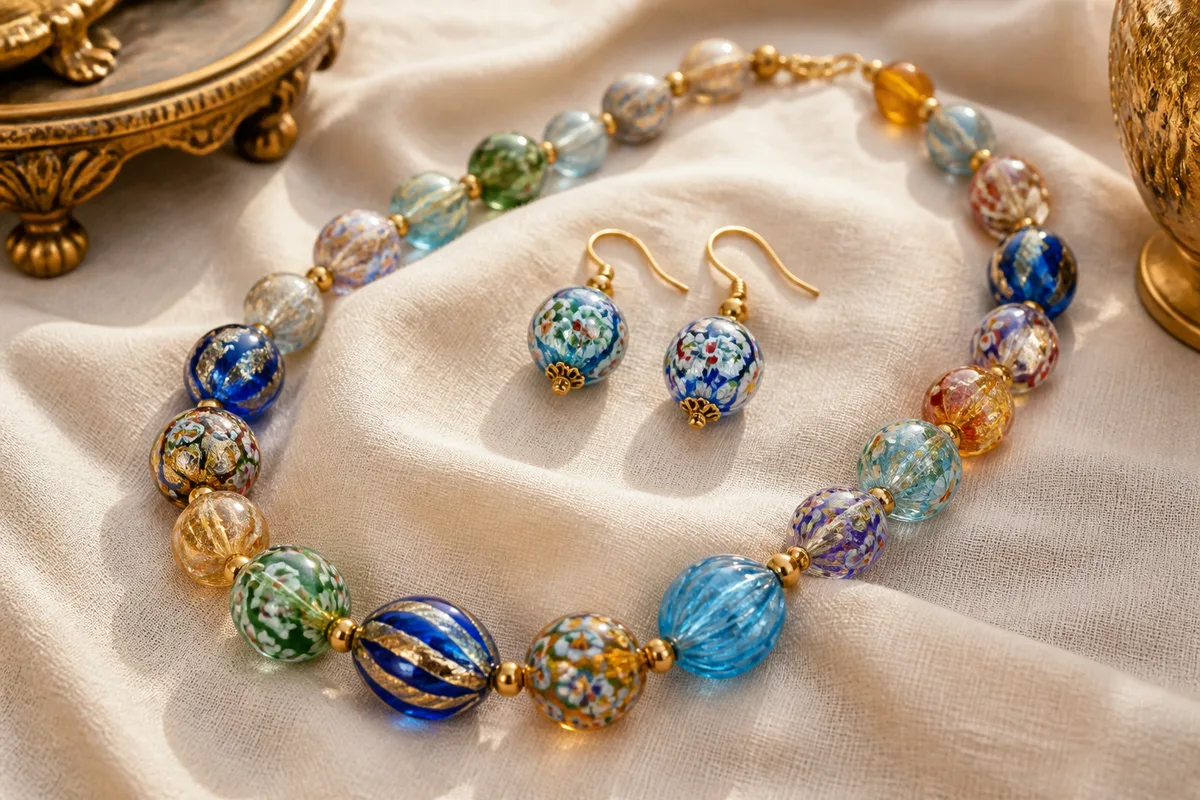
Murano Glass Jewelry & Beads: History of Venetian Glass Accessories
From Venetian trade beads to millefiori jewelry: the history of Murano glass accessories, traditional techniques, and collecting tips.
Murano Glass Jewelry and the Venetian Tradition
When people think of Murano glass, the first images that usually come to mind are elaborate vases, sculptural objects and brightly coloured decorative pieces. Yet some of the most fascinating examples of Venetian glass are much smaller. For centuries, Venetian glassmakers have transformed molten glass into beads, pendants, charms and other forms of personal ornament, creating objects in which centuries of technical knowledge are concentrated into only a few centimetres.
Murano glass jewelry occupies a particularly interesting position within this tradition. It belongs simultaneously to the worlds of craftsmanship, fashion, decorative art and collecting. A necklace made from Venetian beads may be a contemporary accessory, but the techniques used to create its individual components can have roots stretching back generations. A small millefiori bead, for example, can contain a carefully constructed pattern of coloured glass that was prepared in advance as a much larger cane before being cut down to jewellery scale.
This relationship between scale and craftsmanship is one of the defining characteristics of Venetian beadmaking. The finished object may be tiny, but producing it can require considerable control over colour, temperature, proportion and timing.
To understand why Murano beads remain so popular today, it is therefore useful to look beyond their decorative appearance and examine the long history of Venetian glass beadmaking, the techniques that shaped it and the craftsmen who kept these traditions alive.
For a broader introduction to the material itself, see our guide to Murano glass, which places Venetian glassmaking within its wider historical and artistic context.
The Long History of Venetian Glass Beads
The history of Venetian beads is closely connected with the history of Venice itself. Glassmaking developed on the Venetian lagoon over many centuries, and the relocation of glass furnaces to Murano in the late thirteenth century helped establish the island as the centre of a highly specialized industry.
Beads became an important part of this world. Their relatively small size made them easier to transport than larger glass objects, while their colours and elaborate decoration made them desirable in markets far beyond Venice.
The production and export of Venetian beads eventually became an important commercial activity. Different forms of beads were manufactured for different markets, ranging from relatively simple drawn-glass beads to elaborate pieces decorated with coloured glass, gold, aventurine and intricate patterns.
One of the most important historical categories was conterie, a term generally associated with very small glass beads produced in large quantities. Their production developed into a specialized industry in Venice, with beads being used for jewellery, embroidery, clothing and decorative objects.
At the other end of the spectrum were more elaborate handmade beads, including perle a lume, produced individually using the lampworking technique. These could be highly decorated objects in their own right.
This distinction is important when studying Venetian beads today. The phrase “Murano bead” does not describe a single technique or historical object. It encompasses a remarkably broad family of products, ranging from mass-produced glass seed beads to individually worked pieces of considerable artistic complexity.
The international history of Venetian beads also means that their story extends far beyond Murano. Venetian glass beads travelled through European commercial networks and became important trade goods in Africa, the Americas and elsewhere. Their history is consequently intertwined with the history of global commerce, although the uses and meanings of the beads varied enormously between different cultures and periods.
From Murrine to Millefiori Beads
Among all Venetian glass decorations, few are as immediately recognizable as millefiori.
The Italian word means “a thousand flowers”, an apt description of the tiny floral patterns that appear when specially prepared glass canes are cut across their width. Yet the technique is more accurately understood through the word murrina.
A murrina is a section of a patterned glass cane. The cane is created by assembling different colours of molten glass around a central design and then stretching the entire mass into a long, relatively thin rod. The important point is that stretching does not destroy the internal pattern. Instead, it reduces its size while preserving its basic geometry.
When the finished cane is cut transversely, every slice reveals the same design.
A flower, star, heart, geometric motif or other pattern may therefore be repeated hundreds or thousands of times along a single cane. These sections can subsequently be incorporated into a larger glass object or arranged on the surface of a bead.
This is where the relationship between murrine and millefiori becomes important. Murrine are the patterned sections or canes themselves, while millefiori refers more broadly to the characteristic mosaic-like floral effect created by arranging such elements.
The technique is technically demanding because the glassmaker must coordinate several stages of production. The colours must be chosen and arranged before the cane is formed, the glass must remain sufficiently hot and workable during assembly, and the cane must be stretched with enough control to maintain the intended pattern.
On a bead, the effect can be extraordinary. A surface only a few centimetres across may contain dozens of tiny flowers or geometric motifs, each one representing a section of a much larger piece of glass.
This is why millefiori beads have become one of the most recognizable forms of Venetian glass jewelry.
For a deeper examination of this technique and its relationship with other Murano traditions, see our article on Murano glass techniques.
How Murano Glass Beads Are Made
The making of a handmade glass bead begins with heat.
At the furnace or torch, glass is brought to a temperature at which it becomes sufficiently soft to be shaped. Unlike a large blown vessel, a bead can be produced using a relatively small amount of glass, but this does not make the process simple. Working at such a small scale requires precision, particularly when the bead incorporates several colours or decorative elements.
One traditional method is known as perla a lume, or lampworked beadmaking. The glassmaker heats a coloured glass rod in the flame and winds the softened material around a metal mandrel. The glass is gradually built up around the mandrel until the desired volume is achieved.
The mandrel is crucial because it creates the central hole of the bead. Once the glass has cooled sufficiently, the bead can be separated from the rod, leaving the characteristic opening through which a cord or wire can later be passed.
During this process the glassmaker can introduce additional colours, threads, gold leaf, murrine and other decorative elements. The bead can also be shaped while hot, either by hand or with simple tools.
The result is an object that retains evidence of its handmade origin. Two beads produced by the same artisan using the same technique may never be perfectly identical. Slight variations in colour distribution, shape, size or decoration are a natural consequence of working hot glass by hand.
Other Venetian beadmaking methods involve drawn or pressed glass. In drawn-bead production, a decorated glass mass can be stretched into a long cane and subsequently divided into individual beads. This approach is particularly important for certain forms of patterned and small-scale production.
The distinction between these methods can be useful when examining antique and modern beads. A bead made individually at the lamp has a different visual and technical history from one produced by cutting or processing a drawn cane.
The small scale of beads can therefore be misleading. Behind a tiny object may lie a highly sophisticated production process.
For a broader explanation of the transformation of molten glass into finished objects, see our guide to how Murano glass is made.
The Many Decorative Languages of Murano Beads
Millefiori is perhaps the most famous decorative technique associated with Venetian beads, but it is only one part of a much larger vocabulary.
The history of Murano beadmaking is essentially a history of finding new ways to manipulate colour, transparency, texture and light.
Avventurina, for example, is immediately recognizable because of the shimmering metallic particles suspended within the glass. Despite its name, which refers to the accidental discovery traditionally associated with the material, aventurine glass is the product of a highly controlled process. Tiny metallic crystals create the characteristic glittering appearance, which can range from subtle flashes to an intense golden or copper-like sparkle.
When incorporated into beads, aventurine can be used as a solid field of colour or combined with transparent glass and other decorative techniques. Its reflective qualities become particularly striking when the bead moves in the light.
Sommerso produces an entirely different effect. Rather than emphasizing a patterned surface, the technique creates the impression that one colour is submerged inside another. A coloured layer is encased within transparent glass, often producing strong contrasts between the internal colour and the clear outer layer.
In jewellery, the effect can be remarkably elegant because the colour appears to float within the glass rather than simply sit on its surface.
Another important tradition is lattimo, the opaque white glass whose appearance recalls porcelain or milk. The name derives from latte, or milk, and its dense white appearance provides a strong contrast to Murano's transparent and brightly coloured glass.
Lattimo can be used alone or combined with other colours and techniques. In beads, its opacity can make coloured patterns appear particularly vivid.
Then there is filigrana, one of the most delicate forms of Venetian glass decoration. Fine glass threads are arranged within transparent glass to create linear patterns, spirals and lace-like structures.
One particularly recognizable form is vetro a fili, in which glass threads run through the body of the object. Related techniques can produce more complex geometric patterns, including the celebrated zanfirico effects.
On a bead, these techniques transform the interior of the glass into a miniature geometric composition. Instead of looking at decoration applied to the outside, the viewer sees patterns suspended within the transparent body.
Gold and silver leaf introduce yet another dimension. Thin sheets of precious metal can be incorporated into the glass, producing luminous surfaces that change dramatically as the object moves.
These techniques are not mutually exclusive. A single bead can combine murrine with transparent glass, gold leaf with coloured layers, or filigree with other decorative elements. This ability to combine techniques is one of the defining characteristics of Murano craftsmanship.
Murrine, Millefiori and the Art of Miniaturization
The importance of murrine to Murano jewelry deserves particular attention because it demonstrates how Venetian glassmakers adapted techniques originally used for larger decorative objects to the tiny scale of beads.
A complex murrina may be constructed from numerous layers of coloured glass. The final cane can be elongated considerably, reducing the size of the internal pattern while maintaining its structure.
Once sliced, each section becomes a miniature piece of glass mosaic.
When these slices are arranged on a bead, the glassmaker must work quickly and carefully. The murrine must be heated sufficiently to bond with the surface without becoming so hot that the pattern loses its definition.
This is one reason why handmade millefiori beads often have subtle differences from one another. The position of individual murrine, the amount of heating and the final shaping of the bead can all alter its appearance.
The result is fundamentally different from a printed or mechanically reproduced pattern. The image exists inside the structure of the glass itself.
That characteristic is central to the appeal of genuine Venetian millefiori.
Venetian Beads, Fashion and Personal Adornment
Glass beads have always occupied an unusual position between fine art and everyday life.
Unlike a monumental vase, a necklace or bracelet is designed to accompany the human body. It moves, catches the light and changes appearance according to the surroundings. Venetian glassmakers responded to this intimate scale by developing colours and decorative effects that were particularly effective when seen in motion.
Historically, beads could be sewn into clothing, incorporated into embroidery or assembled into necklaces and other forms of personal ornament. Their relatively small size also made them highly portable, contributing to their importance as commercial products.
During the nineteenth and twentieth centuries, Venetian beads became increasingly associated with fashion and decorative accessories. Different periods brought different preferences for colour, transparency and ornament, while traditional techniques continued to evolve.
This ability to move between tradition and fashion has helped keep Murano beads relevant. A millefiori bead can look unmistakably Venetian while fitting naturally into a contemporary necklace.
That is an important distinction between Murano glass jewelry and many forms of historical decorative art. Jewelry does not simply preserve a technique; it continually gives that technique a new context.
Murano Glass Jewelry in the Modern Era
The twentieth century brought profound changes to Murano glass.
Designers increasingly collaborated with master glassmakers, and the distinction between traditional craft and modern design became less rigid. Companies such as Venini played a particularly important role in this transformation, introducing new approaches to colour, form and collaboration.
Although Murano's reputation is often associated with large decorative vessels, the same spirit of experimentation influenced jewelry and small glass accessories.
Contemporary designers can combine traditional millefiori with minimalist metal settings, use large sculptural beads as the centrepiece of a necklace, or incorporate transparent and coloured glass into earrings and pendants.
Some modern pieces deliberately preserve the appearance of traditional Venetian jewelry, while others use Murano techniques in ways that would have been difficult to imagine a century ago.
This is one of the reasons it is useful to think of Murano glass as a living tradition rather than a historical style.
The techniques may be ancient, but the objects produced with them continue to change.
Handmade Murano Beads and the Importance of Craftsmanship
The phrase “handmade Murano bead” is widely used today, but it is worth understanding what handmade actually means in this context.
Glassmaking has always involved tools and specialized equipment. A handmade bead does not necessarily mean that every part of its production is performed entirely without tools. Rather, the crucial stages of shaping and decoration are carried out by an artisan who controls the hot glass directly.
This gives handmade beads a character that is difficult to reproduce mechanically.
The differences may be extremely subtle. One bead may be fractionally larger than another. A millefiori flower may sit at a slightly different angle. A gold leaf inclusion may break differently across the surface. A transparent layer may have a slightly different thickness.
These variations are not defects. In the context of handmade glass, they are often evidence of the production process.
At the same time, variation alone should never be treated as proof that a bead is authentic Murano glass. Modern manufacturers around the world can deliberately create irregularities to imitate handmade production.
Authentication therefore requires a broader assessment of the object, its provenance, technique, construction and, when available, its original packaging or documentation.
How to Recognize Authentic Murano Glass Beads
Identifying Murano glass jewelry can be more difficult than identifying a large signed vase.
A necklace may contain dozens of individual beads, and the original manufacturer or workshop may not be immediately apparent. Individual beads may also have been assembled into jewelry by a retailer or designer rather than by the glassmaker who produced them.
The first thing to examine is the glass itself.
Look closely at the way colours are incorporated. In genuine millefiori, for example, the pattern should form part of the glass rather than appearing to be simply printed onto the surface. The internal geometry of the murrine can often be seen clearly when examining a bead from different angles.
The quality of the workmanship is also important. Handmade lampworked beads can display minute variations in shape and decoration, while more mechanically produced beads tend to exhibit a different degree of uniformity.
The hole is another useful area to examine. Its size, position and finishing can provide clues about how the bead was produced, although none of these characteristics should be considered conclusive on its own.
Bubbles and inclusions require similar caution. Small bubbles can occur naturally in handmade glass, but their presence does not automatically establish Murano origin. Contemporary imitation glass can also contain bubbles.
Labels, signatures and certificates may provide stronger evidence, particularly when they can be connected to a known manufacturer or documented provenance. However, even a label should be assessed critically.
For valuable pieces, attribution should ideally combine physical examination with documentary evidence.
This is particularly important because “Murano style” is not the same as “Murano made”. Glass produced outside Venice can imitate many of the visual characteristics associated with Venetian glass, including millefiori and other decorative techniques.
For a more detailed discussion, see our future guide to How to Identify Authentic Murano Glass.
What Makes Murano Glass Jewelry Valuable?
The value of a piece of Murano jewelry depends on much more than the fact that it was made from Venetian glass.
A modern handmade necklace may have significant artistic and craftsmanship value even if it has little relevance to the antiques market. Conversely, an older bead may be historically interesting without being particularly rare or valuable.
The maker can be important, especially when a piece can be attributed to a recognized Murano company or artist. Design is equally relevant. An unusual or particularly successful form may be more desirable than a conventional example.
Technique also matters. A complex millefiori pattern, sophisticated filigrana work or unusual combination of colours may require considerably more skill than a simpler bead.
Age can contribute to desirability, but it should not be treated as an automatic indicator of value. Condition, rarity and provenance can be equally important.
A well-documented twentieth-century necklace by an important Murano designer may therefore be considerably more desirable than an anonymous older piece.
This is one reason collectors should avoid simple rules such as “older means more valuable” or “more colourful means more expensive”. The Murano glass market is too diverse for such formulas.
Buying Murano Glass Accessories
For someone purchasing a necklace, bracelet, earrings or individual beads, the first question should be what exactly is being bought.
Is it an antique or vintage object? Is it contemporary handmade jewelry? Are the beads themselves Murano-made, or has someone assembled imported or imitation beads into a Venetian-style necklace?
The distinction can be significant.
Documentation is particularly useful for expensive pieces. Original packaging, labels, receipts, catalogues or information about the workshop can help establish provenance.
The construction of the jewelry should also be considered. If the beads are the principal reason for buying the piece, examine them individually rather than judging the necklace only as a whole.
A high-quality bead should reward close inspection. Its colours should have depth, its patterns should be integrated into the glass, and its proportions and finishing should reflect careful workmanship.
When comparing pieces, it is also useful to understand the difference between traditional techniques. A simple transparent bead and a complex millefiori or filigree bead may have very different production histories even if both are described simply as “Murano glass beads”.
Our Murano glass collecting guide can provide a broader framework for evaluating Venetian glass, while a dedicated guide to Murano glass accessories can help when comparing jewelry and other smaller objects.
Why Murano Beads Still Matter
The remarkable thing about Venetian glass beads is their ability to preserve the identity of Murano at an unusually small scale.
A vase can demonstrate the grandeur of Venetian glassmaking, but a bead reveals something else: the extraordinary ability of Murano artisans to control colour, heat and pattern within an object small enough to fit between two fingers.
Millefiori turns a complex glass cane into a miniature mosaic. Aventurina captures light through metallic crystals. Lattimo introduces an opaque, porcelain-like whiteness. Filigrana creates delicate patterns inside transparent glass, while gold and silver leaf transform small surfaces into luminous objects.
None of these techniques exists in isolation. They belong to a broader tradition in which generations of Venetian glassmakers have experimented with the same material, constantly finding new ways to manipulate it.
That continuity is what makes Murano glass jewelry more than simply decorative fashion.
A contemporary necklace may look very different from a nineteenth-century Venetian bead, yet both can be understood through the same fundamental relationship between artisan, heat, colour and glass.
Frequently Asked Questions About Murano Glass Jewelry and Beads
What are Murano glass beads?
Murano glass beads are beads produced using the glassmaking traditions associated with Murano and the Venetian lagoon. They can be made using several techniques, including lampworking, drawn glass and decorative methods such as millefiori, filigrana, lattimo and aventurine.
What is the difference between Murano beads and millefiori beads?
Millefiori is a decorative technique rather than a general name for all Murano beads. Millefiori beads typically incorporate sections of patterned glass canes, or murrine, which create the characteristic floral or geometric designs visible inside the glass.
Are all Murano glass beads handmade?
No. Venetian beadmaking includes both highly specialized handmade production and forms of industrial or semi-industrial production. The term “Murano bead” alone does not establish how an individual bead was made.
Are Murano glass beads valuable?
Their value varies considerably. Factors such as maker, age, rarity, technique, workmanship, design, condition and provenance can all influence desirability. A handmade contemporary bead can be artistically significant without necessarily being an antique or high-value collectible.
How can you tell if a Murano glass bead is authentic?
There is no single visual characteristic that proves authenticity. Technique, quality of workmanship, construction, labels, provenance and documentation should be considered together. Particularly valuable pieces should be assessed using as much documentary and physical evidence as possible.
A Small Form of a Great Venetian Tradition
The history of Murano glass is often told through monumental objects and famous designers, but beads deserve a place within that story.
They demonstrate how Venetian glassmakers could adapt sophisticated techniques to an intimate and highly portable form. From the international trade in Venetian beads to the intricate millefiori jewelry produced today, these small objects connect commerce, craftsmanship, fashion and design.
For collectors and enthusiasts, that is precisely what makes them so appealing. A Murano bead may be only a few centimetres wide, but within its layers of coloured glass, murrine, metallic inclusions or delicate threads lies a tradition that has developed over centuries.
In that sense, Murano glass beads are miniature examples of the larger history of Venetian glass itself: technically demanding, visually distinctive and constantly reinvented while remaining rooted in the extraordinary craft tradition of Murano.